I’ve had a lovely, quiet Sunday and I’m glad to say my emotional wellbeing is better than yesterday. Still a bit fragile, but there’s that hint of contentment that has been lacking over the past few days.
I’ve even had my oompf back to draw. This took the guise of adding patterns and outline drawings to my visual reference journal, and then using some of these ideas, plus some old favourites, in this drawing. I even added some dangles in places. Just little, delicate dangles, but still there’s dangles there.
For the drawing, I used a hard nib Tombow Fudenosuke pen. This has a flexible nib, not overly flexible, and so I could vary line weight while drawing.
I was inspired to try the Fudenosuke pen again after my experiments with digital brushes that vary line width with pressure and found that so much fun.
I found it much easier to use the Fudenosuke pen after my experience with digital brushes; it turns out working digitally does influence my work in traditional media and helps me gain new skills or confidence in new media.
I drew this design on an A5 piece of Winsor and Newton Bristol Board which is white and very smooth. Then, scanned it in and digitally added a background texture and some colour, along with my watermarks.
The drawing was mainly to try out the Fudenosuke pen, but also a bit of quiet self-care too. I’m quite happy with it, especially as it’s main purpose was to explore using the pen for drawing with.
I’ve relied on line weight to add some dimension to the drawing, though some colour and/or shading could help a lot. Maybe that’ll be my next task with this – to colour it either digitally or to use my Chameleon DuoTone and Color Tops marker pens after I print the image out.
I’ve really not been myself the past few days. With a couple of busy days this week, the emotional fallout from EMDR on Tuesday finally caught up with me as I slowed down Thursday afternoon. I’m so tired, and my mood isn’t the brightest to say the least.
It’s always a sign that even when I’m tired I can usually draw and create, but not much this week. I haven’t been able to find the inspiration to draw, nor have I found the interest or energy.
Today, around a meeting, I managed to draw this.
It’s a throwback to the more familiar art of earlier days. It has given me a chance to use some new motifs, as well as some favourite ones that crop up often.
The process of drawing was soothing, and I did my very best not to be too judgemental, though I did want to throw it out and restart several times as I wasn’t at all happy with what was coming out of the nib of my fountain pens or Uniball Unipins.
I switched to the Uniballs as the fountain pen ink was smudging lightly. I’ve fixed that, mostly, by digital wizardry. I also added the Distress Ink background digitally.
I know my inspiration and energy to draw will return, I’m just not feeling at all myself at the moment.
I do have a new self-care activity, which is sitting in/on the bed, crocheting shawls and listening to audiobooks – currently working my way through the Harry Potter series.
The rhythmic nature of crocheting is soothing. The familiarity of the Harry Potter story is also soothing. Being upstairs makes me feel safe, secure and it’s also comforting.
The memory being worked on in EMDR certainly has stirred some stuff up. I’ve had some very upsetting insights into how I’ve viewed myself. Releasing the trauma associated with this particular memory will be accompanied by a better view of myself. I may not fully believe it, but if I can believe a little of it then that is good enough for now.
I have to believe that with each memory and its associated traumatic experiences that are processed via EMDR I’ll believe the healthier, more positive statements about myself more and more.
These are some quotes I’ve found recently that are helpful to me in understanding me, helping me through this.
Trauma creates changes you don’t chose. Healing is about creating change that you do choose.
What happened to you was not your fault. The struggles you have today, like your cPTSD symptoms, are a normal response to abnormal events. So, please be kind to yourself.
The poison leaves bit by bit, not all at once. Be patient. You are healing.
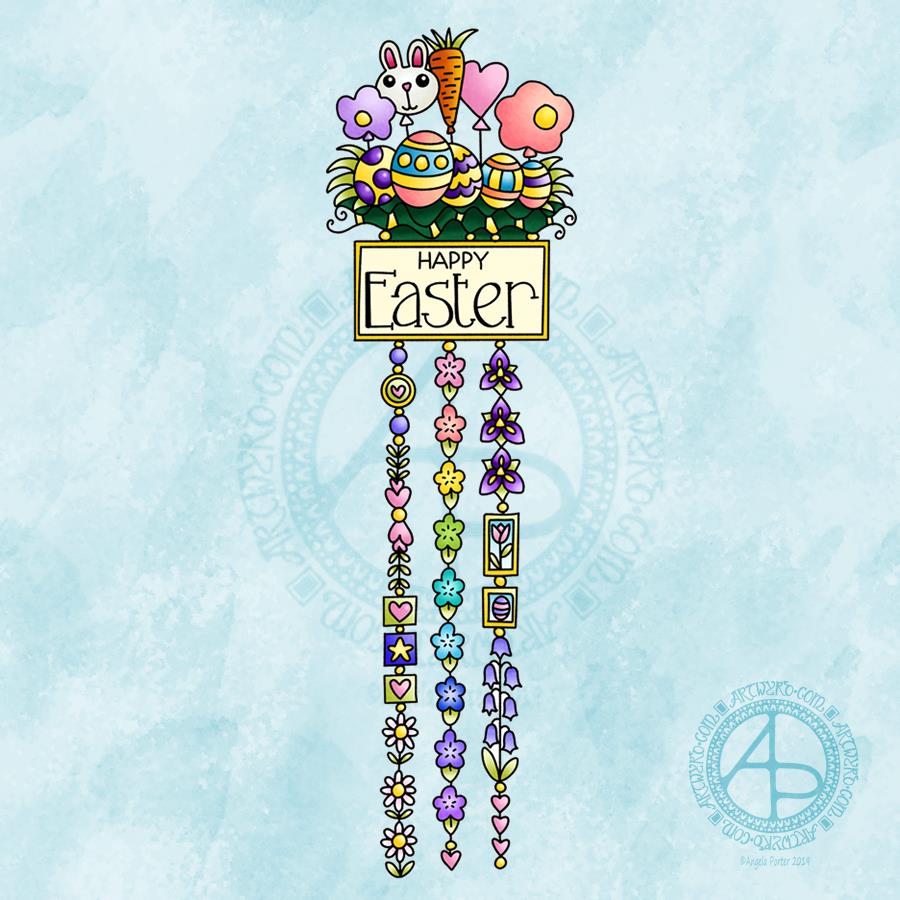
This cutely whimsical dangle design is from my tutorial book ‘A Dangle A Day’, which has the step-by-step instructions for drawing this design. They really are simple to draw, and the hand lettering is based on your own writing style too.
For this design, I chose spring-time colours, more pastel than bright. Of course Easter eggs and a bunny balloon had to feature, along with all the lovely spring flowers and a sprinkling of hearts. I even snuck a star in, hearts and stars being some of my favourite motifs to include.
This design would make a really cute greetings card or notecard. The dangles can easily be drawn shorter. It would also make a lovely bookmark. As a BuJo page, planner page or an element on a scrapbook page it would be lovely.
Using Nuvo drops or Ranger’s Stickles or similar to make dots where the beads are as well as a sprinkling of them around the top of the design would add some lovely dimension and sparkle for sure.
I do hope you give drawing dangle designs a go. They are so much fun and a lot easier to do than you think they are. They can also be used in many, many ways, especially when it comes to sharing love with others at different times and events throughout the years of our lives.
About the drawing…
When it came to designing the dangle designs and monograms for A Dangle A Day, I started off by sketching the idea out on dot grid paper using either a pencil or a pen. I could then adjust the lines and draw guidelines in to help me with the design quite easily.
When I was happy with the sketch, I scanned it in and then re-drew it in a digital form. For drawing digitally I use a Microsoft surface pen directly on the screen of a Microsoft surface book or surface studio. This is like drawing with pen or pencil on paper, or even painting or colouring.
So, although my designs were created in a digital environment, they were still very much drawn by hand.
I used very little in the way of smoothing lines – only enough to remove the wobbliness that comes from the great sensitivity of the pen and screen position sensoring stuff, and never used the predictive line tools available in Autodesk Sketchbook Pro. I worked out how to set up pens that would leave a line texture similar to the pens I like to use to draw on paper with. I determined I wouldn’t make everything perfect, that there would be that perfectly imperfect human touch to everything that I created. I also made sure I included examples of dangles drawn and coloured on paper and turned into cards, bookmarks and BuJo pages too.
Working digitally to draw and then colour the designs allowed me to edit, erase, adjust and keep the image free of smudges and blots that would require re-drawing. It also made it a lot easier to make the edits my lovely editors suggested to improve the work.
It certainly saved a lot of time scanning image after image in – something I find extremely tedious.
Although I may have used digital tools to draw with, the techniques I used were the same as if I’d drawn on paper with pen and then coloured with various traditional media.
I also have to say that the year to year and a half ago when I was colouring these I was only just starting to explore the realms of digital colouring and I hadn’t quite worked out exactly how I’d like to do it. They worked out good enough, but now I think I’d approach it a bit differently.
I had such a lot of fun creating the dangle designs season by season, month by month, celebration by celebration and I hope you have the same amount of fun doing this too.
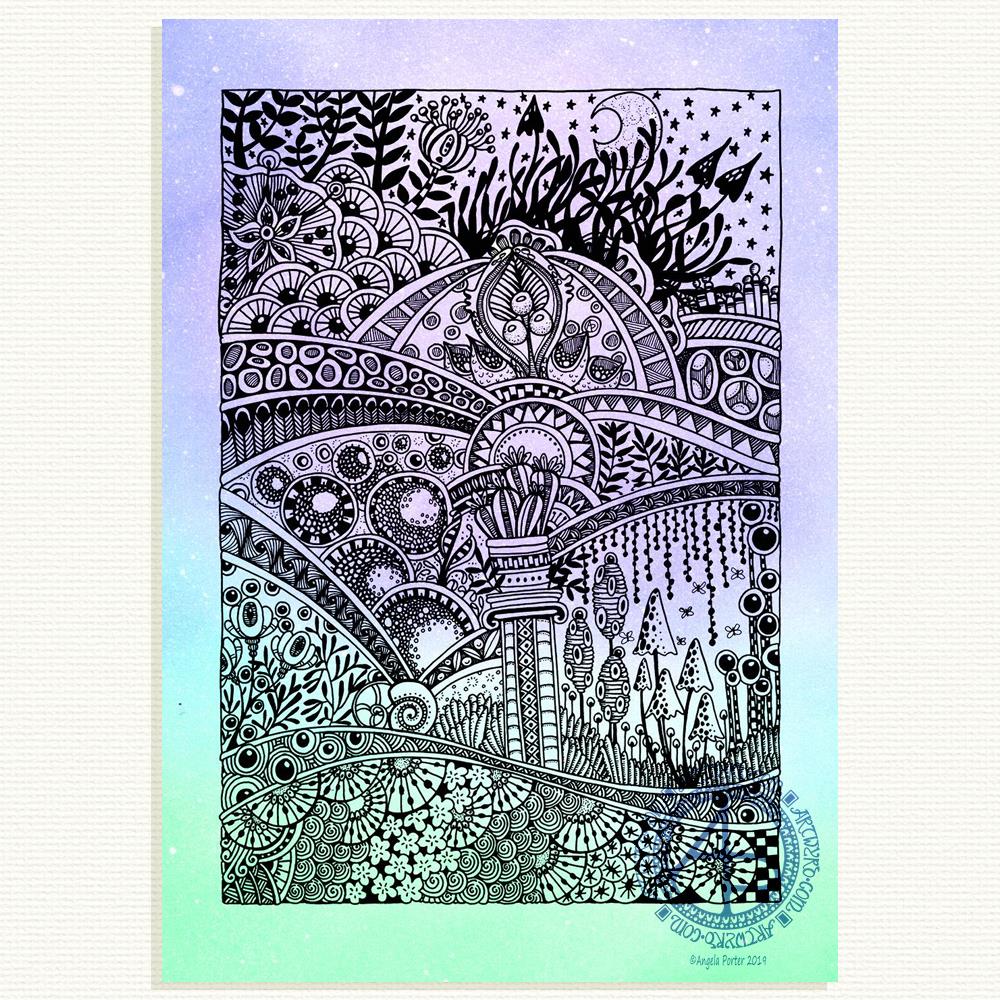
Creating this mandala has had me smiling. Gentle smiles on my face and in my heart. There’s something about the graphic black and white, the grey foliage in the background and the mystical, magical moonlight illuminating the design. I look at it and I feel a sense of achievement and satisfaction with this one. It’s not perfect. There’s things I want to do with it, and working digitally allows me to do that. However, for now, it’s more than good enough. I need more tea and a bit of a break from it.
I have to say that it looks really nice in just black and white. but, the simple gradient background really sets the atmosphere for the design. I did use a gradient fill tool to create the coloured background, but I do want to go back and create one that I can have a bit more control over for sure, maybe using watercolour brushes to do that, and adding spots of glow too.
I’m really pleased with the lighter foliage in the background, adding depth and dimension to the design, adding interest. It’s delicate and ephemeral, misty too.
I want to try not letting the background colour the motifs. That’ll involve me adding white to the white spaces. For some reason I created them with transparent ink.! No great problem to go back and sort that out though.
I also want to try working on a landscape that isn’t a mandala, using the same kind of style of drawing and adding magical, mystical coloured backgrounds.
But overall, I’m pleased with this and I’m pleased with the progress I seem to be making in both digital art and in developing my art ‘voice’.
There’s been quite a few pieces of art I’ve created that have made me smile recently – many of my mandalas and entangled drawings, my cute kitty ‘cartoons’ spring to mind, especially one I did of the pink anti-stigma badger as a Jedi knight!
I can honestly say that this mandala, and my previous one, have made me smile more than most.
A black and white mandala today. No colour. No shading. Just black and white and varying line width.
I set up one of my pen brushes in Autodesk Sketchbook Pro to vary it’s width with pressure. I’ve only ever used brushes where I’ve had their thickness set at one size as that has usually been my style of drawing in both traditional and digital media.
My favourite pens to draw with on paper are Sakura Pigma Micron, Sakura Pigma Sensei, Uniball Unipin, fountain pens, or technical drawing pens from Rotring or Staedtler. So, it was natural for me to set the digital pen brushes to mimic them and the lines they leave on paper – which are usually rather uniform in thickness, but with a bit of feathering around the edges.
I’ve never had much success or satisfaction in using dip pens or brush pens with drawing. No matter how much I practiced I never got a result I thought was good enough. The only dip pen I like to use is a glass dip pen as it has a very uniform line and writes smoothly too.
Late last night, I thought it was time that I experimented with a pen brush where I could vary the thickness with the pressure of my Microsoft Surface Pen on the screen of my Microsoft Surface Book.
I did set the pen to have a sharp edge and to vary in size from 1px to 9px with pressure, Then off I went with the intention to draw a mandala.
It took me a few attempts to work out how the new kind of pen brush worked for me. It also reminded me of lino prints, so I wanted to get that kind of graphic quality into my drawing.
I like it just as it is. I may try adding colour, even if it’s a subtle background colour, at some point. But I do like it.
What I particularly like is that the brush pen made it possible for me to draw lines that started fine and became thick in a gradual way and with a neat edge, something I struggle with when using my favoured pens or brush pens or flexible nibs.
I feel that this experiment has taken my drawing to a bit of a different level.
What I think I need to consider in future is adding elements of the design in shades of grey to create depth and dimension to the image. Perhaps even using different colours to draw such designs on a coloured background.
I also need to use this pen on drawings other than mandalas, such as the fantasy garden type design I did the other day ago.
I also think playing a little with the pressure sensitivity settings is on the cards, until I get it just right for me!
My mental and emotional wellbeing
I’m feeling more resilient today and I have a soft smile on my lips and in my heart.
The feeling of satisfaction with the mandala, and also completing the edits of the templates for the new book has contributed to this, along with a goodly amount of rest.
Days like this are nice for me. Days where I’m content. Days where my emotional and mental wellbeing are ‘good enough’. And they are today.
I may not feel brave enough to go out into the busy and people-y world today. If I can find a crochet pattern for a pretty shawl I may head out later to get some yarn with which to create that. I’ve almost successfully finished a crochet shopping/market bag for a friend and that has given me the confidence to try a different project. I love pashminas at all times of year. So I’d love to successfully crochet a pashmina/shawl for myself in yarn that changes from one colour to another perhaps. First to find the pattern.
Yes, the success with something I’ve struggled with – two failed attempts at a bag for myself had me feeling really useless, but the perseverance and success has lifted me. In fact, there’s been a lot of perseverance this week, what with EMDR and foiling and now the different kind of pen brush for digital drawing.
I need to make notes of this in my ‘When it’s dark, look for stars’ book as a reminder that things can be surprisingly good and I do do good stuff on my darker days. In fact, I need to start to add patterns/designs around the quotes and so on in this little book, and colour some more pages with Distress and Distress Oxide Inks for future use.
My biggest problem at the moment is feeling overwhelmed with all the ideas I have that involve drawing, foiling, creating digital stamps, a mandala coloring book, another tutorial book, designs for RedBubble, and more. This is part and parcel of cPTSD. So much I could do that it overwhelms so much that I can think and organise myself at all…
Despite that, it’s still a day where I feel what I’ve done recently is good enough, at the least it’s good enough. And for me to recognise and accept that is quite a step forward.
Here’s to getting a ‘good enough’ life and opinion of myself through EMDR and recovery from CPTSD!
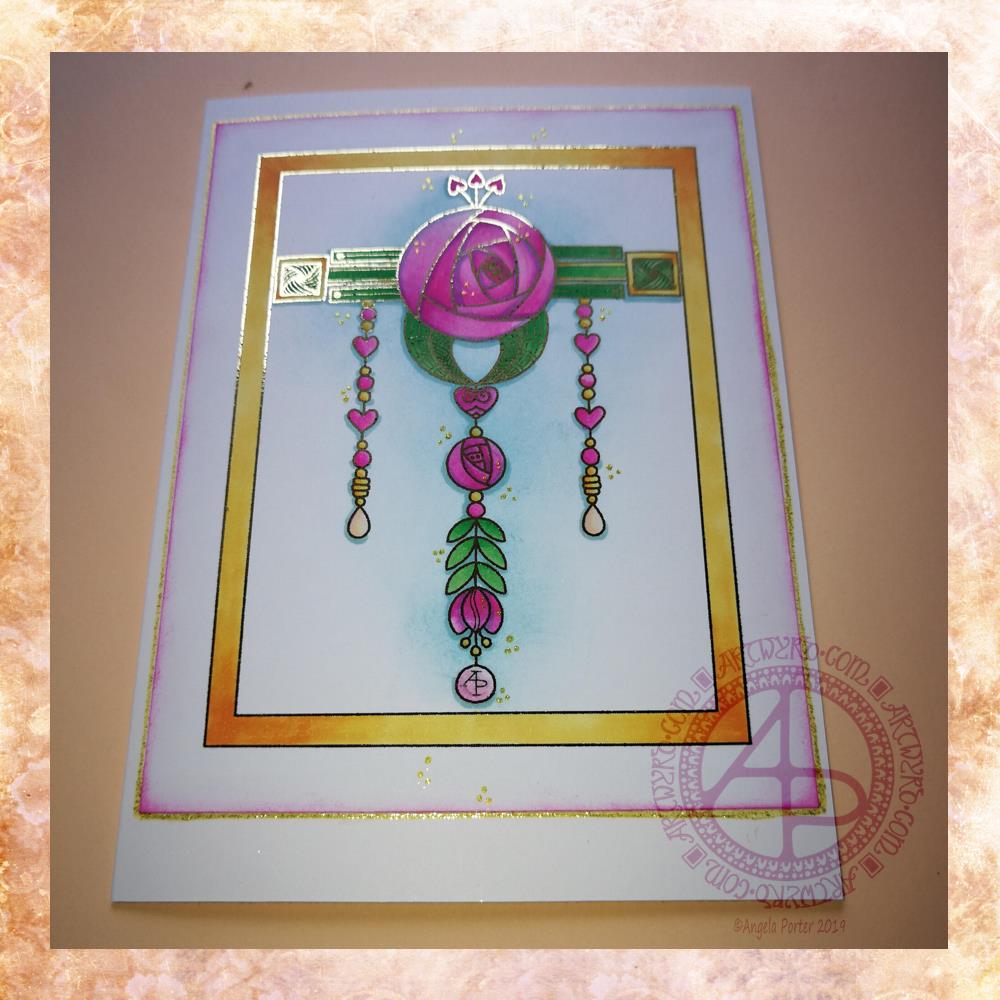
Given my experiments with thermal foiling this week, today’s dangle had to be foiled, in gold this time.
As I enjoyed creating a dangle design inspired by Art Nouveau last week I thought I’d like to do that again this week, and this is the result.
I drew the design digitally, using my usual tools of choice viz. Autodesk Sketchbook Pro, Microsoft Surface Pen and Microsoft Surface Studio.
I coloured the design in using Chameleon Markers. Then I added the blue background with Distress Inks, followed by a pink edge to the card. Not sure pink was the right choice, but it’s ok I suppose.
I mounted the design on an A5 card blank and drew a glittery gold line around it with a Uniball Signo gel pen. I also added some small groups of glittery gold drops to the design.
Overall, I’m quite pleased with this one. I like the combination of the more geometric designs with the more organic motifs.
I didn’t add any hand lettering or a sentiment so it makes it perfect for any occasion or as a note card. It would also make a fantastic page design for a BuJo (bullet journal) or as part of a scrapbook, journal, diary or notebook spread.
If you’d like to try your hand at creating your own dangle design but don’t think you could, well you could find my book ‘A Dangle A Day’ helpful. Not only are well over 100 different monograms and dangle designs included that you can use, but help and advice is given for creating your own, as well as plenty of words of encouragement. I’d love to see your dangle designs too.
I really needed some quiet, creative time this morning. Some time without any pressure on me in terms of requirements from publishers and others. Dangle designs are simple to draw, and there is a soothing quality in simplicity. Colouring is also a very soothing activity and the magic of hot foiling always makes me smile.
I’m feeling a bit below par in terms of my mental and emotional wellbeing. I have a stinking headache, which isn’t helping, and I’m feeling exhausted again. That’s all to do with emotional exhaustion.
Fortunately, I can take time today to just do what I need to do in terms of self-care. I managed to get three and a half out of the four edits for my next coloring book done. I have until Monday to get the other half finished, so that’s definitely do-able, either later today when the headache subsides or tomorrow.
My emotional and mental sea has some smooth waves on it, not stormy, not choppy, just swells that come and go. I may be in a bit of a trough at the moment, but I’ll soon be heading back up to the crest of the gentle swells.
This took me a bit longer than I expected this morning. I did, however, enjoy creating this card.
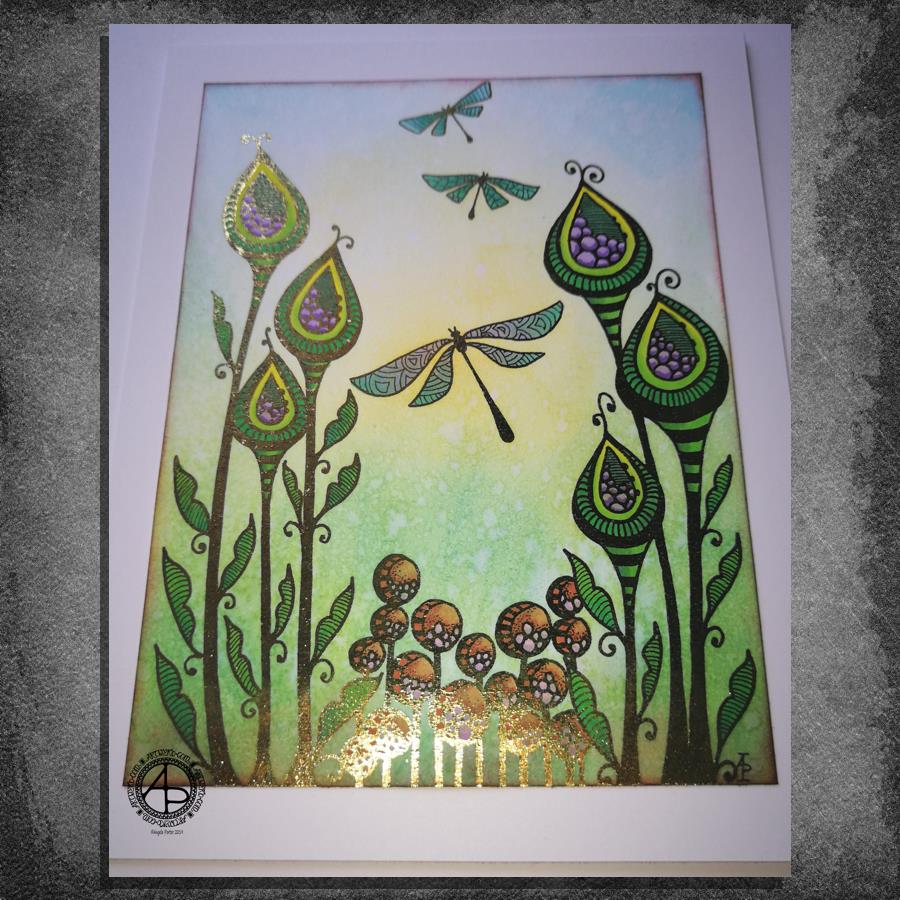
First, I drew the design out on a piece of paper that is 10cm x 14cm using various sizes of Uniball Unipin pens.
I copied the image using my Brother Laser printer. I didn’t scan it in at this time, but will do later on. All I needed was a copy to play around with.
The next step involved the use of Chameleon Duo Tone and Color Top markers to colour the design elements in. Even though some areas were quite small, I still managed to get bits of shading there.
Once the colouring with the Chameleon markers was done it was time to hot foil the design, and you can see where the gold foil catches the light in places as I took the photo. A friend of mine saw some of my foiling yesterday in person and she was said she was wowed by it. She thought it was good in the photos, but the photos really don’t do it justice at all.
After foiling, it was time to colour the background. I used a selection of Distress Inks, starting with mustard seed in the centre to give a subtle glow, then tumbled glass, crushed olive, peeled paint, pine needles and evergreen bough. I used a piece of cut and dry foam and a very light touch to add the colour.
I was worried that the Distress Inks may muddy up the colouring done with the Chameleon markers. Yes, they subtly changed the colours in some places, but I was careful to choose colours that wouldn’t make mud. Also, so little Distress Ink is added it barely alters the colours.
I can tell you I was well relieved by that!
Distress Inks are water reactive, so I gave the image a light spray of water knowing that only the Distress Inks would be affected. After a short while I dabbed the water off with a piece of paper towel. This lifted some of the colour leaving a subtle background texture.
As this point, after letting the paper dry completely, I could’ve added more Distress ink. Instead, I decided to use aged mahogany, again on a small piece of cut and dry foam, to edge the paper, to give it a border, and also to add a darker layer at the bottom of the design to ‘ground’ the image.
When I can find my Wink of Stella pen from Kuretake I’ll add some very subtle shimmer to the dragonflies, maybe to the seeds in the seedpods too. I also think some gold dots in small clusters would enhance the background.
I also need to think about adding a bit more shading to the bottoms of the laves to give a more dimensional look to them I think. I could definitely do the same to the dragonflies’ wings too.
Those are simple and quite minor changes that will make a difference I think. It’s only as I’m looking at the finished image now that I can see how those things would help. I often don’t think to step back and give myself time to look at the image with fresh and kindly critical eyes, seeing what I could do to improve my work.
In hindsight, the dragonflies may have worked well as black silhouettes in the design, which would then become totally covered in foil. Or just outlines that would be foiled. That’s something for me to try another time and see if I like that idea more.
I think you can tell I’m really enjoying this branch of my artistic journey. I’ve concentrated a lot on digital art of late. I’m not going to abandon my digital art journey at all; I can do things digitally that I can’t with traditional media.
However, it is showing me that working with traditional media is also a pleasurable and successful activity for me to do.
What am I going to do with this? I don’t know. Part of me wants to add it to my BuJo. Another part wants to mount it on a blank greeting card to send to a friend. Another part of me wants to put it into a reference sketchbook or folder for inspiration in the future.
Another useless photograph, but I think you get some idea of how the foiling appears.
I’ve had a bit of a nightmare with the laminator. This morning it decided to terminally ‘eat’ a ‘foiling sandwich’ and there is no way I can get it out. I tried to put an A4 sheet through the laminator which meant that the folded ‘carrier’ paper had the fold to the side, not going through the laminator first. I think that’s what caused it all to get caught and stuck.
Lesson learned? Hopefully. I think I’m going to have to work on images that are A5 (UK) in size or less. Which is fine now I’m sure about that. However, I really was hoping to foil one of my A4 monogram images.
Ho hum. I shall purchase another laminator later today so I can continue working on it. The instructions with the foil say any home laminating machine will work with this particular foil.
About the foiled works…
Here’s what I’ve discovered so far.
Foiling works best on smooth paper, such as the heavyweight ‘premium’ paper I use in my printer. I do want to try Bristol Board as that is smooth and a bit more weighty again and stands up well to quite a few media.
Coloured cardstock, such as the dark blue example to the bottom left, doesn’t work quite so well as it’s not all that smooth. The foiling ends up a bit uneven and has a kind of ‘brushed’ look to it.
The copper foil I’ve used is amazing! It is like an interference ink or paint in that it’s colour changes from coppery-red to gold as it catches the light in different ways. I’m in love with this one for sure. It looks fab with turquoise blues and greens, a lot like the colours of verdigris.
I tried colouring the top left, top middle and bottom right images with Distress Inks after foiling. This worked brilliantly! It needs to be added after foiling; a little wipe with a dry paper towel removes any excess ink from the foil.
I’m not sure if you can see it, but the centre of the two mandalas at the top left and middle have some colour added to them. I used Staedtler Fineliners for the blue one and Zig Clean Colour Real Brush pens for the orange one.
The mandala at the top right I coloured using Chameleon markers and pencils after I’d foiled it. Not my best choice of colours, in my opinion, but it was an experiment. The alcohol inks stained the foil where I couldn’t keep the nib in the tiny spaces. The mandala was designed to be printed on A4 paper so the gaps weren’t quite so tiny, but I printed them at 4″ x 4″ just to try the foiling out.
I need to draw at sizes that it’s possible to foil successfully without killing a laminator off quickly in the future, and that means A5 or less in size. Unless I decide to ’tile’ the image in some way.
Future experiments in foiling…
There are some different papers I want to try. Bristol Board from either Frisk, Daler-Rowney or Winsor and Newton in particular. Strathmore is textured and I suspect it won’t work well, it’ll be more like the coloured card stock.
Coloured, heavyweight paper is a definite, particularly black I think. Just for the line art in foiling.
Hot-pressed, smooth watercolour paper may be worth a try, along with the smoother side of Claire-Fontaine or Daler-Rowney mixed media paper.
Different papers mean I can used different coloring media in different ways.
What else I have learned and what else I need to think about.
I really, really like digital colouring and I’m rather rusty with different traditional media.
I also need to think about what I can do with foiling and any market that I can create for myself with my art.
I’m really not at all good at promoting myself or my art and pricing work is so very difficult for me to do. It really is. I have a bit of a break in contracts at the moment (apart from editing some templates this week) and it’s something I really do need to turn my attention to. I create so much, but do so little with it.
I’ve had some fun today with thermal foiling. I’ve been waiting for an Amazon Basics laminator to arrive, which was the one that seemed to be the most recommended out of simple laminators. I’ve had the foil for quite a while.
For thermal foiling, the images need to be printed with a laser printer. The laminator then heats up the laser toner which becomes sticky and the foil sticks to it as you run the layers through the laminator. A quick cool down, peel the foil away and the black lines are left with foil covering them!
I played around with adding the foil first then adding colour, and coloring first before foiling. I also tried out alcohol markers, coloured pencils and Tombow Dual Brush markers both before and after foiling. They all worked well either way, though the alcohol markers do colour the foil, so for alcohol markers it may be best to colour first.
I then had to try them out on images and I chose to use two of my cute kittie designs. I coloured them with Copic markers before foiling. The one of the left has been foiled with gold, the one on the right with silver.
I mounted the designs on 4″ x 4″ square kraft card card blanks. To be honest, I could’ve done with printing these out a bit bigger as the lines were very bitty as they were so thin. Something I have to keep in mind when printing out future work. I think I’m going to have to design them to the size they’ll be printed at to make sure the lines are as thick as I’d like them.
I’m not a photographer. No matter what advice I’m given and follow I still don’t manage to get a good image. The gold shows up well and there are hints of silver visible on the right hand one, but I think you’ll get the idea.
I’m rather pleased with them and the sparkly, shininess keeps my inner raven quite happy.
I also now have a new tool in my creative tool box, one that I will use fairly often I think.
Emotional and mental wellbeing…
For the first time in ages it seems I feel awake and not needing to go back to bed for a nap in the afternoon. The emotional exhaustion of the recent EMDR, therapy sessions and Time to Change Wales anti-stigma talks is beginning to wear off. Mind you, that may change tomorrow as I have EMDR then rather than today just for this week. All the same, it’s nice to feel content and quite creative.
I’ve started a little book that I’ve titled ‘When it’s dark, look for stars’. It’s an A6 (UK size) sketchbook, and inside I am going to use Distress inks and other media to colour the pages and then add all shiny, metallic hand lettering and images and patterns with quotes and helpful words of advice, reminders for me on my darker days that I am not what the inner critic wants me to believe I am. Of course, my cute, foiled kitty and raven with rainbow and stars is definitely going to make it into the book.
I’m open to suggestions of what I could add to my little book, be it quotes, or kind words, or ideas for self-care. I’d also like to know if you’d like to see glimpses of it from time to time.
New coloring template in the facebook group
A new month means a new coloring template is available for members of the Angela Porter’s Coloring Book Fans facebook group.
This month, I’ve designed a mandala with some of the motifs I’ve been using in my more abstract works lately.
If you fancy printing and coloring a mandala designed by myself, pop over to the group, join and you’ll find the new template and quite a few others there available exclusively to members. Terms and conditions apply.
If you do join in, I’d love to see your finished coloration!
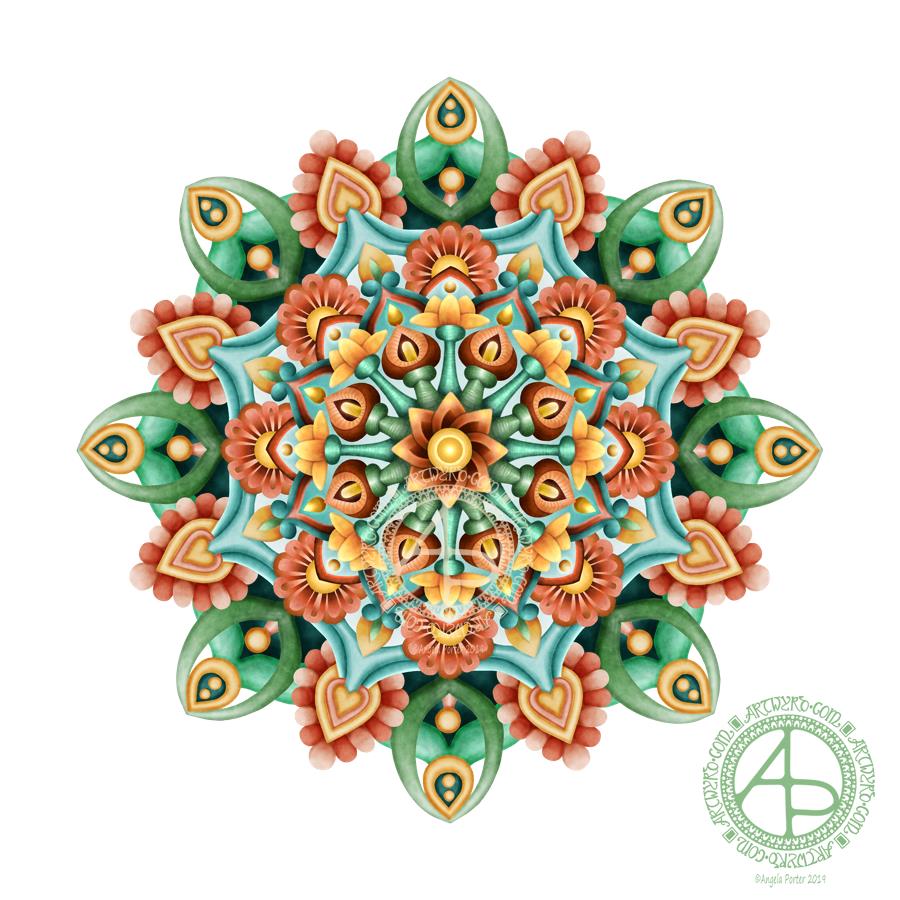
Yesterday, I had an urge to try colouring my latest mandala design but without black lines, just pure color. This is the result. I’m actually quite pleased with it, and I’ve surprised myself too, in a nice way. I’m quite eager to do more art like this as time goes on.
I chose a similar color palette to the one from yesterday, similar but not the same. I also edited the shapes and lines as I felt I needed to as the design grew out from the centre.
The color palette was of just six colours – two greens, one aqua, two orangey colours and one yellow, all muted, subdued colours. I think I could’ve done with one more colour, or used the darker version of the aqua as the background in the inner and middle ‘circles’ of the design. Of course, I can try that out without ruining this version. That’s the beauty of digital art.
I would never have done this using traditional media. My skills with colours are relatively limited in the physical realms.
The world of digital art is opening up new ways for me to express my creativity, that’s for sure. The skills required are different but equally as complex as traditional media in my opinion.
There’s also a lot of learning and exploring for me to do to get the style of coloring right for ME. The advantage of digital work is that you can try and try again until you get it how you want it to be without having to start over from the beginning. Some see that as ‘cheating’ or ‘making it easy’. I see it as learning and growing and developing in real time. Digital art is very forgiving, but that doesn’t mean it’s any easier. Far from it in my opinion.
I know my limitations with paints, markers, pencils and so on. I’m kind of competent with markers and pencils I suppose. Working digitally, however, allows me to really work at making sure I get the finish I want in each section of the design, with or without my characteristic black lines. I can try things out and adjust to get them just as I wish them to be.
Each time I do something different like this I learn. With this mandala it’s the use of high contrast to gain the depth and dimension I like, and it’s working out how to get that with the various types of brushes and effects that are available to me.
It’s a huge thing for me to use my line art as just a guide and to lose the lines to create a design such as this. It involves learning how to make the different sections separate from each other using shadow/light as well as color, something I’ve rarely done in my artistic journey.
This is definitely something I’m going to do more of in the future and develop my skills in creating art in this way too. It’s taking me a long while to get my head around it all, but little by little my digital art is developing I think, and I’ll find my own voice with it for sure, or maybe another voice.
I used my usual trifecta of Autodesk Sketchbook Pro, Microsoft Surface Pen and Microsoft Surface Studio.









 Art is the Adventure