I started by colouring a 6″ x 6″ piece of Strathmore Bristol paper with various shades of green Distress Ink (Peeled Paint, Shabby Shutters, Crushed Olive, Bundled Sage and Iced Spruce) and edged it with some Aged Mahogany.
Then, I drew the design using a metallic bronze Uniball Signo gel pen. Finally,I added some shading and depth with an olive green Chameleon Fineliner pen.
My photography skills aren’t good, which is why there’s two photos. The top one is a bit truer to and you can see the design more clearly on it. The bottom one shows the shiny bronze ink I used.
I think you’ll get the idea of what I’ve created.
It’s been a busy day here in the Angela studio/office. I’ve been focused on social media stuff for something I’m involved with at the moment. I had to get things done this morning and afternoon, so it wasn’t until quite late in the day I could turn my attention to art.
By then, I just wanted to draw something that was comforting, familiar, soothing. Which is why I ended up with another entangled design.
It did it’s job in soothing and calming me somewhat. Now, I can settle down, after I finish off a couple of things. I think time away from technology is required this evening.
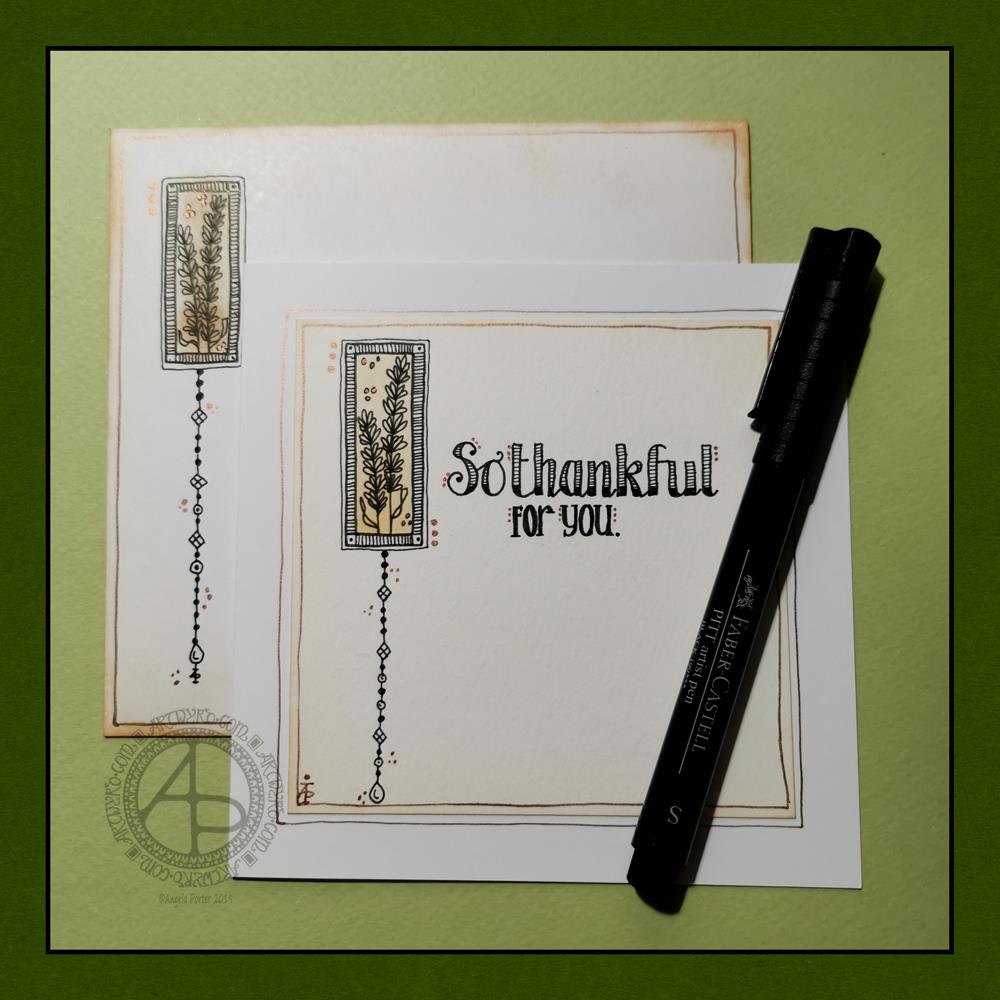
Today, I have a simple dangle design greeting card along with a coordinating envelope. If you’d like some more ideas, inspiration and step by step instructions for drawing dangle designs then my book, A Dangle A Day, is a good place to start.
Materials and dimensions
4″ x 4″ Strathmore Bristol paper with a vellum finish 5″ x 5″ acid-free white card blank White envelope that card will fit in Distress inks in Tea Dye and Rusty Hinge Small piece of foam and a mini foam blending tool A piece of card with a 1.5″ x 0.75″ window cut in it to use as a stencil. Faber-Castell Pitt artist pens in F, S and XS Ruler and pencil Adhesive Glass pen and coppper ink by J Herbin
Making the card.
Use the card stencil and a small sponge dauber to apply a rectangle of Distress Ink in the top left of the 4″ x 4″ top layer. I used Tea Dye to colour the whole rectangle in, followed by a subtle gradient of Rusty Hinge from the bottom up.
Use a mini foam blending tool to add Tea Dye Distress ink to the edge of the top layer.
Use a pen to draw the rectangles around the colour block. I like to do this free-hand as it gives a more organic, human feel to the design.
Draw the sprigs and add the lines to the border. Dots help to add some interest to the more empty parts of the design.
Use a ruler and pencil to lightly draw a vertical line as a guide for the dangle. Also, draw pencil lines as guides for the position and size of the hand lettering. Sketch in the letters of the greeting.
Draw round and diamond shaped beads to form the dangle. I like to finish my dangles with a ‘heavier’ or larger bead.
Ink the letters in. I did some faux calligraphy where I made the down-strokes thicker. I added some lines and shading to the top line.
Carefully erase the pencil lines.
Attach the top layer to the card blank.
I used a glass pen and copper ink to add copper dots to highlight the dangle design and the hand lettering. I also drew a box just inside the top layer and another just outside it on the card blank. Again, I free-handed the lines, embracing the wobbliness.
Making the envelope
I used Tea Dye Distress Ink and a mini foam blending tool to edge both the front and back of the envelope.
I then used a sponge dauber and the card stencil to add a rectangle of Tea Dye ink in the top left.
I drew the design on the envelope as I had on the card, including adding a line border in copper ink.
Finally, I drew similar sprigs on the envelope flap, using the glass pen and copper ink.
Before mailing…
Once I’ve addressed the envelope, I’d apply a thin layer of Distress MicroGlaze to the front and back of the envelope to protect the Distress Ink and drawing from the elements. I’ve done this to other cards and they have traversed the UK and US postal systems with no problems.
Ideas for using the design.
Although I’ve presented this dangle design as a greeting card, which is, I think, a lovely way to share a little bit of artistic loveliness with others, there are many other ways the design could be used, with or without any hand lettering.
In a BuJo, journal, planner or diary it would make a lovely little design to fill in a blank space.
This is a design that would work really well as a bookmark.
I’m sure it would look charming as part of a scrapbook spread.
I also think it would look lovely on a ‘with compliments’ slip or decorating the edge of a hand-written letter.
I’m sure there are many other ways and media that this design would be suited to.
Final thoughts…
I’m really enjoying drawing these kinds of dangle designs. They’re simple and elegant, to my mind anyway. They’re also quite easy to draw.
I do prefer to free-hand the lines and let the wobbliness be part of my signature style. It gives that human, hand-made, hand-crafted feel to the finished project, and a warmth to the finished project.
I work hard at finding a way of drawing digitally that lets me keep this uniquely ‘Angela’ way of expressing myself through line and pattern. I’m still working on it and sometimes get frustrated that, to my eye, my digital art seems too, well digitally perfect.
It’s all part of the process though – learning, developing, experimenting, trying out new ideas, techniques and methods. That’s what helps me grow as an artist.
This could be the last piece of mail art from me for a few days. I need to get focused on art that is ‘work’ rather than just ‘for fun’. I enjoy my art, no matter what it is, but I can be easily distracted by the metaphorical shiny, bright new toy.
Mind you, once I’ve spent time doing art ‘for fun’, the commissioned work then feels like fun. A change is as good as a rest for sure. Different styles and methods of working keep everything fresh for me.
Here’s a brief outline of how I created the card:
Distress Ink background on watercolour paper. Use torn paper to use as a mask for the landscape. Use a circular mask for the sun.
Spray with a mixture of Perfect Pearls and water.
Use Faber-Castell Pitt Artist Pens to draw the design.
Add metallic highlights using a fine brush and Cosmic Shimmer Iridescent Shimmering Watercolour paints.
Add a distress ink ‘frame’ to the image.
Mount the design on black card. Attach the black card to the 6″ x 6″ card blank.
Use a gold glitter Uniball Signo gel pen to outline the top panel and black panel.
And here’s a brief outline of how I created the envelope:
Use a white Sakura Glaze pen to draw the flower motifs.
Use a fine paintbrush to add Cosmic Shimmer Iridescent Shimmering Watercolour paints.
For the envelope, I used a rainbow of colours for the flowers.
I like using Sakura Glaze pens to draw motifs when I’m adding watercolour; the ink dries to give a raised line that is waterproof. The thicker line width can also give stained glass feel to the artwork; this is particularly true for the black Glaze pens.
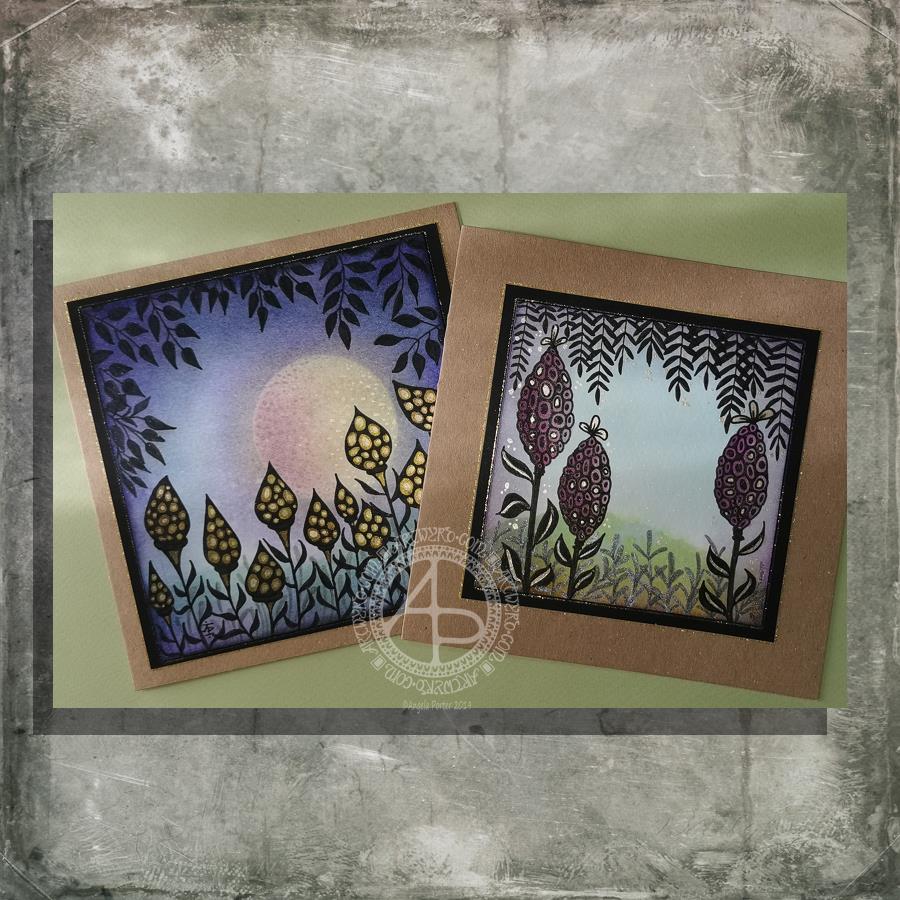
I had a lovely time this morning making the card on the left. Before I started drawing, I added a moon or planet to the background. It really adds something to the card, I think. Something like this is needed on the card to the right I think. However, as I’ve assembled the card it’s not going to be easy to alter!
How I made the cards.
I used Distress Inks and a mini-foam blending tool to colour the backgrounds. I used a circle of paper as a mask for the moon/planet in the left-hand card. To create the land, I used a torn piece of paper to mask off part of the card.
Once I was pleased with the backgrounds, I sprayed the image with a mixture of Perfect Pearls and water and let it dry.
The next step was to draw the designs. I used black and grey Pitt Artist Pens by Faber Castell.
Metallic/iridescent highlights were added; I used Cosmic Shimmer watercolour paints and a fine brush.
The final steps were to adhere the top layer to a black mat, and then this to the card base. Finally, I edged the mat and the top layer with a gold glitter Uniball Signo gel pen.
I have made coordinating envelopes for each card.
My thoughts on the cards.
I think you can tell that the card on the left is the second made. I can see how I’ve learned from the first card. I do like them both.
I would, if I could, add a moon/planet to the right hand card. It would fill that space rather nicely and give a more magical, mystical, ethereal feel to the landscape.
As to the left hand card, I wish I hadn’t done the pods all in black; they appear a tad ‘flat’. In hindsight, I could have used just black outlines and then filled the pod with a colour gradient before adding the metallic highlights.
I also am glad I didn’t try to add a spine to each leaf as I did on the right hand card. However, a highlight at the top of each leaf, suggesting the moon/planet light is reflecting from them.
Oh the whole, however, I am pleased with these cards. They are a new style of working for me. leaving open space is never easy for me, but I’ve managed it with these cards.
Would you like some happy mail?
I’ve already got some recipients in mind for these cards. However, if you’d like some happy mail then send me a message.
I had a lovely time this morning making the card on the left. Before I started drawing, I added a moon or planet to the background. It really adds something to the card, I think. Something like this is needed on the card to the right, I guess. However, as I’ve assembled the card, it’s not going to be easy to alter!
How I made the cards.
I used Distress Inks and a mini-foam blending tool to colour the backgrounds. I used a circle of paper as a mask for the moon/planet in the left-hand card. To create the land, I used a torn piece of paper to mask off part of the card.
Once I was pleased with the backgrounds, I sprayed the image with a mixture of Perfect Pearls and water and let it dry.
The next step was to draw the designs. I used black and grey Pitt Artist Pens by Faber Castell.
Metallic/iridescent highlights were added; I used Cosmic Shimmer watercolour paints and a fine brush.
The final steps were to adhere the top layer to a black mat and then this to the card base. Finally, I edged the mat and the top layer with a gold glitter Uniball Signo gel pen.
I have made coordinating envelopes for each card.
My thoughts on the cards.
I think you can tell that the card on the left is the second made. I can see how I’ve learned from the first card. I do like both cards, though.
I would, if I could, add a moon/planet to the right-hand card. It would fill that space rather nicely and give a more magical, mystical, ethereal feel to the landscape.
As to the left-hand card, I wish I hadn’t done the pods all in black; they appear a tad ‘flat’. In hindsight, I could have used just black outlines and then filled the pod with a colour gradient before adding the metallic highlights.
I also am glad I didn’t try to add a spine to each leaf as I did on the right-hand card. However, a highlight at the top of each leaf, suggesting the moon/planet light is reflecting from them.
Oh the whole, however, I am pleased with these cards. They are a new style of working for me. Leaving open space is never easy for me, but I’ve managed it with these cards.
Would you like some happy mail?
I’ve already got some recipients in mind for these cards. However, if you’d like some happy mail then send me a message.
I’ve already got some recipients in mind for these cards. However, if you’d like some happy mail then send me a message.
After a very late night talking to a friend and not enough sleep, today is a self-care day. I’m going to go back to bed soon and try to sleep some more before driving for four hours tonight.
While waiting for sleep to catch up with me again, I thought I’d make some mail art. The photo isn’t the best; I’ve said it before, I’m not a brilliant photographer. However, I’m sure you get the idea. Also, I wanted to catch a glimpse of the metallic highlights I’ve added to this card, so the angle of the photography was just plain weird!
My brain seemed to have ticked over some ideas while I was asleep and I woke with some things I thought I could try out. This card is the result of some of them.
I started by using a 4″ x 4″ piece of watercolour paper and applying Distress inks to it to create a background.
I used a torn piece of paper to mask off the bottom of the panel so that could use an ink blending tool to apply Pine Needles and Crushed Olive Distress inks to create some land.
A sky was required, so I used Broken China Distress ink to create it so that it faded from top to the land.
I then sprayed the background with a mixture of gold Perfect Pearls and water to create a less perfect appearance.
While this was drying, I flipped through my Zibladone (visual dictionary) and found some motifs I liked. I used Pitt Artist pens from Faber-Castell to draw the motifs on the panel. I chose these pens because they’re waterproof when dry and I knew I wanted to add colour and sparkle to them later on.
To give a sense of dimension, I used black pens for the foreground motifs and a grey brush pen to create the foliage in the background.
To help the seed pods stand out, I used washes of Dusty Concorde and Seedless Preserves Distress inks. Then, I used some Cosmic Shimmer gold iridescent watercolour paint to add the gold highlights.
Once everything was dry, I used a piece of Cut’n’Dry foam to edge the panel with Dusty Concorde Distress Ink. The design was framed nicely by this edging; it also added a sense of dimensionality.
Next, I mounted the panel on a piece of black card and then adhered these layers to a 6″ x 6″ blank Kraft card, all done with Tombow Mono glue.
Finally, I carefully used a gold glitter Uniball Signo gel pen to add lines around the edge of the design panel and also the black mat.
I then turned my attention to the envelope. I drew some more of the seed pods before adding a light wash of Dusty Concorde and Seedless Preserves Distress Inks, being careful not to overwet the envelope. I added dots of gold watercolour paint to the seed pods and the space around them too, making sure I left enough space to write the name and address of the eventual recipient.
I’m quite pleased with the card. I’ve done this style of drawing digitally in the form of a mandala, but never like this. However, as I look at the card, it seems to need a focal motif in the space between the seedpods. I may be wrong; it may just be my constant need to fill up space with line and pattern and the difficulty I have in leaving white space in a design.
I shall let the card ‘sit’ for a while before making my mind up on that issue.
Distress Inks in Bundled Sage, Weathered Wood and Stormy Sky.
Distress Oxide Inks in Iced Spruce and Peeled paint.
Small paint brushes – I used a 0 for the details and a 4 for the circles.
Mini foam blending tool.
A spray bottle containing a mixture of gold Perfect Pearls and water.
Tim Holtz’s Distress Micro Glaze and a dedicated foam blending pad. (or just your fingers!).
A glass pen or other fine nib dip pen.
Gold and Silver inks from J Herbin
White Sakura Glaze pen.
Gold glitter Uniball Signo Pen.
Light grey 05 Unipin pen by Uniball.
Glue or strong tape to adhere the card layers (I used Tombow Mono glue)
Method:
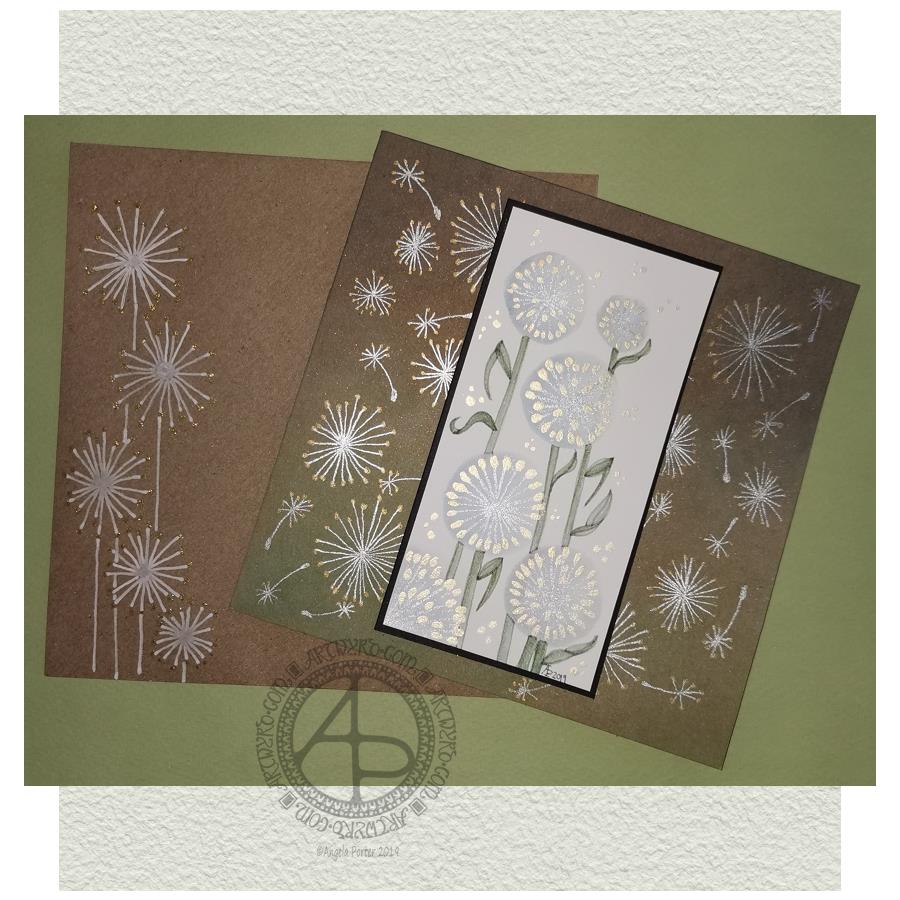
I started with a 2.5″ x 5″ piece of watercolour paper and a brush. I used water to draw circles where I wanted the dandelion heads to be. I then used the brush to add Stormy Skies and Weathered Wood Distress Inks into the water, letting it spread as it liked. To ensure I had a darker area of the seedhead, I dropped the watered-down inks to the bottom and left of the circles.
While the circles were drying, I worked on the card base. I applied Peeled Paint and Iced Spruce Distress Oxide Inks with a mini foam blending tool. Then, I sprayed the card with a mixture of gold Perfect Pearls and water and let it dry. Finally, I used Tim Holtz’s Micro Glaze to seal in the Distress Oxides – they react all too quickly with the sweat in fingers.
By the time I’d set the card base aside to dry I could return to the dandelion seed heads. I used a fine paintbrush, and some Titanium Iridescent Watercolour paint from Cosmic Shimmer to add the stems of the seeds. Once they had dried, I added dots of Enchanted Gold Iridescent Watercolour paint to the stems and set the panel aside to dry.
I wanted to add some dandelion heads and seeds to the card base. I used a glass pen along with silver and gold inks from J Herbin. I didn’t think these would adhere to the micro glaze treated surface, but they did. On a darker background, I could really see how these inks look like liquid metals as they flow onto the paper. They didn’t dull as they dried, thanks to the micro glaze acting as a barrier to the Distress Oxide ink.
Next, I wanted to add the stems and leaves to the dandelions on the watercolour paper panel. I used some Bundled Sage, Weathered Wood and Stormy Skies Distress inks for this. I pressed them onto a sheet of plastic, diluted and mixed them with water and a brush and then used the mixture to add the stems and leaves. I started with a lighter colour wash, adding darker colours to the left of the stem and also under the dandelion heads to add some dimension.
Once I was reasonably happy with the stems, I worked on the leaves. Again, I started with a pale-coloured wash to get the shape of the leaves in place. Then I gradually added darker tones to give a sense of dimension.
When I’d finished this, I looked at the panel, and I wasn’t happy with the stems and leaves. They looked unfinished. So, I dug out a light grey Uniball Unipin pen and proceded to outline the stems and leaves. This improved matters greatly to my mind. I like the way the stems and leaves are now defined and how they contrast nicely with the airy, ephemeral feel of the seedheads.
I then set about adding some dots of the gold watercolour around the arrangement of dandelion seedheads, added my symbol and year, and that completed the top panel.
I cut a piece of black card that was approx. 5.25″ x 2.75″ and adhered the top panel to it. I then adhered these layers to the card base.
My last task was to decorate the envelope. I used a white Sakura Glaze pen to draw some dandelion seedheads. When the Glaze pen lines had dried, I used a gold glitter Uniball Signo gel pen to add dots.
My reflections.
I started with a 2.5″ x 5″ piece of watercolour paper and a brush. I used water to draw circles where I wanted the dandelion heads to be. I then used the brush to add Stormy Skies and Weathered Wood Distress Inks into the water, letting it spread as it liked. To ensure I had a darker area of the seedhead, I dropped the watered-down inks to the bottom and left of the circles.
While the circles were drying, I worked on the card base. I applied Peeled Paint and Iced Spruce Distress Oxide Inks with a mini foam blending tool. Then, I sprayed the card with a mixture of gold Perfect Pearls and water and let it dry. Finally, I used Tim Holtz’s Micro Glaze to seal in the Distress Oxides – they react all too quickly with the sweat in fingers.
By the time I’d set the card base aside to dry I could return to the dandelion seed heads. I used a fine paintbrush, and some Titanium Iridescent Watercolour paint from Cosmic Shimmer to add the stems of the seeds. Once they had dried, I added dots of Enchanted Gold Iridescent Watercolour paint to the stems and set the panel aside to dry.
I wanted to add some dandelion heads and seeds to the card base. I used a glass pen along with silver and gold inks from J Herbin. I didn’t think these would adhere to the micro glaze treated surface, but they did. On a darker background, I could really see how these inks look like liquid metals as they flow onto the paper. They didn’t dull as they dried, thanks to the micro glaze acting as a barrier to the Distress Oxide ink.
Next, I wanted to add the stems and leaves to the dandelions on the watercolour paper panel. I used some Bundled Sage, Weathered Wood and Stormy Skies Distress inks for this. I pressed them onto a sheet of plastic, diluted and mixed them with water and a brush and then used the mixture to add the stems and leaves. I started with a lighter colour wash, adding darker colours to the left of the stem and also under the dandelion heads to add some dimension.
Once I was reasonably happy with the stems, I worked on the leaves. Again, I started with a pale-coloured wash to get the shape of the leaves in place. Then I gradually added darker tones to give a sense of dimension.
When I’d finished this, I looked at the panel, and I wasn’t happy with the stems and leaves. They looked unfinished. So, I dug out a light grey Uniball Unipin pen and proceded to outline the stems and leaves. This improved matters greatly to my mind. I like the way the stems and leaves are now defined and how they contrast nicely with the airy, ephemeral feel of the seedheads.
I then set about adding some dots of the gold watercolour around the arrangement of dandelion seedheads, added my symbol and year, and that completed the top panel.
I cut a piece of black card that was approx. 5.25″ x 2.75″ and adhered the top panel to it. I then adhered these layers to the card base.
My last task was to decorate the envelope. I used a white Sakura Glaze pen to draw some dandelion seedheads. When the Glaze pen lines had dried, I used a gold glitter Uniball Signo gel pen to add dots.
Reflections on this project.
When I started, I only had a rough idea of what I’d like to do. I knew I wanted to use watercolour media and stylised dandelion heads.
At first, I tried to make the circles for the seed heads by using a Tombow Dual Brush pen to draw the outer circle. Then, I used water and a brush to get the ink to bleed into the circle.
The result wasn’t pretty.
So, I regrouped and tried Distress Inks and water, and I was much happier with the result, and the card grew from there.
I’m pleased that I ran with a more stylised dandelion head than I’d initially considered. One of my artistic strengths is my ability to create stylised motifs. I certainly think I managed to do that with the dandelion heads and their leaves, especially as watercolour media is not a strength of mine.
I’m also glad I used the iridescent paints to add the details. That makes my inner raven very happy. The use of metallic inks on the card base increased the happiness of the raven even further!
I was about to give up on the card when I’d added the stems and leaves with just Distress Inks; I wasn’t happy with them. However, trying the grey line made all the difference in the world. The dandelions went from almost being consigned to the waste bin to being good enough.
I’m now happy with the card and the envelope; it’s something I’ll try again in the future, maybe. After all, I do have a few more watercolour paper panels that need to be used!
So, Angela, how are you today?
Yesterday, I had EMDR therapy. The session was quite painful, physically, and a bit distressing emotionally. I felt content and optimistic going to the appointment, and I left feeling pretty much the same. However, I suddenly became exhausted when I was half-way home. And I do mean exhausted. I felt my eyes trying to cross and close.
I made it safely home and, after having a little something to eat, I collapsed into bed and slept until early evening.
I was still really tired when I woke, but a random chancing upon crochet patterns for hyperbolic surfaces and ammonites kept me up for a while. Indeed, I lost myself in crocheting hyperbolic forms.
This morning I woke feeling content and optimistic and cheerful. The sun was shining, which always helps my mood for sure.
Even though I was feeling sunny inside, I wanted to spend time on a little project or two today. I didn’t want to push myself after what turned out to be a gruelling EMDR session yesterday. So, that’s why I threw myself into creating this little card.
Now, it’s nearly 7 pm here in the UK, and I’m bone-tired once again. I’ll spend the evening either creating another card or crocheting. Either way, it’s self-care time.
I’ve woken to a grey, wet, fresh day here in the Welsh Valleys. The coolness is actually quite delicious on my skin. The rain is freshening the air and world up, clearing the dust away. What a way for the weather to see out August!
It’s a perfect morning to do some artsy crafty stuff. For me, that meant finishing off a pair of cards with coordinating envelopes.
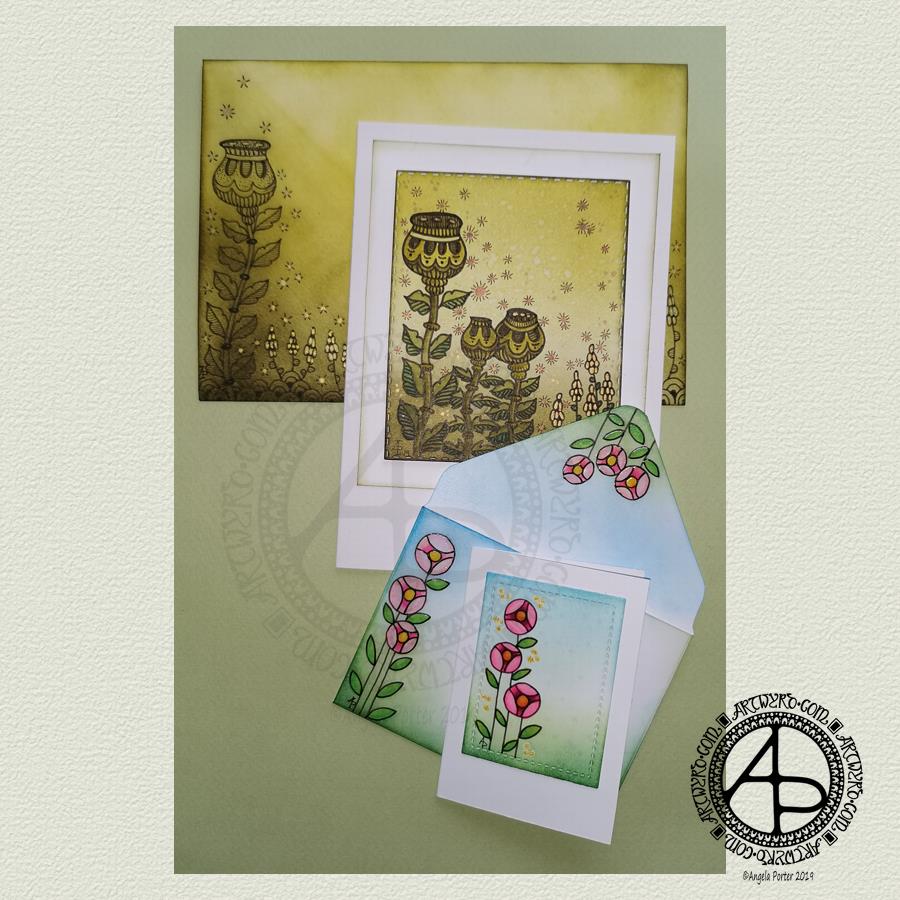
Making the larger entangled seed pods card.
The top panel measures 3″ x 3.75″, mounted on an A6 card (UK sizes).
I coloured The envelope, top panel and the border of the middle panel envelope and the edge of the middle panel with Crushed Olive, Forest Moss and Shabby Shutters Distress inks. I used a mini foam blending tool to achieve a gradient.
I sprayed water onto the top panel. Distress Inks react with water and results in some interesting textural patterns. I didn’t spray water onto the envelope; the paper is too thin to take such treatment.
My next task was to draw the entangled designs; I chose to go with some seed pods, leaves, a geometric pattern and some little flowers too. I added some ‘sparkle’ patterns around the main elements to give the illusion of little things floating in the air.
Next, I added some sparkle and shine with some gold and copper ink. I placed ink inside the sparkles, the seeds inside the larger seed pods and the flowers too.
I used a brush and Distress inks to add some depth of colour to the design on the card. I decided not to do this on the envelope, again because of the quality of the paper.
Once I have someone to send the card to, I will address the envelope and seal it with Distress Micro Glaze so that moisture won’t damage the envelope.
The colour choice on this card is unusual for me, but it’s worked out nicely, particularly with the gold and copper accents.
The tiny floral card.
This card is tiny, measuring just 2.25″ x 3.25″. It’s envelope is a little larger than needed, but the We R Memory Keepers Envelope Punch Board didn’t have measurements on it for a card this size, so I just used the closest available.
The panel on the card measures 1.75″ x 2.375″. It is one of the panels from the Foursquare background frames I messed up while making yesterdays cards.
I used one of my ideas from yesterdays musings on the cards I’d made. I drew a simple design on both the card panel and the envelope front and flap using Uniball Unipin pens and then coloured it with Copic markers. I added some gold glitter dots with a Uniball Signo gel pen.
Once all was dry, I used a Versamark Pen to colour over the flowers, leaves and gold sparkles. Versamark ink is colourless and sticky and is made by Tsukineko; it comes in ink pads but also in double-ended pens – a bullet point at one end and a brush tip at the other. The ink takes a little while to dry.
I covered the sticky areas with WOW super fine clear embossing powder and used a heat tool from Ranger to melt it, giving the design elements a glossy, protective and slightly raised finish. It also intensifies the colours somewhat, which I rather like.
So, I could now colour the background and envelope with Distress Inks without affecting the colours of the flowers, leaves and gold dots. I used a mini foam blending tool along with Pine Needles, Mowed Lawn, Tumbled Glass and Salty Ocean Distress Inks.
The final task was to glue the card panel to the card blank as well as the envelope flaps.
Again, once I’ve addressed the envelope, I’ll use Distress Micro Glaze to seal the inks and prevent any damage to the artwork while journeying to the recipient.
Reflecting on the cards.
I enjoyed making these cards. I particularly like the simplicity of the small card and the effect of the embossing powder. There’s something about teeny-tiny cards that really pleases me. I think it’s that their size makes them just so darned cute!
The larger card I am also pleased with, particularly in my use of colours that are unusual for me. I’m glad I added colour to the seedpods on the card; it helps them to stand out. I do love the copper and gold ink on this darker background too and how well they stand out.
Making envelopes that coordinate with the card is also something I enjoy doing; hopefully, the recipients see them as something a bit special dropping through their letterbox.
So, what’s on the cards for today?
It’s the last day of August, so I need to get a wiggle on to create a September colouring template for the Angela Porter’s Coloring Book Fans facebook group. I feel the need to include some autumn imagery in this one as we are in the dog days of summer for sure.
Tell me, Angela, how are you feeling today?
I’m tired but feeling quite content and optimistic again. I slept well last night; the weighted blanket really is working wonders for me as far as sleep is concerned. One problem is that I don’t want to get out from under it in the morning, so it must be comforting or soothing me.
I seem to have turned in a magnet for people who have escaped narcissistic abuse of all kinds. It’s nice to be able to help others by giving them space where I will believe their experiences, and I can help them, hopefully, to understand that they are not at fault but are victims.
Synchronicity pointing out to me how much I have learned and understood and healed and am now able to help others, perhaps?
Today I have two card designs for you, both featuring dangle designs, but in different ways.
If you like dangle designs and you’d like to give drawing them yourself but need a little help or inspiration, then you may find my book “A Dangle A Day”of interest. In the book, I take you, step by step, through how to draw over 100 dangle designs, along with some ideas of how you could use them.
Love Ya and With Love Card.
I started by using the Foursquare Backdrop: Portrait die from lawn fawn to cut the frames and panels from a piece of Winsor and Newton Bristol Board. I purchased this die, and the one in the second card, from Seven Hills Crafts here in the UK.
Next, I used Stormy Skies and Broken China Distress Inks to add a subtle colour gradient to the panels.
My idea was to draw four different dangle designs for each small square panel. I also wanted to include some hand-lettering, which I did.
So, I used Unipin pens from Uniball to do the drawings and lettering. I did use pencil outlines for the ribbon banners and lettering to make sure their placement was just right.
I coloured the design elements and charms using Copic markers. As the individual design elements were so small, I just used two colours to achieve shading in the bigger ones.
I also added a drop shadow around the designs using a BV marker that is a greyish-violet. It’s a very subtle drop shadow.
I had to add some sparkle and shine to the card, so I used a clear Spectrum Noir Sparkle brush pen along with a gold glitter Signo gel pen to do this.
To assemble the card, I glued the frame to the card base using Tombow Mono adhesive. Then, I glued the square panels into place.
I managed to get glue onto the front of the card and trying to rub it off while wet just left a dark, dirty smear. I’ve ordered some Tombow Sand erasers to see if they’ll remove the mark. If not, I’ll have to either work out another way to cover it up or just consign the card to the pile of things not to do again!
Black and white floral card.
Again, my first job was to cut out the frame and panels using a die. For this card, I used the Foursquare Backdrop: Landscape die from lawn fawn along with Winsor and Newton Bristol Board. I also decided to use this die in portrait mode.
To draw the design elements, I used Unipin pens from Uniball. I hung dangle designs from the top of each card to fill in some of the space that was there. I wish I’d used a slightly thicker pen than the 01 though. They look almost like an afterthought.
Anyway, once I finished the drawings, I wasn’t sure whether to add colour or not. So, I’ve left the pictures as black and white line art for now.
I used Tombow Mono glue to attach the frame and panels to a 5″x7″ piece of Winsor and Newton Bristol board. I did this as I realised that the dies are made to fit card blanks made from half a sheet of US letter-sized paper folded in half. In the UK, we use A4 sized paper, which is different enough in size to make it awkward to cut the paper to fit the card. I have ordered some 5″ x 7″ card blanks with envelopes, and then I can finish assembling this card. I’m likely to trim the foundation panel down a little and maybe try to carefully add some colour around the edge. Maybe.
It’s at this point I’ll decide whether or not to add colour and to see if I can thicken the lines around the dangles without messing it up. Mind you, if I do mess it up, it’s another experiment I can learn from, hopefully remembering not to do this again.
Things I’ve learned and techniques I want to try.
The lawn fawn dies work great! They come with smaller dies – heart, cloud, small star, large star, sun, small sun and speech bubble – which may be useful in the future. I had made my mind up that I’d limit myself to die sets that are simple in shape to for cutting out panels to draw on and maybe for layering.
I rolled my eyes at myself when I worked out that dies from an American company would work best with American sized paper for card bases. However, I can work around that now I’ve realised that. I’m comfortable working with inches; most of my craft tools have both inches and centimetres on them. However, the inches are visibly the most dominant measurement system.
Glue. Me and glue. Not sure how I can avoid smearing in the future. Hopefully, the sand eraser will help to remove my gluey, sticky, dirty-looking mistakes.
I like using Distress Inks for backgrounds. However, the pale colours of markers that I prefer to use are translucent and so combine with the background. I could use other media such as coloured pencils for colouring. Or I could use distress inks or water-based marker pens with a damp brush to add colour. I could also use a damp brush to remove some of the distress inks. In that case, I may have to use watercolour paper instead of Bristol Board.
I could also use a Versamark pen – which contains transparent, sticky ink – to colour over my design elements once coloured and then use clear embossing powder and a heat gun to protect the colours. I could then add the distress inks after heat-setting the embossing powder. The embossing powder would add some dimension and shine to the cards. If I used a sparkle pen or gold gel pen, for example, the embossing would encase it and highlight these embellishments Ieven more, I think. I need to try this idea out!
So, there are lots of possibilities for going forward with this.
So, Angela, how are you feeling today?
I’m feeling the more content and optimistic than I have for the past two or three weeks.
I’m still feeling out of kilter; changes are happening in my perceptions around my emotional/mental wellbeing. I’m also aware of shifts that are happening in other parts of me.
I’m still poop-scared about what is going on in the world. I can’t see that ending anytime soon, however. This, and the rest of the emotional rollercoaster I seem to be on, are still upsetting my digestive system, so I’m not feeling too well much of the time.
Yesterday, I was so unsettled and scared that I couldn’t settle to do much art, and I became so dissatisfied and frustrated with whatever I did. I couldn’t settle to anything else either – not crochet, reading, nothing.
As I’ve said, today I do feel better, so I need to turn my attention to trying out Affinity Publisher to create some materials I’ve been commissioned to do (the artwork and inserts for a CD by a band!). I’ll see about setting the templates up first and go from there. I’ve not tried to do this the past couple of days as I know my head and my emotions weren’t in the right place. I’m not sure that they are today; it’s only by doing that I will find out whether they are or not.
Yesterday, I mentioned some things I’d like to try out after my experience creating a greeting card using vellum and Distress Inks along with some die-cutting.
So, rather than take the nap I’d said I was likely to, I endeavoured to make another card in the same kind of entangled art style. This time, the two Distress Inks I used were Peacock Feathers and Mermaid Lagoon.
I used these inks to colour the reverse of the vellum and to add colour to the card base – Mermaid Lagoon at the top, Peacock Feathers at the bottom and blending them in the middle.
I used the piece of card I’d cut the frame from as a stencil for the addition of colour, so I was sure it wouldn’t bleed out of the edge of the frame.
After dry embossing the design on the vellum, I passed it just once through a hot laminator. The vellum became flat without losing too much of the definition given by the dry embossing.
I trimmed the vellum panel so it would fit neatly under the frame. I adhered the vellum to the frame using strong double-sided tape.
I wanted to lift the vellum above the card base. I doubled up some double-sided foam tape, using thin strips. In hindsight, I would’ve been happier with just one thickness of the foam tape.
By applying the Distress Inks to the card base the colour has been intensified, and the dry embossing stands out better. I’m quite pleased with the result of this card.
I do wish I hadn’t added the gold dots around the frame though; I thought I needed some to complement the gold dots that I added to the entangled design.
On the whole, I’m much happier with the entangled in blue card.
I’ve just thought that it could be relatively easy to turn that panel into a shaker card by making sure the space beneath the vellum is completely sealed by the foam tape at the edges and then adding some sequins and/or glass beads — something for me to try another time maybe.
Comfort art.
The drawings in both of these panels are an example of me slipping into ‘comfort art’ mode. I tend to draw this way when I’m feeling emotionally vulnerable or fragile. Entangled art like this is familiar to me, like a comfortable pair of old slippers, and it soothes me somewhat.
Entangled art is very much my ‘style’ of art. Digitally, I’m pushing my boundaries with it by not using black outlines or outlines in any colour. When I feel the way I have in the past few weeks, it can be tough for me to settle into art that challenges me even a little bit and digital art has been doing that. That’s why I’ve started many projects and not finished them; I get dissatisfied with what I’m doing and just stop it. That’s a sign that I really am not feeling as balanced as usual.
In the past, I’ve mentioned that redrawing my favourite patterns and motifs in a zibladone ( a mixture of journal and random notes or interesting things) is comforting, soothing to me. I have only just noticed that drawing in this way is also so.
The challenging thing in these cards is the die-cutting and the use of various adhesives. And scissors. Scissors always cause me problems. Although I’m mostly right-handed, I use scissors in my left hand. I use right-handed scissors, and I find that problematic, but left-handed scissors are even worse for me! Craft knives have their own added issues for me.
A little more of a challenge.
Today I received two die sets in the post, both from Lawn Fawn and from Seven Hills Crafts. They’re the foursquare landscape and portrait backdrop die sets.
I want to try to make a pair of dangle design cards with these for tomorrow. So that’s one of my tasks for this afternoon.
So, Angela, how are you feeling today?
I’m OK. I’m tired; I drove for over four hours yesterday, and when I got home, I was not only exhausted but cold as well. I didn’t sleep all that well as I didn’t warm up until around 6 am and I kept waking up shivering.
I’m experiencing a lot of anxiety and even fear about the current state of the world; I feel tearful about this a lot of the time and not very optimistic.
Other than that, I think my life is settling down into a new kind of ‘normal’ after spending time with my friend and his partner last week. I still have lots of things to sort out that were stirred up from the pandora’s box of trauma within me. But now they’ve been identified they can be processed in EMDR.
Being tired makes me a lot less resilient to all this.
The card measures 4½” x 5½” (approx. 10cm x14 cm). The outside of the frame measures 3″ x 3¾” (approx. 7.75cm x 9.5cm).
The vellum panel.
I started with a piece of vellum die cut to the size of the frame. To add colour to the vellum, I applied Twisted Citron and Pine Needles Distress Inks with a foam ink blending tool to what would be the reverse side of the vellum panel.
This was something new to me and a bit of an experiment to boot. The inks blend very smoothly on vellum, though you do have to be extra careful not to bend the vellum. That leaves a noticeable crease in it that can’t be removed or easily disguised. I managed to bend a corner; however, as I was going to trim the vellum down later, I wasn’t at all concerned.
I was surprised at how quickly the inks dried on the vellum, and I was soon able to work on adding my embossed design.
To do this, I used some ball ended embossing tools on the reverse side of the vellum. I drew an entangled art design with them as I would when using a pen on paper.
Once I’d drawn my design, I added some shading using a Pergamano shading tool as well as some dots in the upper part of the image.
Dry embossing on vellum causes the vellum to curl somewhat. So, I passed the piece through a laminator. That corner that I’d creased while ink blending got firmly creased during this process. However, I knew I’d be able to hide it with the frame I’d planned to make.
At this point, I added some gold dots to the ‘sky’ part of the design. To do this, I used a Uniball Signo gold glitter gel pen. I can’t resist adding sparkle when I can.
My last step was to trim the vellum to ¼” (7mm) smaller than the frame.
Making the frame.
To make the frame, I used some stitch edge rectangle dies from Gemini by Crafter’s Companion along with a Sizzix Big Shot machine along with some white card. I cut three frames out, doing my best to centre the inner die to the outer die.
I used some Tombow Mono Liquid Glue to stack the three frames. It was then I noticed I’d not centred the inner die precisely the same on each frame. I can see where they don’t quite perfectly match up.
I decided to use them and learn from the process. I’ve never made a frame like this before, and this card really was, in many ways, an experiment.
Assembling the card.
The next task was to attach the vellum to the frame. I carefully applied a very thin layer of the Tombow glue just inside the inner edge of the frame. I carefully added the flattened vellum to it.
The vellum, though, had started to curl again and try as I might to flatten it out, it just wasn’t going to play ball. In hindsight, it may have been better if I’d trimmed it and run it through the laminator just before attaching it to the frame. Then, to keep the vellum flat on my worktable and apply the frame to the vellum.
The last step was to use glue to attach the frame to the card base.
Thoughts on the card.
Even though I’ve bungled a couple of things, I’m quite pleased with how the card has turned out.
Flattening the vellum through the laminator has decreased the intensity of the white embossed lines. However, I didn’t pass it through once, but a few times to see if I could get the corner to stay down. When the vellum got stuck in the laminator, it took me a while to dig out a pair of tweezers to pull it through. That introduced a bigger curl in the paper than I had to start with! I decided then that the only way to flatten the vellum this way was to use a folded piece of paper to act as a carrier for it.
It was a good idea in principle. In practice, I made mistakes and will learn for the future.
Die-cutting and stacking multiple frames. How to get the inner die centred the same as the others? I don’t know. Maybe I should try washi or craft tape the dies together. I will work it out as I like the look of the frame!
I do like the look of the embossing on the coloured vellum. The white lines are quite soft, though less prominent than I wanted them to be as I reduced them by trying too often to flatten the vellum through the laminator. It’s a rather ethereal looking design, and I like that. Sometimes I find my usual black line-art too stark against colour.
The white background of the card doesn’t help the white to stand out. Maybe I’ll try to add colour to the card base and then apply the coloured vellum over it. That’s an experiment for another day, perhaps. Or maybe soon when my mind is still on it. I think I have time before I need to head off out this afternoon.
So, Angela, how are you today?
I’m feeling tired and a bit spaced out, yet contented.
Therapy yesterday was emotional and distressing. No EMDR was done as I was too emotional for it, and I needed to talk about somethings that I’ve touched upon in recent blog posts.
My weighted blanket arrived yesterday, and it is rather lovely. I don’t know about making you feel you’re being hugged; I’ve only laid down under it so far. However, it feels so lovely that I just wanted to stay there this morning. I will try wrapping it around my shoulders and so on to see how it makes me feel that way.
I mention this as I slept in the evening under it, and through the night. Although I still feel tired, I know I had a good sleep. I may get in another sleep before I need to head out later today, depending on how lost in art I get. I do have a relatively long drive (around 2 hours) to where I need to be, and another 2 hours home, so a good sleep is perhaps in order.
Despite some good sleep, I’m still quite tired. The emotional rollercoaster of the past two weeks or so is taking it’s toll on me, even though I’m making sure I’m practising self-care and self-soothing.
Doing a short art project this morning – the greetings card – is a self-soothing activity. The style of art I created – my entangled art – is familiar enough to me that it is comforting to do. It’s comfort art, which is healthier for me than comfort eating.
Talking of eating. The emotional upsets of the past few days have taken their toll on my digestive system too. I had a badly upset stomach yesterday, and I’m still feeling quite tender in my abdomen today.
This is not an uncommon side-effect of either therapy or emotional rollercoasters for me. As I feel emotions so much in my abdomen, particularly fear and anxiety, then it’s no surprise I end up with sudden trips to the loo!
As I settle down, so my digestive system does, and things return to normal, eventually.
I’ve said this before, and no doubt I’ll say it again, this is part of the healing journey. Events sometimes seem to conspire to shake up the next layer of trauma from the past so it can be processed and I healed.
A few days or a few weeks of painful emotional turmoil is a small price to pay for the eventual years and years (I hope) of a life untroubled by and not held back by my past. A future where I can form those healthy relationships of all kinds with others that I yearn for, a yearning that has recently been reawakened, along with its attendant traumas.









 Art is the Adventure