Seven more days of the pandemic over and done with and gone to the past. That means seven less days before it comes to some kind of end! Always trying to look on the plus side of things, not always succeeding.
In the past week we’ve also left August behind us and entered September.
This week, I’ve created one of my signature ‘Entangled’ designs that includes seed pods, flowers, berries, foliage and plenty of arches with abstract, geometric patterns.
I drew this template on Canson Bristol Board with 05 and 03 Uniball Unipin pens. I’ve added colour digitally.
As I can feel autumn ready to burst forth soon, I’ve chosen colours that represent that season. Of course, any colour palette will work well. The aim is to have fun, relax, and take time out for creativity. There’s no coloring police to tell you you’ve done wrong, apart from our own inner critics.
As always, I look forward to seeing how everyone brings this template to life with colour!
I started doing the Inktober52 challenge at the start of the year, but quickly fell off the wagon, so to speak.
I really enjoyed doing Inktober last year, though I didn’t use the official prompt list as it really didn’t do anything for me. Instead, I used two alternative lists – one of skulls, the other of fungi.
I’m thinking of using this year’s list to practice typographic art. Mind you, that depends on what alternative lists I stumble upon, as I may use one of them instead.
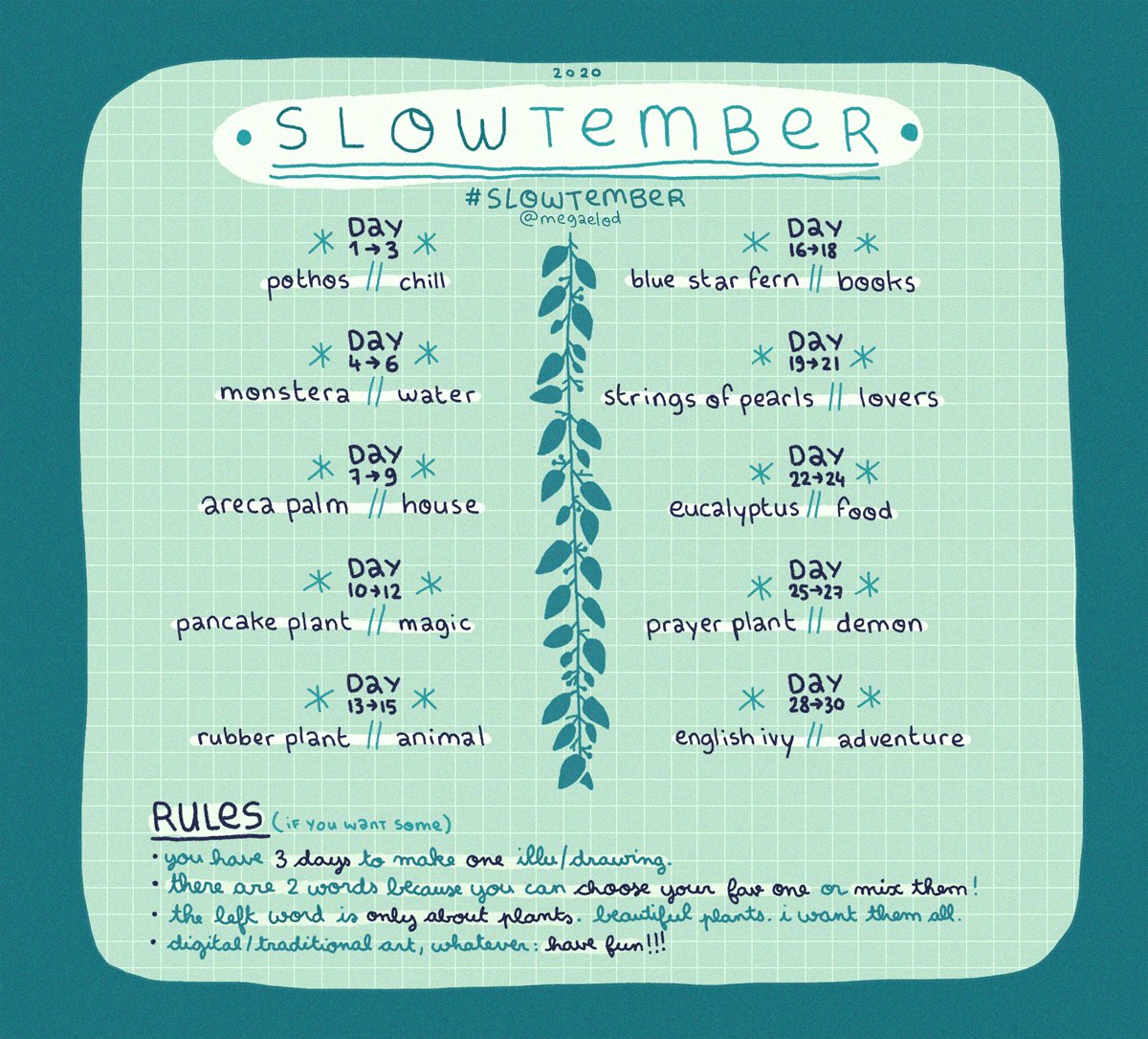
I also discovered this Slowtember challenge on twitter from @megaelod:
I am tempted to use this for this month. I’ll see what happens!
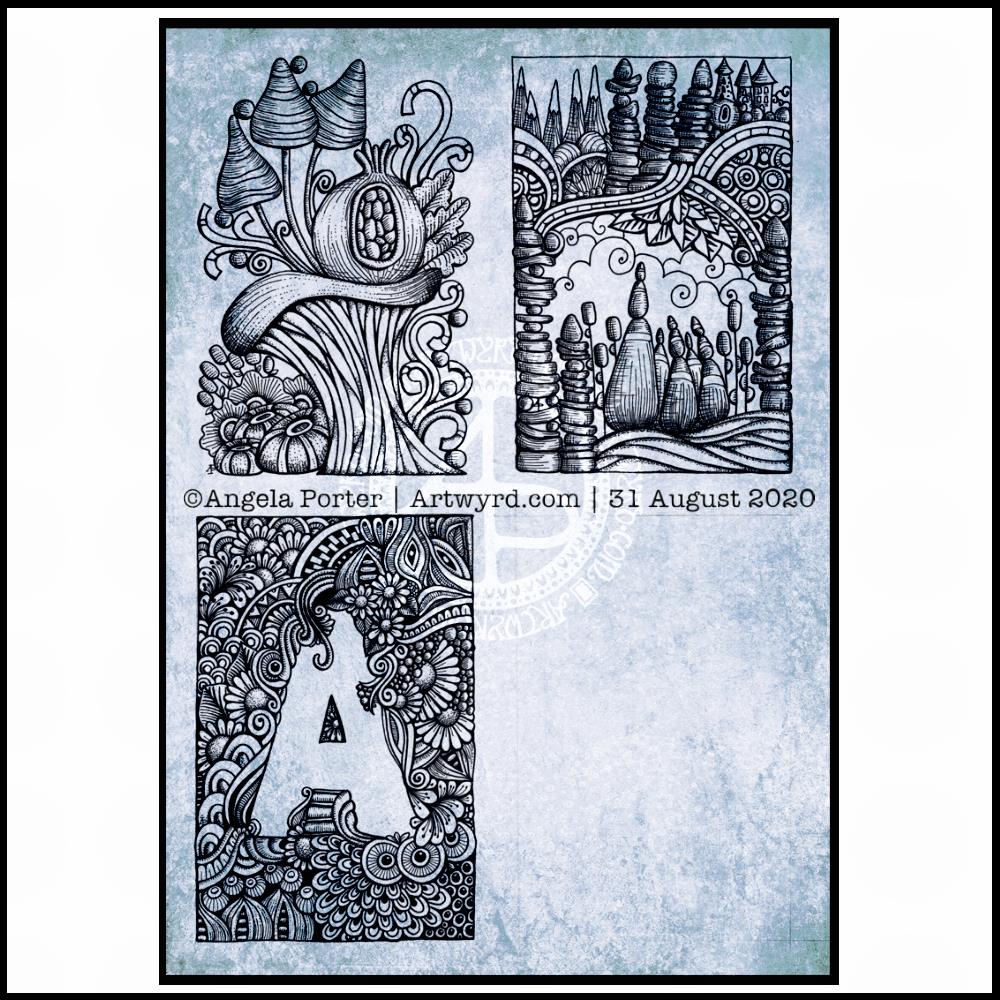
Wednesday is WIP day! WIP is work in progress, and this is one of my current one.
I’m working on A4 (29.7 cm x 21 cm) Claire Fontaine Paint-On mixed media paper with 05 and 01 Uniball Unipin pens.
It’s taken several hours so far, and there’s several yet to go! I’m enjoying creating such detailed drawing in just black and white. Lots of botanical elements, but there’s also arches and spirals and geometric patterns in there too.
I never have much of a plan in mind when I tackle a drawing like this. I know what patterns I like, and if I lack inspiration I can always refer to my visual dictionary or design motifs and patterns. It’s all about intuition. It’s not entirely mindless. I do make conscious decisions about what design element to use, how to use line and pattern to add volume and contrast.
I sometimes wonder, when I see my work like this, why I try to work with colour. I always feel I struggle with colour, but black and white, with or without grey, always seems to work so well for me.
I love to play with the illusion of volume in a drawing, and whether that is done with density and shape of line/pattern, or with colour (even though I really do feel I struggle with colour).
I will persevere with this illustration, drawing, artwork over the coming days. In fact, I may spend time on it today. I’ve completed my morning errands, so I can remain at home, which is where I need to be. I’m tired today; I didn’t sleep at all well last night, or for the past few nights and my mood and ability to concentrate is suffering as a result.
I finished the top right design, and have completed the ‘A’ illustration on the bottom left. That leaves one space to be filled, no doubt later today.
I’ve used either Faber-Castell Pitt Artist pens or Uniball Unipin pens to complete the drawings on ClaireFontaine’s Paint-On mixed media paper. This paper is fairly weighty (250g/m²) and has a lovely velvety feel to it.
The only pencil lines I’ve used have been to delineate the ‘boxes’ to draw in, and for a couple of the design elements in the top left image as well as the A.
Reflecting on the designs
The white space in the top left design works really well I think, and is quite an accomplishment for me. The same is true, to a lesser extent for the top right design. In both cases, the white space brings attention to the design.
In contrast, the densely pattered area helps to bring out the monogram A, making the white space the focus of the design.
I think I’m going to work on some more monograms in this style. They are fun to do, and dense, entangled patterns are one of my signature artistic voices. It’s been a long time since I’ve completed art like this, with a lot of detail to bring out dimension/volume in the design.
In fact, I’ve enjoyed using line and stipple to add volume in all the designs, exploring how I like to do this as I go. All the work I do with colouring books means I have put this to one side. It’s interesting how I’ve circled back to this style. It’s even more interesting to look at how my drawing skills have developed and evolved over time as well.
I found some peace, contentment and joy while drawing these, and feel a sense of accomplishment, particularly with the two on the left.
Do I prefer digital or traditonal drawing?
A difficult question to answer. I think it depends on what I’m creating.
I really do enjoy using pen on paper. I get a better sense of the overall design. Paper and pen is very portable too – whether I’m sketching when out and about, or drawing in different places at home.
Drawing on the screen of my Surface Studio with a pen is a lot like drawing on paper. The smoothness of the screen makes it a very different tactile experience. It also is great for inking in sketches. It also makes correcting mistakes or re-working areas a lot easier, and there are techniques I can use that are near impossible or very time consuming when working traditionally.
Sometimes, the lines produced digitally are too perfect. I’m still working on developing the brush styles that will mimic the unevenness of an inked line. I do have to use some element of line-smoothing as I draw; without it the lines are really wobbly, but with it they can be too perfect and I lose, to a degree, that personal and unique way that my pen moves on paper.
I also find it difficult to have a sense of proportion or detail when working digitally, even though I can look at the design at the same size as it will be printed. The ability to zoom in and work on a small area means I lose all sense of relative size and complexity/detail of a design. So, if I’m going to work on a drawing digitally, I prefer to start with a sketch to give me that sense of scale.
I rarely sketch out my design when I work on paper, except if I need the outlines of a design element as I’m drawing. I do tend to work very intuitively.
So the answer is, I prefer each for different purposes, and also to suit my different moods and purposes.
Of course, once I’ve drawn a design, I then have to decide if I want to add colour, and then what media I will use – traditional or digital!
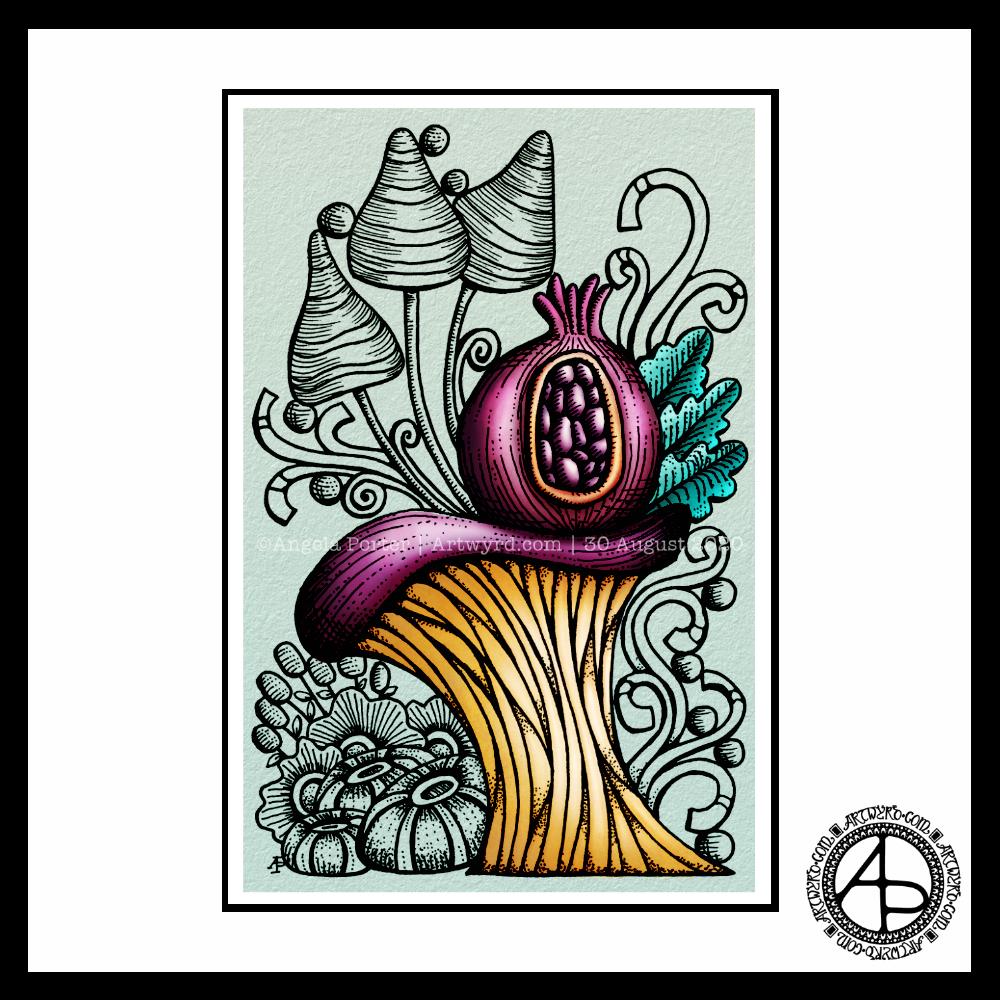
Today, I thought I’d digitally colour one of my recent drawings. I thought it would be nice to compare and contrast digital colouring with traditional colouring.
It’s been a while since I did much art digitally, I’ve been lost in traditional media this week as I slowly heal from some emotional wounds. Art helps with healing. Meditation helps too. But time is still needed for the healing to take place, and for rest to relieve the exhaustion that lingers still.
Any kind of art, digital or traditional, soothes my mind, emotions and body.
What I like about digital art is the way I can get such high contrast in colours to enhance the sense of volume the design elements have. I also like the vibrancy of colours. I also like the ability to add texture to the colour in so many different ways.
Of course, I like the ability to alter colours when they don’t work, without having to start over. I’m not sure if those leaves are going to stay that particular green-ish colour. Nor am I sure about the background colour.
As is my wont, I’ve used Autodesk Sketchbook Pro to add the colour and textures. My hardware is a Microsoft Surface Studio and Surface Slim Pen.
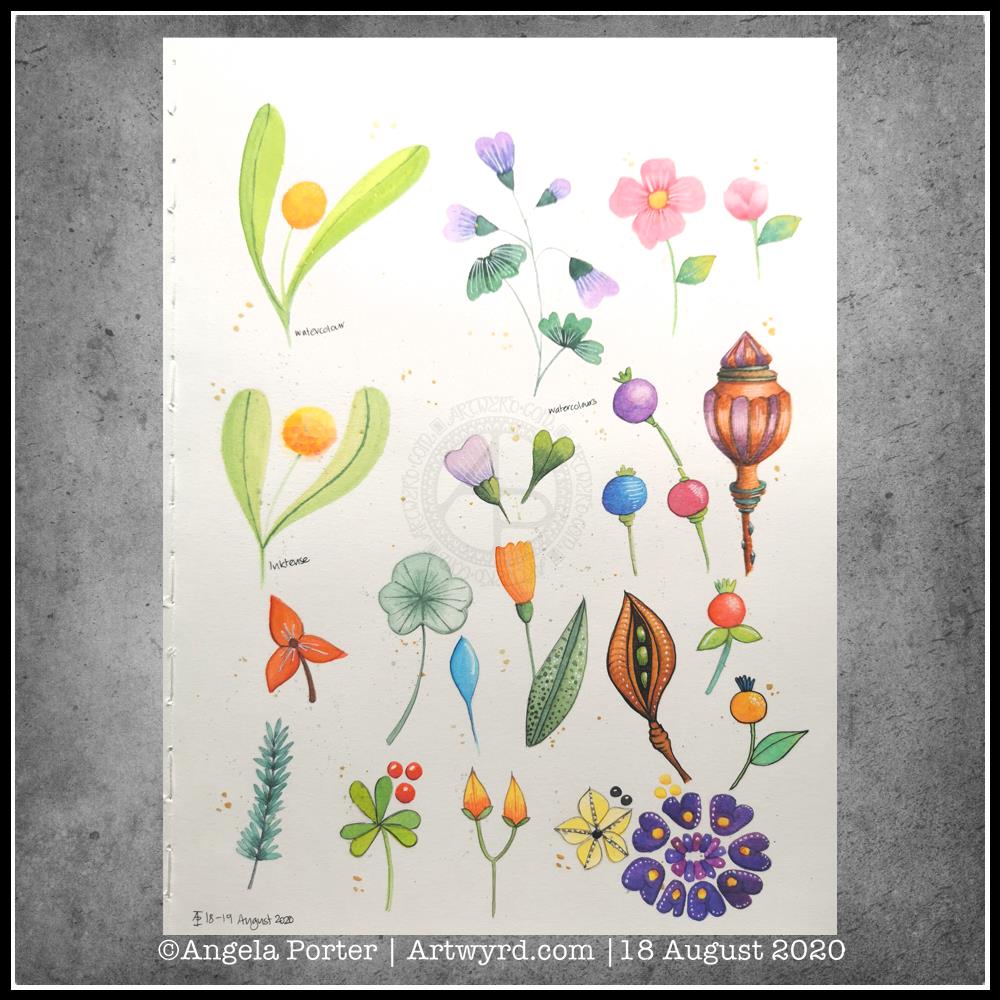
More art therapy was required yesterday and today. This time I messed around with watercolours and botanical motifs.
Some I like, some are hideous, but all resulted in me finding some calm amidst a maelstrom of emotional and mental pressures being exerted against me.
Although I’ve not yet tried to express my emotions via colour and pattern today, working with motifs from nature is soothing in it’s own way.
Perhaps there’s more of me expressing my needs in creating botanical art. I do feel the need to be out walking where there is nature. With Covid19 still doing the rounds, my places of choice are cemeteries; so few people visit them and I feel safe there in a way I don’t feel safe in nature when I’m by myself.
So, as it’s fairly overcast and there’s a good breeze, I’ll head out as soon as I’ve completed my social media stuff for the day.
Materials and method
I used mostly watercolours, but I did try out the Inktense paint palette I received yesterday for one motif. For some of the motifs I used a faint pencil outline. On others I darkened that outline once I’d painted the motif. And I tried black outlines using a Signo DX 0.38 pen on some others. I also used white Signo gel pens to add highlights. Finally, I splattered some gold watercolour over the page, and added some bigger dots of gold.
Oh, I worked on one of the smooth textured pages in my A4 Arteza watercolour journal.
This morning I created some tall, thin (or short and wide) backgrounds using Distress Oxides on some Arteza Mixed media paper. The paper is 8.25″ x 2.87″ (21cm x 7.2 cm) in size.
I chose this one to draw on for no other reason that it was the one that appealed to me at this time. I started with the seed pods and foliage at the bottom, and worked my way through some hand lettering / hand-drawn typography to more abstract line-art.
I drew with a M Pitt Artist Pen from Faber-Castell, though I added the stippling with an XS Pitt Artist pen.
No glitter or glitz on this one, nor any highlights. Not yet. I’m not in the mood for any, not today.
I have been really enjoying drawing tiny botanicals in little ‘windows’. So, I combined drawing with watercolor practice.
The image on the left involved me using a pencil to draw the boxes and their contents, then watercoloring. For some, I tried painting the image in sections and with layers of colour. I really wasn’t happy with the results. I painted the rest of the boxes with washes of watercolour and then either inked or re-drew the designs in pencil. I felt happier with these.
I used Daler-Rowney Smooth watercolour paper and I’ve been struggling to get the paper to stay wet enough for long enough to mix colours wet in wet. Not even on these tiny little windows. It was becoming very frustrating.
A couple of days ago, I’d ordered a pack of 100% cotton rag paper and it arrived early evening. I used a small piece of it for the illustration on the right.
I started by painting rectangles of colour on the paper. I used a waterbrush rather than a paintbrush for this. I used the same kind of transparency of watercolour for each as I did for the illustration on the left. Oh my gosh, did the colours shine and show up so much more vibrantly! Not only that, it was so easy to mix colours, wet in wet. The cotton rag paper is an absolute joy to work with!
I was beginning to get frustrated with myself and watercolors once again. This has been a common feature of my love-hate affair with them over many years. This paper may change that totally.
This morning, after letting the paper dry, I drew tiny botanicals in each window. I used, as in the image on the left, a 005 Sakura Pigma Micron pen to draw with. I was worried it would struggle with the paper’s rough texture. The lines aren’t as uniform as they’d be on, say, smooth Bristol board. I just went with the rougher nature of the lines and was surprised at how much I enjoyed them. They meant I loosened up my drawing style a little.
I really enjoyed creating these little artworks (the one on the left is approx. 5″ x 5″, the on on the right 4″ x 4.75″). There is something I find really satisfying about creating teeny tiny drawings, in the same way I find drawing intricate designs makes something inside me smile.
What I do want to try later on today is adding some more colour to some of the design elements on both drawings using both watercolours and watercolour pencils or inktense pencils. On second thoughts, I think I’ll do some samples to experiment on, annotate and add to my journal, just in case I don’t like what transpires.
Before I do any of that, I woke with a headache. It’s beginning to shift, but as it lifts it’s leaving me feeling really tired.
Floral designs, an entangled garden was my fancy this morning and this is the result, not fully coloured though.
Coloring is a great way to find some calm and peace during troubled times, such as the times we find ourselves in. Scientific studies have shown it has a similar effect on the brain as meditation.
I have a number of templates available for free in the facebook group, including this one.
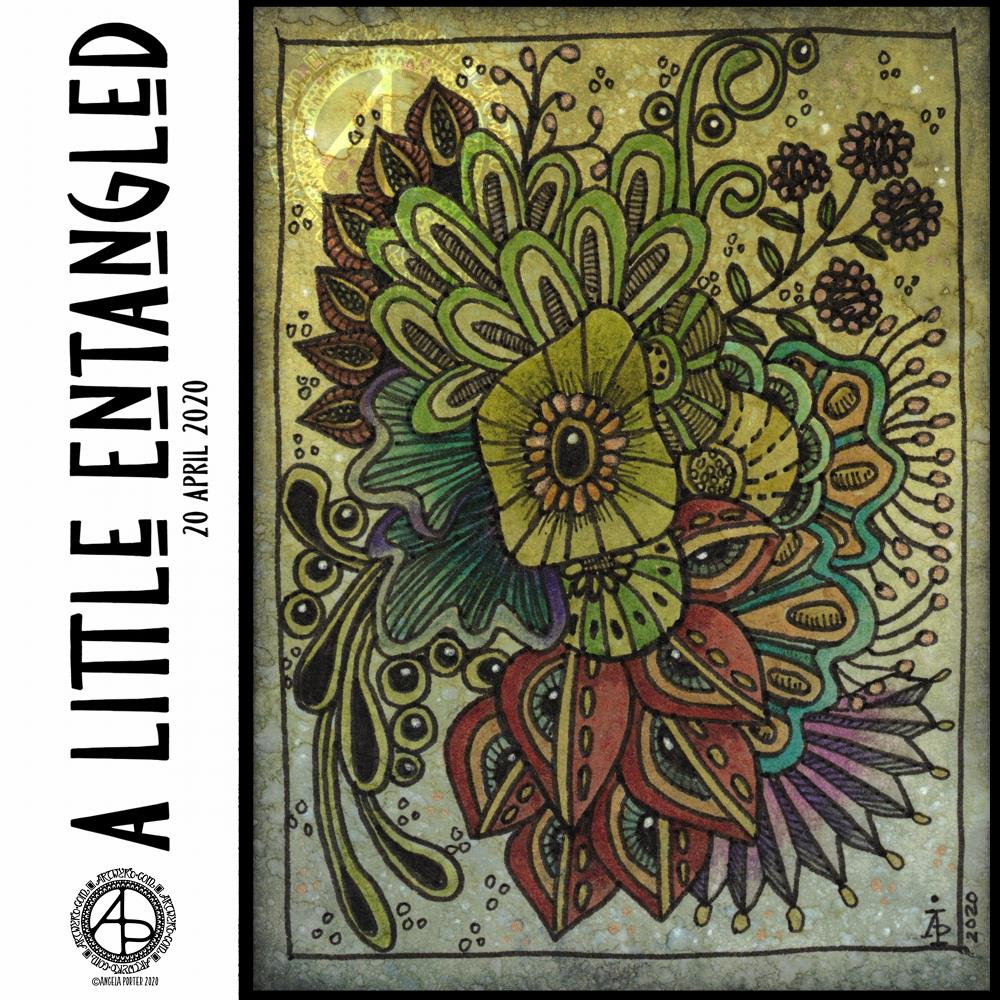
Today’s arty offering is this little bit of entangled art. It measures 4″ x 3″, so is small in size, but big in detail, I think.
Distress Oxide inks were used to colour a 4″ x 3″ piece of Claire Fontaine mixed media paper, with water to add extra texture to it.
I drew the design using 08 and 02 Unipin pens. To bring the design out of the background, I used Faber-Castell Pitt Artist Brush pens. Dots of gold and white finished the embellishment.
My final step was to apply some Distress Microglaze to add a subtle sheen that brings out the colours and layers of texture, not just to the Distress Oxide ink, but to the Pitt Artist Pens too.
I thought I’d try the Pitt Artist pens with this background as it seemed more dull and dusty, and that’s how I find the colours in the Pitt Artist Pens. Initially, I was going to keep it monochrome. However, I liked the nature of the colours in the pens, so experimented with them.
I enjoyed creating this little work of art. Now, it’ll find its way into my sketchbook-journal, with reflective notes for future reference.
Yet again I woke with my mind swimming with an idea I wanted to try out. I’d had a problem when I was trying to add colour to drawings I’d done on distress ink backgrounds. Whether I used water and a brush or a Tombow Blender pen, the pigment from the Sakura Micron and Uniball Unipin pens bled, and I really wasn’t happy with that.
I spent some time yesterday trying different pens out, with no luck in finding any that didn’t smear/bleed. So, I put this to one side until I had a chance to think about it.
I slept on it and woke with an idea to try.
Why not use the Tombow blender to draw the basic shapes of my design in colour and then add black lines afterwards. Seed pods seem to be my default design when I’m experimenting, but I’m fine with that.
So that’s what I did. And this card is the result.
As I was starting to add the black lines to the design I thought I’d made a horrible mistake, had a bad idea. However, as I added more and more detail, I realised it would work out, and I think it did.
I added some gold to the seeds in the seed pod with a glitter gel pen. I also splattered some gold watercolour paint over the design.
The envelope is really simple; three seed pods, black line art with golden seeds.
Not a unique artistic approach, but it is something that has never worked for me before.
It’s not a dissimilar approach I take to my digital art, where I start with the basic shapes and then add shading and detail. I do use line art as a guide for my design, and that is an approach I can apply to traditional art in that I may need to pencil in the design, then colour, then add the line art.
Who would’ve thought it – working digitally is helping me develop my traditional art methods and skills.










 Art is the Adventure