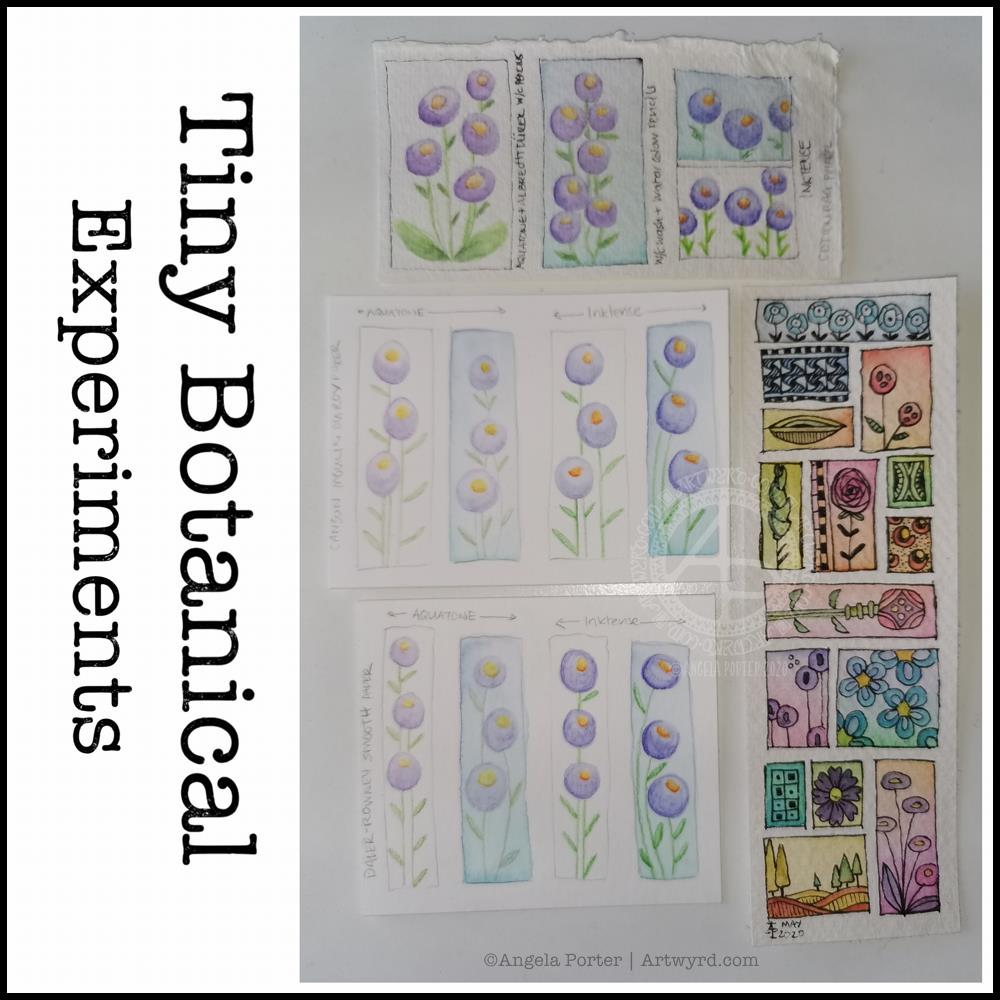
I thought I’d start Sunday morning off with some experiments with my tiny botanical drawings.
I apologise for the photograph quality – I’m really not a good photographer, something I really do need to work at! The pale colours really don’t help at all.
The artwork on the bottom right is one where I applied rectangles of watercolor on 100% cotton rag paper. Then, I used Sakura Pigma Micron pens to draw designs in the windows. Finally, I added some watercolours to the designs to help bring them forward from the background.
I don’t think I messed the drawings up at all, which was my worry. Mind you, I do have to be careful what colours I do add so I don’t make weird colours.
That led to me wanting to try watercolour pencils and Inktense pencils on different watercolour papers: top – 100% cotton rag paper middle – Canson Moulin du Roy paper bottom – Daler-Rowney Smooth watercolour paper.
On each paper, I drew four rectangles, two of which I coloured with a wash of watercolour.
I used the same colours of Derwent Aquatone and Inktense pencils to draw the stylised/abstract floral design and a waterbrush to activate the pigment. I did my best to apply the same amount of pencil in each case. However, I noticed that the papers grabbed different amounts of pencil even though I was using the same kind of pressure.
The amount of pigment grabbed, however, wasn’t at all indicative of how vibrant the colours would be.
The 100% cotton rag paper seemed to have the smallest amount of pigment from the pencils, yet it gave the most intense colours of them all. This paper is quite ‘hard’ in feel and very textured and I was surprised it didn’t seem to take as much pigment. Appearances are deceiving it seems. This paper also allowed me the longest ‘wet’ time to move the coloured pencil pigment around, and to lift some of it where it had got too intense.
The Moulin du Roy paper was a softer texture and it was lovely to colour with the pencils on it. The resultant drawings have a soft quality to them too that I rather like.
The Daler-Rowney seemed to grab the most pigment, yet the colours are not as vibrant, except the for the Inktense on the watercolour background. I think that’s because the watercolour background was still very slightly damp and Inktense pigment activates with the tiniest amount of water. I also think that’s why this one was the hardest to blend the colour smoothly. This was the paper that was the hardest to add the watercolour background to as it dries so darned quickly, or water just puddles on the surface with a tiny bit more water.
The cotton rag paper is, again, my favourite for working with watercolour and Inktense pencils. The vibrancy of the noticeable too – much less pigment is needed to get a rich colour on this paper.
For the other two papers, I did enjoy drawing the flowers on the plain paper and activating the pigment with a waterbrush. I partiuclarly like the Moulin du Roy paper for this technique, though the Daler-Rowney gave a pleasing result on the plain paper.
I have been really enjoying drawing tiny botanicals in little ‘windows’. So, I combined drawing with watercolor practice.
The image on the left involved me using a pencil to draw the boxes and their contents, then watercoloring. For some, I tried painting the image in sections and with layers of colour. I really wasn’t happy with the results. I painted the rest of the boxes with washes of watercolour and then either inked or re-drew the designs in pencil. I felt happier with these.
I used Daler-Rowney Smooth watercolour paper and I’ve been struggling to get the paper to stay wet enough for long enough to mix colours wet in wet. Not even on these tiny little windows. It was becoming very frustrating.
A couple of days ago, I’d ordered a pack of 100% cotton rag paper and it arrived early evening. I used a small piece of it for the illustration on the right.
I started by painting rectangles of colour on the paper. I used a waterbrush rather than a paintbrush for this. I used the same kind of transparency of watercolour for each as I did for the illustration on the left. Oh my gosh, did the colours shine and show up so much more vibrantly! Not only that, it was so easy to mix colours, wet in wet. The cotton rag paper is an absolute joy to work with!
I was beginning to get frustrated with myself and watercolors once again. This has been a common feature of my love-hate affair with them over many years. This paper may change that totally.
This morning, after letting the paper dry, I drew tiny botanicals in each window. I used, as in the image on the left, a 005 Sakura Pigma Micron pen to draw with. I was worried it would struggle with the paper’s rough texture. The lines aren’t as uniform as they’d be on, say, smooth Bristol board. I just went with the rougher nature of the lines and was surprised at how much I enjoyed them. They meant I loosened up my drawing style a little.
I really enjoyed creating these little artworks (the one on the left is approx. 5″ x 5″, the on on the right 4″ x 4.75″). There is something I find really satisfying about creating teeny tiny drawings, in the same way I find drawing intricate designs makes something inside me smile.
What I do want to try later on today is adding some more colour to some of the design elements on both drawings using both watercolours and watercolour pencils or inktense pencils. On second thoughts, I think I’ll do some samples to experiment on, annotate and add to my journal, just in case I don’t like what transpires.
Before I do any of that, I woke with a headache. It’s beginning to shift, but as it lifts it’s leaving me feeling really tired.
Last night, I carried on with the Domestika Course – Modern Watercolor Techniques by Ana Victoria Calderon. The last sections are all about painting ‘galaxy’ style backgrounds. Scientific pedantry here – they’re not really ‘galaxies’, more nebulae. Just had to say that and get it off my chest.
I painted along with her, and the first background I created was really not at all good, perhaps. I used White Knights watercolours, Cosmic Shimmer metallic gold watercolour and salt. Way too much salt and probably way too much water, and trying to work how someone else does. Still, you learn by doing, even if it doesn’t work out as you’d want it to.
I let the paper dry, did my best to remove the salt and then decided to use a 0.1 Sakura Pigma Micron pen to draw on the background.
I allowed the shape and flow of patterns in the colour to inform me as to how I could draw shapes and patterns, and the end result is today’s image!
As disappointing as my first attempt at a ‘galaxy’ background was, I actually rather like the end product that includes drawing, a typically ‘Angela’ entangled design.
What I am also kind of pleased with, is that I chose to leave some areas of colour without any drawing on them. That is something unusual for me to do.
I started with the floral motifs and let the rest of the design flow from there. As it flowed, the patterns became more and more of an abstract nature.
What you can’t see in the scan, are the subtle areas of gold shimmer that resulted from the spreading of the Cosmic Shimmer metallic watercolour paint. It gives a very subtle sheen in some areas.
While the first background was drying, I had a go at creating another, using what I’d learned from creating the first. Instead of the White Knights, I used Kuretake Gansai Tambi watercolours and I had a bit more success. I’m not entirely happy with the overall balance of the colour areas, but when I’ve decided what to do with it, I’ll share it.
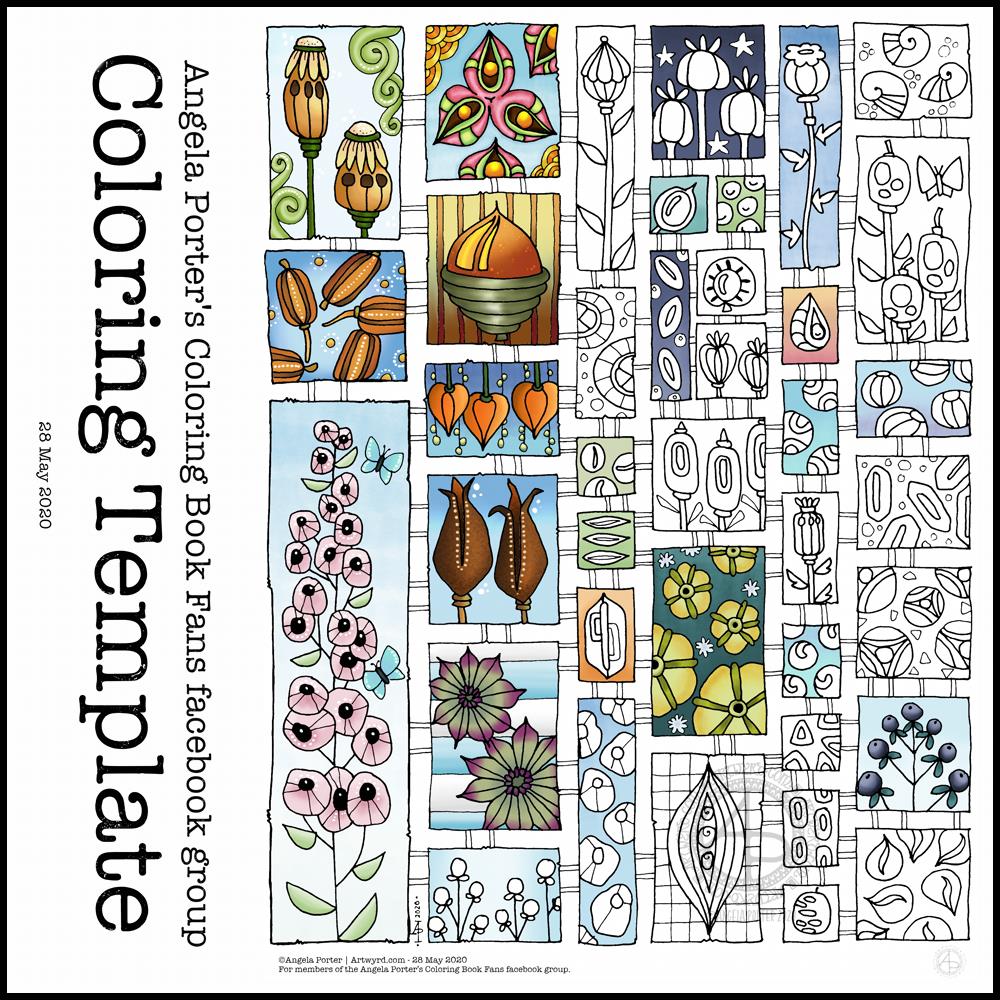
Another week in lock-down has passed us by here in the UK, as well as many places around the world. That means it’s time for another weekly coloring template.
This week, the inspiration for this template has come from the pages full of capsules, pods and seeds in my sketchbook. Lots of opportunity to experiment with colour, but also adding little details to each tiny picture.
Drawn using Sakura Pigma micron pens (05 and 01) on ClaireFontaine dot grid paper. Clean up of drawing, colouring and typography done digitally using Autodesk Sketchbook Pro along with a Microsoft Surface Studio and Microsoft Surface Slim Pen.
I had a very fitful night’s sleep (or non-sleep) last night. So, around 5:30am I decided to get up and ‘art’.
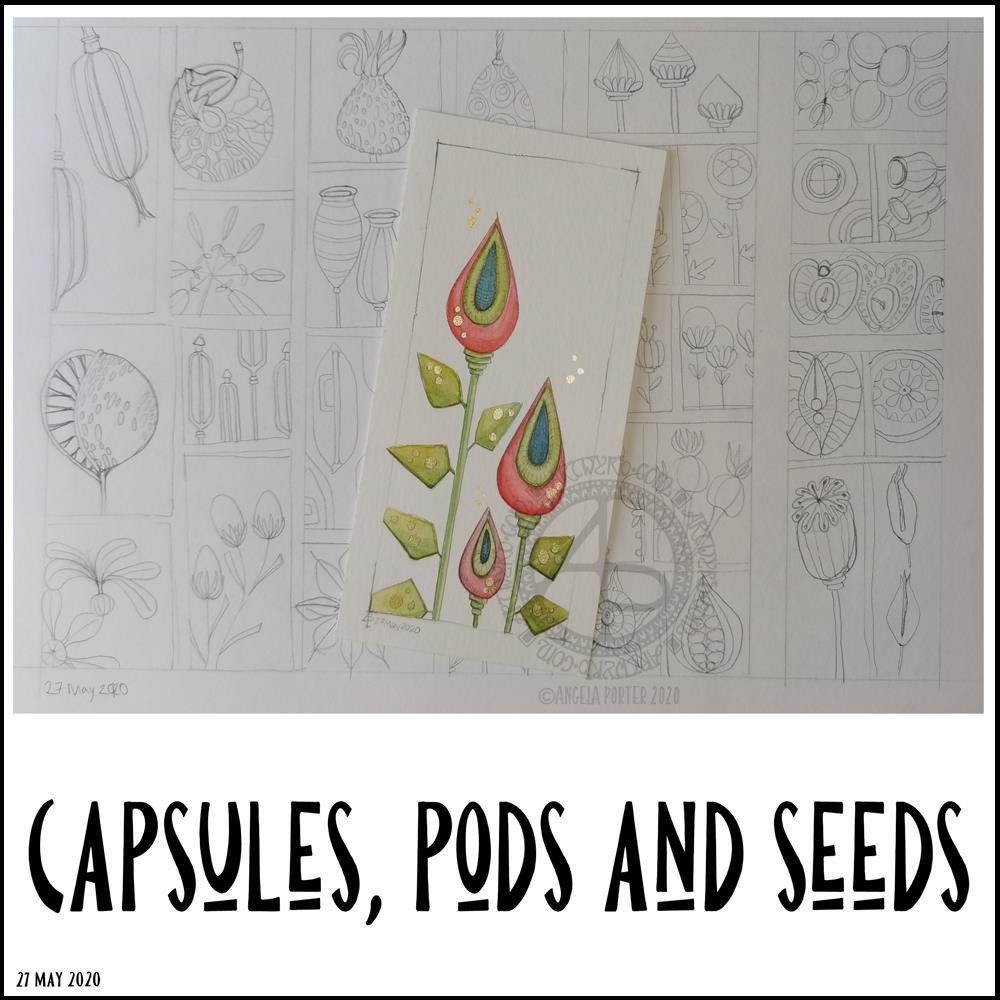
I finished off the watercolour of some seed capsules.
I’m really, really happy with this watercolour illustration, with an unusual color palette for me. I smile when I look at it! I decided to use a 0.5mm HB pencil to add heavier lines to the more shadowed parts, as well as a little bit of subtle line to help give the pods some volume. It’s difficult to see on the image.
I am so happy I drew a ‘window’ on the paper to draw within. I’m never happy drawing without a frame to keep within and the edge of the paper just never feels right for me. I also like the way that it feels like you’re looking through a window and that it’s OK to cut things off (apart from one cheeky leaf that I just had to have overlying the frame!).
There may be a bit too much white space above the seed capsules, I don’t know for sure. It’s so unusual for me to leave space around the various elements in a design that it feels a bit weird. However, I do like the space in this illustration.
Once I finished the watercolour, I turned my attention to drawing more capsules, pods and seeds in my A4 sketchbook. I completed two pages of small drawings, one of which you can see in the background.
Unusually for me, I drew in pencil. I’d usually use pen straight away. I have no idea what that is about, but it was a pleasant and soothing experience for me. I now have plenty of sketches I can use to create more watercolour paintings from, small ones as I really enjoy working on a small scale. Creating my own little treasures, complete with some precious, metallic details.
Painting little treasures will have to wait though. My eyelids are becoming leaden with a need to sleep. This frustrates me as I had things I wanted to get done today, things that need focus and concentration. So, I’ll soon be back in the land of nod.
Yesterday turned out to be a funny old day. Funny as in not what I’d planned.
I got most of my recent experiments into watercolour added to the journal I’m making/working on, with brief notes. That journal is now getting a partly open ‘crocodile mouth’ look, which is fine by me. Before adding the experiments to the journal, I needed to colour some pages with Distress Ink.
As I was adding the little pieces of art to the journal, I realised that the background colours tied in rather nicely with the artwork placed on them – all completely by chance.
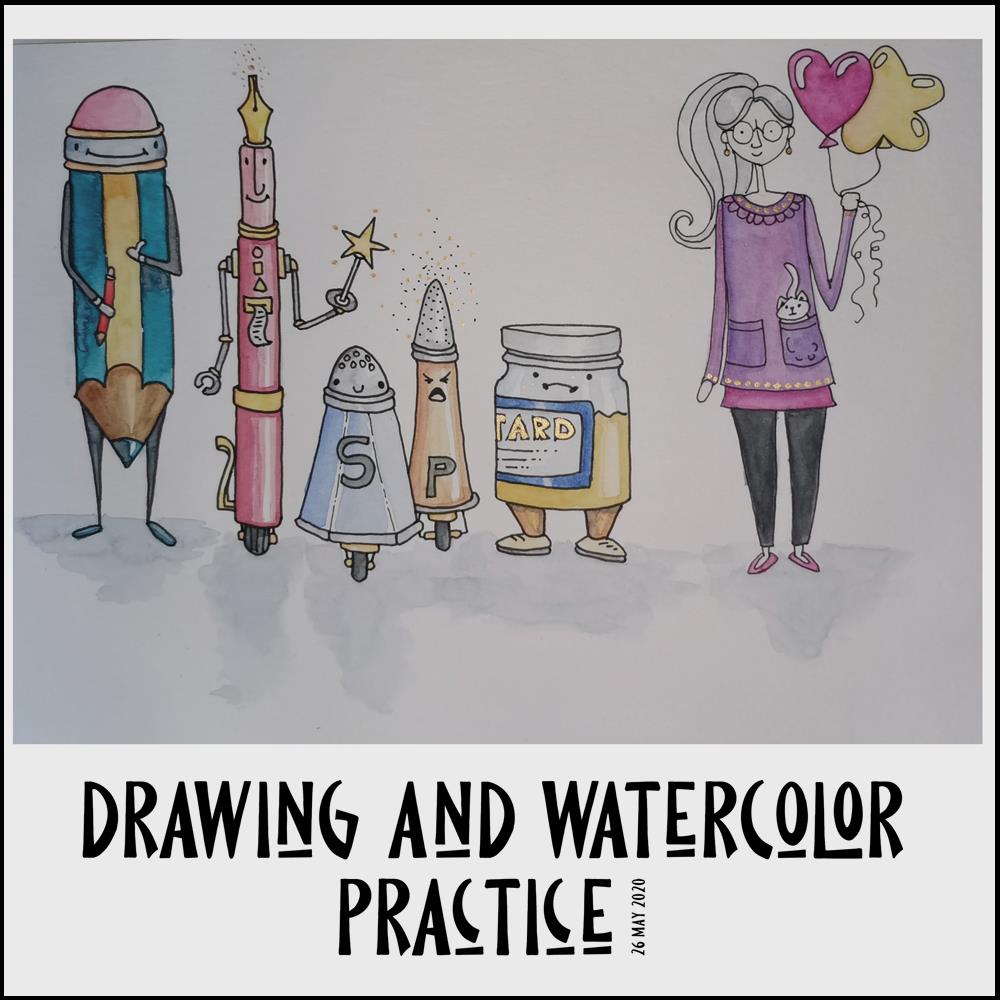
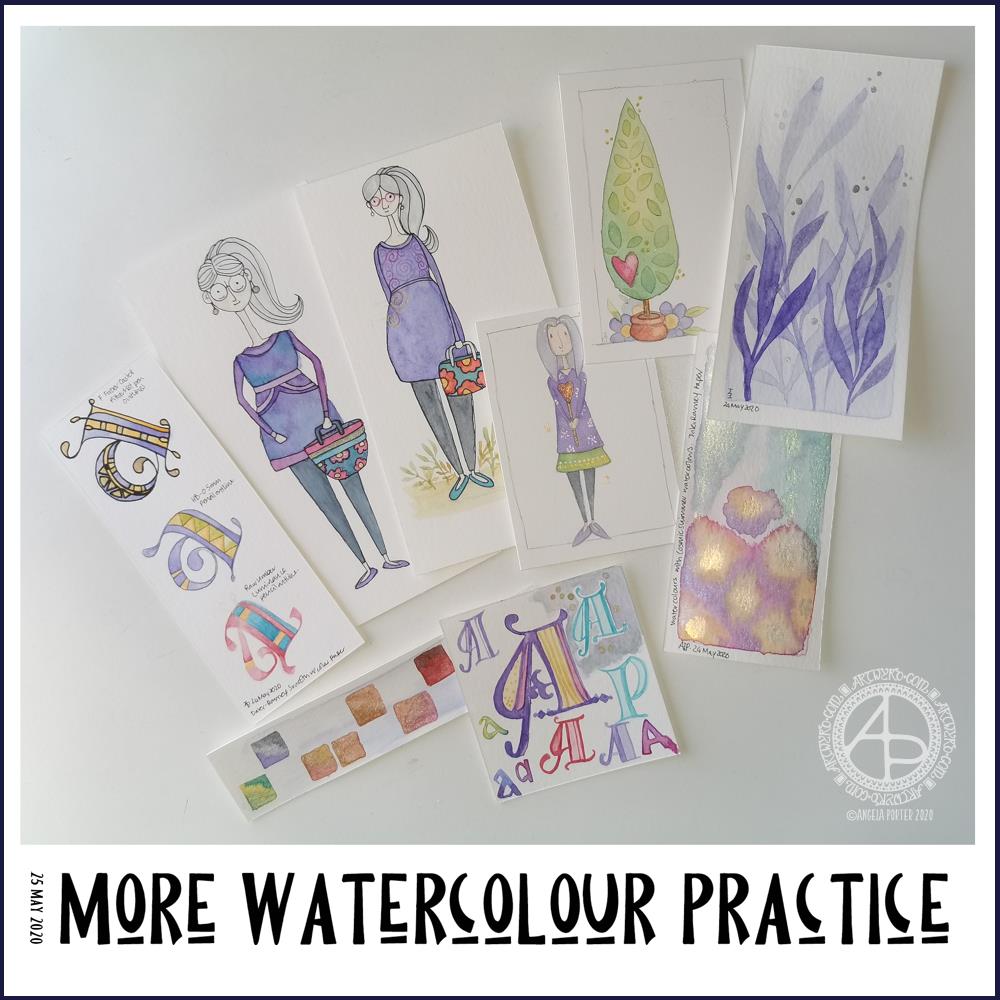
After that, I had some tasks around the house to do, and had phone calls that disrupted my flow of work somewhat. In the evening, though, I decided to continue with the Mattias Adophsson Domestika course, and the drawing/painting above was the result.
I’d already done some sketches of the anthropomorphic items in my sketchbook, and I re-drew the character drawing of myself, again. I made myself too thin by far! Ho hum. More practice is required for sure.
Anyways, after drawing the characters, I used flat, controlled watercolour washes followed by glazes to colour them in. This I felt more confident with – and more controlled about.
I can see how the kitty needs some shading, both on it’s body and on my top. I also need to add a line to the hand holding the balloons to make it more like a closed hand.
I’ll be following Mattias’ course, well parts of it. People and characters aren’t quite my thing. I don’t have the imagination it seems, or maybe I just don’t have the need to draw them. However, it’s nice to explore other ways of artistic expression. Those explorations are never wasted as it may just be that I find out that a particular style isn’t for me, no matter how much I admire it! Also, there’s always new things to learn that can be incorporated into my own art going forward.
Over the past couple of days I’ve been playing around with watercolours. Apart from fun, it’s trying to work out how I can get them to work for me, and here you can see some of my experiments.
As well as continuing with the Domestika course, I found a book on my Kindle called “The Art of Creating Watercolor : Inspiration & Techniques for Imaginative Drawing and Painting” by Danielle Donaldson.
I’d forgotten I’d bought this, but on rediscovering it and looking at it I found it inspired me, particularly when it comes to drawing people.
What was reassuring, is that Danielle Donaldson is someone else who likes to work on a small scale! She also uses a very fin (0.3mm) pencil to draw with, but also to add line and pattern to her drawings instead of pen. I wanted to try that out.
I also really like the whimsical nature of her art, and her people inspired me to have a go. The three people in the collection of images above are inspired by her work, one more than the others. The one that is most directly like Danielle’s work is the person to the right of the trio. I used a pencil to draw the design as well as outline it after it was painted.
With the other two, I used a very fine Pitt Artist pen to outline them once the paint was dry.
Looking at them all together, I quite like the softer quality of the pencil line.
Oh, these trio are also my way of developing a version of myself. Unfortunately I look pregnant in the middle one (I’m not!), though I rather like my hair in this one – I wish my own hair was as thick and long! I really need to work on feet and foot positions.
Watercolours have vexed me, and continue to do so though I will persevere with them. Drawing people has vexed me for longer!
I’m not entirely sure that watercolour will be the best medium for me to use…I’ll try others, including digital, to see what I can get to work for me and is in my style.
I also spent sometime experimenting with monograms and botanical themes. I really like the blue foliage, and the cute tree too.
Yesterday my art and other stuff was put on hold for much of the day; I woke with a migraine and couldn’t do much until painkillers had kicked in and I could sleep away the remnants of it. Once I woke, that’s when I found the book and did some art inspired by it.
I slept quite well last night, and woke just fine and dandy today.
All these bits of art will find my way into the journal I’m making, including notes and reflections on them.
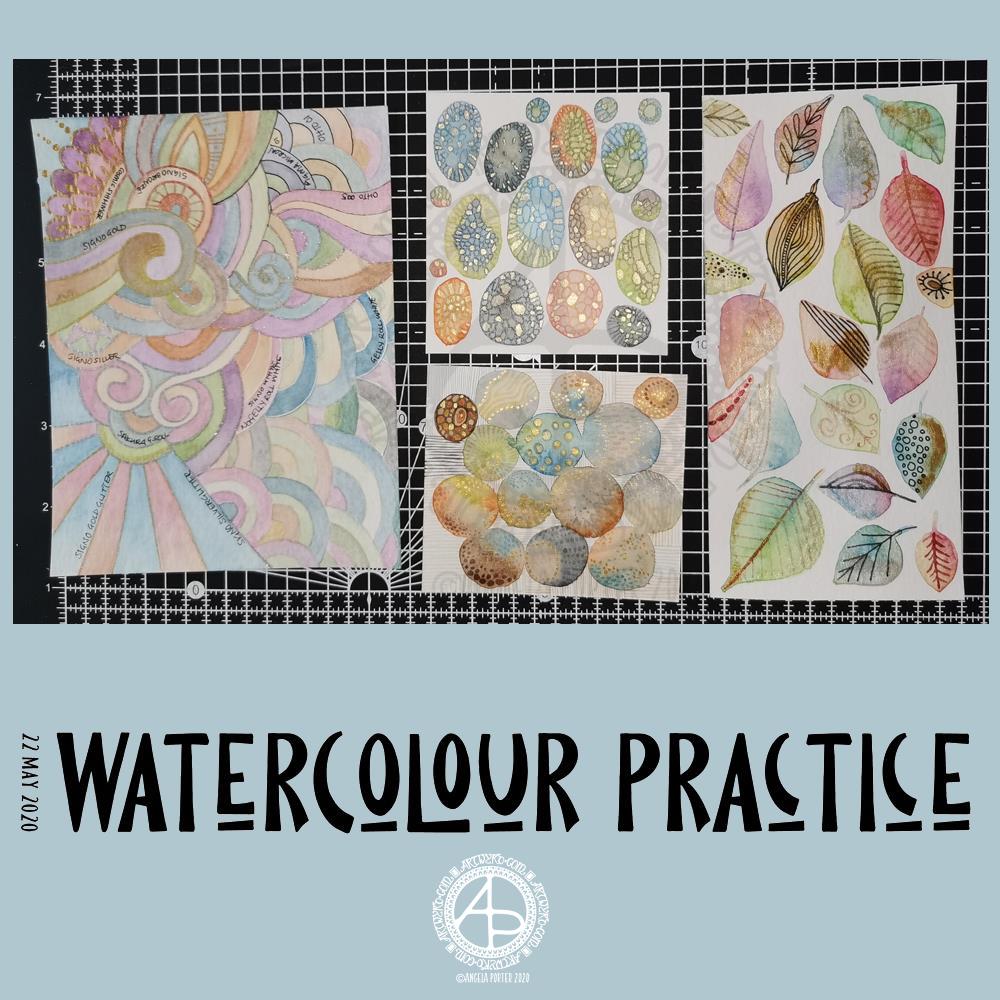
Yesterday was another day where I got lost in watercolour practice – unintentionally! I had planned to do some editing of drawings for ‘Entangled Gardens’. However, time ran away with me.
Panel 1
The first panel I completed was the one with leaves on. They do have plenty of gold metallic/iridescent watercolour paint along with traditional paint, though it doesn’t show up in the photo.
I tried different ways of adding details to the leaves – Faber-Castell Pitt Artist Pen (F) and metallic watercolour and brush. I find the black pen either too black or I used too thick a point. The metallics in a red-copper, gold and grey-black were more sympathetic to the colours of the leaves, in my opinion.
Panel 2
The next panel I created is the one at middle bottom. I made circles of watercolour and let them touch while wet so there was some flow of colour from one to another. After they’d dried I used a fine brush and both watercolours and metallic watercolours to add line and pattern to it.
I enjoyed making this one very much. I used some quite earthy colours that are unusual for me. The line and pattern added a lot of interest, though I did wonder if I’d covered up too much of the underlying watercolours.
Looking at this with fresh eyes today, I think it shows through just fine. I want to try using metallic paints that are complementary to the main colours in the watercolour to see how that works out.
Panel 3
This is the one at the middle top. I created ovals of watercolour, again using unusually muted, earthy tones.
Once they’d dried I used some Caran D’Ache Luminance coloured pencils, well sharpened, to add patterns to each oval. I used the variation in colour/tone to help me add the patterns, as well as to choose the colours of pencils I used on each oval.
Finally, I used a yellow-green metallic/iridescent watercolour paint to fill in some of the patterned areas.
I enjoyed making this panel too. Again, I thought when I finished it that the pencil lines were a bit thick. However, after a night’s sleep and with fresh eyes I can see that it’s worked out well. I think that using coloured fineliner pens may work out better than coloured pencils – something I’ll try another time.
Panel 4
The last panel I created yesterday was the fourth panel. I used a different kind of watercolour paper, by Tim Holtz. The paint just dried so quickly on it I couldn’t really drop colours in, though the paints would re-wet and I could blend colours that way. I didn’t really enjoy using this paper.
Anyway, I thought I’d make a typically ‘Angela’ entangled style painting. I did use a raw umber Caran D’Ache Luminance pencil to draw the design on the paper. This was such a pale colour it disappeared into the watercolour sections. Again, I used uncharacteristically earthy, muted colours.
The final panel was nice enough, however, it was lacking in pattern and interest. So, I decided to use it to experiment with different ways of adding outlines and pattern to the various sections. I also noted on the panel what method I’d used next to each one.
The metallic paints and pens worked nicely and were practically or totally opaque. I prefer using a pen rather than a brush, though I’d not be averse to adding line and pattern using a fine brush and watercolour.
The gold and silver Uniball Signo glitter pens worked really nicely, and because the glitter is suspended in a transparent ink, there’s interesting effect where the watercolour shows through. I actually really like this a lot.
I couldn’t find a gold Sakura Gelly Roll pen, so I used a silver one instead. This, surprisingly, wasn’t as shiny as the Signo silver pen, but it worked just as well in terms of opacity.
I tried two white gel pens – a Uniball Signo and Sakura Gelly Roll. Both seemed to be fairly opaque, the Sakura being very slightly more so.
Finally, I dug out some really fine black pens – 005 and 01 OHTO Graphic Liners and a 01 Sakura Pigma Micron. These worked much nicer than the thicker pen I’d used on the leaf panel.
Of course, I left some areas of the panel without any lines added for comparison.
Of all the pens I tried, I like the metallic and glitter gel pens the best for this.
On reflection…
I’ve found I really like to work on a smaller scale. I feel like I’m creating small ‘treasures’ full of interest and fascination. I’m happier working smaller and more detailed than I am working on a larger scale.
I want to try coloured fineliner pens to draw patterns on watercolours.
Another experiment will be for me to use metallic and plain acrylic and other inks to draw with. I do have a glass pen that will work nicely with indian ink and writing ink. I’ll have to dig some dip-nib pens out to try with the metallic acrylic paints as well as a brush. I think that ball tools could be used to dot spots of ink onto the work rather than a brush; something else to try.
I also need to find a way of leaving a border on the page! When I draw a colouring template or other piece of lineart, I start by drawing a pencil line to demarcate the area I want to draw in, leaving a border around the line. I need to do the same for watercolour panels, either using a pencil or masking or washi tape.
Something else I’ve worked out is that I tend to use too much water when I paint, and I need to experiment with using less and trying dropping colours in when the area is at different levels of dryness.
Lots of things to try and consider.
Doodling? Really?
I see a lot of people calling the addition of line, texture and pattern as part of an artwork ‘doodling’. I don’t like doodling being used in that way.
Here are the definitions for ‘doodle’ from Dictionary.com
verb (used with or without object), doo·dled, doo·dling. *to draw or scribble idly: He doodled during the whole lecture. *to waste (time) in aimless or foolish activity. noun *a design, figure, or the like, made by idle scribbling.
When I add line or pattern to my drawing, it’s not an idle or unconscious activity. I deliberately choose what patterns and textures I want to use and where to place them. The process of adding the lines, patterns and textures may be a more mindful process if the pattern is familiar to me.
The lines, textures and patterns are used to add interest to elements of the overall design. But they are not meaningless, as implied in the words scribble and doodle, and they are anything but idle or mindless scribbles. There is purpose in them, and this is why the use of the word ‘doodle’ irks me!
What am I going to do with the panels?
The leafy panel I created to add to a tag to put in my journal. The other panels will also live in my journal, even the one with annotations, possibly with a pocket behind it for my notes and reflections!
Another lock-down week has passed us by, so it’s time for another coloring template for members of the Angela Porter’s Coloring Book Fans facebook group. Here’s my partly coloured version. I’ve gone for rather soft yet glowing colours for this one.
As always, if you’d like to print and colour it, then pop over to the facebook group and join up. It’s free, it’s a lovely community of people who love my artwork and share their amazing colorations with each other. You’d be made most welcome.
I used one of the dragonfly designs from yesterday’s posting as the focal point for this design. Mandalas are something I love, so to place one behind the dragonfly felt the natural thing to do. I’ve used my signature style of entangled art to fill the space around the mandala.
This is digital art, drawn and coloured using Autodesk Sketchbook Pro, along with Microsoft’s Surface Studio and Surface Slim Pen.
One of my ideas is to create a digital library of designs of things that interest me and that may be useful in my journal making, card making, or just other kinds of art.
For some reason, I decided on dragonflies. So, I sketched out some ideas and then inked the drawings in digitally. I also added details and patterns ot the designs that weren’t present in the sketches. The dragonflies are in my signature entangled style for sure.
I still have a few sketches to work on, and some alternatives of the wing shapes and body designs. I also want to do them as silhouettes. I like silhouettes on coloured backgrounds, like the one I’ve used today.
I used Autodesk Sketchbook Pro to ink in the designs. I also used it to add the background, shadows and typography.
The background is one of my own made using Distress Oxide inks and water. I love that I can recolour the image digitally; the original was in shades of pink and purple, but I thought that blues and greens would suit the dragonflies much more.
I’ve left the dragonflies uncoloured, for now, though adding colour will bring the designs to life and add some dimension to them.
I don’t have a colour printer anymore, just a black and white laser printer. I may consider getting a colour printer in the future, however, as I think being able to print my own digital art would be useful, especially for using in journal making. An inkjet printer would be the most useful; it would allow me to print on many different kinds of paper and lightweight card.
I’m also thinking of putting together digital collections of backgrounds and ephemera and/or digi stamps for sale via my Etsy shop. Let me know if you think that’s a good idea by dropping a comment.








 Art is the Adventure