Sketchbook Page

Sketchbook Page © Angela Porter | Artwyrd.com

I’ve been awake since stupid o’clock, which roughly translates to 3:30am BST. While I was trying to get back to sleep I watched a youtube video about making pockets and tuck-ins for an altered book journal.

I thought that could be something good for my sketchbook-journal. I have worried a little about gluing my little artworks into it, but pockets, tuck-ins, see-through envelopes could be a good way to both show the work and store it in a non-permanent way.

So, with my mind now working and sleep eluding me, I decided to have a go at making my own pockets. You can see the result at the top right, with a journalling card popped in one of them for now.

How I made the pockets

I used some ordinary white card, cut it into what I thought would be good sizes to make a set of stacked pockets for the ATC sized cards I’ve been working on.

I then coloured the cards with Distress Oxide Inks. For one of them, I used a brayer to add ink to a gelli plate. Before pulling a print, I spritzed the gelli plate with water that had some white perfect pearls added to it.

For another panel, I used the brayer to add ink directly to the paper. It did that unevenly. So, I used a ball-tool to carve some texture into the black side of a piece of cut and try foam and used that to add colour. That worked really well! Dabbing the foam added a lovely textured layer of colour. A spritz of water activated the dusty, chalky, soft nature of the Distress Oxides.

I enjoyed the look I achieved with the distressed foam that I coloured the remaining pair of paper panels in the same way.

I then tore the top edge of each panel, for added interest, then used a piece of foam and Rich Mahogany Distress Ink to add grunginess to the edges of each panel.

I wanted to add some embellishments to each panel, so I used a copper sparkle Gelli pen to draw patterns on them.

Finally, I used Tombow Mono adhesive to stick the panels together.

When I put the panels on the page in my sketchbook-journal, I thought a panel behind them. So, I coloured a panel of the same card with Distress Oxide inks and the distressed piece of foam and used the same gelly roll pen to add some sparkly patterns. Then, I adhered the back panel and pockets to my sketchbook.

When I tested some ATC cards in the pockets, I realised I need to work out a way for some more ‘give’ in the pockets as they’re too tightly put together to slip more than one ATC card in them. Also, I placed them just low enough down the page so the ATC card doesn’t stick out of the sides of my sketchbook.

I’m not well known for my fore-planning projects like this, though I do try to learn as I go along.

Inchies and Twinchies

My mind was working in weird ways this morning. As I was making the pockets, my mind strayed to inchies and twinchies. I’ve not made any of these for a long, long time. I thought it could be fun to do so and add them to my sketchbook-journal.

I cut two 1″ wide, and one 2″ wide strips of card. I used the distressed foam to apply Distress Oxide inks to them, spritzing with water to add to the distressed look. Then, after drying with a heat tool, I cut them into squares – 1″ x 1″ inches and 2″ x 2″ twinchies.

I decided to use metallic watercolours from Cosmic Shimmer to add a sparkly, shimmery border to each tile. I used rich gold, pale gold or copper on each tile.

Then, I got to draw on the tiles. Teeny, tiny zentangle-style drawings. That was fun to do!

After adding some dots using a white Sakura Soufflé pen, I adhered the inchies into my sketchbook-journal. I’ve left the twinchies for decoration later.

Journaling cards

I realised that I could stored journalling cards in the pockets. All I needed to do was to colour the back of one of the ATC cards I coloured a few days ago. I also just realised that I could have added a layer of squared, dot grid or lined paper to write on too. That’s an idea for another time, maybe.

After drying the ink, I used a rollerball pen to add what notes I wanted to about this mornings creative sessions.

In fact, I’ve just created another journaling card to jot down ideas and notes to self as a result of reflecting on my pre-dawn arty activities!

Sketchbook Sunday

Sketchbook Pages – 26 April 2020 ©Angela Porter | Artwyrd.com

Over the week I’ve been adding to my sketchbook- notes and images, ideas and reflections.

Each page has been coloured with combinations of Distress Inks, applied using the black side of a piece of Cut and Dry foam, followed with a spritz of water to bring out some water-staining grungy loveliness.

All the little drawings have been done on either Daler-Rowney Smooth watercolour paper (300gsm) or mixed media paper, either from Claire Fontaine or Daler-Rowney. The papers have been coloured with Distress Oxide Inks, Distress Inks, or a combination of them. Most of the pieces have had the inks applied with the foam, but some were made by brayering Distress Oxide inks onto a gelli plate and taking a print of them.

The reflection about what I like, what I don’t like, and ideas that arise is important to me in my sketchbook/journal. I do reflect on my art, a bit too much in my head. When I write it down, it forces my sometimes abstract and swirling thoughts into some kind of order. When I make these thoughts a material manifestation by writing them down, it helps me to recognise the thoughts, sift through that which is useful, and still record those that are not particularly useful at this moment but may be in the future.

I think I need to find a way to do this with my digital art. My mind goes to using One Note to do this. I shall think on this one, and make a note of it in my physical sketchbook/journal.

Sketchbook – Journal Pages

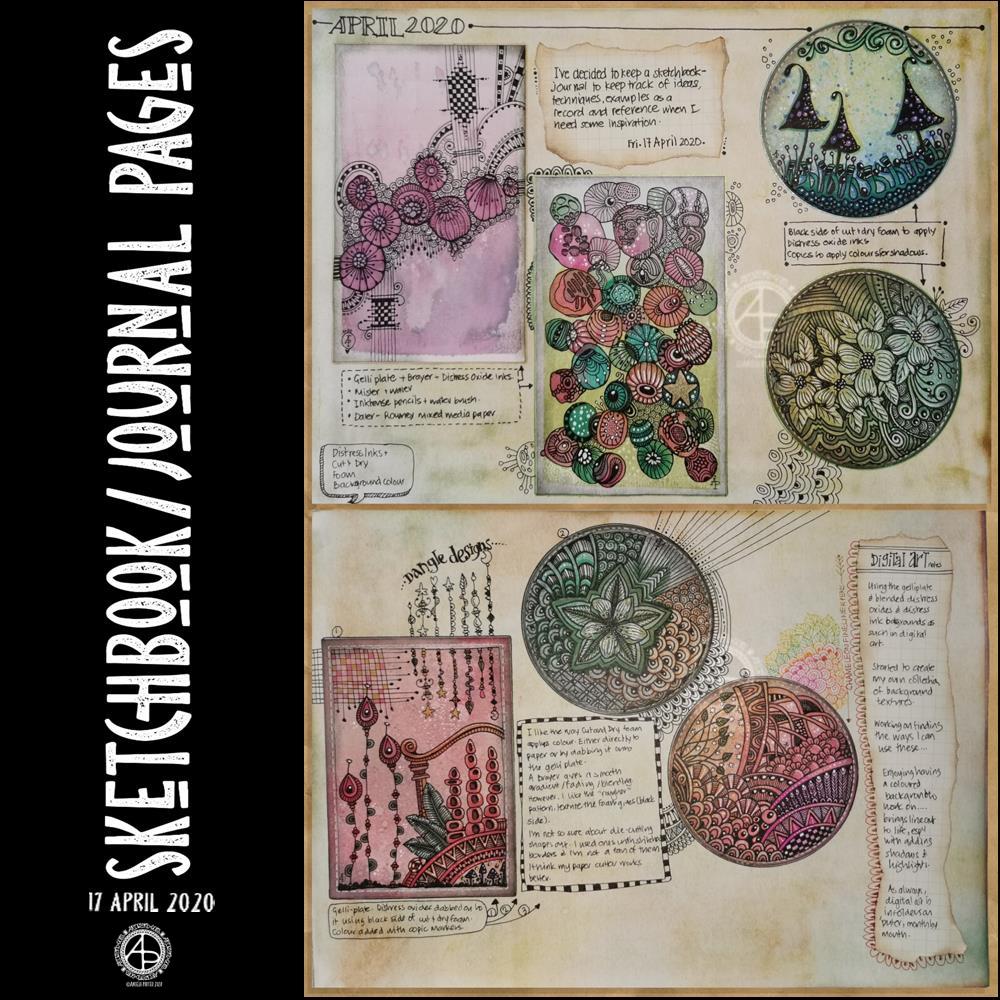
Sketchbook – Journal Pages 17 April 2020 © Angela Porter | Artwyrd.com

I’ve been creating a lot of little bits of art that I just don’t know what to do with. They’re often little experiments. Sometimes I mount them as greeting cards, other times they end up in a drawer.

This morning, I woke with an idea to start a sketchbook-come-journal as a place to keep safely and annotate some of these artworks. The annotation is important; it’s lots of notes to myself about the techniques and materials I used to create a specific type of effect, thoughts, ideas for the future, inspirations.

I dug out an A4 Goldline sketchbook to use for this. The white pages just looked uninteresting and stark to me. So, I added some colour using a piece of Cut and Dry foam and Distress Inks followed by a quick spritz of water. A blast from a heat gun, and the pages were ready.

I did prepare a couple more spreads with colour. I realised that if I did this after I’d attached my art to the pages I’d get all kinds of lines and marks that I wouldn’t want. So, I need to make sure I add coloured pages each time I add work to the journal.

I adhered the artwork to the pages using Tombow Mono liquid glue, outlines them with either a metallic or plain black pen, and then set to annotations and notes.

It also gives me a chance to practice my hand-lettering and to use design elements used in bullet journals or planners. I have to say that my handwriting appeared far more than hand-lettering. I used the hand-lettering for headings though.

I also let some of the design elements from the artworks to spill onto the page. I have a problem with leaving white space! This gave me a chance to remember media I have in my stash, such as the Chameleon fineliner pens, which I haven’t used much.

Some dangle designs appeared in one of the drawings, so I redrew them above it. And, of course, metallic gold gel pens add a touch of sparkle.

One thing I ‘discovered’ (maybe rediscovered) is how fab Copic Markers work to add colour and shadow to the Distress backgrounds. White gel pen adds bright highlights.

One thing I wanted to do was add notes about my digital art. I’d like to add prints of my art, but I only have a black and white laser printer. So, I’m going to see if I can have sheets of images printed via the web and posted to me so I can then use them in my journal too.

Part of me knows I could do this via One Note or similar, but there’s something lovely about having a physical record of the art completed and with notes to reflect on or get inspiration from in the future.

I am sure this is something I did in the past, but it’s time to do this again. It’ll be fun to add journal elements to the pages, like envelopes or pouches for notes.

I’ll have to be less of a perfectionist, something I still struggle with. I’m hoping it will help me me to recognise the value of work I’ve done that I may not be happy with, but can learn from and make notes about this, and ideas that arise, for future reference.

Inktober 2019 Day 13

Inktober 2019 Day 13 ©Angela Porter | Artwyrd.com

Another sketchbook style of page from me. The prompts for today were rabbit skull, Macrolepiota excoriata fungus and Yin-cut tangle pattern (Instagram lists from @book_polygamist, @nyan_sun and @havepen_willdraw respectively).

Simple, fun, with space for more additions if I should choose to do so in the future.

As I’m typing this, I realise that I could have added some patterns etc. from the skull in boxes. Duh go me!

On this skull I have increased the contrast between highlighted/shadowed areas. I’ve forgotten to sort the teeth out, however, and they do look a tad flat.

Traditional tools

To draw the mushrooms, texture panels and the tangle pattern I used a Sakura Pigma Sensei 04 pen with Rhodia dotgrid paper.

Digital tools

I used Autodesk Sketchbook Pro, Microsoft Surface Pen and Microsoft Surface Studio to draw the skull and also to add colour/shading to the skull, some of the fungi drawings and the colour swatches and gradient. I also added a vintage, aged, grungy textured paper as the background.

Artistic journeys…

Mixed media

IMG_0650My previous blog post about a mixed media work in progress is still on hold, although I have added a crackle paint to it in places, which has added some texture to it.  I’m pleased with the result, but I still am not sure what else to do to complete it.
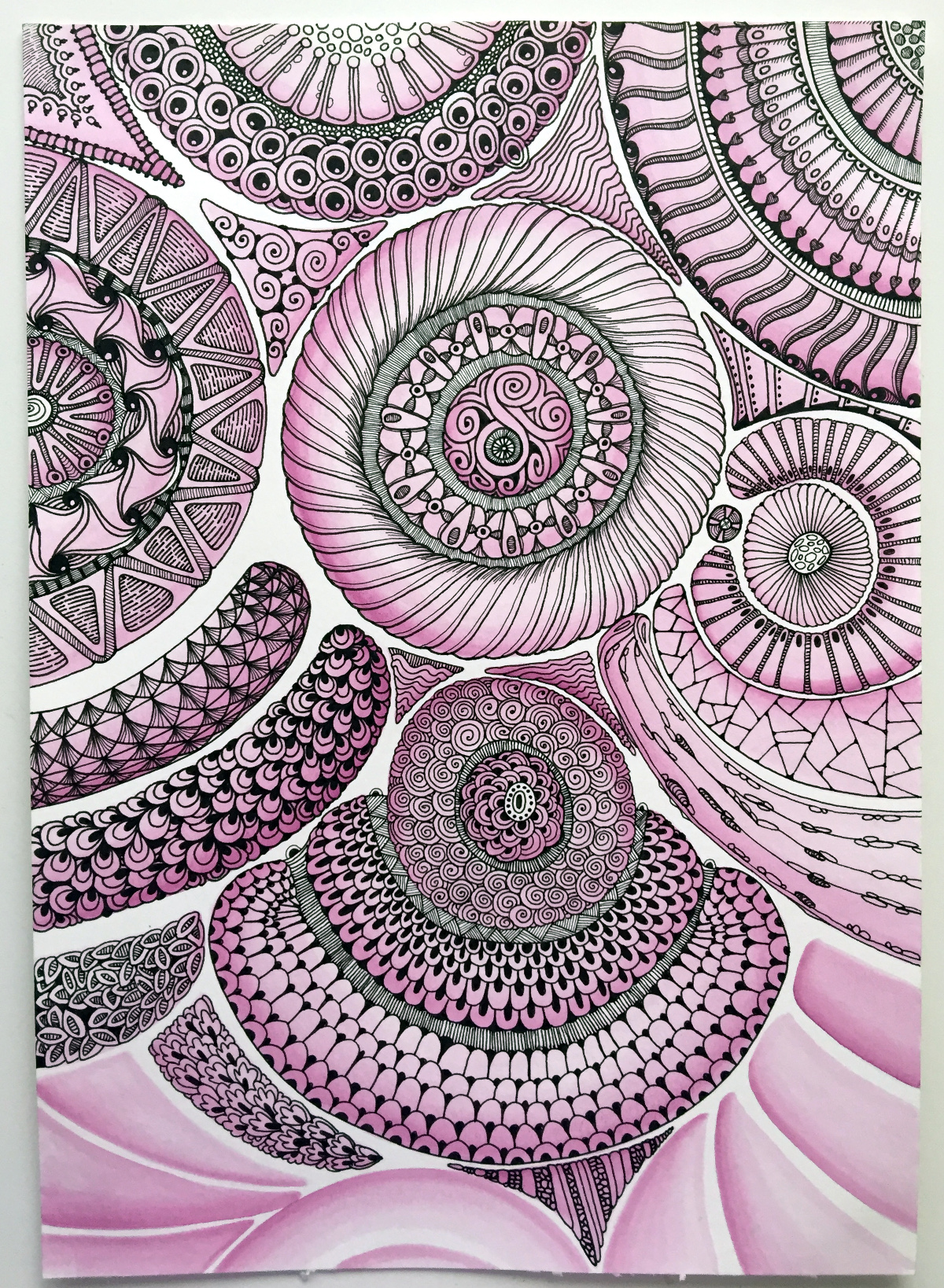
I have completed a very textured background for some mixed media work; you can see it above.  What I’m going to do with it I’m not quite sure, but I’m sure it will all come together at the right time.

Abstract Line Art

I’ve been drawing more ‘Doodle Worlds’ images from time to time and now need to gather them together to see if there’s enough for another ‘book’ for the Colorist app.

IMG_0646

IMG_0648

I also turned my attention to colour and pattern and the two images above are the results of around three to four days work.

I used A4 300g/m² smooth watercolour paper and applied distress inks to create the coloured areas.  I wanted to create the illusion of shadow and light in these areas.  Next, I used various drawing pens to add the patterns.  On the green piece, I’ve added copper and gold coloured metallic highlights.  The pink one isn’t quite finished yet.

Sketchbooks and my artistic journey

IMG_0649

As the days are becoming lighter and warmer, my thoughts are going to getting out to visit places and to do some sketching/drawing (intense anxiety and intense self-consciousness allowing).

With this in mind, I’ve prepared pages in an A5 and an A4 sketchbook.  I’ve used Distress and Distress Oxide Inks.

The image above shows the first page in my A4 sketchbook, a page full of daisies, worked using different media, trying out different styles and degrees of detail.

I like to work on a coloured background, I don’t know why, I just do.  I think it may be that I like to add shadows and highlights to create and image from the colour on the page.

I’ve not done much in the way of sketchbook work for a long while, but the need to revisit and to continue to explore different ways of expressing myself artistically has surfaced.  I think this is a much over-due response to the surfeit of work on colouring books in the past three or so years, as well as the struggle I’ve had with my mental health.

My energy, when mentally able, has been focused on completing the work I was contracted for with various publishers.  I enjoyed the work, the subject matter pushed my boundaries in the subjects I tackled.  I’m so grateful for that work as well as it allowed me to make changes in my working life that helps me to take care of my mental health.  It was/is also an activity that helps me manage my mood.  I lose myself in drawing/creating, finding myself ‘in the flow’ where my mind stills, or, rather, where I no longer pay attention to the inner critic.

However, the colouring book work was the focus of my artistic energies for much of that time, and I had little energy left to explore other areas of artistic expression.  I didn’t mind that at all, as I’ve said, I enjoyed all the work I did, and I will continue to create templates.  However, that is not all I want to do or to create.

I now have time to revisit ways of artistic expression I put to one side in my focus on the work for publishers, and I have the chance to see how my skills and expression have developed/changed.  I also get the chance to explore and discover new ways of expressing myself, using new media.

In this way I can continue to discover, practice and refine my artistic voice and vocabulary.  I still feel like a toddler in the world of art.  I wonder if I’ll ever progress from that state.

The biggest obstacle to me doing this is the lack of belief and confidence I have in myself and my artistic abilities.  I also have a problem in deciding on what to draw.  Then, there’s also the issue of finding themes/styles/media to explore that will challenge me just enough that I feel I can make a good attempt at them and gain confidence in them, but not so much that it overwhelms me and I fail before even trying.

The most important thing for me, however, is to enjoy my artistic journey, no matter where it leads me.  The pleasure and peace I get from creating will be something that will serve me extremely well throughout the rest of my days on this planet.


Tea and musings around liminality

Yesterday I sat at a table lit by the golden light of the late spring sun, enjoying the feel of a soft breeze contradicting the warmth of sunlight on my skin while the glorious sound of birdsong gently caressing my ears in the café at the Blaenavon World Heritage Centre. On the table was a lovely pot of tea and a home-made fairy cake (small ‘cupcake’) topped with vanilla buttercream icing and my journal-sketchbook into which I would be recording my thoughts and observations. This was a treat after picking up a batch of mugs that I’ve had printed with a piece of my artwork and a short greeting for my lovely year 11 class who are leaving on Thursday. That will be a day filled with tears and joy, a liminal moment for the pupils as they stand on the threshold of the next phase of their life. The leavers’ assembly being an opportunity to mark this transition point, a liminal point, with celebration, with laughter and with the memories of experiences.

The view from the window was of the neglected graveyard attached to St Peter’s Church which falls away towards the valley bottom as the café abuts the eastern edge of the graveyard and I realised that I was sat at a liminal place, but not one of one phase of life to another. This liminal place marks the boundary between the living and those who have passed out of this earthly existence.

As I realised this, a pair of magpies flitted from tree to tree, their tails twitching as they settled on branches, and sunlight on their plumage revealing the iridescent purples, blues and greens that are so often missed. A solitary cabbage white butterfly careened from plant to plant, it’s pale colour standing out against the brown tangles of brambles and the bright greens of spring growth, signs of life surrounding the memorials of those long dead.

Magpies are associated with bad omens, and one such superstition is that if you see a single magpie on the way to church then death is close (myth-making at blogspot). Considering that many churches have a graveyard around them or close to them, then that is quite true! I love magpies and the other members of the corvidae family of fine feathery friends, despite their gloomy reputations.

As one thought bounced to another, I realised that I too, was at a liminal point in my life as I continue to work on unravelling the tangles of the past through journaling, meditation, self-hypnosis, gratitude and pennies-dropped-epiphanies as I’m becoming more aware of the inner critics and their continual sussuration of negative messages about me. I’m learning how to dis-empower them, little by little, and I may be approaching a turning point for myself in how I view myself and what my beliefs are.

The grave markers were splotched with lichen and algae, patterns reminding me of growths of penicillin on laboratory agar plates or stale and mouldy bread. Tumbled tangled brambles wrapping round them, seemingly pulling them down, down, down into the ground, the Earth reclaiming what had been taken from it, and with it the memories of those long passed. Despite the pull of time and neglect, the taller columns and headstones bravely rose above the tangles, holding their heads up high in the sunshine, proud of their leprous appearance, suggesting age and longevity, that they remember even if the living no longer do.

Others, however, seemed to be surrendering to the gradual depredations of time. Their sharp leaning stance, the first phase in laying down, showing an acceptance of their fate. No one alive who remembers them, who cares for them enough to tend to the memorial of a life once lived. The connections between the present generation and the past generations fading and weakening with time as symbolised by the tumble-down state of the gravestones. This was reflected in the laughter and chatter of the living enjoying beverages and vittles in the bright, warm, life-giving sunshine. The proximity to the necropolis and it’s visible symbols of death, funerary rites, and grief having no effect upon the high spirits of the living.

Perhaps that is because a wall, a visible boundary separates the activities of the living from the area of the dead. If we were to dine and party on their graves, perhaps we may feel differently, irreverent perhaps; an attitude maybe not unique to our own culture or time. I saw this video about dining with the dead in Georgia on the BBC news website earlier this week, and an example of how different cultures approach death and the places of the dead and how rigid and solid the boundary between us, the living, and our deceased friends and family are.

Death is, essentially, a great leveller; the great and the good lie alongside the poor and meek. Only the memorials tell us who is who,and only a skilled osteologist would be able to tell which was which were their skeletons disinterred and separated from any clothing, jewellery or other funerary offerings that they were interred with. To most of humanity they would be the remains of people, equal in death as they were not in life. Given enough time, all return to the Earth, return to what we were created from, very few leaving traces that will last for centuries, millennia or the aeons of time.

Traces remain in the bones that remain of their lives; hardship, luxury, adversity, ease all leave their marks in the bones. As the flesh decays, as memories fade, so do the individual stories of each person’s life, the stories that make each of us unique. The funeral monuments may tell us about them, there may be hints of their life in written records, but so much about them, such as whether they were kind or cruel, loving or neglectful, are lost.

Gloomy thoughts? Not at all! I like what the we can learn of our ancestors from their funerary rites, from records, from stories still held in the memories of the living, maybe experienced first hand or tales handed down through the generations. It matters not whether they are iron-topped tombs of the magnates of Blaenavon or the ring-barrows of a person from the Bronze Age, or the fossilised remains of our distant relatives. For many, we can only make educated guesses about their life and times, sometimes more educated than others when written records exist.

Of course, the choice of a place for cemeteries is a story in itself. In ancient times where a lot of effort was expended to bury a few in monuments such as cairns, ring barrows, cists, long barrows, then they weren’t just plonked in the nearest available place. The choice of place had meaning, just as the choice of place has meaning to us whether it’s where we go on holiday, where we choose to live and experience life. We choose places that give us meaningful experiences, be they linked to happy or sad times. The same is true when we choose places for funerary rites, whether we choose them ourselves before we die or whether we choose them for our loved ones who have passed away. My father’s cremains were buried beneath a sapling plum tree in a country lane where he used to collect all kinds of fruits and plants to make wine from. A friend’s father’s ashes were sprinkled from a bridge to return to the sea which he loved and sailed while serving in the Navy. Another friend’s father’s ashes are to be buried with his brother, if permission can be gained from her aunt.

If we take time and care to choose an appropriate resting place for the physical remains of our loved ones, I’m sure our ancestors did so too, even though it may not have seemed so to us as in many cases we have no ideas of their beliefs and the practices that stemmed from them. Nor do we know for sure why certain people were accorded such seemingly prestigious and important funerals, whether they were the great and the good or whether their deaths had a different meaning and the funeral a different purpose than commemoration and a reminder of our connections to the people of the past, to our ancestors, to those who have shaped the society we life in at any particular point in history.

I couldn’t help but wonder what stories the land could tell us if we could access it’s memory. I’d love to know what events the stones beneath my feet have witnessed in their long aeons of existence. What lovers’ trysts and promises. What betrayals, joys, toils, griefs. Whose feet have passed over them and what is the story of the lives. I don’t just want to know about the great and the good, people whose lives are most probably fairly well documented. I want to know about the ‘ordinary’ people as well. Everyone has a story to tell, everyone’s life experience is unique to them due to their unique perceptions, beliefs, actions, reactions and personality, and what thoughts and beliefs they had about themselves and others.

Perhaps the land, the position of the cemeteries, their relationship to the use of the land in the past and the present, the stories told about the land, it’s people all serve to keep alive the memory of the ancestors, aiding in remembering their stories and the stories previous generations and in so doing keeping the ancestors alive, in memory, and our connection to them stronger. The scape surrounding the cemetery becomes woven into the stories of the recent ancestors and the myths of the more ancient ancestors, acting as aide-memoires to the tales. Each feature in the land around the cemetery is not devoid of emotion, of meaning, and for each feature these would change as the time of day, the season of the year and the weather changes. We interact with these scapes through the feelings and meanings and the way that we make use of them and that induces a feeling of belonging to them. Ideas such as these are propounded by archaeologists such as George Nash.

I realised then, how much I’d enjoyed writing my thoughts, how going to a different place other than home allowed me the inspiration I needed. It’s also brought up links between things that are occurring in my life at present, and that will help to unravel any tangles knotted by the inner critics in the past.