After a walk and lunch yesterday, I eventually settled to working with my aha moment. This sketchbook page is the result, though I have work left to do with it.
The designs are inked in with Pitt Artist Pens and I’ve used watercolours and Inktense paint pans and pencils to colour the motifs. Well, most of them. I’ve left some parts in black and white to show the difference that colour makes.
I used a Daler-Rowney artist’s sketchbook. The paper is acid free, but is not specifically for watercolours. It held up surprisingly well to multiple layers and glazes of colour, though it does grab the colour and it’s difficult to move it around as on watercolour paper.
I also found the wet brush lifted some of the pigment from the Pitt Artist Pens. That surprised me as they were totally waterproof on watercolour paper.
Reflections
Having an ‘aha moment’ and working with that realisation can be quite different. It’s nice to try different ways of using line and stippling to add shadow and volume to the drawings.
The half-beetle was an interesting one to work with. On the lower wing I could’ve used lines to add the illusion of curves, but for some sections I just used colour. I also used the beetle to practice adding lines and stippling.
I tried drawing the beetle digitally, but it just didn’t feel ‘right’. I didn’t get the same satisfaction as I did drawing it with pens on paper. I’m sure that’s due to me having my brushes set up incorrectly. That’s something I’m going to have to work on. I ended up with a drawing that was too perfect. That surprised me too, as I love to work digitally. Perhaps that was a function of my current mood and energy levels.
I do tend to switch between digital and traditional media, sometimes mixing the two. That is certainly an option moving forward – drawing the line art on paper, then colouring digitally.
I do like the earthy tones I’ve used to add colour to many of the design elements on this page. That still continues to surprise me, as much of my work has been brightly coloured, often with ‘in your face’ colour palettes used.
The smaller designs I’ve drawn here also have their own sense of satisfaction and enjoyment for me. Usually, I draw full page designs for colouring books. But here, I’ve drawn small compositions, and that is not so overwhelming for me at this time.
I wasn’t in the mood to continue with the watercolour work in my sketchbook, soI made some Distress Oxide backgrounds on some Bristol board (5.5″ x 4″). I thought I’d do some intuitive drawing on them using metallic gold ink. So much for what I thought I’d do.
Brush and FW pearlescent Mazuma gold liquid acrylic and a brush didn’t work for me. I was getting frustrated with it. So, I tried a gold metallic Gelly Roll pen, which also didn’t feel right. I followed this by a white Gelly Roll pen, a gold glitter Signo gel pen, and finally a black Pitt Artist pen, none of which allowed me to feel I could settle into some art.
Whatever I did I just wasn’t happy with. It seems that this morning I’m not meant to be doing any art.
Feeling Meh
I am feeling meh this morning, meh meaning a lack of enthusiasm, interest and lacking in inspiration. I feel flat, fed up and still emotionally exhausted. This is finally expressing itself in my art today.
So, today is a day to do something different I think. I’ll most probably do some crochet and read.
I started reading a book yesterday by Rupert Sheldrake – “Science and Spiritual Practices”. I’ve long enjoyed reading Sheldrake’s books, after discovering his theory of Morphic Resonance (thanks to the ‘It’s morphic, innit?’ statements in the Discworld books of Terry Pratchett). I also have an interest in what consciousness is, where it resides, and so I find books that tie science into spirituality and a non-mechanistic approach to consciousness and life quite interesting.
For a number of years, I’ve found it difficult to read and focus on reading for any length of time. I experienced burnout, and with it the depression and anxiety related to CPTSD all my life, had become almost unbearable. With these, my ability to read and process written information mostly vanished. That happened nearly seven years ago now. Slowly, my ability to read and understand and retain what has recovered to where I can now enjoy reading, though it’s not always a natural activity to return to.
Today, however, may be the perfect day to snuggle down with a good book, decent mugs of tea, as it’s grey and damp outside. Nice music on would be good too.
Feeling uninspired
This happens to me on a fairly regular basis. I need a break from art and to do something different. I may do some quick, easy, familiar and comforting types of art just to keep my hand and eye in. I do, however, give myself a break from trying to work at any challenging projects. It’s like a short holiday from art. In time my energy, enthusiasm and inspiration returns anew and off I go again.
Learning to be kind to myself, giving myself permission to take a break, hasn’t been easy. It’s taken a long time. On days like this, though. Days when I feel flat, sad, exhausted, it’s easy to beat myself up about being ‘lazy’.
It’s not being lazy at all; I’m busy taking care of myself. I have to work hard at reminding myself of this. And busy taking care of myself means slowing right down and doing activities that soothe, calm, relax and allow my energy to recharge. Today that means rediscovering the joy of reading, something I used to take for granted, and now it’s something that I will appreciate so much more.
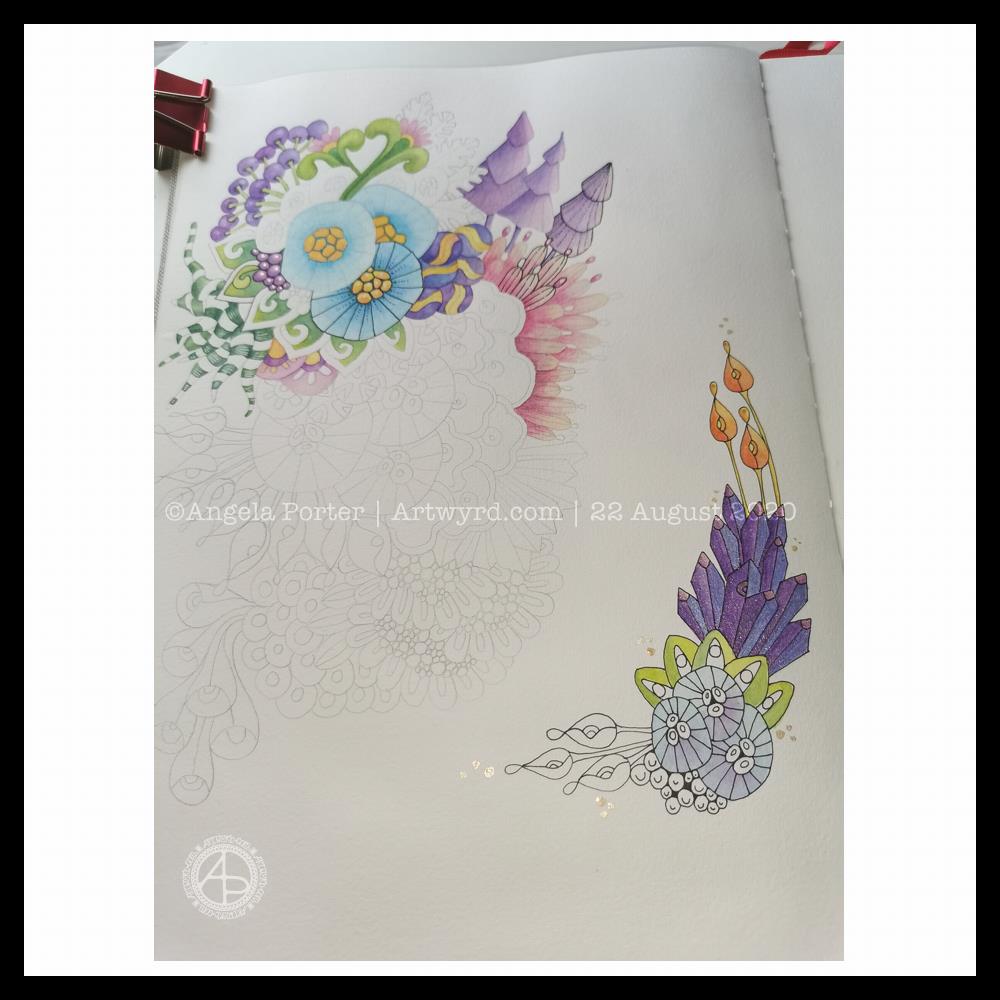
I’ve been working in my Arteza watercolour sketchbook (A4 in size). I’ve continued to add some colour to the larger design. As this is a sketchbook and nothing has to be perfect or finished and is a place to experiment, I decided to try adding black lines to the bigger design as well as to draw a smaller design in black pen first.
I’m still not all that comfortable with my entangled kind of designs without black lines it seems. Or maybe this is just a function of me being totally out of sorts over the past few days if not weeks, possibly months.
The black lines add structure and form to the design, but there’s also a colouring book feel to it too.
I am thinking I’ve not yet worked out how to get enough contrast in the watercolours to bring out the volume of the various design elements and to separate them one from another clearly enough.
I also tried adding white lines using a Signo gel pen. That worked out nicely in terms of adding highlights. The shapes of the lines also helped to add the illusion of dimension.
Finally, I tried adding some metallic watercolour in a pale gold. I tried adding dots as highlights,but I also tried a very dilute glaze of the watercolour over the paint. Now I liked that very much, but it has to be dilute and blended out quickly. Sadly, the photo doesn’t show this well on the purple weird mushroomy thingy on the top of the big design.
I’m telling myself it’s all learning, experimenting, finding my way. I just don’t know what my way is at this moment.
Art and my emotional and mental wellbeing
I am tired today. Emotionally drained. and I’m finding it difficult to be satisfied with anything I’m currently doing, even artistically.
This is definitely affecting my ability to ‘art’ at the moment. I lack focus, energy, inspiration even. I am getting frustrated with myself all too quickly, and fed up of what I’m working on too easily.
These are sure signs that I’m out of balance, emotionally more than mentally. However, my emotional health does have an effect on my mental health if I’m not careful.
It feels like some self-care time is needed, with activities that won’t overwhelm me but will help to soothe me and give me the time and space to find that inner balance and contentment once again.
The touchstone of contentment is there, in my heart, but it’s hidden by the shadows the clouds of emotional disturbance are casting within me.
Like all weather, the current unsettled emotional weather will pass. It has lessons to teach me and adjustments to be made. I am resilient enough to do this, to work through this mood and exhaustion, as well as to know how to take care of myself in times like this.
As I reflect backwards, it wasn’t all that long ago, just over a year, that I discovered the touchstone of contentment within me and found that it was OK to look after myself, take time out for myself, to have quiet, non-busy days to myself.
I never feel guilty about doing this any more.
I know if I try to do things that need to be finished, done well, then days like these are not the days to attempt them. The frustration kicks in and just unsettles me more.
I’m not sure if it will be Ben and Jerry’s and Star Wars that will help me, or something else. But I will find my way back to my usual, default, contented state of being.
Productive? Busy?
Everyone could do with learning that we need time to relax, to give ourselves permission to do nothing other than just be.
Society expects us to be constantly busy, productive, on the go, making the use of every single minute of waking.
But all that does is to drain energy, pile on the guilt if we’ve not completed every task in our planners, journals, diaries, and so on.
Social media is full of videos and memes and blog posts about how to be more productive, successful, famous, noteworthy. All of which can make a person feel guilty, useless, underachieving, unworthy.
There seem to be relatively few saying how important it is to look after your mental and emotional health as much as your physical health. So few messages about how important it is to take time out to recharge your energy, to stop and just be rather than forcing yourself to get something done, even if the frustration with the task means it’s taking longer and longer to do.
It’s not easy to give yourself permission to take time out, to relax, recharge just be, watch the world go by, read, listen to music, create, day dream, just for the joy and peace they bring. No, it’s not easy at all, given all the pressures that come at us from every direction.
These kinds of activities are just as important as the ones that are ‘productive’. They are activities that are productive in a different way – you are productively taking care of your energy levels, your mental and emotional well being, feeding your heart and soul with the tasks that soothe and heal.
It’s all part of self-care, making sure your needs are catered for. It’s not being selfish; it’s recognising that you need to take care of yourself as much as you take care of others. It’s about balance in life.
I am hoping that through the pandemic more and more people realise how important it is to slow down the pace of life, to take time to do things that feed heart and soul.
Today, my heart and soul need soothing and caring for. Everything else can be put on hold until I’m able to face them without frustration and rapidly getting fed up of them.
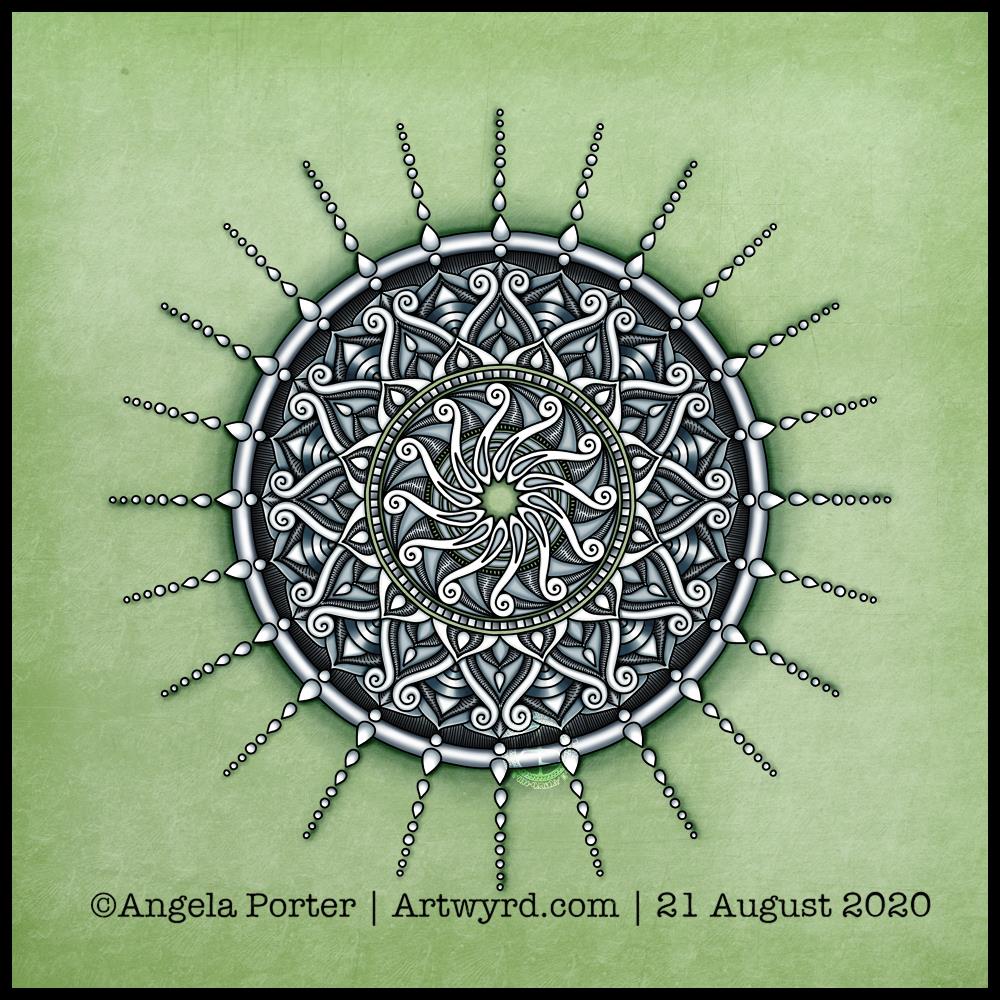
Today’s art is a simple mandala. A cool grey, black and white colour scheme on a soft, calming green background.
Drawn in Autodesk Sketchbook Pro using a Microsoft Surface Slim Pen and Microsoft Surface Studio.
Confusion
I am emotionally drained, confused and overwhelmed again today. I don’t have much in the way of focus. I was surprised I could complete even this quick and simple mandala.
I don’t have the focus or energy to reflect on the choices of colours and symbols in the mandala and how they relate to messages bubbling up from my unconscious mind.
I feel trapped, caught between a rock and a hard place. I’m damned if I do, damned if I don’t. The stress of it all is giving me a migraine, upset digestive system and is dragging my mood downwards.
Heck, even the mandala looks like it is either sinking down, pulling itself up or hanging on by the chains of teardrops. That is how I feel, and I had no idea that was how the mandala would appear when finished.
How are you all doing and coping with the continuing pandemic and the public health restrictions in place?
Here in Wales, our Senedd (Welsh Parliament) has been slowly easing the restrictions, pausing after each one to see how it affects the rate of transmission before easing more restrictions.
I, like many others, don’t leave my home often. I did go out for a walk in the fresh, sunshiny and windy morning. It was so nice out and moving my body around. I am still very nervous of being around people, so I go to a big cemetery near me where I know I will encounter few people. It’s a very quiet, serene space too, and nature flourishes quite wonderfully there as well.
Template Thursday
Each Thursday marks another week of the continuing Covid19 crisis, and so I make a new freebie colouring template available in the Angela Porter’s Coloring Book Fans facebook group. There are some terms and conditions relating to the use of the template.
This week, I have a typically ‘entangled’ style of template for people to colour. As well as some cute winged stars, botanicals, arches, spirals, feathers, crystals and clouds, I’ve also included some hand drawn typography. Let me know what you think of using typography as a way of adding pattern to the arches.
If you download the template and colour it, don’t forget to tag me in your coloured version if you share it on social media! I always love to see how people colour my templates and bring them to life.
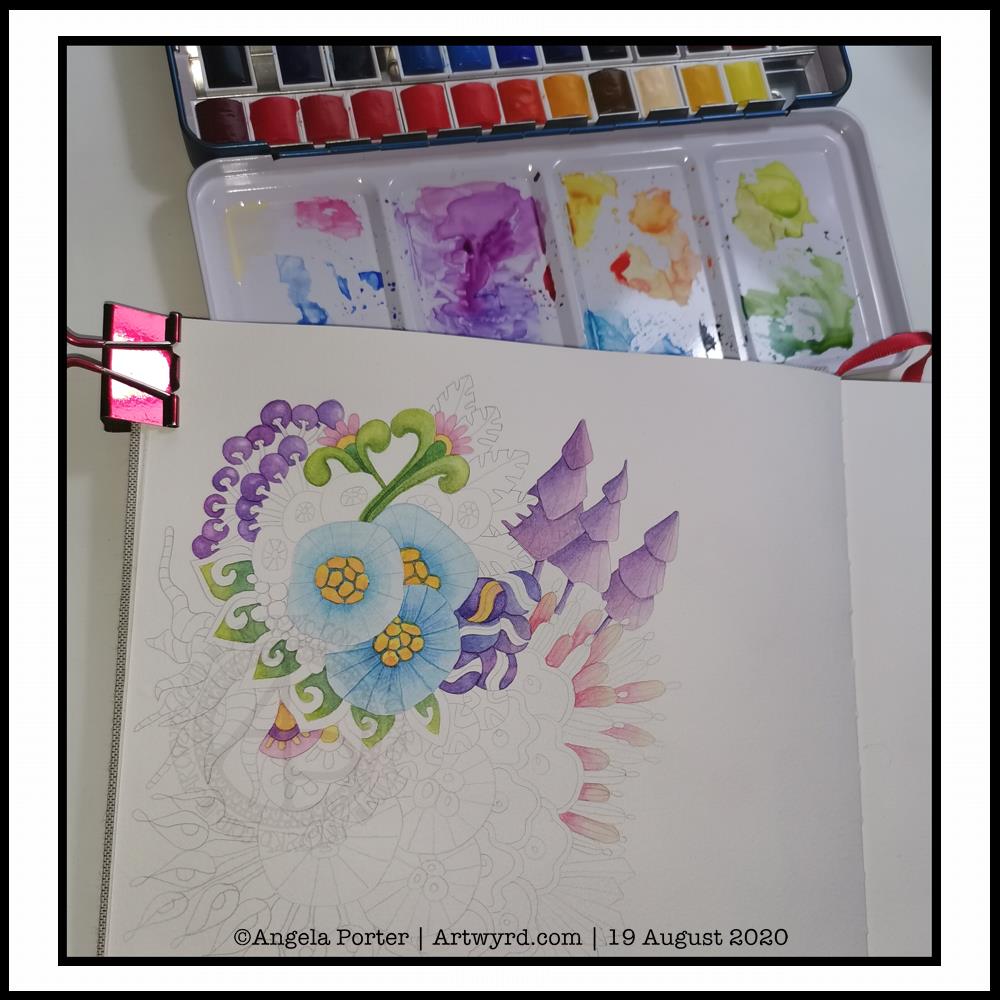
It’s WIP Wednesday, so here’s a work in progress I started this morning.
I woke thinking it was about time I tackled rendering one of my abstract, stylised, imaginary botanical designs in watercolour.
I think I’ve gained a bit of experience with watercolours, kind of have a feel for them and how I like to work with them. Or so I thought.
Anyways, I started by drawing the design lightly in pencil. I used a 0.5mm mechanical pencil by mistaked; I had intended to use a 0.3 mm one instead. No matter, this is an experiment, a trial in my Arteza watercolour sketchbook.
Once I was happy with the drawing, knowing I can always add more to it or alter it before painting it, I started to add colour.
I started with the bottom right blue seed-poddy/stylised flower motif. I thought I’d use two different shades of blue alternately around it, adding shadow and depth. That didn’t work out too well. I tried dry brushing on the ‘spokes’ of the motif. My reaction was ‘yeuch! Angela what were you thinking???’.
I didn’t give up at this point, though it would’ve been easy to do so. I continued on, reminding me this is an experiment, I’m trying something out that I’ve not had much success with in the past; just keep going.
So I did. And I know I have work to do to recognise when the wet paint has dried enough for a different wet colour to spread nicely, but not too much, when dotted into the first colour.
As time was going on, I was becoming more comfortable with how I was adding colour. I was working out that adding glazes was a way to darken areas, and that I could gently blend the edges out while the glaze layer was still damp so I didn’t get harsh lines.
Slowly but surely I coloured in different motifs, careful not to do wet next to wet.
All in all, I’ve worked on this painting for around three hours. There’s a lot more to do, but I can pick at it from time to time.
What I have noticed is, however, how much I want to add colour in the same way I do when working digitally. An interesting observation, the implications of which I have not even started to unpack yet.
Therapeutic art once again…
Once again, I turn to art to help me manage my unsettled emotions and thoughts. I am so tired, again. The stress of the past week or so has taken it’s toll. However, like the heavy rain and rather windy weather we’re experiencing here in the Valleys of South Wales, these will eventually blow over and I’ll be able to focus on my contracted work.
I’ve learned that when I’m all out of balance, it’s best for me to focus on art that is soothing, that no one expects anything from me, that I don’t have to worry about messing up. If I try to do art that others need to be happy with too, then I get frustrated and negative about myself, doubt myself.
So, for today at least, I will be creative in ways that will give me the time and space to heal my frazzled emotions and gradually work my way back to mental and emotional well-being once again.
After a life-time of putting everyone else’s needs and happiness first, I’m gradually learning to take care of my own needs first.
I felt guilty and selfish to say ‘my own needs first’. But it isn’t selfish to look after myself. It’s a recognition of being responsible for myself and my own needs and well-being.
And so, today I art, for art’s and heart’s sake.
I just wish it wasn’t so darned rainy and blowy. The rain alone I’d be happy to go and walk in, or the wind alone. But not both together. It is forecast to ease off in a couple of hours, so maybe I’ll get a walk this afternoon, with brolly and waterproof jacket. I’d like that. But for now, I’m going to go and drink tea, draw the design for Template Thursday, and have the quiet time I need to heal, recharge and refresh.
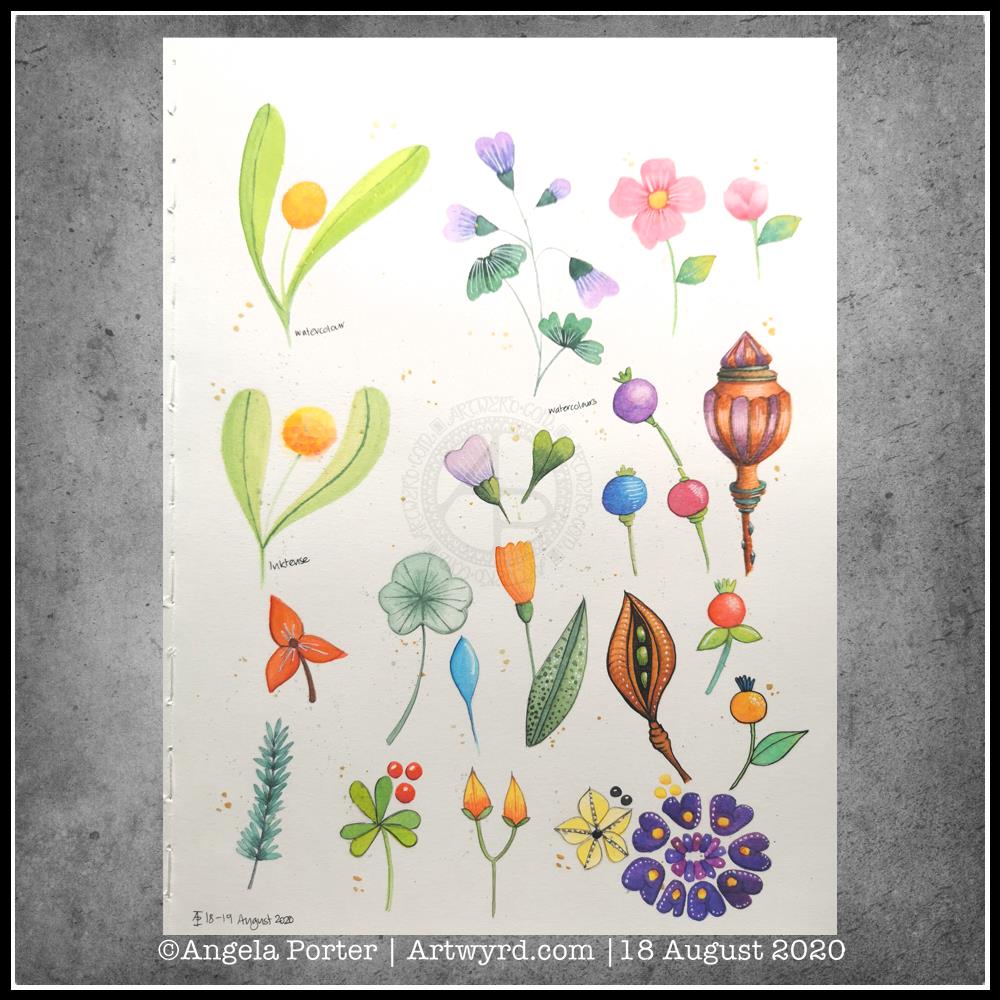
More art therapy was required yesterday and today. This time I messed around with watercolours and botanical motifs.
Some I like, some are hideous, but all resulted in me finding some calm amidst a maelstrom of emotional and mental pressures being exerted against me.
Although I’ve not yet tried to express my emotions via colour and pattern today, working with motifs from nature is soothing in it’s own way.
Perhaps there’s more of me expressing my needs in creating botanical art. I do feel the need to be out walking where there is nature. With Covid19 still doing the rounds, my places of choice are cemeteries; so few people visit them and I feel safe there in a way I don’t feel safe in nature when I’m by myself.
So, as it’s fairly overcast and there’s a good breeze, I’ll head out as soon as I’ve completed my social media stuff for the day.
Materials and method
I used mostly watercolours, but I did try out the Inktense paint palette I received yesterday for one motif. For some of the motifs I used a faint pencil outline. On others I darkened that outline once I’d painted the motif. And I tried black outlines using a Signo DX 0.38 pen on some others. I also used white Signo gel pens to add highlights. Finally, I splattered some gold watercolour over the page, and added some bigger dots of gold.
Oh, I worked on one of the smooth textured pages in my A4 Arteza watercolour journal.
I do apologise for the poor photos. These were the best of many that I took of my arty pursuits this morning. I’m not sure if I’m finished with it or not.
This was an unusual excursion into the realms of art for me. I was feeling totally emotionally overwhelmed – scared, anxious, sad and confused.
So, I thought I’d try to express my emotions artistically, with watercolours.
I used masking tape to edge an area approx. 6″ x 2.75″ (15.5 cm x 7cm) in my Arteza Watercolor Sketchbook. I used a new page for this, and it was the smooth side of the paper.
Next, I applied a wet wash of indigo watercolour, and then dropped in greys and rusty oranges, reds and browns into it.
The paper warped with the quantity of water. No biggie though, as this is a sketchbook. Once I’d finished adding colour and letting the watercolour do it’s magic, I used a heat tool to dry the paper. When I removed the masking tape, which was low tack, it lifted some of the paper with it, which was a bit of a disappointment. However, it is a sketchbook, so no biggie.
I then wanted to add some gold patterns and lines. I dug out a Cosmic Shimmer iridescent/metallic watercolour palette and a size 1 brush.
Finally, I thought I’d add some details in black pen (Uniball Signo DX 0.38), but I’m not sure about them at the moment.
Reflections
My emotions were, and still are to a degree, all over the place. I tried to meditate to find some peace and calm; my mind was just racing faster and faster and I just couldn’t sit with the emotions.
So, I decided to try to paint my feelings, to put into colour and pattern what I couldn’t put in words, or make sense of. I thought I’d try a totally intuitive block of colour where I asked my feelings what colour they wanted to use, where to put it and when it was done.
I chose dark, gloomy inky indigo for the background, and rusty yellows and browns. Indigo for both the sadness and upset I was feeling, but also the deep calm I was seeking. The rusty colours perhaps represent the blood, sweat and tears I’ve been expending for a while now. Or maybe the stains on my soul and emotions that have resulted in my struggle today. Either way, the colours just seemed the right ones to use.
There’s also a lot of depth in the way the colours sit on the paper.
Oddly, this is a colour palette I’ve been using for a while now, but never quite so dark. Perhaps my unconscious has been trying to tell me what was likely to come if I didn’t take care of myself.
Once I’d got the block of colour done, I knew I needed to add lines and patterns of gold, a kind of artistic kintsugi. I hoped that the gold would help to heal the shattered pieces of my emotions and mind in the way gold infused resin is used to repair much loved pieces of porcelain. I hoped that the gold would remind me that my healed trauma-wounds that have been filled with gold would remain healed and I could be reassured that I wasn’t going to break.
I won’t, but I could feel myself unravelling.
For some reason, once I’d calmed a little, I felt the need to put the pattern of black at the bottom. Piles of tiny little stones. What springs to mind is they represent the touchstones that are the foundation of my emotional wellbeing. There’s quite a few of them there! That surprises me, as my usual one is the one of contentment, a gentle smile in my heart. I may have to explore what these other touchstones are at some point.
As I look at the panel now, I can see there are lighter areas, where a storm seems to be breaking. Light is shining through, clarity perhaps. The photo doesn’t show the colours at all well. I really do need to learn how to use the camera on my phone or my DSLR much better I think.
A successful experiment
I know art always is a source of peace and calm for me. What surprised me was that I felt I was expressing my feelings in this little, very personal artwork.
I’ve never really used art as a way to work through difficult (or not so difficult) emotions before. I think it’s something I’ll be doing again in the future.
Yesterday, I thought I’d give Clip Studio Paint a go. The bottom part of the template above was coloured in Clip Studio, the top part in Autodesk Sketchbook Pro.
I spent yesterday afternoon, and a bit of this morning, colouring part of the template above in Clip Studio Paint. So, these are my first impressions of Clip Studio Paint and a comparison with Autodesk Sketchbook Pro.
I think it’s impossible to tell the difference between the colouring I’ve achieved with both programs. What is different is the user interface more than anything else.
I’ve long been a fan of Autodesk Sketchbook Pro, and that isn’t going to change. I love the intuitive and rather beautiful interface of the software, the menus on screen and the colour and brush ‘pucks’. Everything is done easily and simply through the quite minimalist, yet powerful, tool bars and menus. Keyboard shortcuts are available, but I prefer to use my pen directly on the screen as I work. It makes working digitally as natural as working with traditional media.
As I’m familiar with the Affinity suite of programs from Serif, working out what the different menus and tools,, which are similar to Photoshop, wasn’t as confusing as it would’ve been in the past. Thanks to working with Sketchbook Pro, I have a better understanding of what the various tools do.
While the tools and options are all accessible on the screen, I find it frustrating and time consuming as I seem to have to perform more steps in Clip Studio Paint to do the same task as I would in Sketchbook Pro. I’m sure there must be keyboard shortcuts, which may help streamline the process somewhat. However, I work directly on the screen with Sketchbook Pro and the only time I use my keyboard is name the file before saving it, or if I want to add text to the art. Usually, they keyboard is out of the way so that I can adjust the angle and distance of the screen to suit my comfort.
I do prefer the way I can choose colours in Autodesk Sketchbook Pro, as well as the ease of creating a custom palette. Sketchbook Pro also comes with a separate Copic color palette. Being able to move them around the screen means I can pop them where I like, make them easily and quickly accessible for me.
Don’t get me wrong, there’s a comprehensive colour palette and various options of viewing colours in Clip Studio Pro, but I like the more intuitive and streamline way of doing it in Autodesk Sketchbook Pro. It’s just personal preference more than anything.
Having the colour puck makes it easy to alter the saturation and tone of a chosen colour really quickly. The brush puck makes changing the size and opacity a breeze. I keep the pucks close to where I work for convenience.
Again, there’s nothing wrong with how all this is done in Clip Studio Paint, but I just prefer the ease with which I can do everything in Sketchbook Pro.
The Sketchbook brush palette is a great tool too; I have all my favourite brushes available in one, easily accessible place. A click on this palette and I can access all the brush sets I’ve either downloaded or created so I can add or remove brushes as I need to.
The zoom and rotate touch functions only work separately. I found this a clunky and awkward way to work. I think that’s because I’m used to doing both at the same time and at will in Sketchbook Pro.
What I did like are the many more choices of brush effects in Clip Studio Paint. However, I think I can replicate many of them in Sketchbook. There are some interesting brushes in Clip Studio Paint, but nothing that I couldn’t replicate if I found I really wanted to use them.
Anyway, I will persevere with Clip Studio, working with it from time to time to become more familiar with it. The ability to draw vectors may be helpful in the future, but then I have Affinity Designer on my ‘puter, which is Serif’s version of Adobe Illustrator.
Also, I’m hoping I can find a way in Clip Studio Paint to work in CMYK rather than RGB. When I convert files to CMYK for printing, the colours shift and I’d like to work in roughly the colours that would be printed.
Overall, I think it’s a good, affordable application. It’s a fraction of the cost of any Adobe Product. I paid £40 for the Clip Studio Paint version; that’s a one-off purchase and you have free upgrades for life. You also get access to online resources created by other Clip Studio Paint users.
This price is on a par with the price of each of the Affinity suite of programs (approx £50 each), and there are regular, free updates to the software.
You can get Autodesk Sketchbook for free, though I subscribe to the pro version monthly for approx. £12; it does have a few more features than the free version. Just because Sketchbook is free doesn’t mean it’s not professional; it is. It doesn’t look powerful, but it is.
How much will I use Clip Studio Paint? That I’m not sure. Perhaps with more use the frustrations I experienced with lessen as I become more familiar with the software. Perhaps I’ll gain fresh ideas on what effects I can try out in Autodesk Sketchbook Pro.
Do I think Clip Studio Paint is a bad program? Not at all. It seems to be powerful and similar to Adobe Photoshop and artists and illustrators are able to create fantastic artworks with it. I’m sure that if you are familiar with the way Photoshop works, you’ll find Clip Studio Paint an easy transition to make.
Personally, I find the way the menus are set up hard work and time consuming to use. I’ve been spoiled with the simple sophistication and intutive nature of the Autodesk Sketchbook interface, no matter which version you use. I find I spend less time clicking on menu after menu to get to what I want to use, and more time creating art in Sketchbook. That may be a function of my familiarity and comfort with the software. What I don’t want is to feel I’m struggling or working so hard to get an effect I’d like when I could do it so simply in Sketchbook.
One thing I know is that Autodesk Sketchbook Pro will be my go-to digital art program. It does all I want to do digitally, and most probably a lot more I’ve not worked out yet.
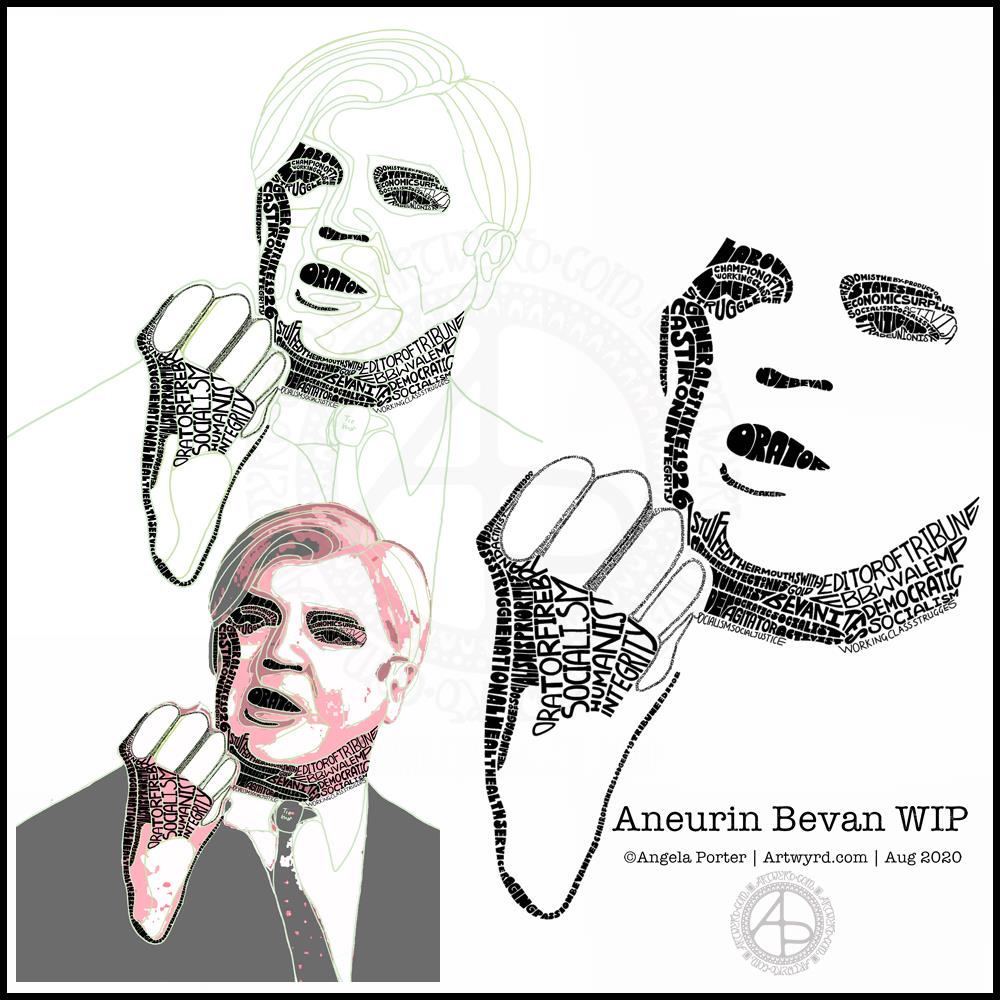
This morning I’ve been working on my typographic portrait of Aneurin Bevan. This portrait is the third iteration. I’m learning as I go along, trying out ideas as they occur to me.
I started with the photograph Nye Bevan and used the posterise tool in Affinity Photo to create areas of contrast. Then, I added colour to these areas to help me differentiate ‘twixt them. I completed this task in Autodesk Sketchbook Pro.
The next stage was to draw lines around these areas of colour, smoothing them out somewhat, and using artistic interpretation where necessary. These are the green lines that delineate the areas for different weights of text. I’ve decided to leave the white areas blank.
The green guidelines have been changed and edited as I work the portrait.
The area that was vexing me most were the fingers. However, I had an idea to use tiny lettering to add some deep shadow. I’m sure I’ll work out how to add some lighter shadow areas later on (my mind is already ticking over that issue) to give more volume to the fingers.
They typography is hand drawn and I’m having to come to terms with the struggle I’m having with my perfectionist side. This isn’t to do with the shapes of the letters, but the weight of them and making sure that they are consistent. As I’m hand-drawing the letters, then they are going to be imperfect, and I need to learn to accept when they are good enough.
Also, those imperfections and style of lettering are personal to me, and that is what will differentiate my work from others.
I’m also struggling with letting go of the desire to be as photographically accurate with the portrait as I can be. This is where learning to simplify the shapes of the different areas of contrast comes in, and recognising they don’t have to be a perfect copy of the photo in order for the resulting portrait to be recognisable as Aneurin Bevan.
One other thing I’ve done is to let go of trying to use full quotes in the portrait. I’m using repetitions of words and short phrases that represent Nye – personally, politically and in terms of achievements. I’ve realised the portrait doesn’t have to be a grammatically correct biography! I will, however, be using quotes to fill in his jacket.
I’m not sure what to do with his shirt and tie yet. It will fall into place soon enough I’m sure.
Working digitally helps me in so many ways. It takes away the frustration of starting over again if I make a mistake, and also minor frustrations. I gain a confidence to try things out, knowing that if they don’t work out I’ve not screwed up the rest of the work I’m happy with.
Working digitally, for me, is like working with pen and pencil on paper. I use a digital pen on the screen of my Surface Studio, just as I would pen on paper. It’s easy to undo and edit changes made. It removes from me the pressure to be perfect first time and helps me to persevere when things aren’t working as I’d like them to.
All the skills I’m learning digitally, in terms of the hand-drawn typography and being more patient with myself and allowing my work to be ‘perfectly imperfect’ is transferable to the work I do with traditional media too.









 Art is the Adventure