A change in blog name. Exploring collage.

The new name…

Yesterday, I did a live stream on YouTube, where I tried my hand at creating collage papers, making collage and mark making. It was an interesting experience, but more about that later on.

The topic of adventures came up in my wintering and the change in title is a result. For me, art is always an adventure. I’m always trying out new things, exploring older ways of working, and developing in my artistic expression.

Adventures aren’t necessarily big trips to far away places. There are so many little daily things that feel like adventures to me- the change in light through the day, the weather, the rhythm of the seasons and stars, the humourous behaviour of my neighbourhood jackdaws. There’s also reading new books, listening to stories and documentaries, trying new dishes, listening to music that is new to me, and so much more. I have a great deal of curiosity and desire to know more about myself and the world that I live in.

It’s a good thing that an adventure can be described as new ideas and grand mysteries. It’s about enjoying the journey with no time pressure, no idea of a destination, just a desire to discover more about how I like to express myself creatively and, through that, learn more about the more profound mystery that is me.

Over the years, I’ve dabbled a bit with collage but never really found how I like to use it other than as an interesting background in a sketchbook or maybe a pleasing arrangement of papers at the edge of a sketchbook page.

I love paper, however, and want to use different kinds of paper, and perhaps fabric, in my work. However, whenever I try to, it doesn’t feel right.

All of my artsy journey has been an adventure. I try out new things and retreat into the familiar when I feel uncomfortable with art, life, and myself. But even with familiar methods, things change due to experiences. Progress is always made. Lessons are learned. Insights are gained, especially from what I don’t like about something and what can be done to ‘fix’ it.

So, chatting in the live chat as I created part of this collage, the idea of my blog changed to reflect my description of how art is a great adventure. I thought of “Angela’s Adventures in Art,” but Judy suggested “Art is the Adventure.” I chose that, though I was tempted by “Art is the Way,” a bastardization of “This is the Way” from the Mandalorian.

And so, now the time is to change the name, but not the web address of my blog; that will remain artwyrd.com.

Collage

I am intrigued by collage, mark-making, and mixed media. Yet, whenever I’ve tried them in the past, I’ve usually felt disappointed in myself.

I remember looking at the collages by Juan Gris during my A Level and loving his work. I actually created a quite nice collage using his methodology. However, I never really followed it up. Yet, the distant memory still brings a sense of joy and, I think, excitement. I have problems identifying my emotions, and they are often faint to boot.

Anyway, I love the work of so many mixed media artists, and I admire their skills and creativity. Again, I’ve tried mixed media many times, and each time felt like a fishie out of water.

I’ve recently looked at collage and bought some books that demystify the process, or so I thought until I tried my hand.

I wasn’t happy with the colours. I glued papers down before I should have. I didn’t think about the scale of the page (A5) when I decided to put really thick black lines. I had to troubleshoot the mess I felt I made of the little leaves down the stem/trunk.

Today, I’ve spent sometime treating this page as a page to reflect on my experience and create a kind of journal page as a result. (Hence all the writing on the page). I’ve also added some patterns and makes in pen and watercolour.

Also, I made some more collage papers to try again. This time, I used Canson Imagine mixed media paper, as watercolours and Distress Inks work well enough on it.

I know I need to consider the size of the paper I’m using as a substrate when cutting or tearing the collage elements. The same is true for the pen thickness.

I have an inkling that my strength may be in more abstract work. Last night, I tried creating a collage that would look like a collection of buildings, but it didn’t feel right. That’s a good thing, though, as it’s something else to reflect upon and make notes on the page.

I really hope I can find my way with collage/mixed media. It will let me use my love of pen drawing, patterns, textures, symbols and stylised art in a different way. I have a desire to involve my love of different kinds of paper in my work.

At the moment, I just feel lost at sea, without a paddle or rudder, and at the whims of the currents of creativity and art.

I was dithering about showing this debacle of a collage publically. Then, I realised that if I am going to write about my arty adventures, then I need to recount the tougher, messier, unsuccessful parts.

The perfectionist and the messy debacle

I have been plagued by perfectionism all my life. I can get very disheartened when my desire for something pleasing to the eye and heart falls even a little bit short. In this case it falls, to my mind and heart, a lot short.

One thing I have learned that this is ok. I’ve learned that even if something is a messy ‘failure’ it is a success in many ways as it’s an opportunity to learn!

I certainly have a lot to learn from this particular collage mini-adventure. But the adventure isn’t over. I have some new coloured papers to use. I’m going to stick with the A5 sketchbook and work on a smaller scale and try out more abstract/stylised shapes. Keeping it simple to begin with may be a very good idea.

I like the idea of using the colours in the collage paper to be the colours used in any artwork, lettering, stitching etc.

And, if nothing else, learning that my adventure may be to discover that while collage and mixed media may not be for me, I can still enjoy the work of others. It may lead to new ideas, new techniques, a different way of deconstructing and reconstructing motifs and patterns going forward.

I can’t possibly predict how this side-adventure in my artsy adventure will work out. All I know is it will lead to interesting places with plenty of things to learn from the experiences it offers.

Slow stitching, mixed media, hand-lettering and a Tangle Pattern!

Link to today’s video that accompanies this blog.

I’ve seen a bit about slow stitching recently. It kept on catching my attention, so time to take a look at it a bit more.

Permission is given!

I lost my way with textile art many years ago – my attention went to other things. I still have a sizeable stash of threads and beads and sequins and so on. I got a couple of Slow Stitching books on my Kindle, had a quick read/flick through and had a realisation. Slow stitching gives me permission to create with stitches with a similar mindset to my more abstract art – to lose myself in the flow of creating, of just letting things happen and going with it and enjoying the process!

Being given permission – that is such a powerful thing! So often many ‘rules’ seem to be set about how you ‘should’ use a particular medium, or how you ‘should’ draw or create. It’s so refreshing when someone gives you permission to just do want you want, whatever brings you relaxation and pleasure (talking about stitching here!).

The stitching doesn’t have to be perfect. It doesn’t have to look like anything. It’s just creating pattern and texture with colour and so on in a way that is pleasurable to you, to me.

It’s taken me a long time to give myself permission to draw the whimsical art I draw, or the more abstract stuff I do. But sometimes it really does take someone else to give that permission, either overtly or tacitly.

So, last night I dug out some felt and embroidery threads and needles and just started to stitch – cross stitch, seed stitch, running stitch and French knots. I’ve never been able to do French knots before!

Fond stitchy memories

As I stitched I had fond memories of Friday afternoons in primary school, I must’ve been 9 or 10, and being able to take out a sturdy cardboard box that stored my sewing project. Everyone in the class had one of these – boys and girls. A rectangle of navy blue Aida fabric, with the holes forming fairly large grids. A blunt needle was carefully stored in the fabric, and there was a selection of embroidery silks on the teacher’s desk to choose from.

Each week, we added another border or row to this fabric, learning different kinds of decorative stitches as we went. The Aida fabric made it easy to do, the only tricky things were not pulling the thread too tight and getting twisted, tangled and knotted thread!

Eventually, a panel was completed and the entire project was turned into a kind of pouch for pens and pencils. I had to add a linking – bright red – and stitch everything together by hand.

I remember being really proud of what I’d made and I treasured that pouch for years, even when black ink stained it, in one corner. I don’t know what happened to it. It just seemed to disappear at some point never to be found again by me. I remember being a bit upset at it going missing.

When I was in University, studying Chemistry and Environmental Pollution Science, I often used to get acid splashes on my jeans. So, rather than throwing them out, it seemed sensible that I use simple stitches to turn the holes into flowers and extend that pattern beyond the holes.

Over the years I’ve dabbled with cross-stitch and stitched tapestry and patchwork, but nothing really grabbed my attention until I did a lot of textile work during my A-Level art in my early 40s. Yet, that went by the by as other art took over, particularly when I started to work for publishers. I even won an art competition with one textile piece.

Slow Stitching

Returning from a little trip down memory lane, I wanted to take a look at this slow stitching. It feels right that I revisit stitching with the aim of incorporating it into my drawing and hand-lettering work. It may take me a while to work out how I’m going to do that, but unless I make a start it may never happen.

Felt is OK to work on, and I may return to needle-felting beautiful fibres onto black felt and then using slow stitching and beads to embellish the work. First, I have to get some black felt! I have loads of the rest of the stuff in my stash!

I also want to explore stitching on paper, using the stitches as a way to collage papers and so on. Like in the photo above.

Working on paper also gives me the opportunity to draw and/or paint patterns or textures alongside the stitches; giving me the opportunity to find different ways to combine my favourite things!

It may not be everyone’s cuppa, but my first attempt is making me smile and there’s a small sense of achievement.

I have no idea where this will take me, nor how persistent I’ll be with the stitching thing. It is, however, one more technique to add to my toolbox of arty techniques to choose from. And another one that is both relaxing and pleasurable, especially now it’s ok for me to do what I want when it comes to stitching!

Neocolor II and a Zentangle Tile

Please click on the ‘Watch on YouTube’ option.

Yesterday, I recieved my tin of 40 Caran d’Ache Neocolour II watercolour wax pastels. I finally gave in to a long-held urge to try them. I kept telling myself, “I don’t need them. I have watercolours, distress inks, water-soluble pencils, distress oxide inks, and more”.

However, a couple of suggestions of videos about the Necolor IIs popped up on my YouTube feed. I looked, and thought that these could be perfect for backgrounds for my hand lettering, or drawings, or even for using like watercolours.

The colours stay nearly the same vibrancy when dry, even the rather watered versions. They can be opaque to fairly transluscent, though not transparent. This is great for layering as the translucency still lets the lower layers show through us much or as little as you want.

Although they can always react with wither, drying with a craft heat tool seems to help set them a bit; perhaps by melting the ‘wax’ into the paper. And of course, not working too hard with a brush helps with preserving the layers.

Brush? Did I say brush? I find that adds way too much water for my liking. So, I used a piece of cut ‘n’ dry foam, black side down, to add small amounts of water and blend gently.

I have had a lot of fun playing with them for sure. In this video I make the pinky background seen behind the Zentangle tile. I already have a use for that background!

I used one of my first experiments with Necolour IIs from yesterday to turn into a Zentangle tile (3.5″x3.5″ or approx 9cm x9cm) and to draw this monotangle on it. Instead of using a graphite pencil or chalk pastel or any other medium to add shadow I used varying line thicknesses and pattern to do this. I really didn’t want to take away the vibrancy of the colour, even in the shadows.

Of course there was another reason why I wanted to draw on a Neocolour II background – to see what it was like to draw on the surface with fineliner pens.

It was actually lovely! The Necolour IIs add a slight slickness to the paper that is just noticeable. That made it a bit nicer drawing on the fairly textured mixed media paper for the tile. The points of my pen didn’t catch as much on the texture, though I still got some wobbly lines thanks to the more bumpy bits!

All I need to do now is to remember to scan the background in before I work on it. That way, I will always have a background I love available for use in digital art or, perhaps, for printing out.

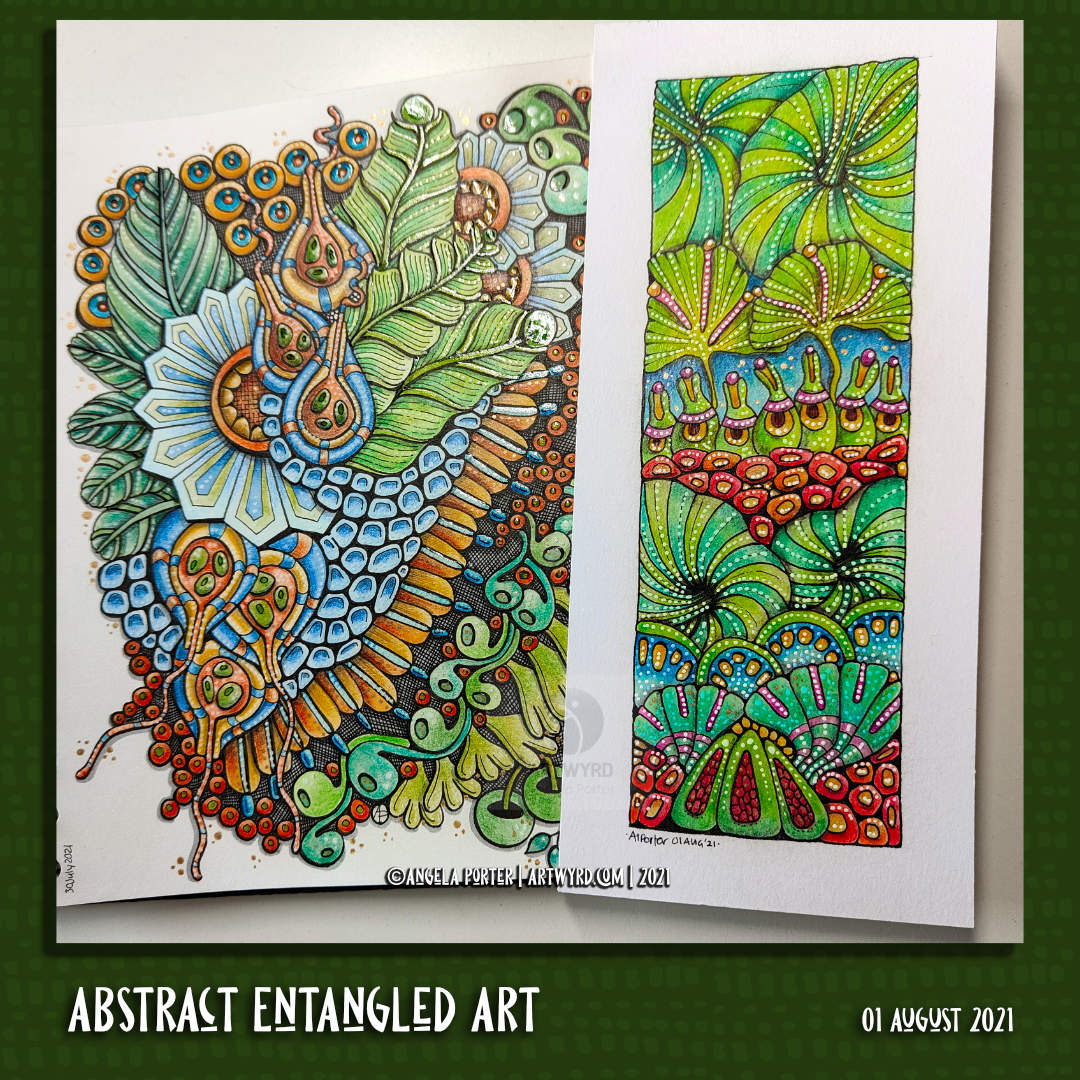
Abstract Entangled Art | 01/08/2021

Yesterday, I took quite a large wedge of time to intensify the colours and adding shadow and embellishments to the art in my last blog post.

To do this, I used Derwent Colorsoft pencils, along with a blender pencil. The embellishments were added with White Sakura Soufflé, gold Sakura Metalic Gelly Roll, and clear Sakura Glaze pens.

It’s difficult to show the effect of the glaze pen on the artwork, though you can pick some up in the top right of the artwork on the left.

Is this the magic formula for me working with colour? A limited colour palette, simple watercolour washes, shadows added with a grey pen, intense colours with pencils, and embellishments with various pens? Maybe.

The drawing to the right was testing this idea out, though I didn’t use a grey pen to add shadows but a grey pencil. I really enjoyed how the coloured pencils added colour and depth to the artwork.

Too many dots? I don’t know. Probably. I do tend to get carried away with them!

I have learned that I can’t use the Zest-it blending fluid anymore – my asthmatic chest doesn’t like it at all! The Derwent blending pencils are a bit abrasive and moved some of the black pigment from the drawing. So, I switched to a Faber-Castell Blending pencil, and that worked just fine.

I also noticed that the blending pencil made the colours more vibrant – both the coloured pencils and the background watercolour wash. I think it’s because it leaves a glossy sheen, which I bring out by ‘polishing’ with a paper towel.

So, lots of learning and experiences yesterday and this morning, and perhaps progress in my use of colour by mixing media to my advantage.

Have an open heart – part 2 – adding color

A time lapse video of me adding colour to yesterday’s drawing. Please click on ‘view in YouTube’ so it can count the views! If you like the video, give it a thumbs up and consider subscribing to my channel.

I’m not paid, sponsored nor gifted any product in order to promote or review any product. I show them just in case you’re interested in what I use, that’s all.

Tuesday En-Tanglings

Central focal image – Tim Holtz’s Ephemera.
Various designer series papers as the mats for the focal image.
Overall artwork size approx 7″ x 8″ (18cm x 21cm)
Distress Ink to colour papers and mats. Mossy green Staedtler Triplus fineliner. Black 03 Unipin pen. Mossy green and black Carbothello pastel pencils.

This one I am happy with. For cartouches/frames I prefer to work in borders rather than a rambling series of patterns and motifs. This seems to satisfy my love of symmetry/balance, yet still allows the use of organic patterns. I really did breathe a sigh of relief when I completed this one.

I am considering adding either colour or metallic ink to the seeds in the outermost border, possibly some shadow within each triangular motif as I realised I forgot to do that.

I did start work on another similar project. I’m really not happy with the penwork. So, I’m going to remove the central motif and mount it on a new piece of paper on which I can draw the borders/frame/cartouche. Not everything has been lost in this case.

Zentangle Cartouches

Over the past two or so days, I’ve not been feeling quite right. I’ve spent a lot of time cwtched up in bed, and about the only art I’ve felt like doing is small projects that I don’t feel overwhelmed by.

Zentangle Cartouches

I saw the idea of zentangle cartouches on the Zentangle YouTube channel a little while back and wanted to give them a go. I’d done one a little while ago where I’d used some vintage rose ephemera from a set of Tim Holtz’s Field Notes ephemera on a piece of natural coloured mixed media paper. I wasn’t at all sure with what I’d ended up with. However, I did want to revisit this idea once again.

So, I decided to explore the idea of cartouches once again. This time, I used smaller pieces of creamy Fabriano Medioevalis paper, which comes sized to 3.3″ x 5.2″ (85mm x 132mm), with lovely rough edges. This is really soft paper, the surface is easily damaged by using a tortillon too roughly.

I added the focal points, again from the Field Notes ephemera by Tim Holtz, along with some little quotes. The quotes are from the sets of ‘chit chat’ stickers, again by Tim Holtz. These items are in my stash from the days I messed around with mixed media, before I realised it really wasn’t quite for me. I admire what people can do with mixed media, but I just never seem to have found my way with it in a way that I’m happy with. I’m much happier wielding a pen (on paper or digitally) with love and a creative heart, than getting rather messy and frustrated with mixed media.

My Reflections on these Cartouches

Anyways, I’ve had mixed results with these experiments in cartouches. My favourite is ‘trust your crazy ideas’, closely followed by ‘be you, bravely’, then ‘treasure. ‘stay curious’ and ‘don’t forget to fly’ are very close to these in how much I like them.

‘trust your crazy ideas’ just seems to have colours and patterns that work harmoniously both with each other and with the mushrooms. Perhaps I got a little close to the motif with the pen work, something for me to consider with future projects of this ilk.

‘trust your crazy ideas and ‘be you, bravely’ are both designs that have a small number of different patterns on them.

‘treasure’ is similar in that respect, but it feels unbalanced. I think I need to consider where I put the central motif; more centrally may work in my favour. ‘stay curious’ is a much more balanced design than ‘treasure’, because I consciously decided to mirror the patterns used, even though the motif was not placed centrally.

‘don’t forget to fly’ is just not a coherent design at all. I like the borders and the seed pods around the motif, but then it all goes weird.

However, I’m really not at all pleased with ‘live gently upon this earth’. It’s incoherent, too many colours, and the words and motif are just not balanced at all. I would’ve been better with not adding the words to this one in the first place.

Actually. It may be that I don’t add the words until the design is finished, at the bottom as a kind of plaque or border, or floating over an area of the cartouche with a border around them, or just not use them at all. I need to experiment with these.

My own ephemera designs?

I also know I’m quite capable, I think, of drawing my own ‘epehemera’ to add as focal points. However, as I tend to draw at a much bigger scale, I’d either need to scan my drawing in, or draw digitally, and reduce the scale before printing them out. At this time, I have a laser printer, which is great for printing documents and so on but not so much for artwork. It changes the surface properties of the paper used. Also, I can’t use specialist art paper with the printer. If I’m going to go down this route of arty expression I think I need to consider changing this printer for an inkjet printer again, especially one that has waterproof, or at least water resistant, ink.

What to do with my artwork?

My home is increasingly becoming filled with my artwork. Most of it I have digital versions of them – either scans or photographs. I do need to decide what to do with my artwork as I really do need to let it go to new homes. Any suggestions, drop me a comment!

Also, I have a problem with putting a price on my artwork, if I were to sell it. I have absolutely no idea of what it’s value could be to other people, or even if anyone would want to purchase it. Again, any suggestions, drop me a comment! Any help or advice would be much appreciated.

Custom Sketchbook

The sketchbook

Last weekend, I made a small sketchbook that would hold approx 4″ x 4″ pieces of paper that was held together by book binding rings. I thought this would be a good idea as I like to work on small pieces of paper.

Then, last night I tried taking some prints from alcohol ink designs on A5 paper. I really didn’t want to cut them up to fit into the smaller custom sketchbook. I also didn’t want to use the metal binding rings again.

I woke this morning with the idea to use a disc binding system to create a custom sketchbook-come-art-journal.

I have been using an A5 Arteza mixed-media sketchbook for this, but it has rapidly become very, very wedge-shaped. I also realised that I want something where I can add a variety of sizes and types of paper, as well as move them around to suit my needs. A disc bound system seems to be the best way for me to do this.

I’ve yet to work out a way to make a hard cover for the sketchbook. For now, I made each cover from two sheets of A4 pearlescent card glued together. They’ll be sturdy enough until I work out how to reinforce them in some way.

I decided to place the disc binding on the landscape edge, just for a bit of a change, no other reason. I’ll be able to take the paper out of the binding to work on. This actually suits me just fine as the spines of sketchbooks really irk me when I work in them, be they sewn or spiral bound.

What I also like about the disc binding system compared to the book binding ring is that the holes in the paper are much closer to the edge. It’ll be much easier to leave a ‘margin’ on the paper.

Of course, there’ll be plenty of times when I’ll work in a commercially produced sketchbook still, especially as I’ve now rediscovered the joy of using one again. However, the ability to colour paper, use different kinds of paper and sizes of paper really appeals to me as a variation on the sketchbook theme.

The different sizes of papers also add a bit of intrigue to the sketchbook. There are glimpses of other designs and backgrounds further on that add to curiosity.

I can choose to add notes either to the back of the work or on sheets of dot-grid or squared paper I’ve added.

Nor am I precluded from adding journaling elements such as envelopes and pages with pockets, for instance.

Abstract art

The top page is an abstract drawing I completed this morning. The colour and pattern on the paper (a piece of ClaireFontaine Paint-On mixed media paper) was added by taking a print from alcohol inks on Yupo paper.

I spent some time yesterday evening experimenting with alcohol inks on Yupo paper (a synthetic paper). Once I was happy with what I’d made, I added some Alcohol Lift-Ink and used a brayer to spread it over the design. Quickly, I placed a sheet of mixed-media paper on top and allowed the alcohol inks to be transferred. If you’d like to know more about this technique, pop over to the Lavinia Stamps YouTube channel; they have lots of videos showing how this is done.

The inks lose their vibrance and become more muted when this is done, but it means it’s much easier to draw on the design without wrecking pens in the process.

I used Pitt Artist Pens by Faber-Castell to draw the abstract design on the paper. Once I was happy with the design, I added some metallic/pearlescent paints in shades of orange and yellow to some of the white/pale circles in the design. Sadly, the photograph hasn’t picked this up.

I decided to not to cover the whole paper with the drawn design. I wanted to leave some areas of the background as they were.

I really enjoy working like this – creating a colourful, textured background which I then use as inspiration for the line-work. It is, for me, a very meditative process. Of course, patterns and forms appear that I can then use in future artwork.

Of course, I could choose to intensify the colours in select places using any variety of media. Today, I have chosen to leave this as it is. I may scan it in and try this out digitally at another time.

Digital or Traditional Art?

Both! For me anyway. I do love working in both ways, and using them in concert too.

I love the portability and smaller scale of paper and pen/pencil, as well as using other traditional art and craft media.

I also love creating art digitally, sometimes using backgrounds I’ve created using traditional media or pen and ink drawings.

Each has their pros and cons. Each allows me to do things that the other can’t.

One thing I do know, however, is it takes time to become skillful in each and also to find your own artistic voice (or voices) for each medium used.

Which I use at any given time depends on the style of art I need to do, what kind of ‘finish’ I want with it, and also what my arty heart and soul requires at the time to be content and happy.

No matter which I use, I’m constantly trying new things out, or revisiting old techniques with fresh eyes and ideas. Of course, changing media and methods also freshens up my art and recharges my motivation when it’s in ebb rather than flow.

Stress, motivation and inspiration

This week has been dominated by stress from venturing forth from my home for the first time since March. When I’m anxious/stressed it can be incredibly difficult to settle to anything. Also, I can easily feel overwhelmed by even the simplest tasks. Activities that usually soothe me can irritate me. My ability to focus on anything approaches a vanishing point rather rapidly.

Working in a sketchbook has helped; there is then no pressure to create a finished piece of work, or even to finish any sketch or artwork. It’s just about doing and enjoying and exploring. I let go of my expectations of artistic success and replace them with expectations of finding some peace and contentment in the whirl of emotions I experience at times like this.

I find it hard to be motivated to create, and even more difficult to find inspiration. I tend to slip back into old, familiar and self-comforting styles of creating art.

Hence this style of abstract art.

Even when I do slip into a familiar style, the art produced may be familiar, but it’s moved along, altered either subtly or more noticeably showing the progress I’m making artistically. It also reflects the current variations in the particular fugue that my artistic voice wants to sing to satisfy it. My artistic voice, song, doesn’t have one tune, it has many, plenty of which are yet to be discovered.

Flower?

I’ve spent several hours exploring and trying ideas out in the realms of both digital and abstract art, and this is the result.

I’m really not at all sure about it in any shape or form. I think I was influenced by watching a few YouTube videos about mixed media and abstract art.

It’s been an “interesting” time, as well as a frustrating time in some ways. I also have a bit issue with choice of colours.

I’m pleased to say that I’ve calmed down an awful lot from the stresses of the last week or so. I actually slept for nearly 12 hours last night, which happens once all the adrenaline/cortisol have left my body. It’s nice to be back to my ‘normal’ state of contentment.

Art Journal Bits and Bobs

Art Journal Bits and Bobs © Angela Porter |Artwyrd.com

I’ve become a bit obsessed with making art journal bits and bobs over the last couple of days. This morning has been no exception, other than the more I do and watch, the more ideas that come to me.

Inchies

Yesterday, I created some blank, printable, templates for inchies, twinches and tea cards. I printed them out on plain paper so I could draw in them. I also made a list of themes I could tackle for them too.

I spent an hour or two filling in a sheet of inches with various designs. Then, I printed them on plain paper and also vellum for calligraphy. The vellum has a rough texture, interesting colours and subtle patterns in them. I have a laser printer, so wasn’t sure if it would print on the vellum; it did, however the print does come off if I’m a bit rough with it.

Nevertheless, I coloured some of the inches with Distress Inks and then adhered them to some 1″ tiles of thick chipboard card. I edged them with tresure gold wax from Imagination Crafts. Then, I gently applied a thin layer of Ranger’s gloss multi-media medium, to see if it would seal the laser printing; it did! It also brought out the colours of the Distress Inks.

Seed packets/envelopes

These are simple enough to make. There are plenty of tutorials online for them. I made them from ordinary printer paper, then coloured them with Distress Inks.

Next, I added some dot embellishments using a small ball tool with Imagination Crafts’ Starlights metallic paint in rich gold. This is a beautiful, glittery, shiny paint that leaves some dimension when applied this way.

Finally, I adhered the inchies I’d made, along with some vintage book paper, to the envelopes.

I’m not sure if these envelopes are finished. I do want to use them to store either journaling notes in, or little pieces of art or mementos in them.

Tags

I haven’t been at all sure about tags and using them. However, I thought I’d see what I could do with them after yesterday’s mucking about with a tri-fold tag that turned into one single tag.

I wanted to make some templates for cutting the corners at the top of the tags, so I did that, using various widths of paper and slopes to remove the top corners.

I then realised I needed something to store them in, so I made an envelope for them.

The envelope has a more rectangular top flap and a plain front, perfect for embellishments.

Backgrounds

Something occurred to me this morning while watching someone make tags using background paper. I thought that I could use my colouring sheets and entangled designs as my own background paper. So, I thought I’d try to use some.

I found some old designs on my computer and printed a couple of them both as the black line originals and with a grey line.

I made a tag and cut out a piece of one of the designs. I coloured the design with Distress Inks and used them to subtly colour the tag.

I didn’t like the way the neatly cut out background pattern looked when I placed it on the tag. So, I tore the edges. I still wasn’t happy, so I tried tearing it into strips. That looked better, but I still wasn’t happy with it, but I stuck the pieces down.

I used a gold glitter gel pen to add lines and patterns between the torn pieces, which created some pattern and interest.

Finally, I added a distress ink coloured belly band along with a word, “creativity” to the tag. For now, I tucked one of the seed packets behind the belly band.

The background drawing may be just too busy, detailed, and varied to work well. I need to bear this in mind going forward.

Notebook

I am keeping notes of how I make tags, pockets, and other bits and bobs in an A5 dot grid notebook, along with ideas for other things to do or try. It’s turning out to be rather useful as a reference.

Acceptance

I’m struggling with accepting that what I’m creating for my art journal is “good enough”, “attractive enough”, “pretty”. It’s not like others I’ve seen, which is part of my problem.

I seem to like, mostly, neat edges, borders on work, very organised, neat, and carefully, geometrically arranged elements in my designs. I know I want to use my own artwork to create a journal, but I’m not sure it’s going to be successful in any kind of way. I have no idea if I’m on a wild goose chase.

I know I enjoy making these bits and bobs, I just don’t know if the overall end products actually work, so I’m doubting myself. I’m not sure I like what I’m creating. I mean, I really like individual elements such as the inchies and little panels on the envelopes. It’s when I start to actually combine them or put them into a journal that it all seems to go more than a bit skew-iffy.

I’m at that uncomfortable place I often find myself in when I’m creating a mandala or drawing or digital painting; partway through I want to give up as I think that what I’m creating is awful and not working. With the mandalas, drawings and digital art, I’ve learned to work through that point and, mostly, to complete the work. I’ve learned by experience and perseverance that I can produce art I’m happy with.

I’m not at all sure of that with this art journal type stuff. I’m not sure at all if I can find my own creative ‘voice’ with this, or whether I have to accept that as much as I’d like it to be one of my ‘things’ it’s not meant to be and that I can continue to watch and admire others for what they create.

Maybe, I’ll end up making digital elements for journals for others to use in their creations. Maybe, I’ll find that collections of inchies are my thing (along with twinchies and tea cards and other little designs).

For now, I’ll take a bit of a break from it all, and come back to it with fresh eyes and a fresh mind.