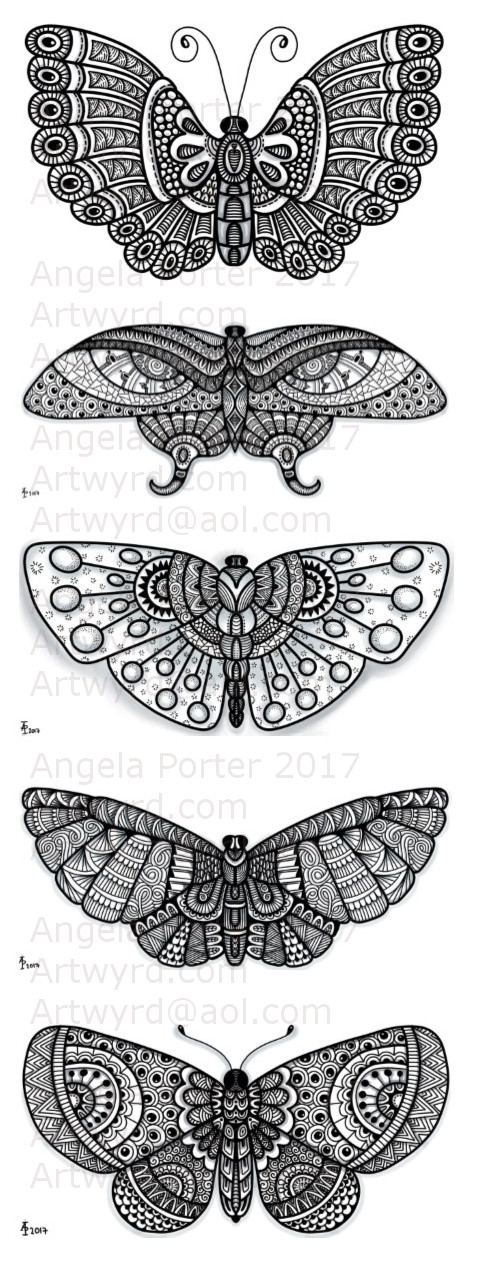
Another four patterned butterflies, drawn using Autodesk Sketchbook Pro on a Microsoft Surface Pen with the Microsoft Surface Pen as the input device.
Another four patterned butterflies, drawn using Autodesk Sketchbook Pro on a Microsoft Surface Pen with the Microsoft Surface Pen as the input device.


I used Autodesk Sketchbook Pro on my Microsoft Surface Book along with my Surface Pen to add patterns and shading to two of the butterfly outline designs I drew yesterday. I’m happy with the results.
Today I’ve also created two more dot mandalas, each around 5″ in diameter. I added some gems to those, as well as to the small dot mandalas I created over the last couple of days. The sparkle really adds something special to them, and helps to emphasise the circularity of mandala designs.
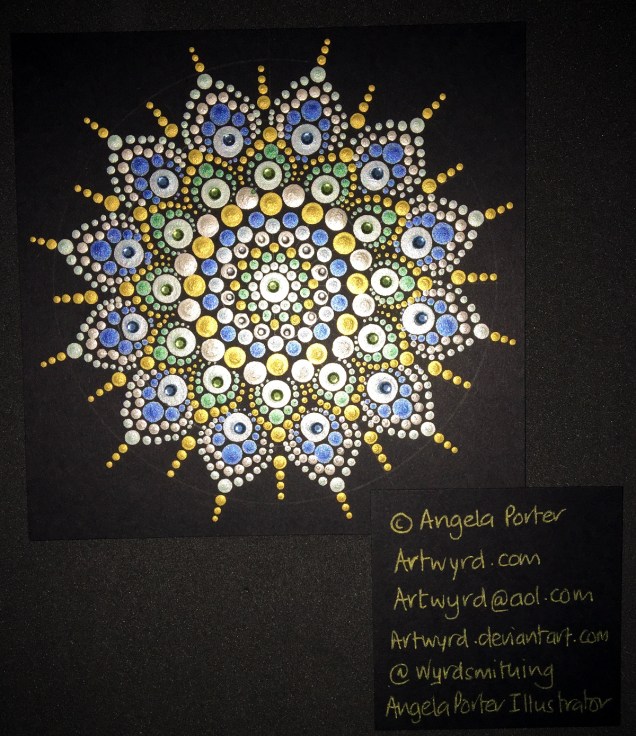
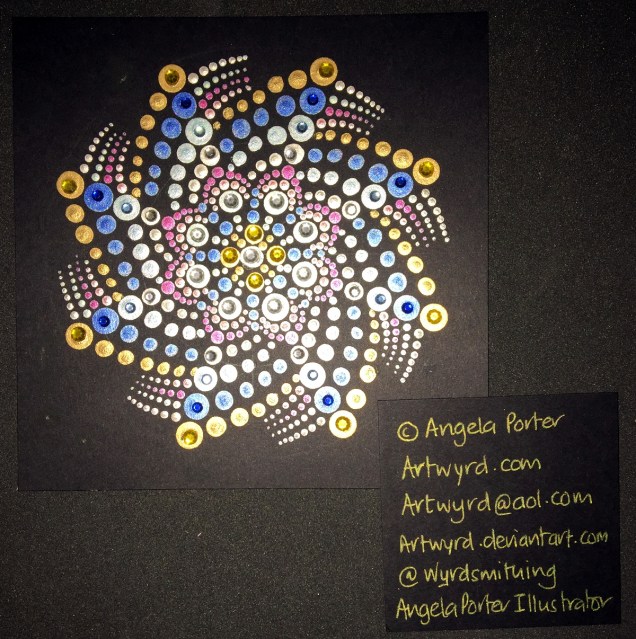


Over the past couple of days I’ve continued working on my Microsoft Surface Book using Autodesk Sketchbook Pro to create digital images for used in card making and mixed media projects. IFungi and butterflies have been my chosen subjects, and you can see some of them in the images above. They’ve also been digitally coloured, though I’ve still got dots and lines to add to them to give more depth and dimension to them.
They’re all now cut out and sitting waiting to be used in various projects. There’s still more drawings carefully filed away on the Surface Book for future uses…


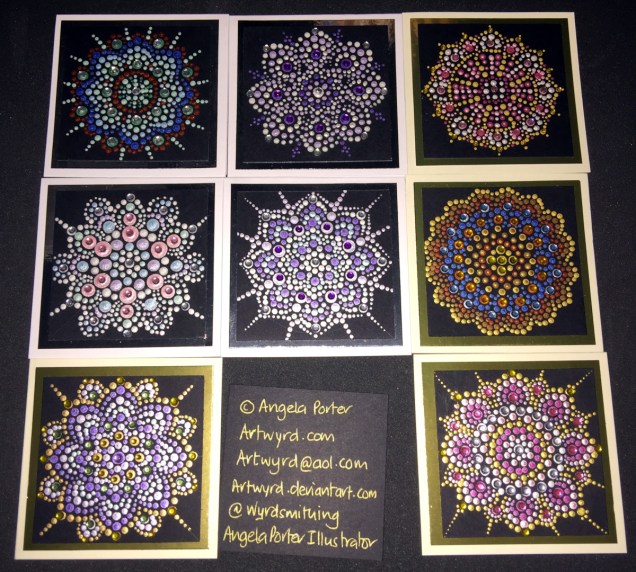
I’ve also have a bit of fun creating some teeny-tiny dot mandalas. Each card base is just 3″ x 3″ (approx. 7.5cm x 7.5cm). The black card I used as the substrate is 2½” square (approx. 6.25cm).
The acrylic paints I used are either metallic or pearlescent, so they do catch the light rather nicely.

Over the past few days, I’ve been spending a lot of time exploring Autodesk Sketchbook Pro on my Microsoft Surface Book.
I’ve been playing with colouring things, mostly in a very ‘flat’, almost marker-like kind of way, but also trying out different digital mediums and textures.
In the last hour or two, I thought I’d give drawing with pencil and pastel a go, something I’ve not been happy working with in the digital environment. This is partly due, I think, to me not being familiar with working with the Surface Pen and becoming comfortable with drawing where I don’t rest my hand on the substrate I’m working on. It’s only through working and working with the Surface and Surface Pen have I achieved this, and unconsciously so. Perseverance really does pay off.
This is my first drawing with pencil and pastel on the Surface … and I’m quite happy with it. It’s certainly something I’m going to work at a lot more.

Two index cards worked on over the last day or two. The focal points are shells I drew, first on paper, then the image was worked on on my Surface book with Autodesk Sketchbook Pro and my Surface Pen,
I had to use scissors to cut out the shells (not my favourite task as I’m not good with scissors) after I’d coloured them using the Chameleon Color Tones and Color Tops marker pens. I’m really pleased with the colouring.
Lots of different techniques/media were used on the index cards – stamping, stenciling, inktense pencils, distress inks and distress oxide inks, pebeo dyna paints, perfect pearls sprays, gesso, clear holographic embossing powder from WOW!
I’m happy with them, though I’m not sure they’re quite finished, especially the little one.
I’m beginning to build up a library of my own digital drawings – fungi, flowers, shells at the moment, oh and one angler fish skeleton that I’ve not used yet (but that’s an idea for later or tomorrow maybe).
I have to decide if I put these images together as packs of ‘digi-stamps’ for sale…I’m really pleased with my shells here, but the fungi have worked out fine too. With my limited scissor skills, I’m keeping it in mind I need to keep the outlines relatively simple, but the inside of the design can be rather detailed, which is fun.
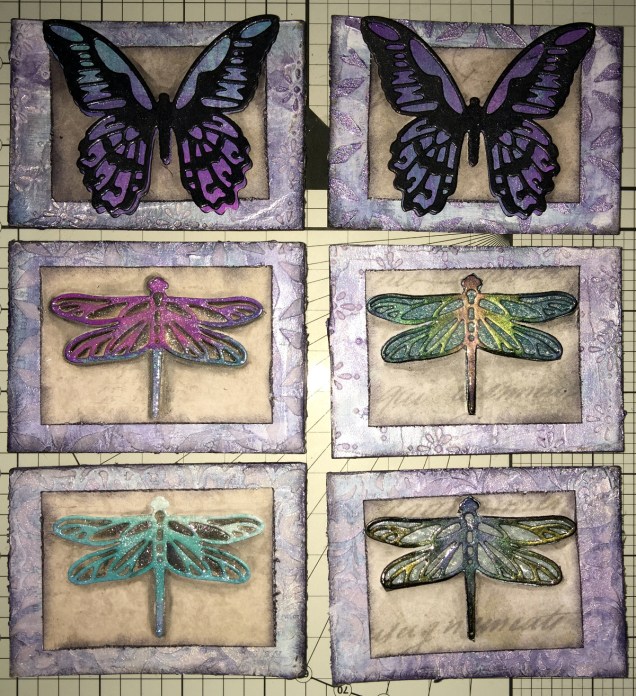
Today I’ve created a set of six ACEO/ATC cards using dragonflies and butterflies as focal images.
The photograph doesn’t do them much justice; the backgrounds are shiny purple and silver with some stenciled patterns created using modelling paste. Peeking through in places are patterns from some reprints of first series Ordnance Survey maps as well as some torn text from an old mathematics text book.
I couldn’t work out how to use my cogs and gears on these, but remembered all the patterned paper I have, so I had a bit of a furtle through and found some paper that looked nice against the busy background, which also the focal images looked good on. Indeed, they look like mounted specimens.
I got the focal images from my stash, already painted. However, I did put some painted and embossed papers behind the wings of two of the dragonflies, which looks quite nice. I did add a wash of iridescent medium to all the focal images (can’t avoid adding some sparkle).
On returning from an appointment, I decided I would cover the dragonflies with 3D Crystal Lacquer, which has worked out really well I think (difficult to photograph though).
I’m really quite pleased with these ACEOs/ATCs; they’re simple, yet they just work and satisfy my need for ornate, sparkle and shine. I’m glad I used the patterned paper to crated a calmer centre to mount the focal images on.
I don’t think I’m going to add any words/quotes to these, though a few gems or similar may be in order once the crystal lacquer has fully dried.
One thing I thought of as I was using the die cuts for focal images, is that I do need to find the confidence/courage to draw my own. I have done some fungi, flowers and ammonites, but haven’t printed them out at the right size, yet.
Also, it may be that using the surface to do drawings for this may not be the best way for me to work; my drawings do tend to turn out a little too ‘perfect’ for my liking in some ways. I’m still doing my best to work out how I can get my Surface Book to work for me as I’d like it too. However, if I don’t use the smoothing tools in the software, the pen wobble just is totally annoying (it’s also something that is inherent in the Surface Pen/Surface book, which I really hope Microsoft will do something about sooner rather than later.
It’s really easy to use dies to cut out images for use, but to create my own…well…but we’ll see if I manage to use my own drawings in the next batch of ACEOs/ATCs.
So, my job this evening (apart from going out to do some food shopping) is to do some drawings, on watercolour paper I think, to cut out and use as focal images.
Oh, using scissors is a bit of an issue for me. Despite me being right handed with pens and so on, I use scissors in my left hand. In fact, there are quite a few things I can do with either hand, and many things I’m equally as bad at with either hand, such as using a badminton racquet or golf club! Don’t ask. Anyway, back to the scissors. I’ve always struggled using scissors well, and I’m worse with left-handed scissors than I am with right-handed scissors. Craft knives and me tend to be a slightly dangerous pairing – for me, not for anyone else! I’m ok if I’m using a rule to cut straight lines, but anything else, well …
So, I will persevere, and perhaps the mistakes I make won’t be as noticeable to myself…


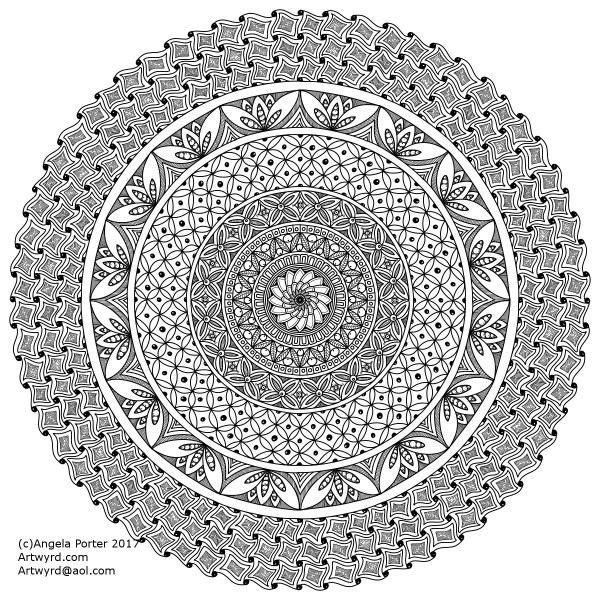

This morning, I’ve drawn the two mandalas above. I used Autodesk Sketchbook Pro on my Microsoft Surface Book to do this.
I’m gradually exploring the features of Sketchbook Pro, and the more I use it, the more I like it, though making the transition from paper to digital drawing isn’t as easy as I thought it would be. This is mainly because I find it hard to work at a detail level that doesn’t require a magnifying glass to see the detail or to add colour – particularly important when I’m doing work for colouring books.
This is partly because of the ability to zoom in so much on the artwork, and partly due to the screen size on my Surface Book being a little smaller than A4.
I have considered getting a Surface Studio, but that’s on hold until I’m sure I really want to go down the digital drawing route. Having such a big screen is an alluring prospect, being able to work on the paper size at it’s actual size…but I’m still thinking about it. Maybe when I find out my tax bill for the previous financial year I’ll make my mind up.
Now, these aren’t the first mandalas I’ve drawn using Sketchbook Pro. In the past three or four days I’ve some some small ones (approx 3″x3″) to print out, colour and mount on blank greeting cards to be sold to raise money for Mia Chambers, Rainbow Warrior Princess to get her to America for experimental cancer treatment not available in the UK.
What I’ve always found tedious as well as a tad challenging mathematically, is setting out the angles and so on for a symmetrical mandala. Sketchbook pro makes that easy for sure, as well as saving on the time in creating symmetry.
I’m still struggling with the idea that I may be ‘cheating’ by doing this. However, I can logically accept that the tools available in Sketchbook Pro allow me to focus on my creativity far more. Also, the ability to zoom in means I can add details and so on I couldn’t do easily when working on paper.
I have used mandala templates I’ve drawn on paper and scanned in Sketchbook pro to draw mandalas, as well as using sketched out designs so I can neaten up the sketch and add details (it saves erasing pencil lines and the mess and wrinkled paper and smudged in that can result). I don’t really need to mention how easy it is to undo mistakes.
Certainly, the symmetry option makes creating these mandalas a lot quicker, and because I don’t strive for total perfection in the hand-drawn lines or added patterns, then even though the mandalas are drawn in a digital environment, they still have that feeling of being drawn by hand, which makes me happy – they’re still ‘perfectly imperfect’!
Of course, I’ve not really got to grips with colouring the designs in Sketchbook Pro, so printing them out and adding colour using a chosen medium is still my favoured way of working. Also, I can add things like metallic highlights and sparkly gems to the mandalas, plenty of which appears on the cards I’ve made as well as the mandalas I’ve framed in order to raise money for little Mia.
I was pleased to be told by Shelly and Kelly at Faction Apps that there’s been an update to the Colorist app. That means I had to have another play!
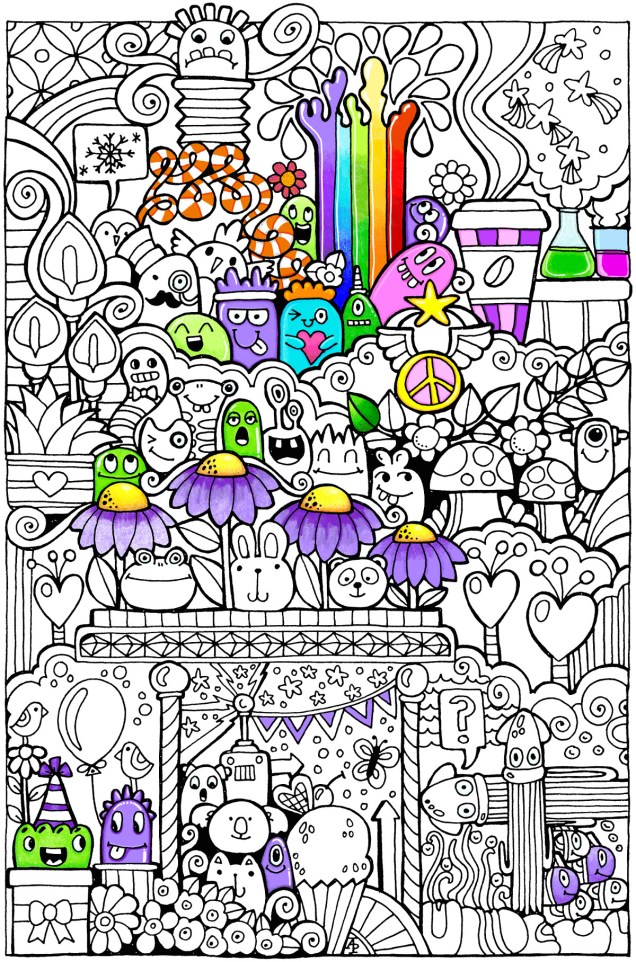
The image above is one from my first book for the Colorist app – Doodle Worlds. Many areas have been filled in using the original pencil tool, which is great as it allows for overlaying of colours as well as being pressure sensitive if your device allows for that (my Microsoft Surface Book certainly does!).
It took me a while to get used to how the pencil works in the app, but that’s not a problem as either the undo or eraser tools allow you to completely remove anything you’re not happy with. (The eraser is also useful for removing colour to create a highlight!).
One of the new tools is a bucket-fill, which is great for filling areas with flat, solid colour. I used this tool for the pink monster. The pencil tool can then be used to add shading/highlights over the base colour.
A useful tool is the bucket tool as it allows for quickly filling areas with a solid colour, even teeny-tiny areas thanks to the ability to zoom in on the image! This saves some time and effort, which can then be spent on carefully adding the shading and highlights to the area.
This is my favourite addition to the tool box in the Colorist app! I love the solid colour it lays down. The colours aren’t transparent, however, so blending isn’t yet possible with them ( perhaps that’ll appear in a future update of the app). Markers (especially Chameleon pens) are my favourite way of adding colour to drawings like this on paper, so I look forward to this tool being developed more in the future (fingers crossed and maybe a bit of pleading from me!).
What I love most about this tool is that I can draw and doodle and add texture and pattern to the image with the solid lines that I prefer in my art. I did this with ease on the flower next to the orange and white stripey twisty thing.
The wide range of colours available in the colour palette mean that highlights and shadows can be achieved, so long as a subtle blend from one colour to another isn’t required. However, I’ve just thought that a clever use of the pencil tool may allow this to happen. I’ll have to try that out!
I didn’t make any use of this tool, but I’m likely to in the future as it means that you can easily select a colour you’ve previously used in the image being coloured without going to the palette and ttrying to remember just which shade of, say, blue it was you used.
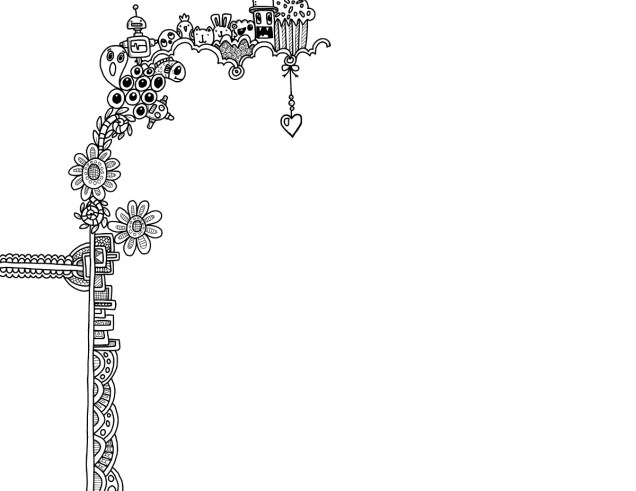
The ability to sketch within the app, and save the drawings too, is the fab new feature. I really like this, especially with the marker pen tool.
Usually, I use Autodesk Sketchbook for drawing on my Surface book. One of the weird things about drawing on the Surface with the pen is that there always seems to be some wobble in the line, even if the line drawn is smooth. Autodesk has a smoothing tool, which in the Pro version you can set to a level that suits the art you are doing at the time.
Although the Sketch function in Colorist doesn’t have the smoothing tool (yet?) it works just as well as Sketchbook for the kind of doodly, abstract, whimsical art I do. The image above is a drawing I did in Colorist last night, it took an hour or so to achieve.
I enjoyed using this function, though not being able to rotate the digi-paper meant it was a tad awkward for me to draw certain things. However, Colorist isn’t designed as a dedicated drawing/art app, but I do wonder if a ‘pro’ version could be developed where a small fee is paid for such a functionality. The latest updates certainly suggest to me that there’s a possibility that this could be a direction the app could take in the future.
I really like the updates, especially the marker and the sketch function. Congratulations to all at Faction Apps!
The suggestions I’ve made above for extending the additions in the future are not criticisms of the great updates made, but they would take this app beyond that of being just a colouring app, so I’m well aware they may not happen.
However, I do believe this app could evolve from being a colouring app into something more…
Yesterday, 11th November 2016, I woke with a desire to create a very simple poppy wreath to mark Armistice Day. Something to homour the memories of all who have lost their lives through conflict, no matter when or where. I’m sure we would all love to live in a world that is far more peaceful, where differences can be settled through discussion and coming to understand and respect one another, even if that means to agree to disagree.
If you’d like to download, print and colour it, please visit my facebook page – Angela Porter Illustrator . All I ask is that you respect it is for personal use only, not for sale, not for re-sale nor for publication. I’d like to see your coloured work, if you feel inclined to share 🙂
And here’s coloured version 1 – coloured in on my SurfaceBook.
Coloured version 2 below was completed using Faber-Castell’s Luminance pencils along with Zest-it blending solution. The glossy centres and glittery and glossy drops were added using Tonic Studios’ Crystal drops.


 Art is the Adventure