A change in blog name. Exploring collage.

The new name…

Yesterday, I did a live stream on YouTube, where I tried my hand at creating collage papers, making collage and mark making. It was an interesting experience, but more about that later on.

The topic of adventures came up in my wintering and the change in title is a result. For me, art is always an adventure. I’m always trying out new things, exploring older ways of working, and developing in my artistic expression.

Adventures aren’t necessarily big trips to far away places. There are so many little daily things that feel like adventures to me- the change in light through the day, the weather, the rhythm of the seasons and stars, the humourous behaviour of my neighbourhood jackdaws. There’s also reading new books, listening to stories and documentaries, trying new dishes, listening to music that is new to me, and so much more. I have a great deal of curiosity and desire to know more about myself and the world that I live in.

It’s a good thing that an adventure can be described as new ideas and grand mysteries. It’s about enjoying the journey with no time pressure, no idea of a destination, just a desire to discover more about how I like to express myself creatively and, through that, learn more about the more profound mystery that is me.

Over the years, I’ve dabbled a bit with collage but never really found how I like to use it other than as an interesting background in a sketchbook or maybe a pleasing arrangement of papers at the edge of a sketchbook page.

I love paper, however, and want to use different kinds of paper, and perhaps fabric, in my work. However, whenever I try to, it doesn’t feel right.

All of my artsy journey has been an adventure. I try out new things and retreat into the familiar when I feel uncomfortable with art, life, and myself. But even with familiar methods, things change due to experiences. Progress is always made. Lessons are learned. Insights are gained, especially from what I don’t like about something and what can be done to ‘fix’ it.

So, chatting in the live chat as I created part of this collage, the idea of my blog changed to reflect my description of how art is a great adventure. I thought of “Angela’s Adventures in Art,” but Judy suggested “Art is the Adventure.” I chose that, though I was tempted by “Art is the Way,” a bastardization of “This is the Way” from the Mandalorian.

And so, now the time is to change the name, but not the web address of my blog; that will remain artwyrd.com.

Collage

I am intrigued by collage, mark-making, and mixed media. Yet, whenever I’ve tried them in the past, I’ve usually felt disappointed in myself.

I remember looking at the collages by Juan Gris during my A Level and loving his work. I actually created a quite nice collage using his methodology. However, I never really followed it up. Yet, the distant memory still brings a sense of joy and, I think, excitement. I have problems identifying my emotions, and they are often faint to boot.

Anyway, I love the work of so many mixed media artists, and I admire their skills and creativity. Again, I’ve tried mixed media many times, and each time felt like a fishie out of water.

I’ve recently looked at collage and bought some books that demystify the process, or so I thought until I tried my hand.

I wasn’t happy with the colours. I glued papers down before I should have. I didn’t think about the scale of the page (A5) when I decided to put really thick black lines. I had to troubleshoot the mess I felt I made of the little leaves down the stem/trunk.

Today, I’ve spent sometime treating this page as a page to reflect on my experience and create a kind of journal page as a result. (Hence all the writing on the page). I’ve also added some patterns and makes in pen and watercolour.

Also, I made some more collage papers to try again. This time, I used Canson Imagine mixed media paper, as watercolours and Distress Inks work well enough on it.

I know I need to consider the size of the paper I’m using as a substrate when cutting or tearing the collage elements. The same is true for the pen thickness.

I have an inkling that my strength may be in more abstract work. Last night, I tried creating a collage that would look like a collection of buildings, but it didn’t feel right. That’s a good thing, though, as it’s something else to reflect upon and make notes on the page.

I really hope I can find my way with collage/mixed media. It will let me use my love of pen drawing, patterns, textures, symbols and stylised art in a different way. I have a desire to involve my love of different kinds of paper in my work.

At the moment, I just feel lost at sea, without a paddle or rudder, and at the whims of the currents of creativity and art.

I was dithering about showing this debacle of a collage publically. Then, I realised that if I am going to write about my arty adventures, then I need to recount the tougher, messier, unsuccessful parts.

The perfectionist and the messy debacle

I have been plagued by perfectionism all my life. I can get very disheartened when my desire for something pleasing to the eye and heart falls even a little bit short. In this case it falls, to my mind and heart, a lot short.

One thing I have learned that this is ok. I’ve learned that even if something is a messy ‘failure’ it is a success in many ways as it’s an opportunity to learn!

I certainly have a lot to learn from this particular collage mini-adventure. But the adventure isn’t over. I have some new coloured papers to use. I’m going to stick with the A5 sketchbook and work on a smaller scale and try out more abstract/stylised shapes. Keeping it simple to begin with may be a very good idea.

I like the idea of using the colours in the collage paper to be the colours used in any artwork, lettering, stitching etc.

And, if nothing else, learning that my adventure may be to discover that while collage and mixed media may not be for me, I can still enjoy the work of others. It may lead to new ideas, new techniques, a different way of deconstructing and reconstructing motifs and patterns going forward.

I can’t possibly predict how this side-adventure in my artsy adventure will work out. All I know is it will lead to interesting places with plenty of things to learn from the experiences it offers.

Small ‘aha’ designs

Lots of little drawings.

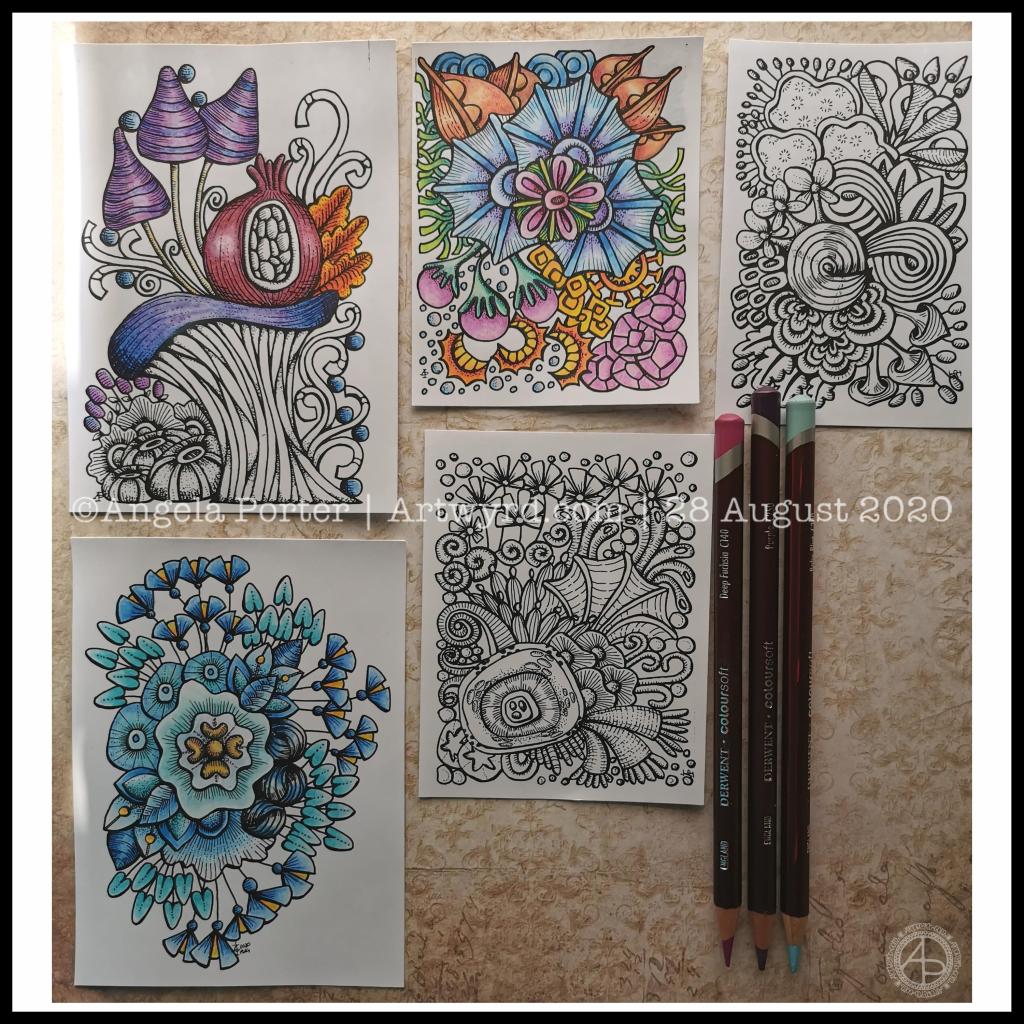
Over the past couple of days I’ve been drawing small designs in pen, including plenty of line detail to add volume and shadow.

Today, I scanned the drawings in and printed them out (after cleaning them up a tad digitally) so I could try colouring them.

I wanted to print them on mixed media paper, which I know my printer will take. However, even with clean scans, the prints were really messy. However, when printed on ordinary paper, the prints were pristine.

I wasn’t happy as I wanted to use a paper with a bit more ‘tooth’ so I could make use of the Derwent Colorsoft pencils. But, I persevered and the results are above.

The first I coloured is in the top middle. My colour sense isn’t always wonderful. Lots of colours, but it just doesn’t feel coherent in any kind of way.

So, I moved on to the next design. This time, I thought I’d use analogous colours (colours next to each other on the colour wheel), with a touch of a complementary colour to add brightness. Complementary colours are opposite each other on the colour wheel.

I like this second one much more. It feels cohesive, like everything belongs together. And the little bursts of yellow/orange just lift it all.

The third design I’ve been colouring is only partly done. I’ve veered away from entirely analogous colours, but I am trying to keep the colour palette simple and with, perhaps, an autumnal feel to it.

As I was working on printer paper, I needed to use some way to blend the colours. I remembered I had some ‘Zest-It’ blending solution and some paper torchons. They worked well. The big frustration was that I couldn’t lay down intense colour. However, as these are prints, I’m not too worried. I do need to find some toothy paper which will go in the main paper drawer of my printer. I do have some cartridge paper here somewhere which should go through it.

Of course, scanning the drawings in means I can also work on adding colour digitally. It means I can try things out until I’m happy with the results.

Pesky printers

I never have much luck with printers. Inkjet printers die on my quickly, even the more expensive professional ones. I thought I’d try a laser printer, but I seem to have problems with this one now not giving clean prints when I use the sheet feeder for specialist papers.

I don’t print much out, to be honest, but it’s frustrating when I want to print artwork out on specialist paper.

A note to self about colour.

What I have learned is that I like to watercolour the designs, but then the addition of coloured pencils to intensify the colours and add shadows works really well for me. I like the intense contrasts that I can get with coloured pencils that I just can’t seem to achieve with watercolours.

Of course, I can always colour digitally, which lets me play with colours, change them, until I get something I really like.

Today, I’ve had a reminder that limited palettes, particularly of analogous colours, seem to be working rather well for me, especially with those accents of complementary colours.

I really do need to put a big ‘note to self’ where I can see it to remind me of this. I can get carried away with colours

Watercolour Practice

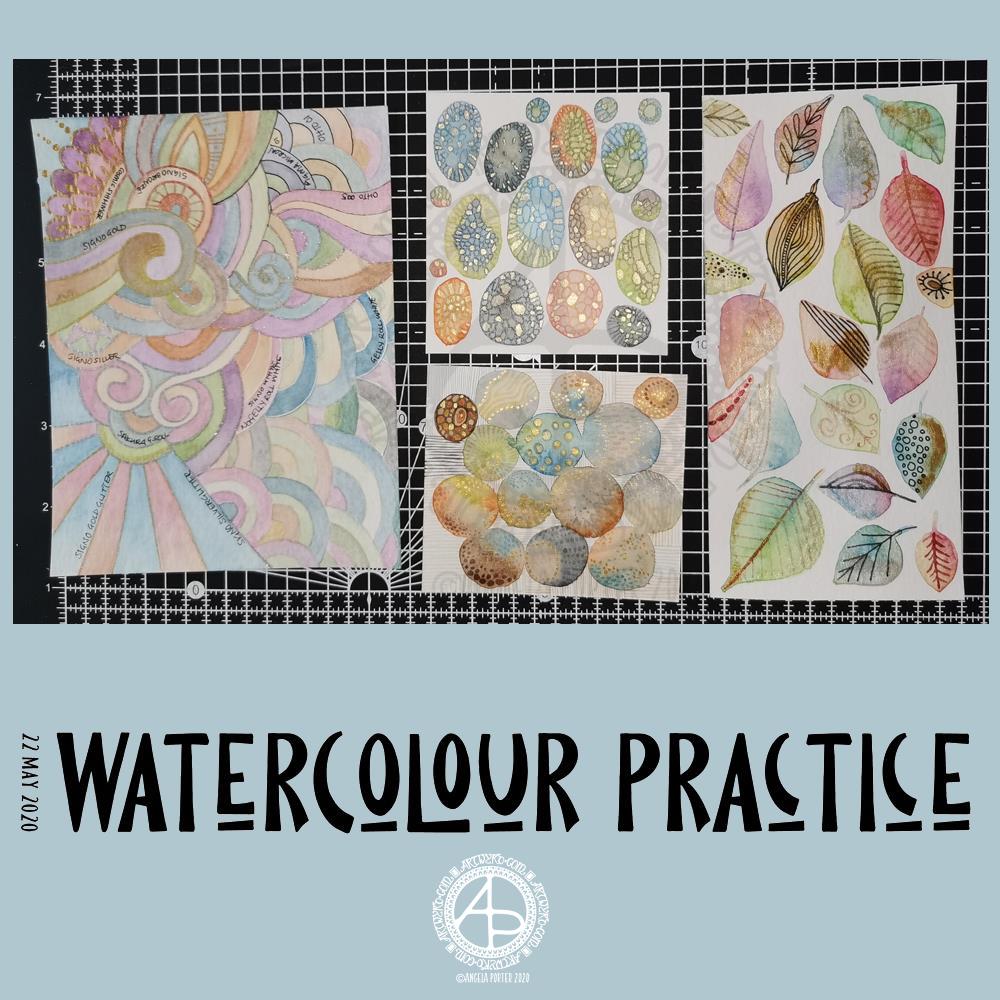
Yesterday was another day where I got lost in watercolour practice – unintentionally! I had planned to do some editing of drawings for ‘Entangled Gardens’. However, time ran away with me.

Panel 1

The first panel I completed was the one with leaves on. They do have plenty of gold metallic/iridescent watercolour paint along with traditional paint, though it doesn’t show up in the photo.

I tried different ways of adding details to the leaves – Faber-Castell Pitt Artist Pen (F) and metallic watercolour and brush. I find the black pen either too black or I used too thick a point. The metallics in a red-copper, gold and grey-black were more sympathetic to the colours of the leaves, in my opinion.

Panel 2

The next panel I created is the one at middle bottom. I made circles of watercolour and let them touch while wet so there was some flow of colour from one to another. After they’d dried I used a fine brush and both watercolours and metallic watercolours to add line and pattern to it.

I enjoyed making this one very much. I used some quite earthy colours that are unusual for me. The line and pattern added a lot of interest, though I did wonder if I’d covered up too much of the underlying watercolours.

Looking at this with fresh eyes today, I think it shows through just fine. I want to try using metallic paints that are complementary to the main colours in the watercolour to see how that works out.

Panel 3

This is the one at the middle top. I created ovals of watercolour, again using unusually muted, earthy tones.

Once they’d dried I used some Caran D’Ache Luminance coloured pencils, well sharpened, to add patterns to each oval. I used the variation in colour/tone to help me add the patterns, as well as to choose the colours of pencils I used on each oval.

Finally, I used a yellow-green metallic/iridescent watercolour paint to fill in some of the patterned areas.

I enjoyed making this panel too. Again, I thought when I finished it that the pencil lines were a bit thick. However, after a night’s sleep and with fresh eyes I can see that it’s worked out well. I think that using coloured fineliner pens may work out better than coloured pencils – something I’ll try another time.

Panel 4

The last panel I created yesterday was the fourth panel. I used a different kind of watercolour paper, by Tim Holtz. The paint just dried so quickly on it I couldn’t really drop colours in, though the paints would re-wet and I could blend colours that way. I didn’t really enjoy using this paper.

Anyway, I thought I’d make a typically ‘Angela’ entangled style painting. I did use a raw umber Caran D’Ache Luminance pencil to draw the design on the paper. This was such a pale colour it disappeared into the watercolour sections. Again, I used uncharacteristically earthy, muted colours.

The final panel was nice enough, however, it was lacking in pattern and interest. So, I decided to use it to experiment with different ways of adding outlines and pattern to the various sections. I also noted on the panel what method I’d used next to each one.

The metallic paints and pens worked nicely and were practically or totally opaque. I prefer using a pen rather than a brush, though I’d not be averse to adding line and pattern using a fine brush and watercolour.

The gold and silver Uniball Signo glitter pens worked really nicely, and because the glitter is suspended in a transparent ink, there’s interesting effect where the watercolour shows through. I actually really like this a lot.

I couldn’t find a gold Sakura Gelly Roll pen, so I used a silver one instead. This, surprisingly, wasn’t as shiny as the Signo silver pen, but it worked just as well in terms of opacity.

I tried two white gel pens – a Uniball Signo and Sakura Gelly Roll. Both seemed to be fairly opaque, the Sakura being very slightly more so.

Finally, I dug out some really fine black pens – 005 and 01 OHTO Graphic Liners and a 01 Sakura Pigma Micron. These worked much nicer than the thicker pen I’d used on the leaf panel.

Of course, I left some areas of the panel without any lines added for comparison.

Of all the pens I tried, I like the metallic and glitter gel pens the best for this.

On reflection…

I’ve found I really like to work on a smaller scale. I feel like I’m creating small ‘treasures’ full of interest and fascination. I’m happier working smaller and more detailed than I am working on a larger scale.

I want to try coloured fineliner pens to draw patterns on watercolours.

Another experiment will be for me to use metallic and plain acrylic and other inks to draw with. I do have a glass pen that will work nicely with indian ink and writing ink. I’ll have to dig some dip-nib pens out to try with the metallic acrylic paints as well as a brush. I think that ball tools could be used to dot spots of ink onto the work rather than a brush; something else to try.

I also need to find a way of leaving a border on the page! When I draw a colouring template or other piece of lineart, I start by drawing a pencil line to demarcate the area I want to draw in, leaving a border around the line. I need to do the same for watercolour panels, either using a pencil or masking or washi tape.

Something else I’ve worked out is that I tend to use too much water when I paint, and I need to experiment with using less and trying dropping colours in when the area is at different levels of dryness.

Lots of things to try and consider.

Doodling? Really?

I see a lot of people calling the addition of line, texture and pattern as part of an artwork ‘doodling’. I don’t like doodling being used in that way.

Here are the definitions for ‘doodle’ from Dictionary.com

verb (used with or without object), doo·dled, doo·dling.
*to draw or scribble idly:
He doodled during the whole lecture.
*to waste (time) in aimless or foolish activity.
noun
*a design, figure, or the like, made by idle scribbling.

https://www.dictionary.com/browse/doodling

When I add line or pattern to my drawing, it’s not an idle or unconscious activity. I deliberately choose what patterns and textures I want to use and where to place them. The process of adding the lines, patterns and textures may be a more mindful process if the pattern is familiar to me.

The lines, textures and patterns are used to add interest to elements of the overall design. But they are not meaningless, as implied in the words scribble and doodle, and they are anything but idle or mindless scribbles. There is purpose in them, and this is why the use of the word ‘doodle’ irks me!

What am I going to do with the panels?

The leafy panel I created to add to a tag to put in my journal. The other panels will also live in my journal, even the one with annotations, possibly with a pocket behind it for my notes and reflections!

Autumnal August Mandala 8

Yup, it’s the eighth one in the series this month.  I really have become hooked on mandalas this past week or two.  The repetition that’s necessary to complete them (well it is  the way I do them) is calming and meditative; that’s not just for drawing the outline, or for the colouring, but for all the texturing as well.

This one uses a rather unusual, for me any way, colour palette.  The background has been left white as I really don’t know what colour (or texture) to do it in.  Do I do earthy greys and black, rich earthy greens, blues the hues of autumnal day, twilight and night skies, or some other colour(s) that I’ve not considered yet?

It will come to me, and any suggestions are always welcome!

August Mandala 8 © Angela Porter 2013

And here it is with a background.  I’m ambivalent about the background; part of me likes it, part of methinks the colours are too similar to the mandala design, part of me wonders if I should have played around with colours more, and part of me thinks that the texture on the background should have been done in a copper metallic ink with dark inner shadows.

August Mandala 8 with background © Angela Porter 2013

After the break

AFter The Break © Angela Porter 2012

Sakura Micron pens on off-white cartridge paper.  Approx 16cm x 12cm.

A bit of a doodle/flowful/meditative drawing relating to my feelings about the big hoo-haa on Friday evening and were I go now.

I’m off work – lost my voice again.

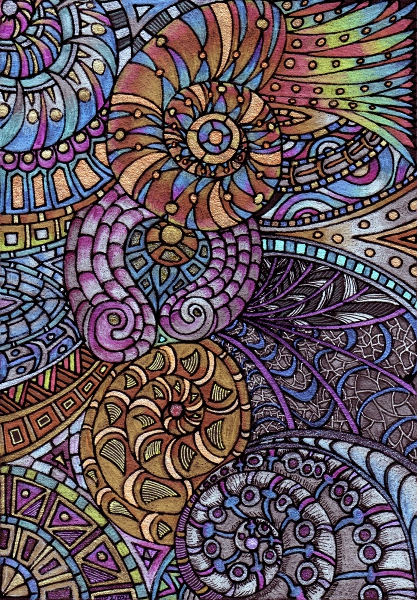
Today’s abstract psychedelic crazy art is…

abstract18Feb12©Angela Porter 2012

6.5″ x 9.25″ approx.

Sakura Glaze pen outline, various metallic pencils, paints and pens to fill in the design.

Totally lack inspiration for a title for this piece.  Inspiration from observations of ammonites, Romanesque and Gothic architecture, formanifera, leaf skeletons, webs…and just my imagination and intuitive way of creating art.  Turning black into glorious colour once again!