Entangled art and my artistic style

Link to real time video of drawing and chatting
Link to time lapse drawing video.

Today, I started my arty day with some entangled drawing and a chat based around some interesting questions posed to me by various people on social media yesterday. The questions got me thinking and talking about my particular drawing and art style.

What I’m realising is, I’ve never really be provoked into thinking about/talking about my art style and where it has come from! For me talking and thinking are the same thing – there are two styles of inner monologue. One is where you hear thoughts in sentences throughout the

The topic of inner speech has caused a stir on Twitter after the user KylePlantEmoji  put out his own observation on the matter. “Fun fact: some people have an internal narrative and some don’t,” he tweeted. “As in, some people’s thoughts are like sentences they ‘hear’, and some people just have abstract non-verbal thoughts, and have to consciously verbalize them. And most people aren’t aware of the other type of person.”

https://mymodernmet.com/inner-monologue/

I have a mix of them. My inner monologue is one that ruminates on the past, is self-critical and so on. But I also have abstract, non-verbal thoughts that I need to verbalise to be aware of them. So, if someone asks me a question about, say, my artistic style and where it comes from, then I have to verbalise thoughts about it. Until I’m forced in some way to verbalise these kinds of thoughts, I have no idea what they are. Same if I’m, say, sitting in nature, observing the world around me. My thoughts won’t be on what I’m experiencing. Often, there are no thoughts, unless I’m stuck in a ruminating, worrying and self-critical mode, which doesn’t happen all too often.

Until I read this, and other articles, I thought there was something wrong with me, because so many others seemed to think in their heads about lessons, or experiences, or the news. But I never seem to do so. Now, I know and understand why that is. I think in an abstract way that I’m not particularly aware of as such. It just happens.

So, creating these daily (almost) vlogs is forcing me to talk about my artistic style, choices, process, lessons and so on. And such it is making me more aware of myself as an artist.

Most importantly, however, it is helping me to understand the value of all these things validating my art to me.

Yes, I do have a bit of ‘imposter syndrome‘ going on when it comes to my accomplishments in life. But, talking about my artistic journey, and how far back it started and where the observational skills and so on started is helping me see it’s been an almost life-long journey. It’s also helping me to accept and understand my artistic voice(s), style(s) as being an expression of my experiences in life where art and observation are concerned.

There’s plenty about this (though not the inner monologue and imposter syndrome stuff) in today’s real-time vlog. It is around 53 minutes long, so I have created a time lapse version with music as well.

Sketchbook Flip-through and Pen Drawing

Today, I share a bit of a vlog . I flip through my sketchbook pages of the past week or so, chatting about them. Then, there’s a timelapse of myself drawing my latest entangled art.

Entangled Drawing WIP

Link to Time Lapse Video of Pen drawing (not adding colour though)

This morning, I spent over an hour starting work on this entangled pen drawing. I did film the process, but it’s recycling day, and the bin lorries and bin men were really noisy this morning. So, I turned the video into a timelapse with music. It lasts about 14 minutes, and the link to it is above this paragraph.

I remember chatting about my influences for this drawing, and they started with me watching a video from the “Journey to the Microcosmos” YouTube channel.

I’ve always loved microscopic images, being able to see things that are invisible to our naked eyes. There’s always a sense of wonder about it, amazement at the different shapes of the various organisms that become visible. That wonder must be the same as Antonie van Leeuwenhoek, a Dutch scientist of the 17th and 18th Centuries must have seen.

I loved drawing what I could see with the aid of a microscope from the first science lessons when I was 11 years of age, right through my degree and PhD and on through my teaching career too. And of course it was bound to creep into my art!

My memories of drawing diagrams of flowers and rock sections, minerals and scientific apparatus and diagrams are very fond indeed. This has certainly influenced my style of art – observing the tiny, abstracting the interesting (important) patterns and forms. Scientifically, the focus is on the features, structures, the important parts that allow identification or communicate the important features of what was seen. After all, photographs and videos can be made of all the glorious detail and colour.

The diagram is a simplified version, a map, that can help others to navigate their way around. A kind of scientific version of the map of the London Underground system. The map helps in navigating the system, but it bears no relationship to the physical layout of the rail lines and the geography of the city above.

Now, however, I take those observations and turn them into my own arty, entangled worlds of wonder. It is still the small parts that catch my attention, fill me with wonder and awe, are the ones I record, rarely the whole thing. If I visit an old church or abbey, I rarely, draw the building as a whole. I spend time looking and drawing the elements of it that capture my arty attention.

My sketchbook page often ends up of a collage of my visit, the various observations fitting together in a pleasing way. Often, I may join the elements together with imaginary lines or patterns. I may end up not with a drawing of the whole building; instead, I record my experience of the building at the day, time, season and weather I visited it.

The same is true for visits in nature, or to museums. My sketchbooks record what catches my attention, and that may not be the ‘whole’ of something, but just a part.

I’m still a scientist in my approach to art – what are the important forms, patterns, shapes, etc. that are the distillation of my experience, that I’d like to record and, maybe, share with others?

Of course, these observations find their way into my more Entangled art, like this one. The round orbs separated into three lobes were inspired by something I saw when watching one of the Journey to the Microcosmos videos. The flat leaves, by seaweed. The triangular pods are imaginary, though there may be real-world analogues of them from which inspiration was unknowingly gained. Curled, baby fiddlehead ferns are the inspiration for another motif in the drawing.

Inspiration indeed – based on observation, but interpreted and altered in a way that is personal to me.

I’m forever wondering what my artistic voice is, and here it is. At least one of the harmonic notes or chords anyway.

Inky Insects! A sketchbook page

Yesterday was a bit of an odd day. Between a couple of mediation meetings in the day and me still not feeling quite right – fatigued, headachy, tummy still not right – I just didn’t feel up to doing much when I was awake. Except for drawing. Drawing insects.

I started with pencil drawings and then decided to ink them in. I know from bitter experience how pencil drawings can quickly smudge and fade in a well used and referenced sketchbook.

I loved the delicate nature of the pencil drawings, but I know I can always draw in pencil again for future work involving bugs.

If you’d like to see some of the pencil drawings before they were inked in, then have a look at the time lapse video.

I started off with bugs that were quite true, in a simplified and stylised way, to the images I was looking at, Gradually, I found myself being more imaginative.

I now have a fair collection of insects in my sketchbook, and I am quite keen to add more! However, I really do need to turn my attention to the colouring book I’m working on for much of the rest of today.

Mushrooms and Insects!

Today’s Vlog (approx 33 mins long)

Watercolour Mushrooms!

I finished the mushroom painting! I was so engrossed in the magic of watercolour and wanting to complete this work that I spent most of yesterday working on it!

I’m really quite happy with the outcome. It was very much inspired by Danielle Donaldson, but I think I may have given it some little twists of my own too.

I’m also beginning to think that I can make watercolour work for me, with a mix of ‘tight’ shapes, the magic textures achieved by wet into wet, and details with gel pens and drawing pencil.

I added the dots with a mixture of white Posca, Uniball Signo and Sakura Gelly Roll pens. I also tried adding dots of gold from a metallic Gelly Roll pen. I like the metallic dots, though they don’t photograph well.

There’s only one thing better than mushrooms, and that’s more mushrooms!

I enjoyed this so much that I thought I’d do a smaller version on some of the Canson Imagine mixed media paper. That’s the work on the top left. I used Zig Clean Colour brush pens and Caran D’Ache Supracolour watercolour pencils on this one to see how they could work. I’m happy with some of the effects I achieved, but in other ways I’m not at all happy.

Surprisingly, I rather like the softer colours of the Supracolour pencils on the mushrooms at the top. I found I could get a ‘painterly’ effect with them too.

The dye inks in the Zig brush pens will reactivate with the slightest touch of water, which meant I had some interesting colour bleeds.

I think what I like most about this experiment were the different colours, particularly those peachy pink colours! I have a lot to learn about colour mixing of my watercolour set for sure!

Insects!

Well, I thought I’d have a little play around with some cute insects, the start of which is at the bottom left.

I used a 0.3mm pencil to draw the design on Canson Imagine paper and then set to adding colour with Mijello Mission Gold watercolours. I’d forgotten that I wasn’t fussed about using them on the Imagine paper. However, I carried on working with them and worked with how they interacted with the paper. I definitely wasn’t working in the prescribed way of watercolour work. But, I ended up with some effects I rather like.

Small Art

I often revert to working on a small scale. It’s something I’ve done throughout my art journey. I’ve never really been happy with working on a huge scale, except when working with pastels and charcoal.

Even when I create A4 art, which is the biggest I do in traditional media nowadays, my artwork is full of tiny details – the size of those details varies depending on whether it is personal art or art for a colouring book.

I get a lot of pleasure from creating small, precious works of art. If I were to frame them, I’d be tempted to put the tiny art in the centre of a huge frame to give that feeling of preciousness. But that would be very pretentious of me, wouldn’t it?

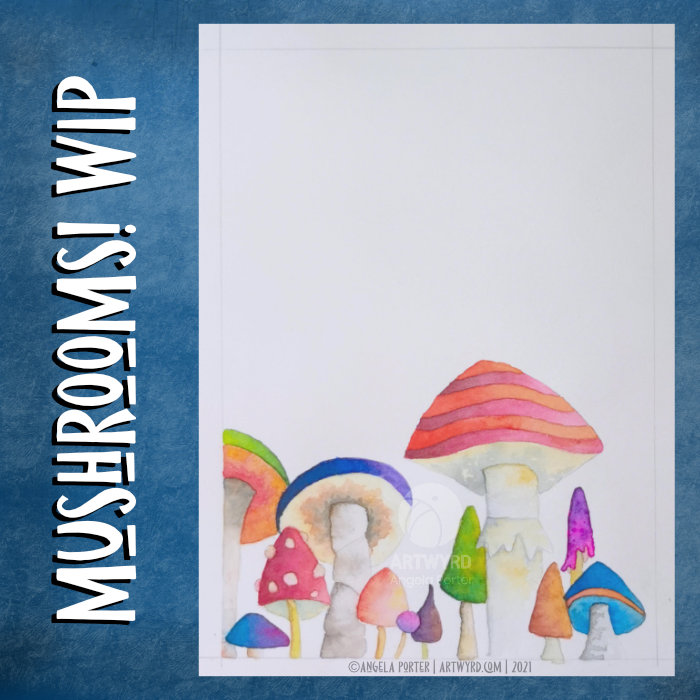
Mushrooms! A Watercolour WIP

Two versions of a video of this artwork are available:
Full, 45 minute video with chat
Speeded up 10 minute version with music

This morning, I continued with a watercolour painting of mushrooms. This is very much a work in progress. It is inspired by an illustration in a book by Danielle Donaldson called ” The Art of Creative Watercolour: Inspiration and Techniques for Imaginative Drawing and Painting.”

As I am continuing to explore watercolour, I am dipping into books in my stash to absorb more ideas and information and try various exercises out.

In this video, I talk about how I think there are no right or wrong ways of being creative, as what is ‘right’ for one person may not be the way for another. We’re all unique people, creatives, and how we express ourselves, the techniques , media and styles is a very personal kind of expression. We can all learn valuable lessons by watching other artists work, taking courses, reading books, doing exercises. The most important lessons learned are those that show us who we are by helping us work out who we are not.

And this will change throughout our lives as we experience new things that change us too. And that is no bad thing at all. It’s all part of the rich tapestry of our lives.

I think that as long as your joy and passion and personality shows through in your art, then that is the most important thing of all. It makes your art uniquely yours, and that is, as far as I’m concerned, a wonderful thing. It may not be my thing, or to my taste, but then my art isn’t to everybody’s tastes either.

And, that is all fine and well and good. It doesn’t mean one is bad the other
good. It just means we are different, and that is what makes life so wonderful. It would be so boring if we were all clones of each other, wouldn’t it?

This chatter was inspired by a video I watched this morning by The Art of Watercolour, and you can see it here:
https://www.youtube.com/watch?v=LFMlh3EP1MA

I also chat about how I’m trying to work out how watercolour works best for me. The biggest challenge is that I partly have to learn to accept that wet watercolour has a mind of its own when you add more colour to it. It’s not easy for me to be out of control of the effects achieved, so I really think it’s a good thing for me to explore and learn to work with.

Entangled Art WIP

Today, I finished drawing this entangled, zentangle inspired kind of floral/botanical design. I did start this yesterday afternoon, but continued it this morning before I settled back to sleep. I’ve had a poor night’s sleep thanks to yet another upset stomach, so after my Wednesday delivery from Abel & Cole, I drew and then settled back to sleep.

I’m still feeling very tired, my digestive system is still uncomfortable, delicate, upset. But I have to run an errand today. I’ll get to that soon enough and then I’ll see how I feel and how that dictates how I look after myself for the rest of the day. I suspect more sleep will be needed.

Anyways, this drawing is on an A5 piece of Canson Imagine mixed media paper. I used a 0.3 Unipin pen to draw the design, and I’m now adding colour using a fairly limited palette of Zig Clean Colour Real Brush pens:
*green gray
*pale dawn gray
*olive green
*deep green
*ochre
*bright yellow
*pale rose
*lilac
*english lavender

I’m considering adding a couple of browns to this palette, as well as using some olive green over the grays.

These pens do move easily with a barely damp brush on this paper making it so easy to get a colour gradient. It’s also easy to add more colour to intensify the dark area.

I have recorded my morning art session as vlog.

In the vlog I talk about how the pressures of being constantly productive turned me into a workaholic when I was a teacher, and then fed negatively into my self-image which ultimately led to my burn-outs/breakdowns. I have learned that taking time for myself, to just be, to relax, to do things I enjoy, to look at ‘goals’ in a realistic kind of way to limit the pressure I put on myself.

I no longer have the external pressures of my career as a teacher, and one of the many hard lessons I’ve had to learn as part of my healing is how to value self-care time, and how that time can change from day to day. It’s so important for me, otherwise life’s own stresses and strains can take their toll on me and leads to physical, emotional and/or mental exhaustion or even ill-health.

Taking time to rest, to relax, is being ‘productive’, but in an important way. The productivity is investing time in one’s self and one’s own well being. And that is so very important.

This is why I take time nearly every day to create art just for myself, for the pleasure of creating, of exploring and experimenting, with no pressure on myself to create a completed work of art or for commercial gain. Just for the simple joy it brings.

Admittedly, I can fixate on art and forget about doing other things I enjoy, such as playing my flute, or learning to play my harp or tongue drum, or reading, or journalling, or even getting out for a walk, or combining my walk with sketching.

I know this is something I do need to work on for sure. But, like everything else, it comes together in it’s own way, in it’s own time, when I am ready to do so.

Exploring media and papers

Today’s vlog is all about me trying out various media on different papers, particularly the Zig Clean Colour brush pens on Fabriano Toned paper.

Exploring different ways of working is important to me; it’s how I learn and work out what works for me. Often, I’ll return to media and techniques I may have tried in the past that didn’t work for me then, but now I can see how they could work for me, particularly in the context of a sketchbook.

In my disc-bound sketchbook, I’ve assembled various kinds of paper, mostly toned. Now, I’m working out what media would be good to have in a pencil case for sketching while out and about (when I finally become comfortable with out and about again!).

The Zig brushes and Tombow markers work really nicely on the Fabriano paper.

Watercolour Experiments

Firstly, let me apologise for the poor photo. I’ve tried a couple of times to take a photo of the artwork, but I just can’t seem to get it in focus across the paper. I did video all but one of these experiments, and a timelapse video is available on my YouTube channel.

I had a delivery yesterday of Canson Imagine mixed media paper. I mistakenly ordered A4 instead of A4, but no problem, it can be used in my disc bound sketchbook.

I wanted to see how various media would work on the paper so, I used
*Derwent Inktense Pencils
*Mijello Mission Gold Class watercolours
*Kuretake Zig Clean Colour brush pens
*Tombow Dual Brush Pens

In each case I used a barely damp brush; I’d already found out that using rather wet colours left edges of colour rather than the smooth colour I like.

I didn’t draw the designs with pen, just an 0.3mm, 2H mechanical pencil.

The inktense are Ok. The colours spread a little patchily as the pigment/ink grabs onto the paper very strongly quite quickly. As they dry permanent, it’s easy to add a glaze of colour to adjust the patchiness. The colours aren’t as bright as I would’ve expected from Inktense. Maybe the off-white colour affected them, or maybe the pigments/dyes sank into the paper more as they dried.

A dry brush technique is needed for the Mijello paints, and they move too easily on the paper with water. The paper doesn’t really grab them, which is surprising as it’s not watercolour paper. I didn’t really enjoy working with them on this paper. Also, the colours are so dull… the colour of the paper, or perhaps the colours sink into it?

I loved using the Zig Clean Colour pens! The ink moved so easily with the barely damp brush. Getting a gradient was so easy. Also, adding a bit more colour to the still damp area helped with this too. I also tried blending one colour into another, and that worked really well. The colours are so vibrant, I loved working with them. My only regret is I forgot to press record for them! However, I’m sure you’ll see more of them in future videos.

The Tombows aren’t my favourite pens to work with. But, in this instance I really did enjoy working with them. The colour grabbed onto the paper more than the Zigs. This made both blending out to a gradient and blending colours more difficult. The colours though are really vibrant.

I did write notes next to each little experiment with a 0.3 Unipin pen. It was a pleasure to write on this paper, and I think I’ll enjoy drawing on the paper too, so it will definitely be a good addition to the disc bound sketchbook.

New Watercolours, & arty lessons learned

New Watercolours

Late yesterday evening, my new set of watercolours arrived. I’m now the proud owner of a set of 36 tubes of Mijello Mission Gold Class watercolour paints, and a pretty neat palette too.

It was too late last night for me to think about adding the paints to the palette and setting up some colour swatches,. So I set to that this morning with a big mug of tea and a headache.

I used them to continue adding colour to this drawing, and I can easily tell the difference between the Mission Gold and Cotman Watercolours, not just because I know where I added each colour, but from the intensity and vibrance of the colours.

I know I got more vibrance from the Cotman colours when I was adding colour to this by adding water to the pans and letting them sit for a while to soften the pigments. But, it was so much easier with the Mission Gold to do this. Indeed, I had to be careful that I didn’t use colour that was too intense!

Some insight into watercolour and me

It was, and will continue to be, an absolute joy and pleasure to use watercolour paint tubes. I’m so glad I splurged out on them after I had a memory of using tube watercolours years and years ago.

They were such a pleasure to use, both to create the swatches and in adding colour to this drawing. Bear in mind that this drawing wasn’t done on watercolour paper, but on creamy coloured Arteza mixed media paper! Also, I created the swatches on SeaWhite all media cartridge paper, which is a lovely bright white colour.

Now, I realise that a lot of my frustration with pan watercolours is with getting colours intense enough for my taste. That won’t be a problem with the Mission Gold set I’m sure.

I also feel that exploring and learning more about watercolour and colour mixing is something that I’d like to do now, and that I may not be quite so frustrated as I have in the past.

Coloring Template doubts and frustrations

Yesterday, I got a couple more templates drawn and edited, so I now have ten out of the thirty-one I need completed, editorial team’s feedback allowing that is.

However, I was really doubting whether what I’d done would work, was good enough. So, I thought I’d try colouring the template I was least happy with to see if that made a difference to how I viewed it, and hopefully the others.

That really did the trick! Just by adding a background colour/texture first, I started to feel better about it. Once I’d added colour and the line-art started to come to life, I started to feel even more confident.

This is something I need to remember going forward, when I doubt my ability to create colouring templates. All I need to do is see if they work with colour!

A bonus was that I really enjoyed adding colour.

Vlogging along …

I touch on all these things in today’s vlog, as well as showing the swatches and adding colour to the drawing.

I’ve also decided that I’m going to mostly keep my vlogs to no more than around 20 minutes, whether that’s real time or a time lapse version. I think they may work the best, though I may still record longer ones if there’s a need to do so.