Today has been a day of working with colour on various drawings in my sketchbook. This one is the one I’m most happy with; it’s been a bit of a frustrating day, colourwise.
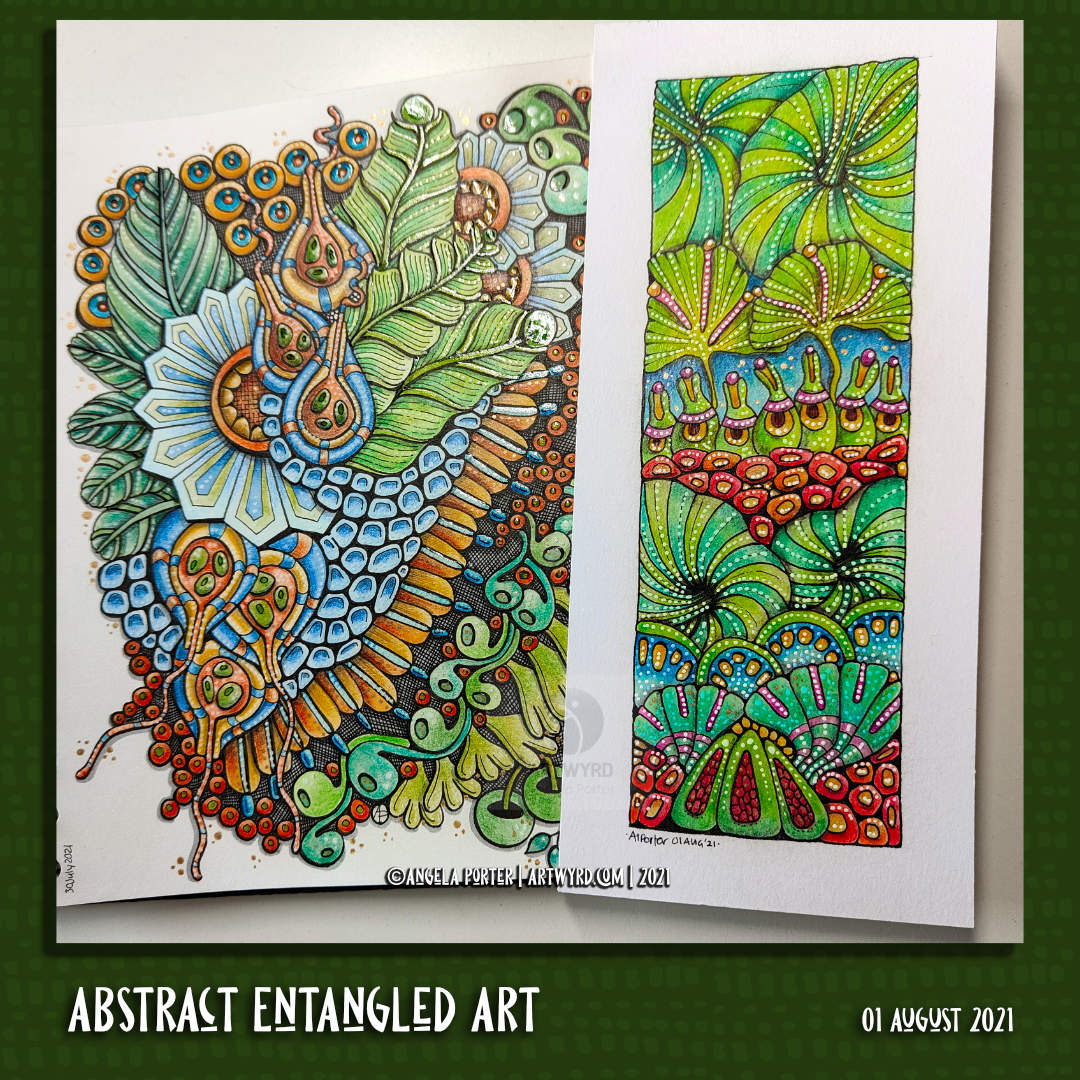
This drawing was finished earlier today, and before adding any shading I wanted to add colour. This time, Derwent Graphitint pencils were my medium of choice, along with a brush and water.
I really like the softer, earthier, more vintage-y tones of these pencils. I was getting frustrated with the brighter colours of the Ecoline watercolour inks and Derwent Colorsoft Pencils.
So caught up in the process of adding colour (along with joys and frustrations), I didn’t realise how much of the day had gone! It’s now about tea-time here in the UK, and normally I do my social media postings mid-morning.
I am tired today. Tired because I was up way too late last night. My mood is weird – I’m content yet at the same time feeling rather sad and teary for no reason that I know. My EMDR therapist told me that in the West, we are convinced we can only feel one emotion at a time, but in the East it’s accepted that you can feel more than one at a time. I certainly experience that quite often.
The sad and teary may be a manifestation of the tiredness, but it’s nice to know the touchstone of contentment is present in the core of my being. Contentment is always present, no matter what other emotional weather is being experienced. It’s a storm anchor that helps me keep balanced during the less settled periods of emotional weather. For like all weather, emotions do pass in time. For me, I’ll feel much better when I’ve had a good night’s sleep I’m sure.
Yesterday, I took quite a large wedge of time to intensify the colours and adding shadow and embellishments to the art in my last blog post.
To do this, I used Derwent Colorsoft pencils, along with a blender pencil. The embellishments were added with White Sakura Soufflé, gold Sakura Metalic Gelly Roll, and clear Sakura Glaze pens.
It’s difficult to show the effect of the glaze pen on the artwork, though you can pick some up in the top right of the artwork on the left.
Is this the magic formula for me working with colour? A limited colour palette, simple watercolour washes, shadows added with a grey pen, intense colours with pencils, and embellishments with various pens? Maybe.
The drawing to the right was testing this idea out, though I didn’t use a grey pen to add shadows but a grey pencil. I really enjoyed how the coloured pencils added colour and depth to the artwork.
Too many dots? I don’t know. Probably. I do tend to get carried away with them!
I have learned that I can’t use the Zest-it blending fluid anymore – my asthmatic chest doesn’t like it at all! The Derwent blending pencils are a bit abrasive and moved some of the black pigment from the drawing. So, I switched to a Faber-Castell Blending pencil, and that worked just fine.
I also noticed that the blending pencil made the colours more vibrant – both the coloured pencils and the background watercolour wash. I think it’s because it leaves a glossy sheen, which I bring out by ‘polishing’ with a paper towel.
So, lots of learning and experiences yesterday and this morning, and perhaps progress in my use of colour by mixing media to my advantage.
It certainly was a task and I needed to persevere at the beginning. I was really hesitant about adding colour and seriously disliking the colour as I started to add it. The more I did, the more comfortable I became with adding colour.
I think what helped with the colours was the use of a limited colour palette. Indigo, prussian blue, gold ochre, burnt sienna and bronze green made the basic palette up. Mixing the colours gave me plenty of variation in colours and tones while at the same time keeping a coherence.
I started adding shading with a biro. As this drawing was a testing ground for various ideas, I used a cool grey Pitt Artist pen to add the rest of the shadows. I found the result pleasing, particularly after adding colour. A darker grey may have worked more to my tastes of high contrast, but this is a starting point.
Indeed, I rather like the combination of biro and pitt pens. I did end up adding some cross hatching to some areas to intensify the dark areas betwixt the elements of the design. That darkness helped to lift the colours somewhat.
To add highlights, a white Sakura Soufflé pen was used. I also had a hankering to add some metallic highlights too, so a gold metallic Gelly Roll came in useful.
Using flat colour washes and letting the grey shadows add volume seems to have worked well enough. I may, later, try out some coloured pencils to add more shadowing. But not until after breakfast!
Some of the colours in my finished artwork weren’t in the palette. I mixed colours from the palette to achieve the oranges and purples.
It was a fun project that I completed rather quickly for me. I used it as an opportunity to find out more about some of the blending options for the brushes in Clip Studio Paint. I’m not sure anyone could tell the difference with how this has finished, but I started to understand how some of these options work.
It’s nearly midday, and I think it’s time for breakfast before I turn my attention to this week’s template for the facebook group. Food first!
This drawing was finished a couple of days ago. I like the graphic nature of black and white, so am not at all sure if I want to add colour to this. I think this is a case of scanning the drawing in and adding colour digitally before deciding. My fingers, however, would like to make use of the Ecoline watercolour inks.
Time will tell what I decide to do. After all, there is no rush.
I have an introvert ‘hangover’ today. This has absolutely nothing to do with alcohol, just a bit too much socialising on Zoom yesterday! The headache will lift soon. The tiredness will gradually go, especially after some more sleep. It was lovely to spend time with like-minded people, particularly Brett from the Angela Porter’s Coloring Book Fans facebook group.
So, doing some entangled, intuitive pen drawing was just the thing to start the day off. Gentle, familiar, enjoyable, calming and peaceful.
I have no idea what this drawing is going to turn into. Time will tell.
I have created a time-lapse vlog of this drawing. Not only do you get to see how this WIP drawing was done, I also show some of the other work I’ve been doing in my sketchbook as well.
As it’s the first day of a new month tomorrow, that means a new color palette challenge for the group members. I’ve not decided on a colour palette yet.
This week it has a botanical theme.
While today’s vlog was processing and uploading, I took the time to edit the image digitally and also to add some colour to it. That gave the opportunity to play with a different brush. I’m not sure about the effect I’ve achieved, however.
In the vlog, I share my thoughts on the artwork and what I’m thinking as I draw. This is mostly focused on the art, but I do have a bit of a grasshopper brain that will flit around from time to time.
As the vlog is rather long – 1 hr and 13 mins or so – I’ve also created a speeded up / time lapse version with music if you prefer.
Today, I started my arty day with some entangled drawing and a chat based around some interesting questions posed to me by various people on social media yesterday. The questions got me thinking and talking about my particular drawing and art style.
What I’m realising is, I’ve never really be provoked into thinking about/talking about my art style and where it has come from! For me talking and thinking are the same thing – there are two styles of inner monologue. One is where you hear thoughts in sentences throughout the
The topic of inner speech has caused a stir on Twitter after the user KylePlantEmoji put out his own observation on the matter. “Fun fact: some people have an internal narrative and some don’t,” he tweeted. “As in, some people’s thoughts are like sentences they ‘hear’, and some people just have abstract non-verbal thoughts, and have to consciously verbalize them. And most people aren’t aware of the other type of person.”
I have a mix of them. My inner monologue is one that ruminates on the past, is self-critical and so on. But I also have abstract, non-verbal thoughts that I need to verbalise to be aware of them. So, if someone asks me a question about, say, my artistic style and where it comes from, then I have to verbalise thoughts about it. Until I’m forced in some way to verbalise these kinds of thoughts, I have no idea what they are. Same if I’m, say, sitting in nature, observing the world around me. My thoughts won’t be on what I’m experiencing. Often, there are no thoughts, unless I’m stuck in a ruminating, worrying and self-critical mode, which doesn’t happen all too often.
Until I read this, and other articles, I thought there was something wrong with me, because so many others seemed to think in their heads about lessons, or experiences, or the news. But I never seem to do so. Now, I know and understand why that is. I think in an abstract way that I’m not particularly aware of as such. It just happens.
So, creating these daily (almost) vlogs is forcing me to talk about my artistic style, choices, process, lessons and so on. And such it is making me more aware of myself as an artist.
Most importantly, however, it is helping me to understand the value of all these things validating my art to me.
Yes, I do have a bit of ‘imposter syndrome‘ going on when it comes to my accomplishments in life. But, talking about my artistic journey, and how far back it started and where the observational skills and so on started is helping me see it’s been an almost life-long journey. It’s also helping me to accept and understand my artistic voice(s), style(s) as being an expression of my experiences in life where art and observation are concerned.
There’s plenty about this (though not the inner monologue and imposter syndrome stuff) in today’s real-time vlog. It is around 53 minutes long, so I have created a time lapse version with music as well.
Today, I share a bit of a vlog . I flip through my sketchbook pages of the past week or so, chatting about them. Then, there’s a timelapse of myself drawing my latest entangled art.
This morning, I spent over an hour starting work on this entangled pen drawing. I did film the process, but it’s recycling day, and the bin lorries and bin men were really noisy this morning. So, I turned the video into a timelapse with music. It lasts about 14 minutes, and the link to it is above this paragraph.
I remember chatting about my influences for this drawing, and they started with me watching a video from the “Journey to the Microcosmos” YouTube channel.
I’ve always loved microscopic images, being able to see things that are invisible to our naked eyes. There’s always a sense of wonder about it, amazement at the different shapes of the various organisms that become visible. That wonder must be the same as Antonie van Leeuwenhoek, a Dutch scientist of the 17th and 18th Centuries must have seen.
I loved drawing what I could see with the aid of a microscope from the first science lessons when I was 11 years of age, right through my degree and PhD and on through my teaching career too. And of course it was bound to creep into my art!
My memories of drawing diagrams of flowers and rock sections, minerals and scientific apparatus and diagrams are very fond indeed. This has certainly influenced my style of art – observing the tiny, abstracting the interesting (important) patterns and forms. Scientifically, the focus is on the features, structures, the important parts that allow identification or communicate the important features of what was seen. After all, photographs and videos can be made of all the glorious detail and colour.
The diagram is a simplified version, a map, that can help others to navigate their way around. A kind of scientific version of the map of the London Underground system. The map helps in navigating the system, but it bears no relationship to the physical layout of the rail lines and the geography of the city above.
Now, however, I take those observations and turn them into my own arty, entangled worlds of wonder. It is still the small parts that catch my attention, fill me with wonder and awe, are the ones I record, rarely the whole thing. If I visit an old church or abbey, I rarely, draw the building as a whole. I spend time looking and drawing the elements of it that capture my arty attention.
My sketchbook page often ends up of a collage of my visit, the various observations fitting together in a pleasing way. Often, I may join the elements together with imaginary lines or patterns. I may end up not with a drawing of the whole building; instead, I record my experience of the building at the day, time, season and weather I visited it.
The same is true for visits in nature, or to museums. My sketchbooks record what catches my attention, and that may not be the ‘whole’ of something, but just a part.
I’m still a scientist in my approach to art – what are the important forms, patterns, shapes, etc. that are the distillation of my experience, that I’d like to record and, maybe, share with others?
Of course, these observations find their way into my more Entangled art, like this one. The round orbs separated into three lobes were inspired by something I saw when watching one of the Journey to the Microcosmos videos. The flat leaves, by seaweed. The triangular pods are imaginary, though there may be real-world analogues of them from which inspiration was unknowingly gained. Curled, baby fiddlehead ferns are the inspiration for another motif in the drawing.
Inspiration indeed – based on observation, but interpreted and altered in a way that is personal to me.
I’m forever wondering what my artistic voice is, and here it is. At least one of the harmonic notes or chords anyway.




 Art is the Adventure