Carrying on with the flowy pattern theme, I explore the Zentangle tangle pattern “Narfello” today.
This pattern is based on wavy lines and is easy to construct. The fun lies in all the variations that are possible. The first three steps in setting the tangle pattern up give an unusual grid that can be filled in so very, very many ways.
I always enjoy exploring patterns. It is, for me, a way of practising creativity, giving myself permission to draw without the end product being as nearly perfect as possible. It’s about trying things out to see what happens; if I don’t like what I’ve done, it’s no biggie! I can learn from it or, even better, work on how to change what I’ve done to make it something I like.
It doesn’t matter how many times I explore a pattern or fragment (the basic cell of a repeating pattern); there are always more things to discover and to use. It is quite addictive at times, that’s for sure!
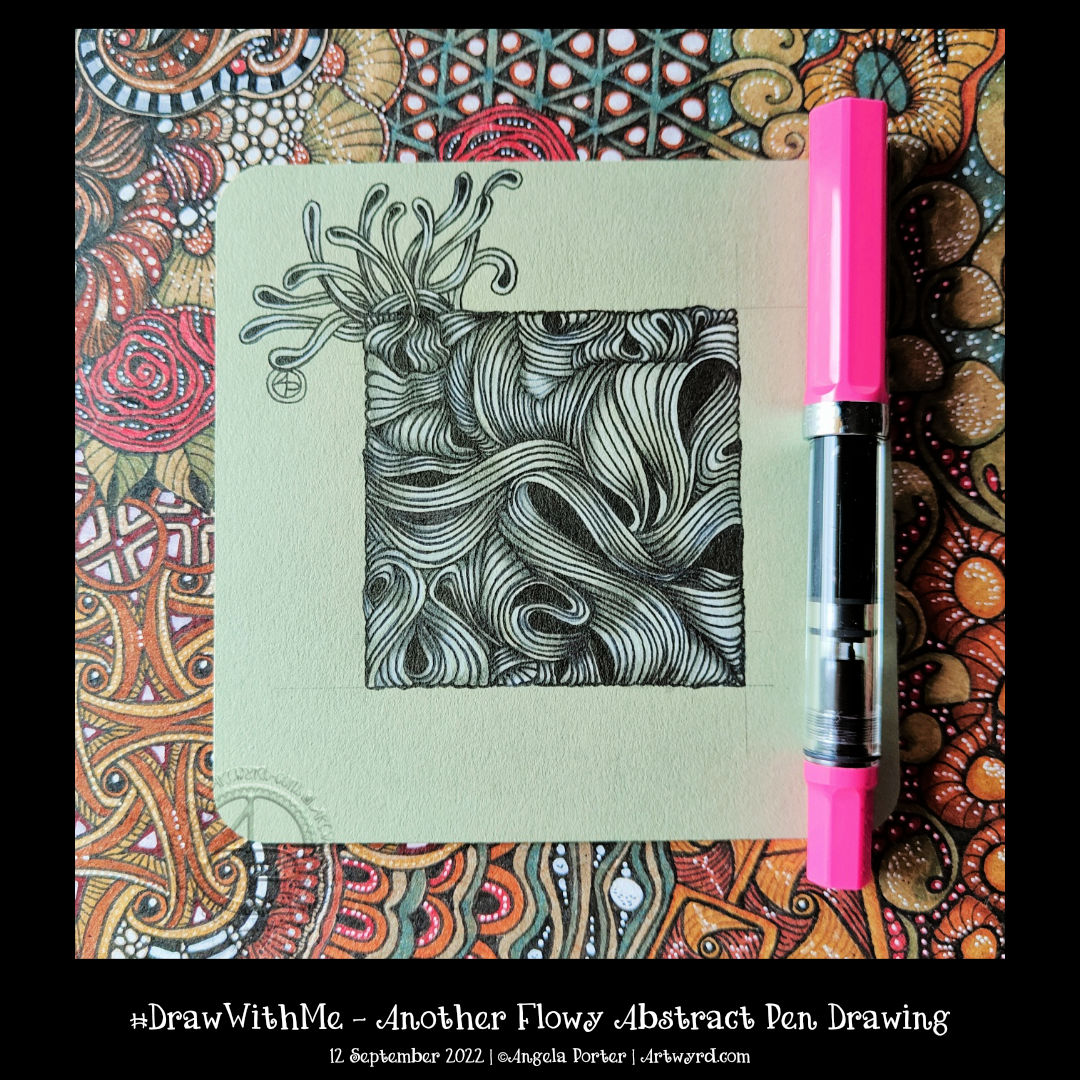
I was asked to look at the absolutely beautiful work by Angel_Draws on Instagram, use the work as inspiration, and explain how to create similar texture and volume.
I chose to use an extra fine Twisbi Eco fountain pen. The paper is Moss toned paper by Fabriano, which measures approximately 12.5cm square (approx 5″). For the shade, I used a Prismacolour Ebony graphite pencil. A General’s white charcoal pencil was my choice for the highlights.
I’ve had a go and done it my way, that’s for sure. I enjoyed creating lines that give the illusion of volume in the drawing. Adding shade and light really brought the appearance of folded space out.
It’s also complex, intricate, convoluted, and maelstrom-like, reminding me of roiling, billowing clouds. The textures of clouds are fascinating to me at this time. I’ve seen some amazing ones recently.
I’m not sure if this drawing is finished or whether I’ll add more of the frilly stuff around it. Only time and a good night’s sleep, or several, will tell!
This morning I wanted to do something fairly simple, soothing and relaxing. So, I chose to look at some variations of a stylised flower motif.
The version I started with is in the centre bottom of the design.
I used various Distress Watercolour Pencils and a water brush to add colour.
The white and gold highlights and patterns were added using gold and white acrylic ink and a dip pen.
Finally, the more intense shade was added using a graphite pencil and a paper stump. I even put some graphite around the gold foliage surrounding the design.
Overall, I’m quite happy with this one. I like the mostly monochrome blue/teal colour scheme on the grey tile. I wasn’t sure bout the gold patterns, but now it’s finished, I think It’s turned out just fine.
Time seems to fly when I get engrossed in a task. Today, that was exploring a simple Zentangle fragment – a circle in a square.
In Zentangle terms, a fragment is the basic unit of a repeating pattern, whether repeated as is or rotated/reflected.
It is always a lot of fun to see what kinds of fragments I can develop using the chosen one to spark some creativity.
It’s always lovely, too, to work on toned paper, in this case, it’s from Fabriano and is in the colour ‘Clay’. Whenever I use toned paper, I realise I’m drawing in shadow and light; the paper is the mid-tone. This is why I love to colour plain paper with Distress Inks or NeoColor II water-soluble wax crayons. The colour immediately becomes the backdrop for dark and light and a strong contrast ‘twixt the two extremes.
In art, chiaroscuro is the term used for the use of high contrast between light and dark in a composition. In drawing, this is affected by using a coloured background, and black and white ink or media are used to create the drawing.
As I was typing this, I realized I’ve long loved working in this way. Since my early days of exploring my artistic nature that started some 20 years ago, I discovered I loved to use coloured paper with white and a black or much darker tone of the paper to draw with. It was far more fascinating to me to draw in light and shade rather than tones of grey graphite on white paper. It was my chosen way to work when I did some life drawing. When I go out and about sketching, I will colour the pages in my sketchbook with Distress Inks and use black and white pens/pencils to draw on them. The shapes of shadows and highlights fascinate me; everything becomes very architectural.
I’ve often mentioned the only oil paintings I’ve ever done and how three-dimensional they appear. When people see them for the first time, they’ll touch them because they think they are dimensional and are always surprised to find out they are totally flat. The high contrast I favour in my work creates the illusion of volume.
This little journey down the pathways of memory has allowed me to make some connections. I’m smiling as some pieces of the jigsaw puzzle that is me fall into place, clicking together satisfyingly.
There are times when I have to work with black pen on white paper, but there are many times when I can choose what colour paper to use. And going forward, I think much of my entangled drawing that isn’t for colouring books will be done on toned paper.
I enjoyed drawing this design, though I wasn’t sure of the grubby-looking graphite and white charcoal on the big leaves. However, I persevered and am now fairly happy with this design.
I started with the Zentangle pattern Fengle and drew it in two different ways. The Fengles are stacked on top of each other.
Rather than try to squash another Fengle in, I elected to add some large, furled Pokeleaves, and of course, some Mookas had to grow with them.
The paper I used to draw on was a piece of Fabriano Toned paper in sand. The paper becomes the mid-tone of the design, so it’s perfect for using both graphite and white charcoal to add shade and highlight. Which I did, and the leaves ended up looking rather grubby.
So, while the video was uploading and processing, I completed adding all the shades and highlights. Then, I re-drew all the black and brown lines. Next, I added dotted highlights using white Gellyroll and Posca pens. Finally, I used a brown Arteza Everblend marker pen to fill the background gaps and draw around the design.
I’m so glad I added so many white dots to the pokeleaves and mookas. They just lifted the colour so much. The richer brown background also helped with this, though I think I need to tidy up the edges somewhat.
For someone who really doesn’t like using graphite/white charcoal in this way, I’m quite pleased with how this has turned out. I’m so glad I remembered I had this toned paper in my stash!
Oh, the patterned background is actually my drawing board! I decided to decorate it with all kinds of patterns and motifs. I’ll finish this side, seal it with some tough spray varnish, then start on the t’other side! Inspired by Zentangle’s Maria Thomas’s suede mat.
In today’s video, I started drawing this design inspired by one by Doodlillusion on Instagram. I’d been asked to look at this one by a YouTube subscriber, so today I have.
I definitely used Doodlillusion’s art as inspiration, drawing it in my own way. I trust that I can show and explain how I approached this kind of pattern, along with some hints and tips and various ways of working with it.
I’m quite pleased with the end result. I like the graphic black and white. Something I need to consider more in my monogram and other explorations, maybe!
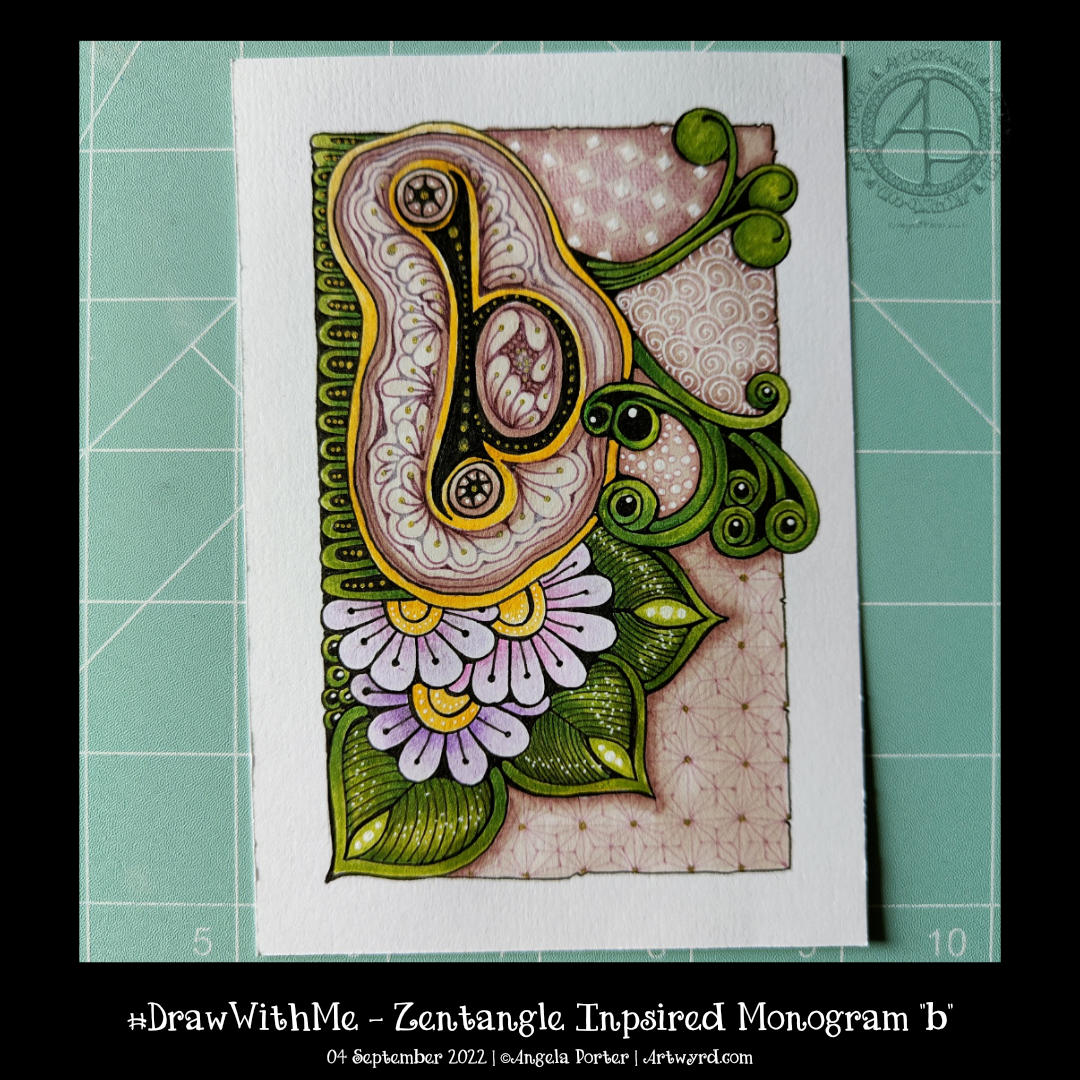
I’m continuing with my exploration of monograms and patterns. This one is a bit odd with the ba sitting above a pool or pebble..or something. But I quite like the patterns I’ve used to embellish it. I’m also rather fond of the background patterns, especially the very faint ones to the bottom right.
I’m not too fussed about the greens, yellows and the colours I used for the flowers. Pretty much every colour apart from the background colours and the colours of the patterns around the b!
Must write a HUGE reminder and stick it where I can see it “WORK IN MONOCHROME!”
All the same, it’s a learning exercise for me, as drawing always is. The ones that turn out not quite to my liking at the ones I learn most from. Having said that, I still haven’t learned that ‘work in monochrome’ thing yet! One day, maybe, I will.
I’ve mostly finished this 3.5″ (11cm) square ’tile’ with a monogram. It’s changed a little since my last blog post this morning.
Apart from completing the colour, I coloured over the brown section in the bottom right. I used dark and light grey Gellyroll Moonlight pens to add the crazy ‘N’Zppel’ Zentangle pattern. It needs tidying up and perhaps some highlight within the inner black spaces.
But for now, it will do. I think I need a break from it to eat and do other things for a while.
This week’s colouring page for the members of Angela Porter’s Coloring Book Fans Facebook group is intricate. Still, it uses only three motifs – spirally furled leaves, starry flowers and stripey, plumptious seed pods.
I drew the design using a fine nib TWISBI eco fountain pen, filled with Documentus ink, on an A4 sheet of Artway’s Eco paper. To add colour, I used various Arteza Everblend markers. The pattern, textures, and highlights have been added with various Arteza Inkonic, Uniball Signo and Sakura Gellyroll pens.
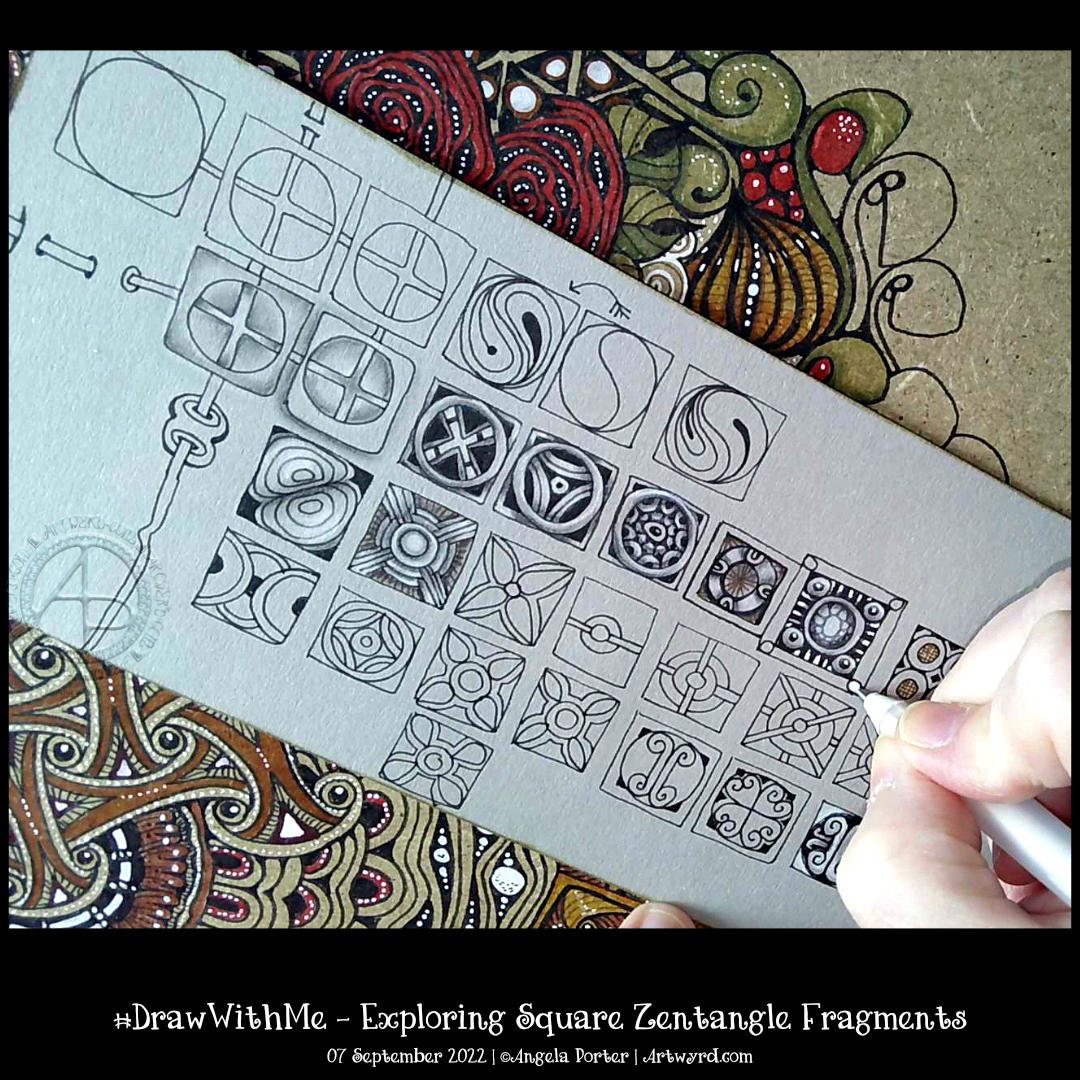
This was a nice way to start my day! Exploring fragments and creating fragments is always a fascinating process. I never quite know what will come from my mind onto the paper. Some fragments work out, others don’t. Either way, it is still of value, even if just exercising hand-eye coordination, fine motor skills and the creativity ‘muscle’!
I can see some of these fragments working best as individual motifs. Others would work well in a reticulum – the zentangle name for a grid.
I still have quite a few rectangles to fill, so I will post them as a resource when that’s done.
Talking of resources… I now have quite a few sketchbooks and loose pages filled with explorations of fragments. I need to start organising them all so I can refer to them for inspiration. Or do I? I mean, it’s not a huge issue to just sit and do some of these fragments until I find one I’d like to use in a drawing. I worry about forgetting things, not using them or referring to them. Perhaps the value in all of this is to get a memory hoard of shapes and ways of putting patterns together, which can be drawn upon when needed.
Yes, a memory hoard, whether conscious or stored in the subconscious, is so important and trusting that all these things will be there, somewhere, ready to be used in different, unusual and even unique ways.








 Art is the Adventure