Pen and Wash | Entangled Art | WIP

Link to today’s vlog on YouTube.

A very small penny dropped yesterday. I realised that what I’m doing is pen and wash, or ink and wash, or line and wash. I’m not entirely sure that a label is required, but it seems to fit.

I’m adding watercolour of one kind or another – Inktense, Ecoline, Mijello Mission Gold, Distress Inks, etc – to a pen drawing. Why I haven’t made that connection to the description of the method/process? I have no idea! Still, I have made that connection and a realisation that it gives a sense of artistic legitimacy to my work. That is a function of my insecurities when it comes to my artistic espression.

Yes, that’s right. Insecurities. Lack of confidence. Lack of belief in myself. Self-questioning about what on Earth I’m doing.

It is always nice for me when pieces of a rather abstract, metaphoric jigsaw fall into place, giving me a more coherent view of my method, my artistic voice.

These pieces always fall into place at the right time for me. I’m ready to accept that line and wash is what I do well, when I work within ‘an elegance of limits’ to quote the team at Zentangle. In this case a limited palette of colours harmonious with the background.

As well as working on this particular drawing, I have included some views of recent work in my sketchbook in today’s vlog. This other work shows me trying to work out how to add more contrast to the wash of colour. Fine ballpoint pen, graphite pencil and tortillon or coloured drawing pencils/chalk pastels are what I’m exploring. Eventually, I will settle on a method that I particularly like. I’m not happy with any of these at the moment.

I will continue to explore an figure it out. That’s what I’ve done with adding colour to my drawings, and that’s what I’ll do when it comes to increasing contrast with shadows and highlights.

Of course, I’m talking here about traditional art. When it comes to digital art, I think I have found a way I’m comfortable with in adding colour to pen drawings. I’m not quite there yet with traditional media, as well as finding the traditional media I like to work with.

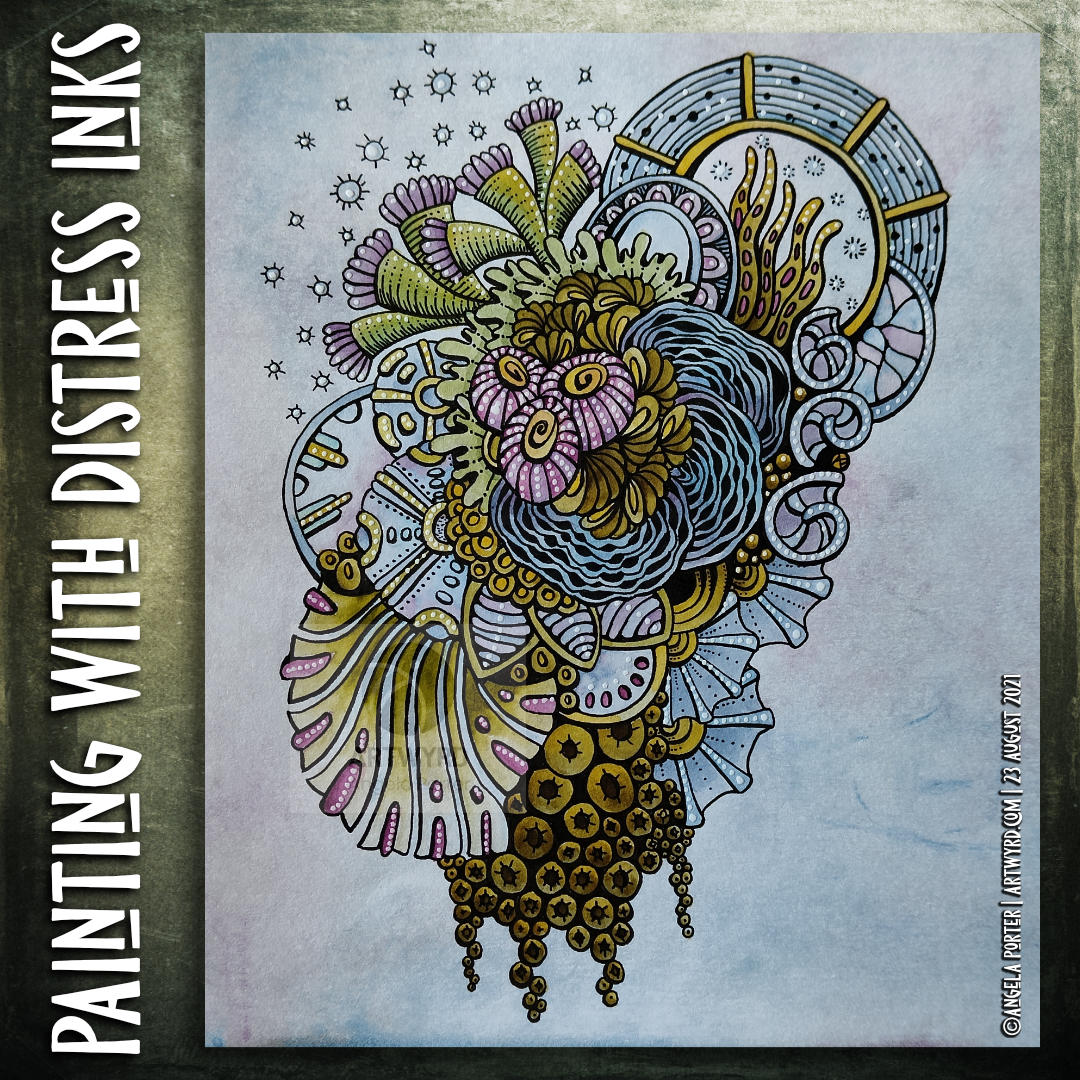
Painting with Distress Inks

Link to today’s vlog on YouTube.

I woke with a stinking headache this morning. So, spending some time adding colour to an entangled drawing, along with a couple of headache pills, was just what was needed. And listening to a podcast or three.

I decided to use Distress Inks as paints, along with a Caran d’Ache waterbrush. Here’s a list of the colours I used:
Forest Moss, Fossilised Amber, Weathered Wood, Broken China, Dusty Concord and Seedless Preserves.

Hindsight is a wonderful thing, and I think I really should’ve stayed away from Dusty Concord and Seedless Preserves – the purple and pink colours. Either other analogous colours and/or browns/greys would’ve worked so much better.

I keep doing this with colour. I’m so used to choosing complementary colours that I still reach for them. In this case it’s understandable as I chose some of the colours that were in the background.

Note to self – monochrome-ish or analogous colours!

To help tone these brighter pink and purple colours down, a liberal use of dot highlights from a white Sakura Soufflé pen was needed! I’ve not finished adding embellishments yet.

Nor have I started intensifying shadows. I’m not sure whether to use biro or either a graphite pencil or a chalk pastel and a paper tortillon. My head isn’t clear enough to decide about that! As the headache is wearing off, my need to sleep the last of it off is increasing.

Adding Color WIP

Link to today’s vlog on YouTube.

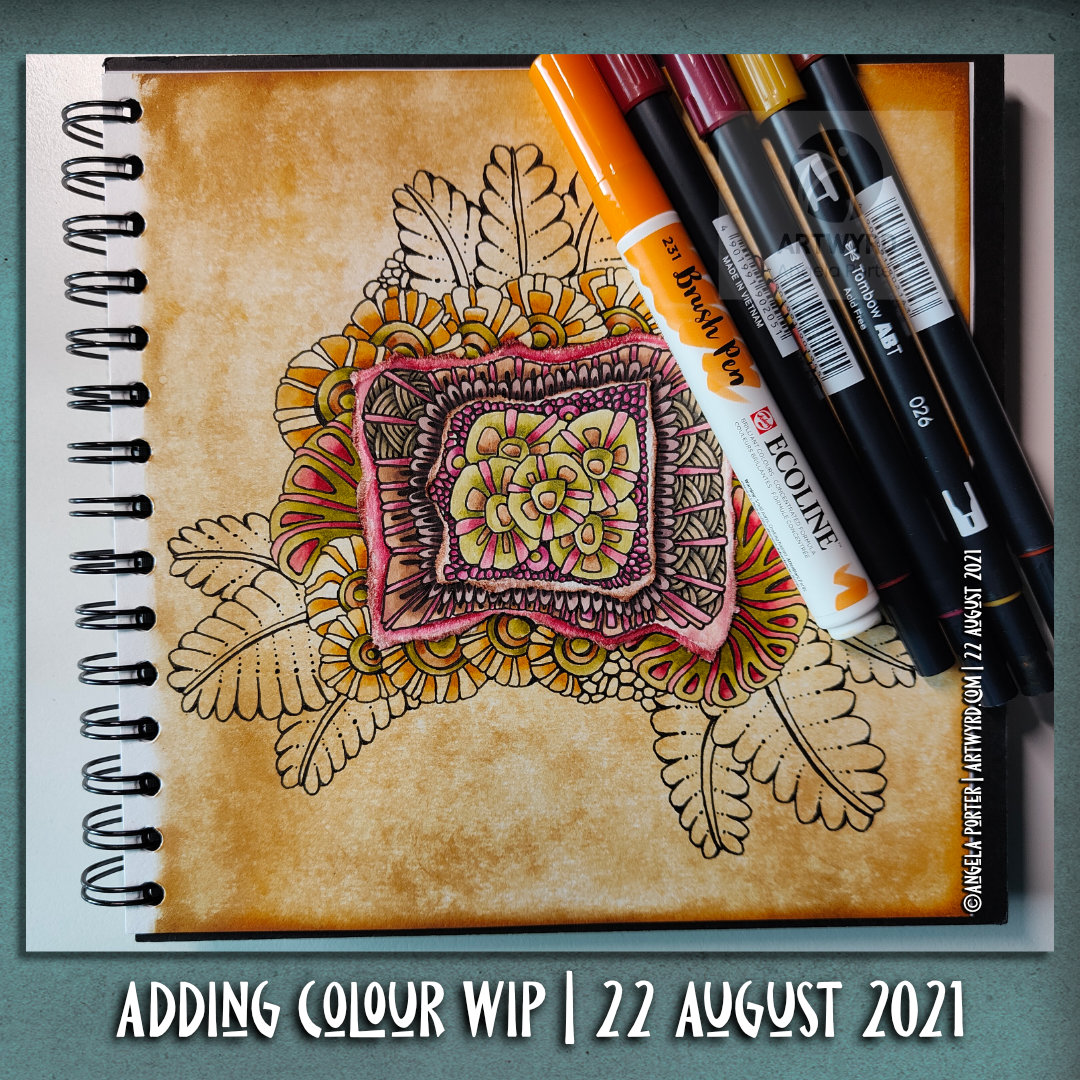
Yesterday, I added pieces of paper coloured with either Distress Ink or Distress Oxide to pages in one of my sketchbooks. These pages had been previously coloured with Distress Inks.

I wasn’t at all sure that what I was doing was a great idea. So, I decided to add patterns to one page using a micro Uniball Eye pen. I still wasn’t sure, but a bit more confident in my idea. So, I started to add colour to see if that would make me happier with what I was doing.

To add colour, I started with some Tombow Dual brush pens in rather vintage, autumnal colours that work well with the background.

As the Distress Ink tends to alter the properties of the paper, I thought I’d try the Ecoline Brush pens. And, they were so much easier to blend out with a waterbrush. Actually, the Distress Ink makes it much easier to blend the Tombow Dual Brush pen ink out too.

So, I’m quite happy with the result. Now, I can complete the drawing and finish up adding colour. And I look forward to working on the other pages in the sketchbook too.

Entangled Drawing | Adding Colour Part 5

Link to the Adding Colour Time Lapse Video

This morning, I spent nearly two hours adding colour to this drawing. It’s getting close to being completed. Well, the adding colour part. There’s embellishing to be done too!

I’ve used Inktense pencils through out, along with a damp brush to activate and blend the colours.

As well as colouring new areas of the design, colour was added to intensify various areas that were appearing too insipid. I still have some of this to do to bring out a sense of volume in various elements.

I’m fairly pleased with this, though in hindsight adding the shadows with a grey Faber Castell Pitt Artist pen first may not have been the best idea. Still, it’s a learning experience, again.

It’s Template Thursyay!

This week’s coloring template / coloring page for the members of Angela Porter’s Coloring Book Fans facebook group is a typically entangled one. But one that’s a bit different too!

Instead of having an outer frame, I’ve included a frame, but behind the drawing. I wanted the elements to grow out of the frame in places, just for a change. And I’ve just noticed where I’ve not coloured a little piece of that frame! Oops! Still, I think that by colouring the frame in, it helps any colourist to work out some of the more intricate and fiddly places where it lies.

I’ve chosen a vintagey, halloweeny colour palette. As we’re nearing the end of August, autumn won’t be far away here in the valleys of South Wales, and the rest of the northern climes. I’m quite eager for nature’s change of clothing. Indeed, I’ve spotted some small changes in colour here and there, a quiet heralding of autumn.

Yesterday, I completed colouring the cover for the book I’m starting on soon for Creative Haven. It was proclaimed as being ‘the cutest thing ever!’ by my editor.

Entangled Art WIP

Link to today’s vlog on YouTube

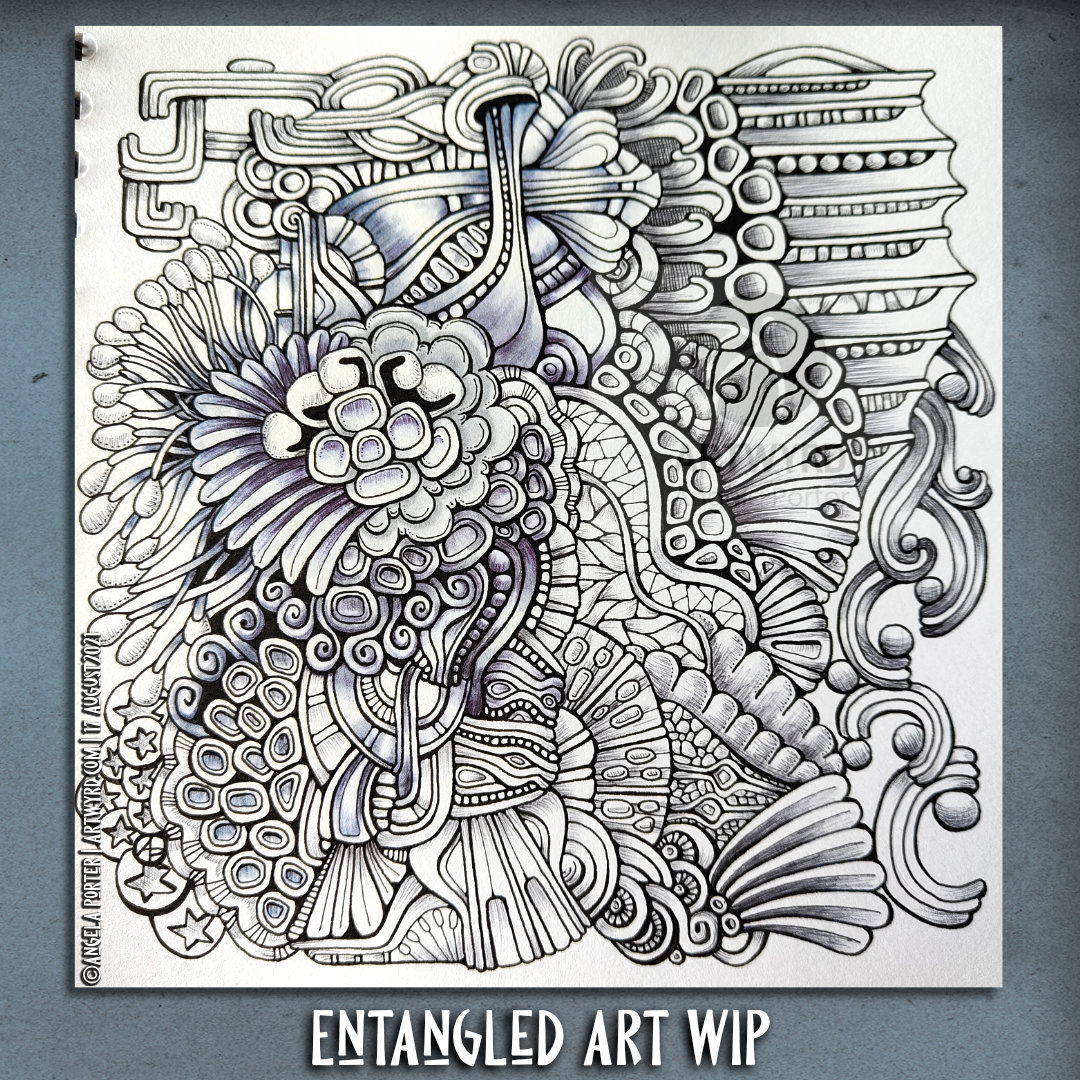
I made a bit of a serendipitous discovery yesterday. I have no idea if anyone else has come across this, but I haven’t before.

Anyway, I was waiting for the sun to get less strong in the afternoon so I could venture out for a walk. So, I thought I’d add some Copic shading to some of my entangled drawings. All was fine and good with the first one (which you can see in the vlog).

Then, I started to do the same to this drawing. I’d used a black biro to add shading to the drawing and didn’t expect anything to happen. But, the biro reacted with the alcohol marker. Some of the colours in the ink were dissolved and moved a little way by the marker – purple when moist and blue when dry.

I had a ‘duh!’ moment when the scientist in me awoke. Of course alcohol would dissolve the coloured dyes in the biro.

It was an also quite magical moment too. It added to the shadows in an interesting, subtle way. This is something that needs to be investigated further with different coloured ball point pens!

So, I actually feel a tad excited by this discovery and wanted to share it.

Entangled Drawing | Adding Colour Part 4

Link to today’s vlog on YouTube

It seems to be dry outside, weatherwise. Cloudy with the odd bit of sunshine. It’s a nice day to go out for a walk. But first I’ll need to get some work done.

The day started with adding more colour to this entangled drawing. I continue to use Inktense pencils. As well as adding colour to new areas of the design, I also started to intensify the colour on the collection of red ‘seeds’ in the centre. It’s subtle, but the colours there no longer look washed out.

As I type, the vlog I recorded while adding colour is uploading and I’m going to get all my social media posts done. Then, I’ll get a fresh mug of tea, put a load in the washing machine and then start to ink in the cover of the new book I’m working on.

Then, if the weather holds, I’ll go out for a walk.

It all sounds like a plan, a good plan for the day.

Saturday Sketchbook

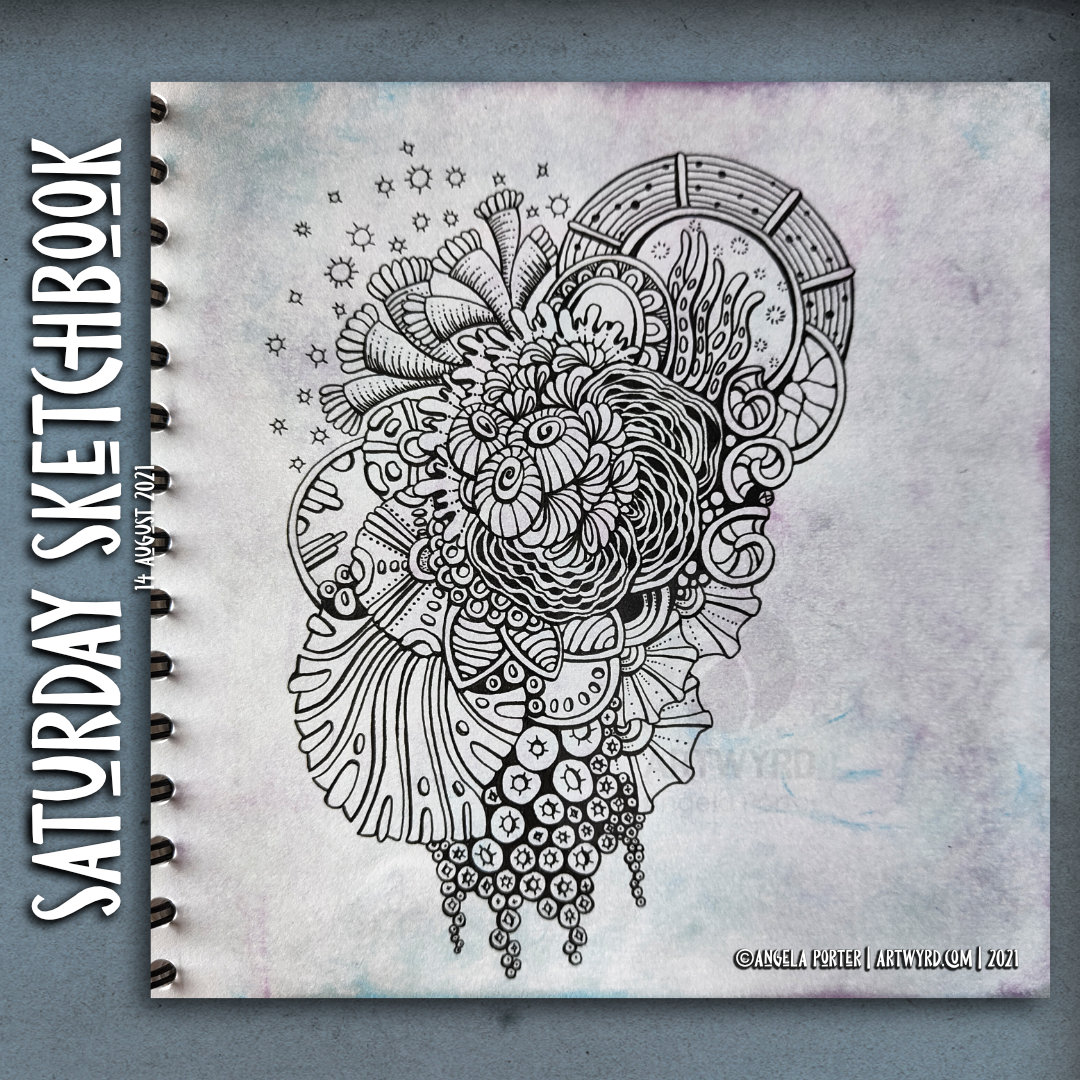
The newest drawing in my sketchbook

Link to Sketchbook Flip Through Vlog on YouTube

Sketchbook Saturday is upon us once again. I’ve created a vlog for YouTube where I flip through my current sketchbook.

The drawing at the top is now finished. I used a Tombow Fudenosuke ‘hard’ pen to draw the design on paper that has been coloured with Distress Inks. The sketch book is 21cm x 21cm (approx 8″ x 8″).

Drawing on coloured paper is something that is pleasurable to do. The colours add mood to the drawing and are an inspiration for any colour scheme I may use, should I choose to add colour.

The grungy, distressed nature of the page is also interesting; already depth and dimension are added to the artwork.

I’ve enjoyed drawing on coloured paper so much, that I actually have coloured quite a number of pages in my sketchbook and you can see them all in the vlog. What I can’t remember is exactly which colours were used for each page.

Some of the pages I like so much that I really do need to scan them in so I can use them as backgrounds for digital art, social media posts and so on going forward.

The colour choices I’m making are often veering away from the bright, saturated colours that were so characteristic of my earlier work. Such colours are still used for my colouring templates / pages and that’s not likely to change much going forward. However, for my more personal art, less saturated, vintage, even grungy, are what I am drawn to so much at the moment. Also, I seem to favour analogous colour schemes, sometimes with a pop of complementary colours.

Entangled Art | Adding Colour Part 2

Link to today’s Vlog on YouTube

As I enjoyed my first mug of tea of the day, I continued to add colour to this entangled drawing.

The success of blending colours yesterday inspired me to do more of this. Little by little, I’m starting to get some sparkles of confidence in adding colour.

Inktense pencils do make this easy in a way. It’s a lot easier to control the application of colour.

Control – it’s that word again in respect to the addition of colour. Watercolour vexes me as I want to control a medium that isn’t easy to control it seems. Perhaps the exploration of watercolour and Ecoline watercolour inks are cul de sacs for me. They’re interesting to explore but lead nowhere except back to where I started, almost. I return with extra knowledge and experiences that can then be applied to other media.

Indeed, the way that I apply colour digitally has partly inspired me in this artwork. But remembering my dabbling with abstract art back in my A level days gave me a few insights into my relationship with colour.

As a scientist, all my observations – drawn or written – had to be accurate, representative of what I could see. Colours had to be correct, as I could see, so others could check what I had seen and confirm those observations are correct.

As an artist, I can put that requirement to one side; but it’s not easy to do so, especially when I’m drawing from observations.

I have little problem adding colour to my cute, whimsical, entangled coloring templates. They’re not meant to represent anything ‘real’. They’re abstract in their own way. Though, when the motifs are based on observations, then I get into trouble with colour.

Remembering the abstract oil paintings I did back in the days of A level exams, I used colour to convey the mood, feeling that went with the time, place, experiences I had when taking photographs to use to work from. The final paintings were in colours that represented these personal, emotional, and sometimes intellectual responses.

Going forward, I need to remember this in my work and to transfer it to artwork. The actual colour of something is not as important as I think it is, and to remove that pressure from myself. If I want a record of the ‘real’ colours, I can take a photograph. But to record my experience, I need to give myself permission to express my feelings, emotions and my response to it in whatever colours suit me at the time. I need to allow my intuition and imagination a greater role in my work with colour

Hopefully I’ll get there, and I probably am little by little. The value of the vlogs is that I have to start to give words to the thoughts that come as I create, and this blog allows me to expand on them.

To give words to the ephemeral, abstract, metaphoric thoughts that wander around my head is to manifest them. The words result in conscious awareness of the thoughts. The awareness is then something that can be learned from, acted upon and put into practice.

I’m learning to externalise what has usually been an internal and fleeting process of thought and analysis, and it’s an intriguing and interesting experience for sure.

Entangled Art | Adding Colour Part 1

Link to today’s vlog on YouTube

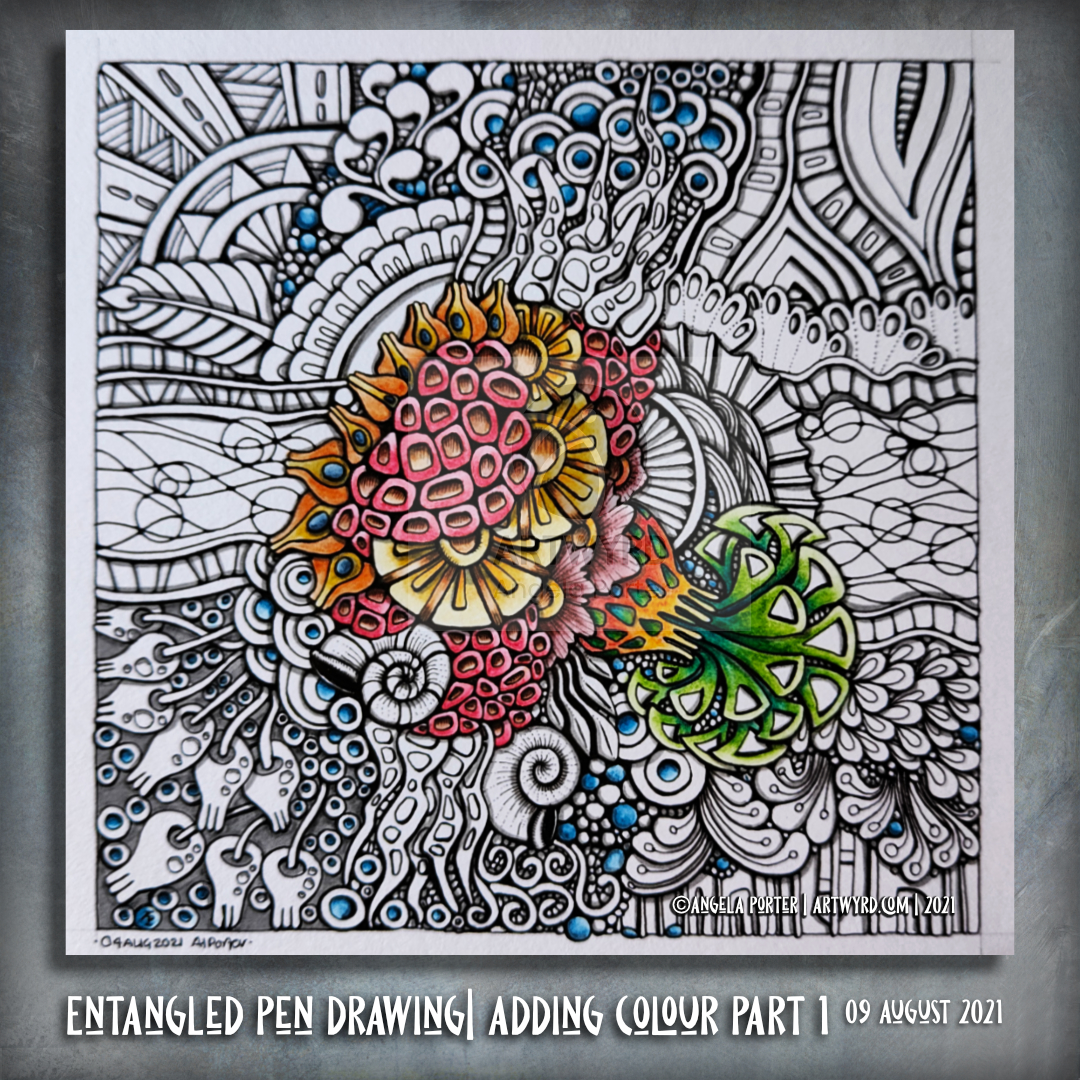
I’m at a bit of an impasse with my other entangled drawing works in progress. So, I’ve started to add colour to this one.

Shadow was added with a grey Pitt Artist Pen on Saturday, along with some of the colour. I think my morning ‘art and a cuppa’ will continue for the next few days, with videos being released of the process.

I’m doing my best to work with a limited colour palette. I started with reds, oranges, yellows and browns. this morning I thought a couple of complementary colours were needed to lift the colours a bit. So blue and green was added.

Inktense pencils and a damp brush are being used, and the specific colours used so far are – Cherry Red, Madder Brown, Baked Earth, Mustard, Sienna Gold, Deep Indigo, Blue Aquamarine and Spring Green.

I did post a photo of the drawing with just reds/oranges/browns on Instagram on Saturday. Adding the blues and green is making the colours seem so much brighter. That’s the magic of complementary colours – colours opposite each other on the colour wheel.

The way that complementary colours, particularly blues with reds/oranges/yellows, is something I am really fold of. I think it harks back to the album covers designed by Roger Dean, to mention one artist! Being a child in the sixties and seventies and the preponderance of psychedelic art at that time.

My original plan was to use an analogous colour scheme (colours next to each other on the colour wheel). But as my mood is so much better and back to normal, complementary colours are totally necessary now!