It’s a very ‘Entangled’ kind of drawing, rich with pattern and detail. There’s even a touch or two of whimsy. There’s some influence from the realms of Romanesque and Early Celtic art, Medieval illuminated manuscripts and Zentangle patterns and fragments.
I’ve chosen a limited colour palette that is rather muted in it’s tones.
This was drawn on some mixed media paper using a TWSBI Eco fountain pen with waterproof document ink that is fountain pen friendly.
Colour has been added digitally using Clip Studio Paint, along with a creamy linen background paper.
May each day of this year have many moments of peace and contentment, happiness and love, and fond memories too. May you also have all that you need. Wishing each of you the very best for the next 365 days, and beyond.
I needed to add shadows to the drawing completed and given a colour wash yesterday. As I so often regret my choices of how I do this, I decided to make a test page of various methods for my sketchbook.
They all have their own charm and feel. However, putting them side by side so I can compare and contrast gave me a better idea of what I really like.
To add shadow/highlight to a drawing, I really like the hatching/contour lines created by a micron pen or a biro. The biro I particularly like as it is much softer and I’m able to get a tone variation with the lines.
I also worked out that for using gradations of colour, they just feel a bit … plain. So, like in the drawing of medieval flowers and leaves, the combination of lines and colour works for me.
I found when I was adding shadow below the drawings that using Distress Inks like watercolours just wasn’t going to work. The use of water results in weird boundary lines that I’m not fond of. Of course, if I’d not coloured the background in Distress Ink, a gradated wash of colour may have created a lovely shadow.
So, I think I’d prefer to use chalk pastels for adding shadow. The ability to blend them out gradually, with no harsh line, is a great advantage. It’s also easy to add more of the pastel if a darker colour is needed.
So, that’s what I chose to do. Not just with the drop shadows, but with darker areas on the leaves etc. I even found that the pastel can tint the gold I’d added in places, which is a really interesting twist.
Bit by bit, I’m working out colour, shadow, highlight and what works for me.
It’s also no bad thing to spend time trying out techniques with various media. Mixing and matching. Making a reference page for my sketchbook / zibaldone has proven to be a very valuable exercise.
When I’m quite happy with the drawing. I will do my best to take a good photograph of it. It’s worked out much better than I thought it could.
The paper is 8″ x 4″ in size and coloured with various Distress Inks in shades of brown. The flowers and leaves were inspired by Medieval illuminated manuscripts, and there’s some zentangle-ish stuff going on at the bottom.
What I really enjoyed was adding contrast with pen strokes. Not graphite pencils, not chalk pastels or markers, just a very fine pen. The end results reminds me of an etching.
I have since added simple washes of colour, using the same colours I used on the paper, with the adding of Old Paper Distress Ink. I’ve mucked up a bit in trying to add shadows beneath the flowers, perhaps. I’ve also added some gold accents. This work isn’t shown in this photograph; I will show it when I’m happy with how things are. Well, happyish. I’m thinking that adding colour may not have been such a good idea after all!
The video is a long one, showing most of the drawing process. But hopefully I’ve done it in a way that if you want to ‘draw with me’, you can!
Well, I have been a bit busy with variations on the simple flower motif in the bottom left corner of the image!
I’ve said (typed?) it before; I really, really enjoy taking a simple motif and seeing how I can vary, alter and create patterns with it. There is something fascinating in doing this. Some explorations don’t work out and need amending, others lead my thoughts to unexpected versions.
Today, I felt the need to play around with a simple flower motif. I had planned on doing a page showing how to draw my current favourite patterns/motifs. Instead, as I started to draw this flower, I wanted to explore variations and patterns I could create with it.
There’s only about one third of an A5 page filled with such line drawings, and that took about an hour or so to do. But there’s so much in there already!
Being able to just lose myself, guilt free, in drawing over the past couple of days or so, has been a pleasure. ‘Adorable Dogs’ is almost done, just three templates to add colour to remain. I have a break before I start work on the next colouring book for Creative Haven from Dover Publications Inc.
That doesn’t mean I won’t be working on another project or two. But for the next few days I’m just going to indulge myself in drawing for the sheer pleasure of drawing! And that includes a New Year template for the facebook group Angela Porter’s Coloring Books Fans.
The first one involved line drawing and adding shadows with a graphite pencil.
Part 2 involved adding some colour and shimmer, and plenty of ‘hiding the crimes’ too, with the gold border.
I rescued the drawing, but looking back, I wish I’d stopped at the end of the first video and just added some gold highlights to the berries. I also think that adding hatching, broken contour lines and stippling may have been much better than adding colour. Or, scanned the image in and added shadow and colour digitally!
I filmed these processes, and the two videos are below.
Actually, the title should be ‘How Not to finish up…’. I had a bit of an accident. More about that in a minute.
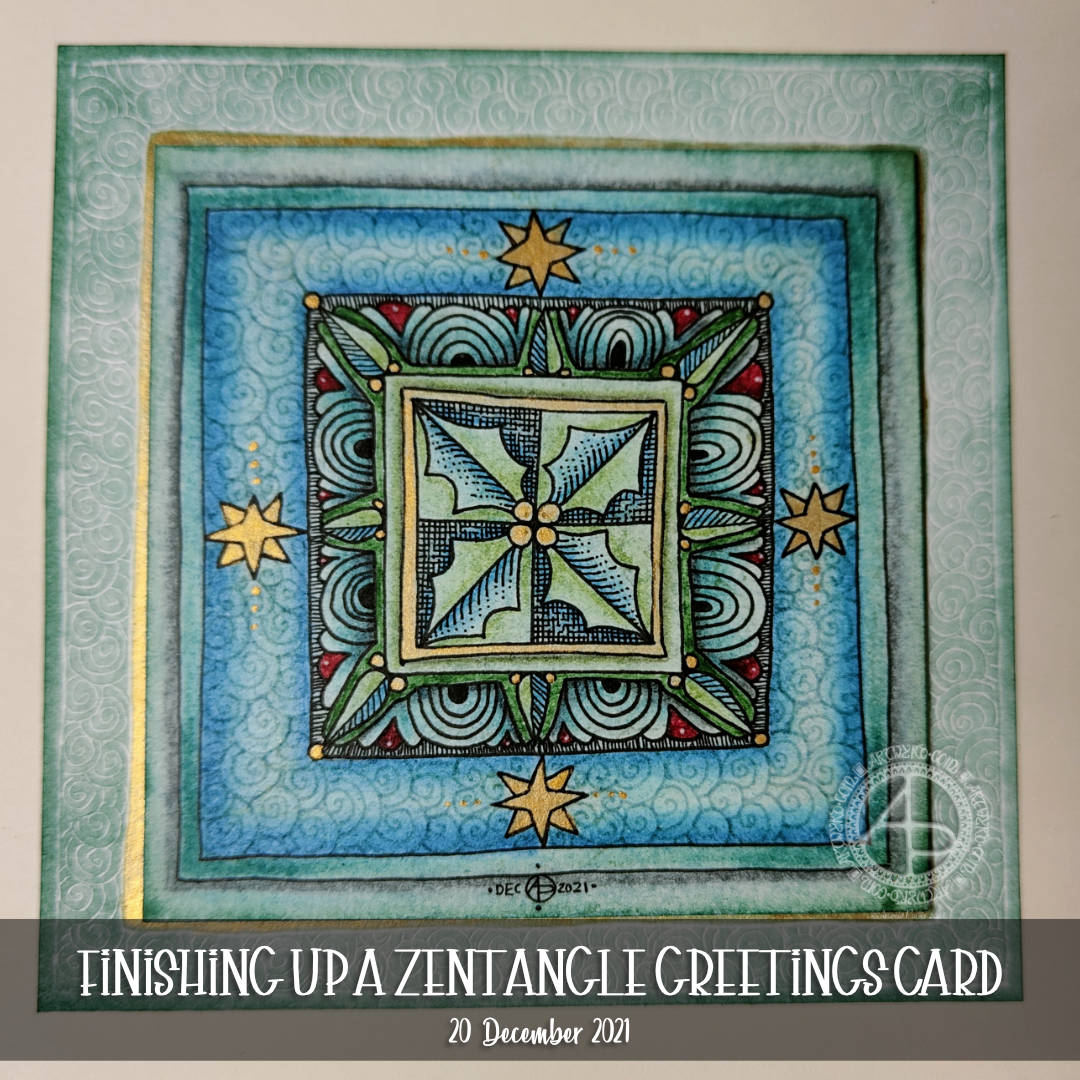
This morning, I decided to work on finishing up one card design. I knew I wanted to add another layer beneath the panel already finished before gluing it to the cream-coloured card blank.
I dug out some scrapbook paper from my stash. Nothing felt right. The colours were just ‘off’. That’s when I realised I needed to use Distress Inks to colour the lower panel.
I could have used them to colour the panel, then use pens (black, fineliner or metallic) to draw a pattern on it. Instead, I decided to try to emboss the pattern into the paper using a dotting tool / parchment craft ball tool / embossing tool.
Before I did this, I experimented on some scrap paper to see how I could colour the paper (more on this in today’s video).
I decided to emboss the paper first, then add Distress Ink (pine needles) with the black side of a piece of Cut ‘n Dry foam. That kept the embossing white. I found that if I used a blending brush (aka make-up brush!) more ink settled in the embossing. That is also a lovely look, but not what I wanted.
Inside this border, I added some gold ink to create a gold border around the upper panel.
That looked fine and dandy. The horror story came with the next step…
I added some foam tape to the back of the upper panel to add some dimension to the card, along with some glue so I had some wiggle time to make sure I got the panel centred.
The glue was the mistake I think. I had the panel nicely centred until I turned it over to add some pressure to get it to stick firmly. It must have wiggled and become de-centralised.
And when I noticed it was very firmly stuck.
I was so annoyed with myself as I know this is something that nearly always goes wrong when I try to make cards.
The only way I can ‘fix’ things is to cut out that central panel and re-make the embossed border and reassemble the card once again. This time I’d consider having the embossed pattern going under the central pattern so that if it is a little off it won’t be quite so noticeable.
I’m not, however, going to do that. This time, I’m going to make notes in the card about what I did, the media used, what I like, what I don’t like, and what I need to be very, very mindful of the next time I make a card.
Reflecting on the card creation
I know I’m fairly happy with the design. I like the central motif of holly leaves. The sutble pattern in the border around it is nice too, as is the embossed border.
I do wish I’d not used chalk pastels to add colour to this panel. There’s something dusty and muted about it that I’m not at all sure of. I think that keeping things mostly monochrome on a coloured background works best for me, with touches of gold and white, with some shading perhaps.
It’s that thing again. I love colour, but making use of it always has me feeling that it’s where I mess things up, unless I keep the colours really simple. Simple as in black, white, the background colour, and a shadow colour, and maybe touches of metallics for some sparkle and shine.
I do better with colour when I work digitally, but in traditional media I always feel like I struggle.
It’s always a learning experience, more so when things don’t go as planned or when I’m not entirely happy with what I produce. My problem is I try the same kind of thing over and over and expect it all to improve. I think I’m hoping that I’ll work out how to make the various media work for me at some point.
I say, often, I’m going to stick to monochrome, and then go and try working with colour, often with the same kind of feeling at the end. The feeling I like the pen drawing, but the colour/media isn’t what I’m looking for.
Perhaps time for me to make use of this colour printer and add colour digitally and print it out!
I was awake way too early this morning, but just couldn’t get back to sleep. So, what am I going to do? Art of course, after a while of tossing and turning that is.
Completing the holly design.
I spent some time yesterday adding colour with various chalk pastels. I finished off the last few areas with fineliner pens. Then, I added another layer of gold to the stars and inked around their outlines again.
To finish the holly design, I wanted to seal the surface. I’d done some experiments to see how a multi-media gloss finish and micro-glaze would work. With both, there was very little shift of any of the media I’d used on my test pieces – chalk pastels, graphite pencil, tinted charcoal, and Ecoline watercolour inks. The only difference was the gloss medium was a bit glossy, while the micro glaze lacked any brush strokes.
I decided on the microglaze. It helped to bring out the colours, as well as stop them being rubbed off. There’s also less chance of me making a total mess of things too.
All in all, I’m fairly happy with this panel for a card. Despite all my doubt and misgivings during the process of drawing the design, it’s turned out quite OK.
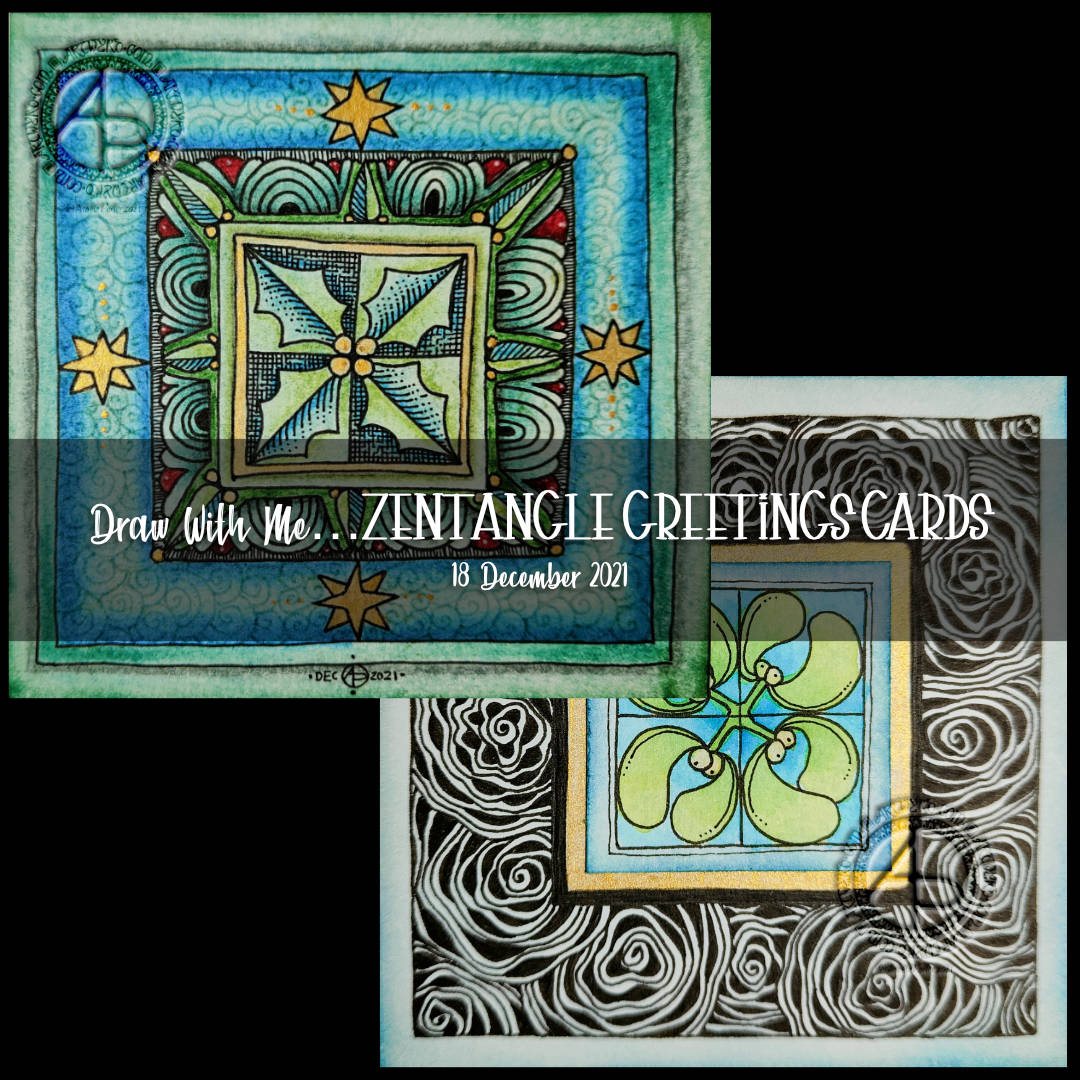
Notes on the mistletoe design
For this design, I decided to create a separate centre panel. I also painted a square of gold beneath where this panel would go.
I used Ecoline watercolour ink to add colour to the drawing on the Distress Ink coloured panel. Then I attached it to the base ’tile’.
Next, it was time to decide what to do with that big border around the mistletoe. I went with the tangle pattern Diva Dance Rock and Roll.
I knew this tangle pattern would add a lot of black to the border, but I think I wanted that to be the case. The black helps the central panel to stand out, I think.
I still have some work to do on this panel, but I to focus on inking in more of the last couple of templates for Adorable Dogs.




 Art is the Adventure