Cute and whimsical fish! What a lovely way to fill a sketchbook page and end up with a shoal of fishies.
Being whimsical, and cute, is so much fun when it comes to drawing as anything goes. All are recognisable as fish, even if only one looks like an actual fish that exists! And I’m fine with that!
Drawing practice, or indeed lettering, has to be fun, enjoyable and something to look forward to. Yes, I know it’s important to develop and advance skills, but that doesn’t mean that just drawing for fun can’t be important too. Drawing for relaxation, to de-stress, to learn how new media work, is also important, as well as expanding and exercising the imagination and creativity that we all have.
So, today fish seemed an appropriate subject to populate a page or three in my sketchbook. If you’d like to grab a pen and a sketchbook (or paper) and draw along with me, click on this link to watch today’s YouTube tutorial.
This was fun! A page full of flowery, shelly, poddy motifs all starting with a circle! I’ve actually already filled nearly six pages in my A5 sketchbook with such explorations. And I’ve not finished!
A simple exercise like this really gets your creative juices flowing. There are so many, many ways to fill a circle with patterns to create a new motif. And as it’s in a sketchbook, there’s absolutely no pressure to make everything perfectly polished. The point is to get an idea down quickly and then move on to the next.
After the page (or pages) are full, there’s time to go back and add finishing details, patterns, textures, colours and/or shadows. There’s no requirement to do this to every single motif on the page. Nor is it essential that each space on a motif is filled identically. This is a space to just try things out, whether they work or not at this time. Be that drawing, patterns, textures, colours or different media.
Eventually, the sketchbook will be full of ideas and inspiration. It will be a place to dip into when at a loss. it will be full of exercises that can be done again and again or varied quite simply.
Exercises that get you drawing and being creative just for the sheer fun of it!
This is exactly what a sketchbook is for! There can be some more polished drawings in there, of course. There can be notes and ephemera and colour palettes and swatches and more too. But the fun of just drawing to see how many variations on a theme, starting with one simple shape or motif. Well, you’ll surprise yourself!
Give it a go! No one ever has to see what’s in your sketchbook. It can be a place where you play with watercolours just to watch the magic of that medium. To lose yourself in a pleasurable activity for a while and take a break from the busyness of modern life and all the stuff going on in the world around.
Drawing in a whimsical, stylised or doodly way takes the pressure off the belief that art has to look like a photograph (it doesn’t!). It allows you to just enjoy the process.
One of my YouTube subscribers wondered what I could do with the Zentangle pattern Huggins. I think Linda’s exact words were ‘I’d like to see you take on Huggins’.
So I did. This page is as far as I’ve got for now, which is further than I got in the video. But what else is there to do while a video is uploading and processing?
Huggins is one of my favourite tangle patterns (there are many). It’s always fun to play around with varying the pattern, and it’s a very good one to add variations to!
Not my neatest drawing, but it is in a sketchbook. Sketchbooks are, sometimes, the place to get ideas down quickly as they come to you. And that’s exactly what I did in today’s video.
I’ve learned a new ‘trick’! New to me that is. I’ve finally worked out how I can use grey shadow underpainting to increase contrast in my artwork! It’s new to me, but not new to the art world I’m sure.
I’m really happy with the result. Digital art makes it so easy to try things out in layers. So, this is the way for me to go.
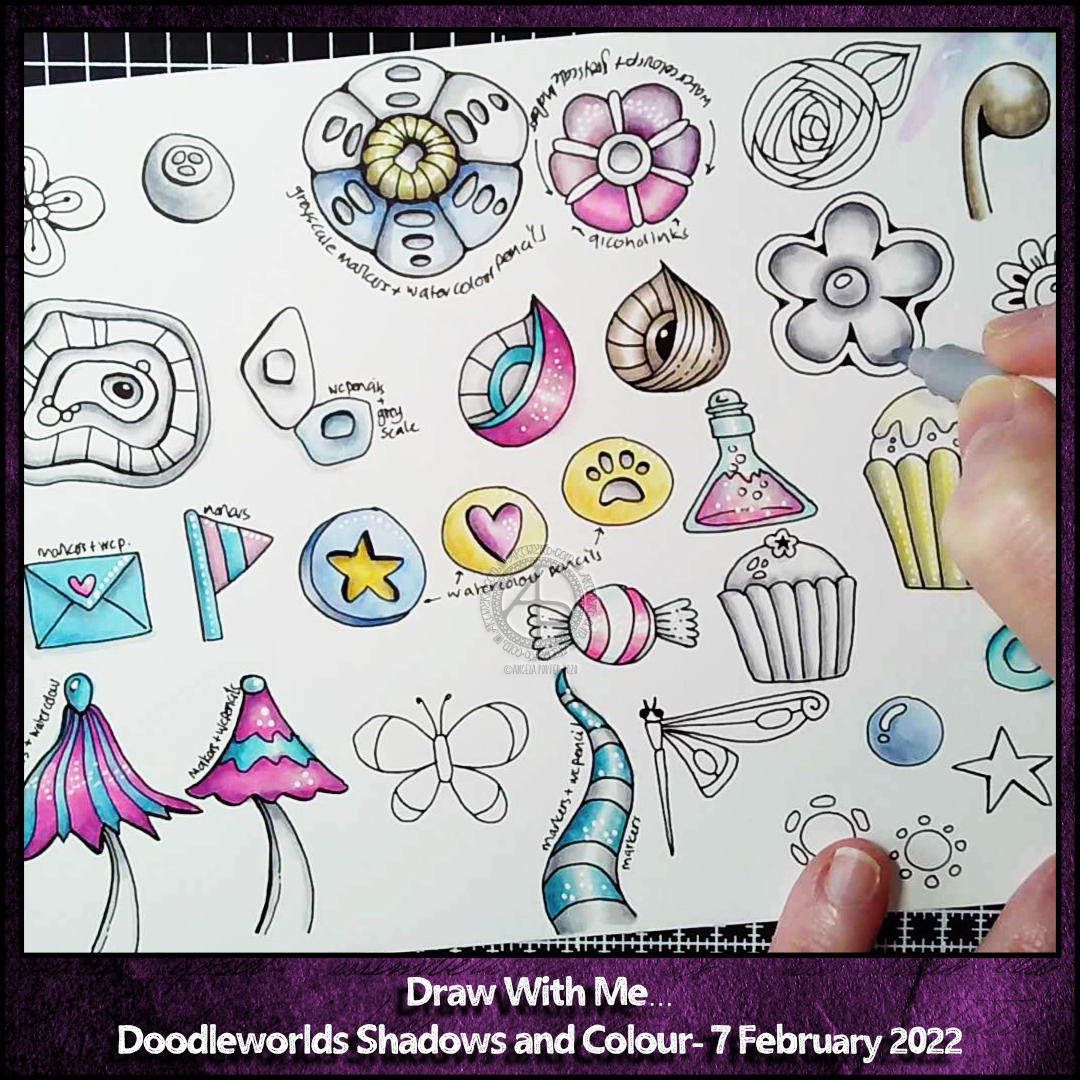
Yesterday morning, I started adding shadows to some pen drawn motifs with marker pens. I wanted to see what that would look like. I prefer these shadows to those done with graphite or chalk pastel pencils.
Then, I added colour using watercolour pencils and a damp brush, just to see what would happen. I liked the result! Lots!
I filmed part of this process today, and here’s the video on YouTube



 Art is the Adventure