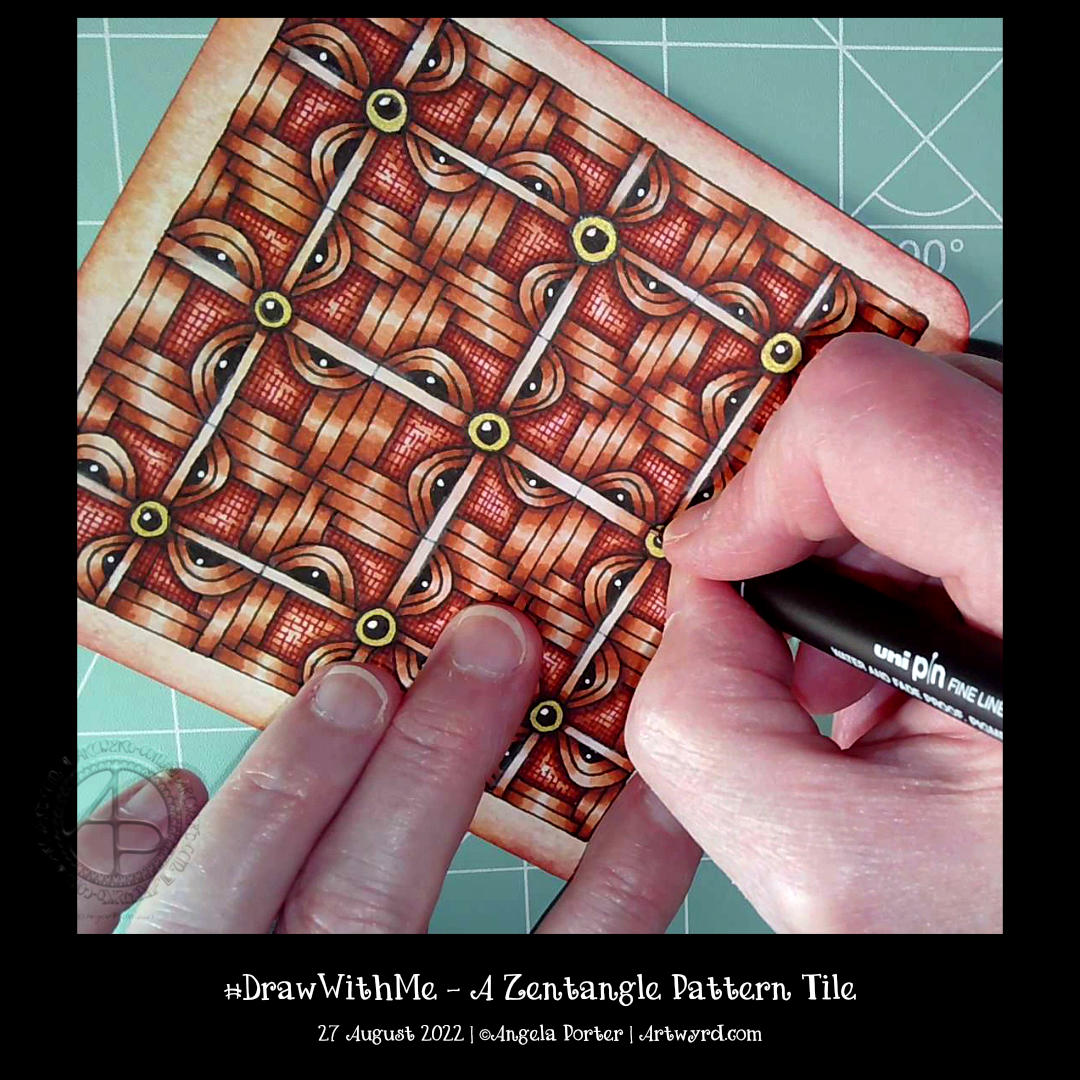
Today, I spent more than two hours creating this tile. I like how it’s turned out, particularly the volume and dimension achieved by shadow and highlight.
I started with a 4½” (11.5 cm) square of Artway’s Flat White Enviro mixed media paper, which is sturdy and works well with alcohol markers. My first step was to colour the paper with some Distress inks – I used Dried Marigold, Spiced Marmalade, Saltwater Taffy, Seedless Preserves and a hint of Aged Mahogany around the edge.
In true Zentangle fashion, no pencil was used to set the grid. And I chose to use a square fragment from my explorations yesterday. Of course, the fragment had a bit of a twist, with some weaving done in the style of the Zentangle pattern ‘Hurry’. Oh, and I used an 0.3 Unipin fineliner pen to do all the line drawing. Apart from the tattered burlap pattern, which I used a rusty red Staedtler Triplus fineliner for
The next step was to start to add shadow and highlight to warp space. Not really, but the illusion of dimension! I chose to use a trio of red-brown Ohuhu Art Markers. They don’t blend as well on this paper as they would on marker paper, but I like the texture that results in this case.
The final steps included: adding some shadow to the overlying grid with alcohol markers, highlights with a white charcoal pencil and a white 08 Gelly roll pen, and finally, the gold outer of the ‘buttons’ or ‘beads’ that hold the grid together.
I wanted to complete a piece of art for today’s video to mark a YouTube achievement of getting 1000+ subscribers. If you are one of those subscribers, I thank you from the bottom of my heart!
Although I didn’t tackle all of the triangular fragments in today’s video, I enjoyed sharing some explorations, along with the little bit of an overall pattern that came about almost accidentally!
I’d almost forgotten how much fun it is to use a basic shape and see how it can be turned into a fragment of a larger pattern. Then, create variations on this theme. Some of the fragments are from the Zentangle Primer Vol. 1, others are variations that resulted.
I thought I’d go with some more abstract, pattern-based templates. The last one I drew, at the top right, just ended up having some seed pods.
Abstract designs like these are great fun to add colour to as there are no pre-conceptions about what the colours should be. Also, they’re great for trying out new techniques, media and colour combinations. And, of course, they’re relatively quick to finish, which is great if you’re short on time.
It’s blessedly cooler this morning as I write this blog. There’s been a little rain, but not enough to help out nature. We have the potential of thunderstorms and torrential rain at some point today. I do hope we get some thunderstorms – I love nature’s fireworks and drama! Rain is fine, but torrential rain can cause huge problems.
Anyhoo, to arty things. There are two drawings in the photo. I completed the one on the right on Sunday and filmed a video tutorial. It explores a new fragment shared on day one of Zentangle Project Pack 18. It’s always fun to explore patterns; I get to understand the pattern more and discover variations.
One of those variations came out in my sketchbook on Sunday evening. I used the ideas of the fragment as a way of filling space. What resulted looked a lot like the tangle pattern Diva Dance. you can see this in the drawing to the right in the image above.
It never ceases to amaze me how patterns can segue one into another as variations are explored. Everything, even tangle patterns, is interconnected and related by not that many degrees of variation!
Of course, I filmed the drawing of the flower and tangle pattern tile as a video tutorial. Hopefully, slowly and clearly enough that it’s easy to draw along with me. I hope you give it a go!
Please click the ‘Watch on YouTube” button, if you’d be so kind. Cheers!
In this video, I draw a mandala (or zendala) step by step so you can join in with me.
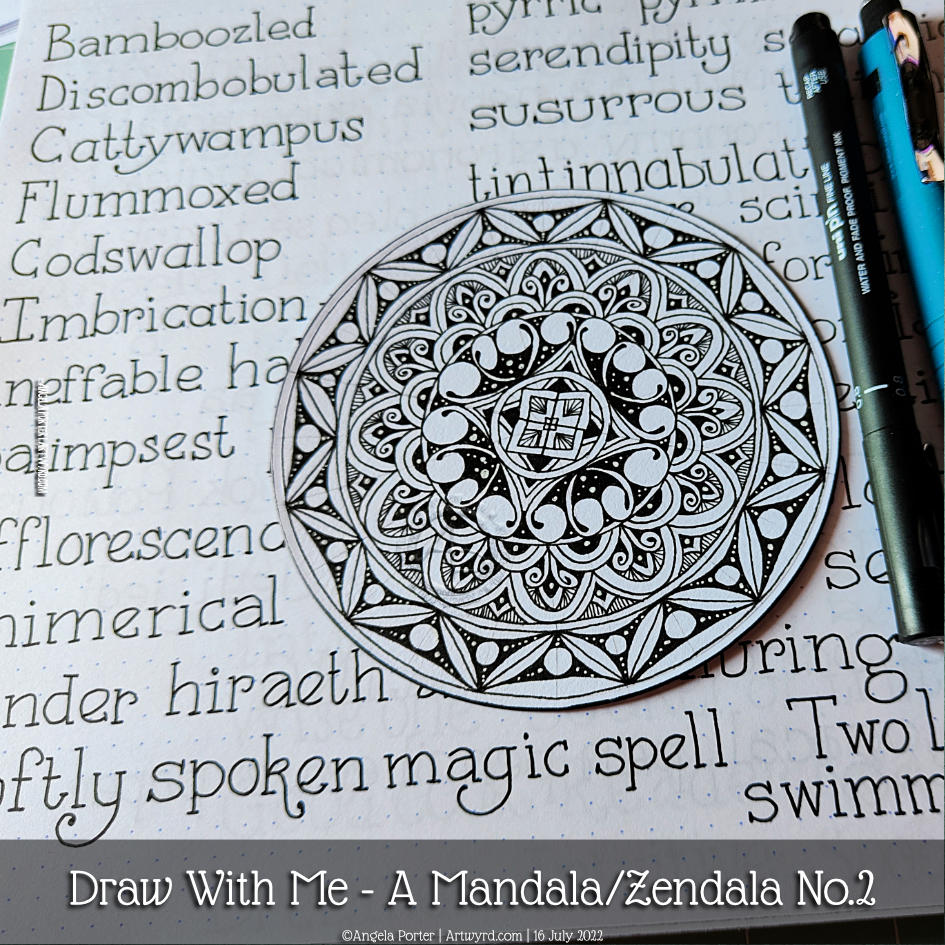
I enjoyed creating yesterday’s mandalaso much, that I thought I’d repeat the experience! I finished drawing the mandala in this video, but I’ve yet to add shadow, highlight and/or colour. I’m not quite sure how I’m going to do that, yet; but there’s no rush to get it done either.
And here’s a photo of the mandala as it is at the moment, with some of my handlettering practice in the background!
In today’s YouTube video, I show how, step by step, I draw a mandala, or zendala, with traditional media. And the help of the Markus Operandus for Mandalas from Zentangle.com! A nifty printable that helps set out a mandala!
I’ve used two tangle patterns in this design – tripoli and between. I’ve taken inspiration from each to complete the outer ring.
To start with, I pre-cut a piece of ClaireFontaine Paint On mixed-media paper using an 11cm circle die, and a Sizzix Big Shot die cutting machine. In fact, I cut four at 11cm and four at 9cm in size, so I have a few that are good to go.
Next, I coloured one large and one small circle with Distress Inks. Then, I set about using the Markus Operandus to lay out the basic bones of the mandala.
Only then could I start to draw the design, though I had no idea what I was going to do.
The photo above is the final mandala. I used Arteza Everblend markers to add shadows to the zendala. A white gel pen was used to add dots of white for highlights. A silver Gelly Roll pen was used to add silver to the fine ring borders, to the circles and to the darker areas in the tripoli pattern pieces.
I’m quite happy with the outcome. More so, as it’s been a very long time since I drew a mandala without using digital tools.
Today’s video is rather long – well over an hour. It’s kind of a celebration that I’ve reached 900 subscribers on my YouTube channel! I never thought I’d get even one subscriber. So, a huge thank you to you if you’re one of my subscribers.
The past couple of days have seen me creating videos that go in a slightly different direction to my usual.
Yesterday’s YouTube video was a look at using and blending coloured pencils – not a skill I’m great at, especially when it comes to choosing colours.
I carried on experimenting with my drawing and trying out various media either alone or in various combinations – coloured pencils, Inktense, and/or graphite. I quite like the way graphite dirties up the colours and creates an almost metallic feeling. Not a shiny metallic, but a dull kind of one.
Today’s video was a response to a comment left for me on YouTube about fineliners smearing with alcohol markers. So, I thought I’d do a look at some of the various fineliners I have, the tricks I use to avoid this, and a bit more about achieving contrast, volume and blending markers.
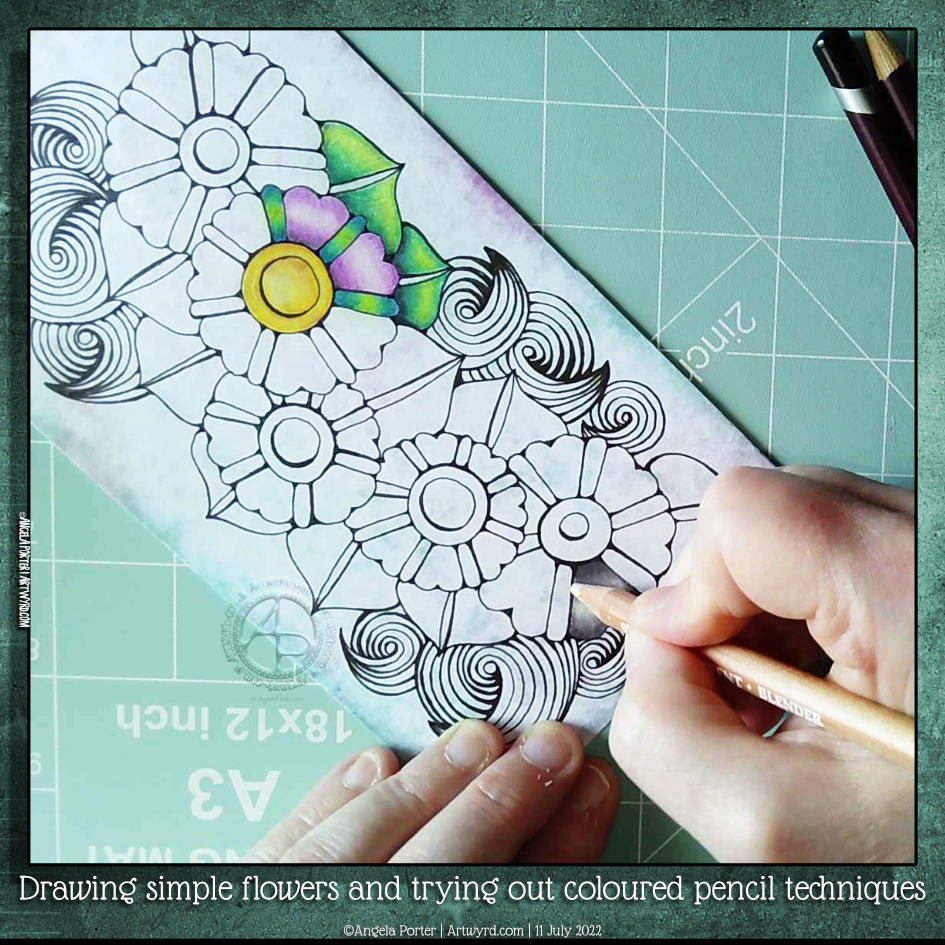
One of my YouTube subscribers (Chen Keith) requested I draw some simple flowers and show how I’d use coloured pencils to colour and add contrast.
Drawing, not a problem! Colouring? Yeuch colour choices! But I do show different approaches I use to adding colour with coloured pencils, or rather what I’ve done in the past. I rarely ever used coloured pencils now. Digital coloring or marker pens are my mediums of choice, with Inktense and the Karin Brush Markers close behind.
While the video was uploading and processing, I did try out other ways of adding colour and/or contrast. It’s way too hot here in the Valleys of South Wales for me to think clearly and explain things at the moment. The heat is making me feel very, very tired.
Drawing Zentangle Tangle Patterns Spoolies and Swerve and adding contrast/colour.
What to do on a Sunday morning? Arty things of course!
So, yesterday I drew the design to the right and added some colour to it. But it was lacking something. I eventually worked out, at around the same time someone made a suggestion on my YouTube video, that it needed more contrast.
So, I set about doing just that, as well as showing/explaining how I add weight to lines to help increase the contrast and sense of volume. That’s what the greyscale drawing is all about.
For the other one, I used sepia and red oxide Inktense pencils and a damp brush to add more colour and increase contrast. I made some bad decisions in adding cross-hatching to some of the elements of that design. But that meant it was a great piece to work on improving my skills.
I’m often way too timid with contrast, at the start. But as long as I use a medium that allows me to gradually build up layers, I eventually get there.
Today’s video shows how I achieved this higher contrast finish with both line weight and colour/shadow, and you can watch it by clicking on this link.
Last night when I arrived home after an absolutely visit with a dear friend, I found the postman had delivered a set of mini Distress Ink pads in the new colours released last year! It was way too late to do anything with the inks, so I decided I’d have a look at them in today’s video for YouTube.
I started by trying blends of the colours. My instincts were not to mix the salmony pink Saltwater Taffy with the other colours – Villanous Violet, Blue Ribbon and Salvaged Patina. Orangey tones with purple, blue and/or pale green-turquoise colour, would make mud, my instincts told me.
However, when I used them all for one background, I was really surprised by the colours that resulted. They were lovely! No mud! Just lovely, aged, vintage-ish colours. What a wonderful surprise!
After spraying water to create water stains, stencilling and another spray of water drops (drying in between each procedure), I edged each paper with Hickory Smoke. Then, it was time to draw!
I used an 0.1 and 0.3 Molotow fineliner pens for drawing. They’re new to me and so was keen to try them out. The ink is lovely! But, I found the pens rather light and awkward to hold. The natural place to rest my fingers was way too high up the pen to be comfortable.
I’ll use the pens until the nibs are wrecked or they run out of ink, whichever comes first. The ink is very black and very opaque. The nibs do write really smoothly on the paper I used. But, they’re just not comfortable for me to hold, and that comes down to personal preference! Otherwise, they really do seem to be great pens!
I started drawing with the tangle pattern ‘spoolies’ to the left. This is where I noticed how the grip I had on the pen was uncomfortable and making it really difficult for me to draw smooth, precise lines. I ended up doing a mash-up of spoolies and diva dance!
The pointy leaves (or shark fins or points of crescent moons, depending on how you want to see them) actually echo the pointed part of spoolies. These then were replaced by the tangle pattern swirl, which is very similar to spoolies. Finally, the pointy leaves/fins/horns of the moon returned.
As I wanted to lift these off the background, I used a crosshatch pattern to darken the spaces between them.
Then, in my not-so-clever wisdom, I decided to help the illusion of volume and layers along by adding colour using Distress Inks as watercolour inks or paints.
I’m not at all sure about the end result, which wasn’t helped as I decided to splatter gold paint over it.
I often ask myself what on earth was I thinking and will I ever learn. This is another of those occasions. I kept compounding the problem as I tried seemingly good ideas.
As I said, I wonder if I’ll ever learn …
No matter what, it was lovely to be sat drawing just for enjoyment. Even though I’m not happy with the end result, I learned a lot about these new-to-me Distress Ink colours. Also, I’ve learned that a spray of water really can make the background lovely. And it’s OK to repeat sprays as more colour or stencilling or edging colours are added.
But perhaps the most important thing is that sometimes the process, the enjoyment of creating and learning is more important than an end piece that I’m happy with. Perhaps, in the coming hours, days, weeks or months, I’ll be able to look at this with fresh eyes and see it as not as bad as I know think it is!






 Art is the Adventure