Purk is a Zentangle pattern, and today it appears, to begin with, in a leaf shape.
I managed to fill in half my sketchbook page with variations. I’m sure there are other variations to be discovered, but just not yet. My mind is ticking over slowly with ideas today. I’m really brain-foggy at the moment and I don’t know why. Perimenopause, not sleeping well, something else? I dunno. But I’ll return to this fragment later today.
In today’s video I start by taking a look back on the past week of the Fragments of Your Imagination Challenge, #FYIC2022, along with some of my recently completed artworks. Then, I share how I worked on variations of Purk.
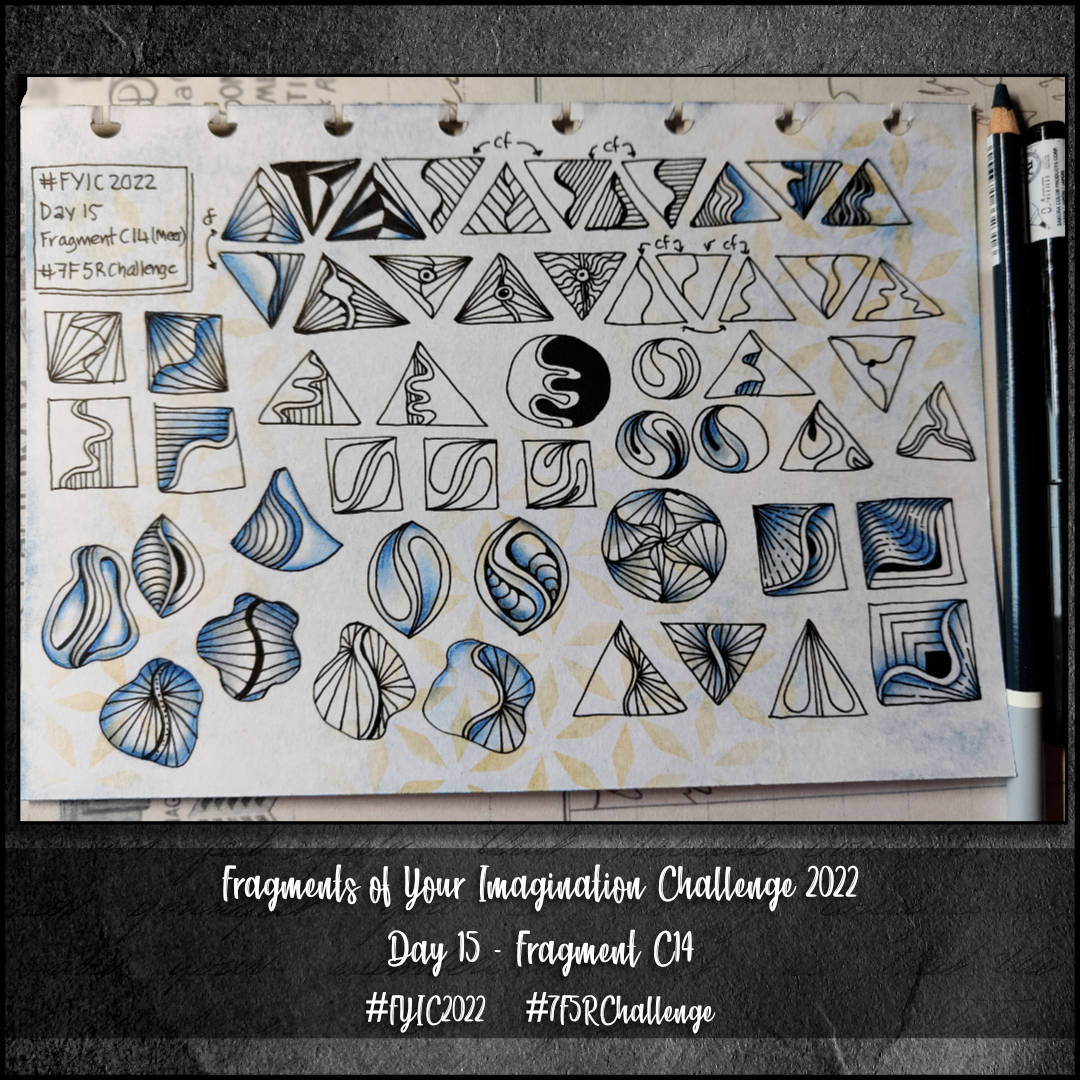
Another coddiwomple on a page in my sketchbook today. The aim to fill a sketchbook page with variations of Fragment C14, though I have no idea of what that would look like.
C14 is a curious fragment. Actually, all the fragments so far have been curious ones in different ways. My usual approach to creating variations is to work out what are the essential features of the fragment, then do my best to keep the essence of these present.
For me, the curvy dividing line is what defines this tangle, and so that is what I worked with…mostly.
Some surprising twists and turns along the way, some rather tangled, and fruitless dead ends too. Yet even with them there is something to learn.
Creating shadow and highlight brought the fragments alive and gave the illusion of volume.
These daily arty coddiwomples are adding ideas to the store of patterns, variations and understading in my subconscious storehouse of such treasures. They’re also increasing my confidence in creating variations, which is spilling over into my other drawings.
I have no idea what impact all of this will have on my artistic style, but it can only be a positive one for sure.
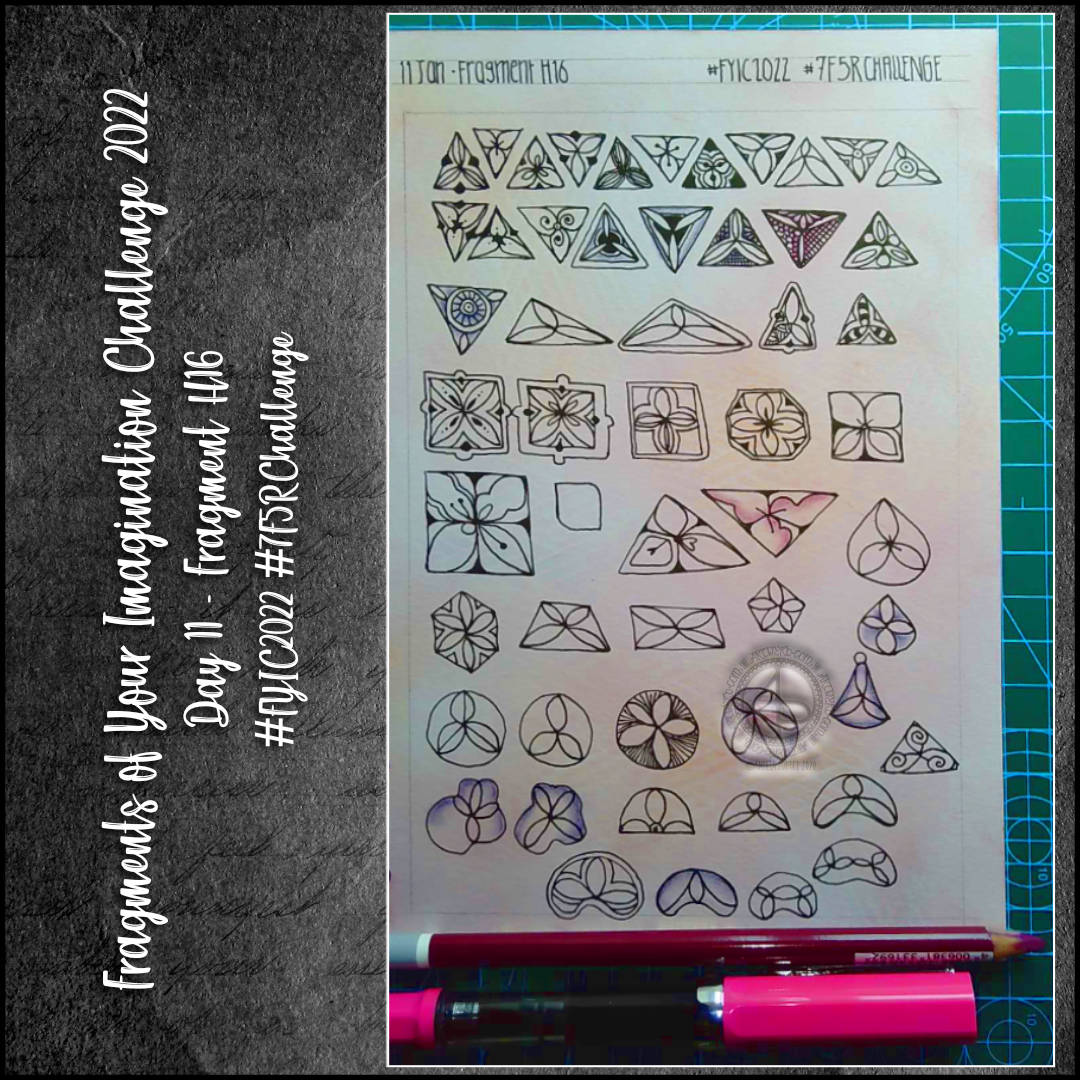
I’m rather fond of triangular fragments. Though the variations don’t have to remain triangular in shape! As long as the basic format, precept, of the fragment is adhered to: a central point and seed-shapes joining it to the points or sides of the shape.
I seem to say this everyday, but when I saw this fragment I did wonder what I could do with it. A fair amount it seems. Putting it together as a tangle pattern reminds me so much of agate.
I did record a video showing drawing some ideas on the smaller piece of paper, as well as adding shadow/colour to the main sheet.
It is definitely a fragment that deserves more of an exploration for sure.
D23 has turned out to be a rather interesting fragment with some really fun and pleasing avenues to wander down. Yet again, I’ve only scratched the surface of variations of this one. No doubt it’ll be something I’ll return to.
The most important thing I’m learning through this challenge is about the ways to vary tangles, and also which ways will best suit different fragments. And, of course, that will translate to my other arty stuff too.
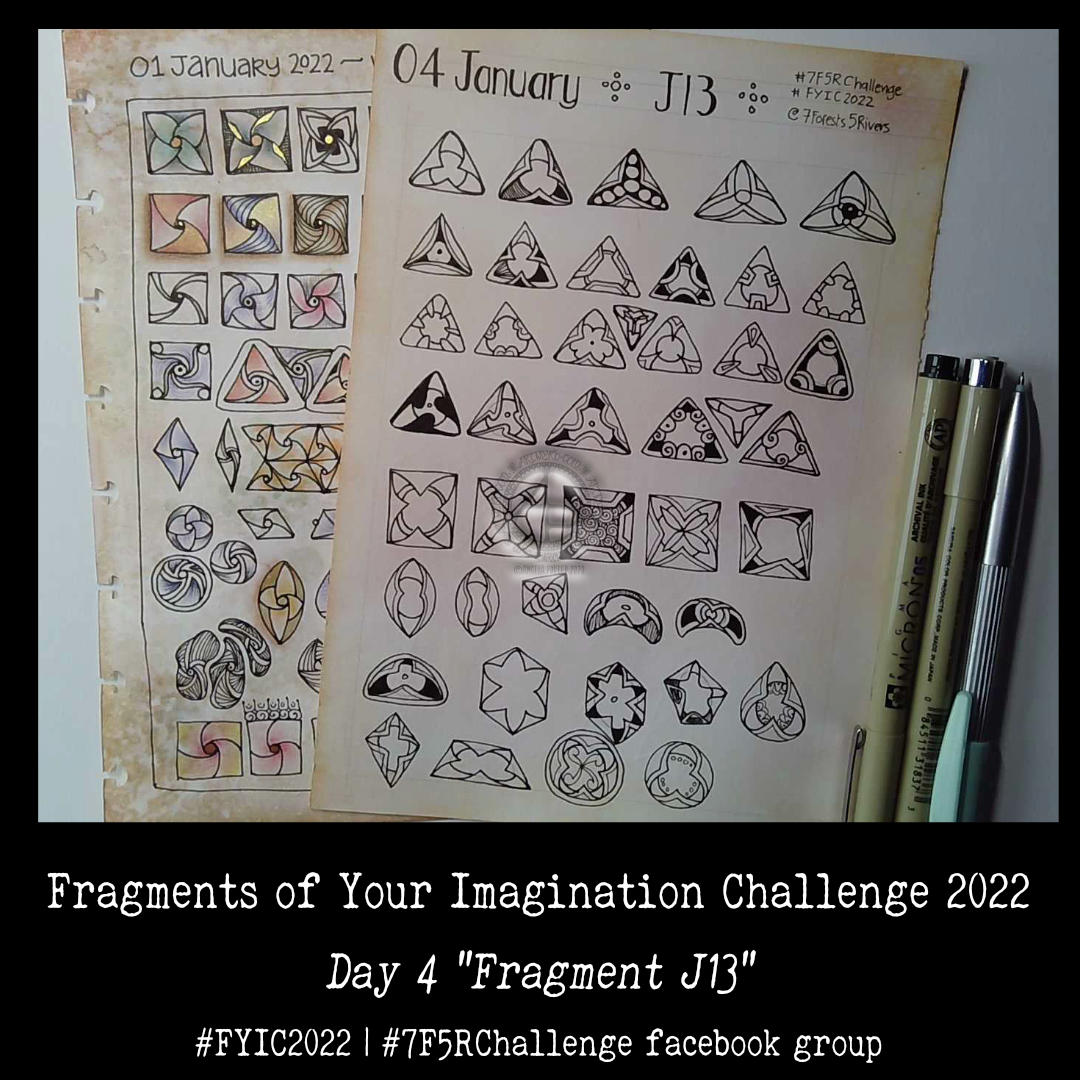
J13 is a fragment that is so full of possibility that I’ve barely touched the surface! This was fun to do and, no doubt, I’ll be re-visiting this fragment at some point.
I managed to get all the days muddled up in the challenge. That’s not a problem, I’ve been told, just work with a fragment a day, follow the list, ignore the list, all is fine and good!
Today, I chose to do fragment X7, which can be found in the Zentangle Primer book. It’s the circular version that is suggested today. But of course I had to work with other shapes and forms too! So much so I fairly quickly filled a page up.
The second sheet was done in today’s video. I had recorded the process of drawing the first sheet, but forgot to check that I was in frame. I wasn’t for way too much of the time. So, I just recorded a different video, including some other variations of the fragment.
Once you start exploring, you just can’t stop! Or so it seems in my case.
This is the first time I’m taking part in this particular month-long challenge. It’s being run by 7Forests5Rivers on facebook. Each day, there’s a different tangle pattern fragment to work with. And, with me being me, that means I’m most likely to create a page of lots of variations on a theme!
A fragment is a small, self-contained pattern-cell that can be repeated to create a grid pattern. The grid is called, in zentangle-speak, a reticulum. Within the reticulum, the fragments can be placed all in the same way, or they can be rotated and/or mirrored to create a pattern.
So, with just one simple fragment – the basic ‘cell’ of a repeating pattern – a whole host of patterns can be created. If the basic cell is changed by simple variations, then even more patterns can be created!
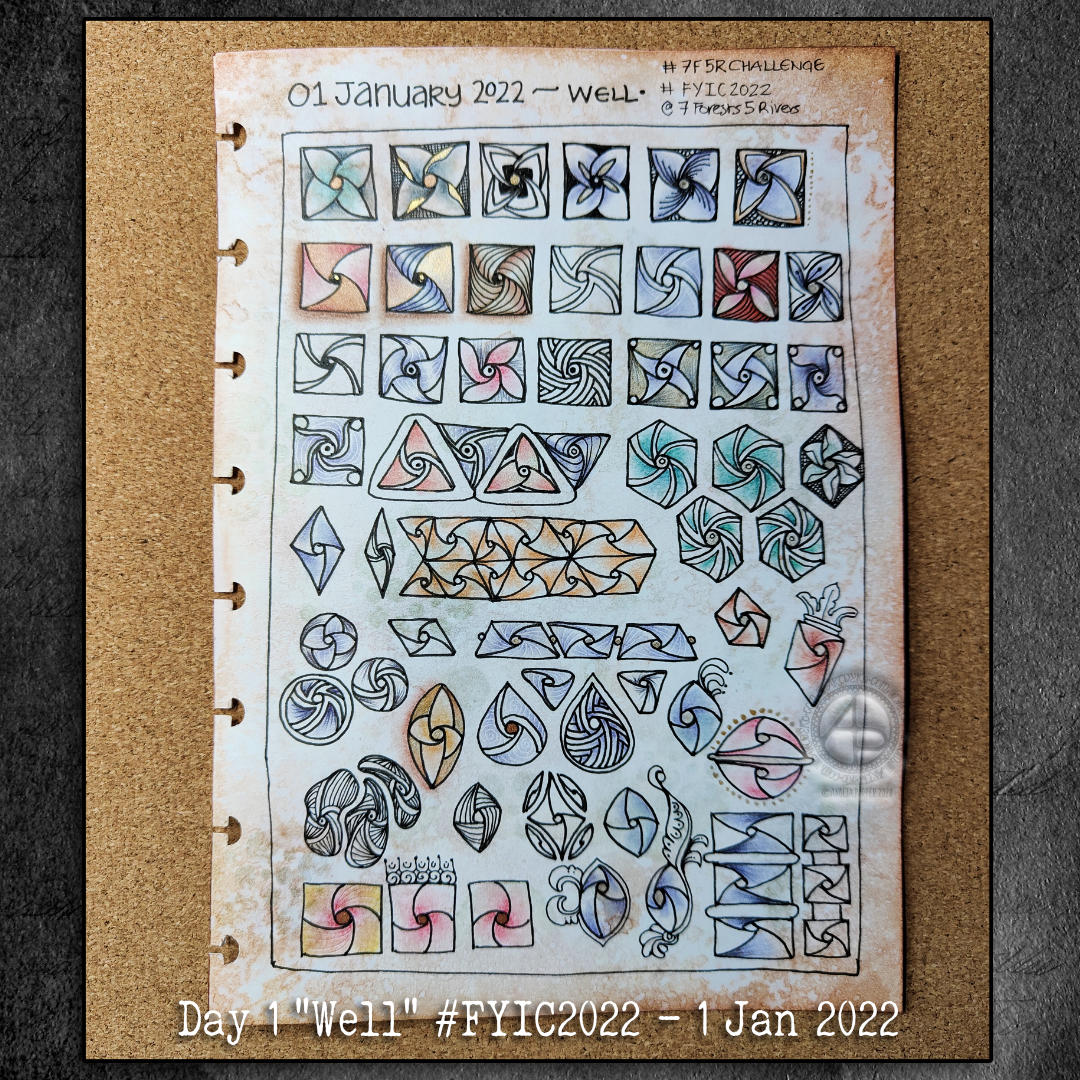
With me being me, I’ve created a page full of variations of the basic fragment for “Well”, which happens to be one of my favourite tangle patterns.
Some of the variations are different shapes for the fragment and ways of spacing and joining them. I couldn’t resist a few of my medieval-style flourishes too.
I needed to add shadows to the drawing completed and given a colour wash yesterday. As I so often regret my choices of how I do this, I decided to make a test page of various methods for my sketchbook.
They all have their own charm and feel. However, putting them side by side so I can compare and contrast gave me a better idea of what I really like.
To add shadow/highlight to a drawing, I really like the hatching/contour lines created by a micron pen or a biro. The biro I particularly like as it is much softer and I’m able to get a tone variation with the lines.
I also worked out that for using gradations of colour, they just feel a bit … plain. So, like in the drawing of medieval flowers and leaves, the combination of lines and colour works for me.
I found when I was adding shadow below the drawings that using Distress Inks like watercolours just wasn’t going to work. The use of water results in weird boundary lines that I’m not fond of. Of course, if I’d not coloured the background in Distress Ink, a gradated wash of colour may have created a lovely shadow.
So, I think I’d prefer to use chalk pastels for adding shadow. The ability to blend them out gradually, with no harsh line, is a great advantage. It’s also easy to add more of the pastel if a darker colour is needed.
So, that’s what I chose to do. Not just with the drop shadows, but with darker areas on the leaves etc. I even found that the pastel can tint the gold I’d added in places, which is a really interesting twist.
Bit by bit, I’m working out colour, shadow, highlight and what works for me.
It’s also no bad thing to spend time trying out techniques with various media. Mixing and matching. Making a reference page for my sketchbook / zibaldone has proven to be a very valuable exercise.
When I’m quite happy with the drawing. I will do my best to take a good photograph of it. It’s worked out much better than I thought it could.
Well, I have been a bit busy with variations on the simple flower motif in the bottom left corner of the image!
I’ve said (typed?) it before; I really, really enjoy taking a simple motif and seeing how I can vary, alter and create patterns with it. There is something fascinating in doing this. Some explorations don’t work out and need amending, others lead my thoughts to unexpected versions.









 Art is the Adventure