Inktober Tangles 2024 – Day 2

‘MaryShel’, the tangle for day 2 of #InktoberTangles2024, was formulated by Alena Light. It’s a delightful, organic tangle in its original two variations. However, I couldn’t resist playing around with the basic principles of the tangle—the initial ‘s’ curve and the ‘lobes’ that grow from it.

You can watch the video of my explorations of MaryShel on my YouTube channel.

I had played around with the tangle in a sketchbook, and some variations appeared in this collection. However, a few didn’t, and I also realized that many more could be created.

Not all the variations appeal to me, per se, nor do the ways I’ve added patterns to some. It is all about exploring, however, and not all discoveries will be pleasant ones! However, the not-so-pleasant ones are the ones that lead to reflection and learning.

I also like the softly coloured background with some stencilling on it. I achieved this by using Distress Inks—Rusty Hinge for the background and stencilling and Walnut Stain (I think) for the darker edging. I used Rosa Studio Watercolour paints to colour the individual MaryShels. A burnt sienna Prismacolor pencil was used to add drop shadows.

Although this page isn’t perfect (and it wasn’t ever meant to be), I very much like the colour. It’s warm and friendly compared to yesterday’s ‘Ambler’ exploration. The black and grey Ambler on the off-white paper has such an austere and cold feel. Perhaps I need to try some coloured Ambler!

I didn’t fuss around too much when adding watercolour; too much tends to break down the Canson Imagine mixed media paper. I just used very simple, mostly flat, colour washes, intending to add shadow with textures and patterns and highlight with a white Posca pen,

The patterns/textures/highlights/shadows are the parts that have not been completed. However, I want to work on larger-scale drawings of MaryShel variations.

What will Day 3 of Inktober Tangles 2024 bring? I don’t know, but it’ll be fun I’m sure!

Seed Pod Variations – A sketchbook/journal page – 7 Sept 2023

This was so lovely to do! I love seed pods, and working on variations to see what will flow in ink from the pen tip is always a delight.

Not stressing over ‘oops’ moments, or not being happy with a drawing isn’t an easy thing to do. However, I push along, knowing that this is a sketchbook page.

Sketchbook pages aren’t meant to be perfect, finished or aesthetic. They’re pages to explore and experiment. Even the wobbly drawings I’m not happy with can turn out to be ones I’m happy with, once I work with their bare bones and add detail.

There were certainly a few gaffes on this page. But instead of gaffes, I like to think of them as starting points to work from as I have worked out something I don’t like in this instance. That is always a valuable experience and leads to new skills, techniques, etc.

I only added colour and shade to some of the seed pods. They give me an inspirational nudge if I need it when I look through a sketchbook. They act as a reminder that colour and/or shade breathe life into a line drawing, especially when the line drawing looks very simple and bare of embellishment.

There are so many ways to add embellishment to a simple line drawing, that sometimes it’s nice to leave the simplest line drawing as an invitation to work with it and create more variations and a later point in time.

I have a video that shows how I created this page on YouTube. It is available to view from 18:00 UK time tonight, 7 September 2023.

Pattern Explorations 23 August ;23

Link to the Draw With Me video on YouTube.

Hollibaugh and Kwazeela – Days 24 and 25 of Inktober Tangles 2022

Click on this link to watch the accompanying video tutorial on YouTube

Today’s tangle pattern is “Hollibaugh” by Zentangle Inc. It forms the white ‘beams’ that overlap and form the gaps between them. Instead of adding patterns to the beams, which is what I would usually do, I decided to add patterns to the gaps. In some of these gaps, I added Kwazeela, a lovely leafy tangle pattern by Eni Oken CZT.

I drew all of this design in today’s video, but I added the colour and highlights while the video was uploading and processing. To add colour, I used Ohuhu markers and a white Gelly Roll pen to add the highlights.

It was a nice way to spend a couple or so hours while I recover from a bout of tiredness, headache and upset digestive system as side effects of my ‘flu jab on Saturday.

“Tilewave” and “Alitos” – days 22 and 23 of Inktober Tangles 2022

Click on this link to view the accompanying tutorial video on YouTube

Days 22 and 23 of the Inktober Challenge 2022 feature two tiling tangle patterns – Tilewave by YuRu Chen CZT and Alitos by Claudia Pbn V CZT.

I took this as an opportunity to explore these patterns and discover variations in how the patterns can be embellished and in adding shade.

Each had its own challenges, but I feel I have a few options to work with when I choose to use these patterns.

I worked in black and white, using a Pitt matt graphite pencil to add shade. That is unusual for me; usually, I like to work with colour.

Although not every section has had shade added, nor has the line weight been adjusted, I’m happy with what I produced. It will be added to my sketchbook, which is fast becoming a repository of ideas and inspiration!

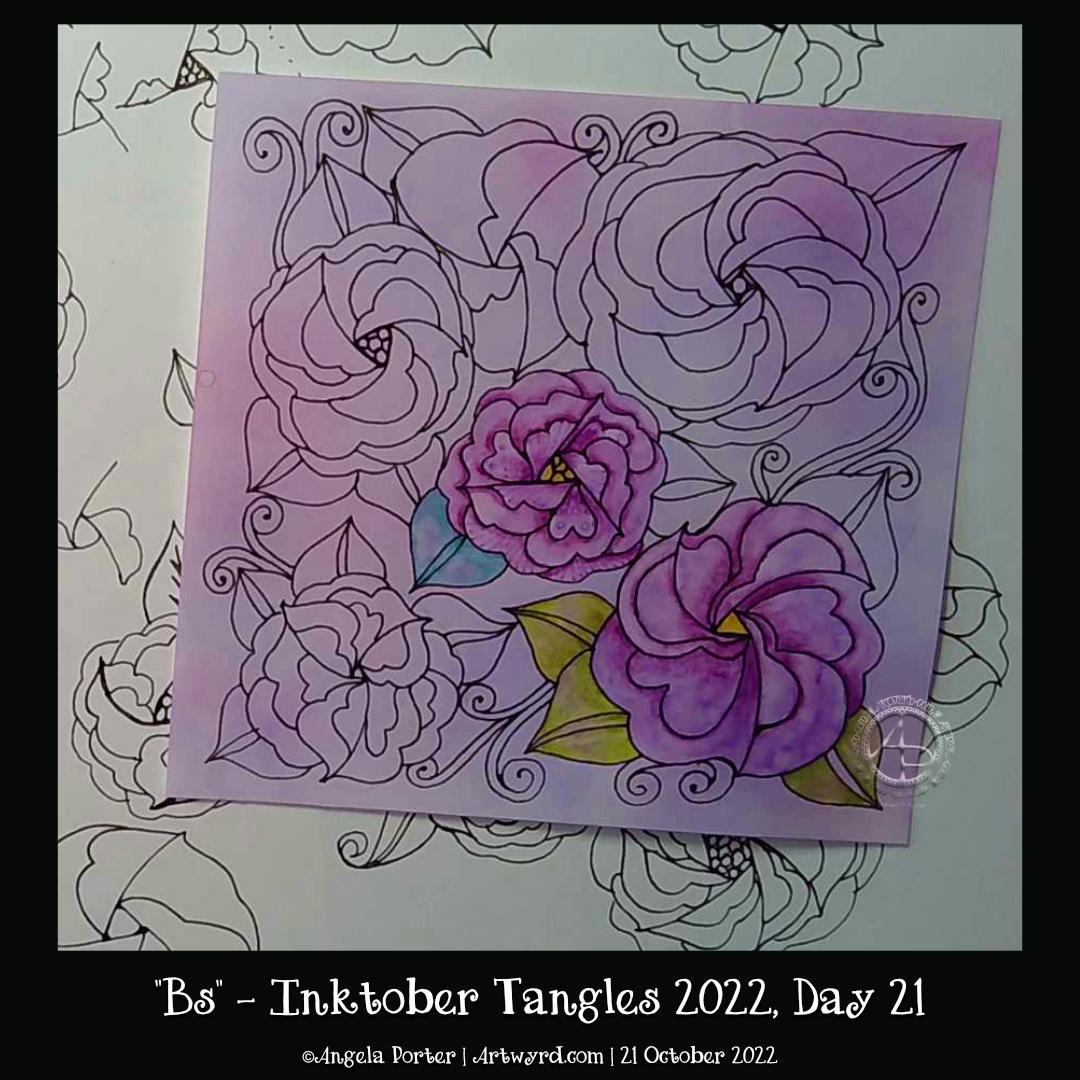
“Bs” – Inktober Tangles 2022, Day 21

YouTube drawing tutorial.

Bs by Midori Furuhashi CZT is a lovely floral zentangle pattern, yet it managed to throw me a few curve balls! I explore this pattern in today’s YouTube drawing tutorial video.

However, those curveballs helped me to better understand the tangle. They also helped me discover some interesting variations and a beautiful flower bud too!

I tried adding some texture lines and patterns to the petals, but they just didn’t feel right. However, using colour to add shadow and highlight worked well. To do this, I used Inktense pencils and a water brush. They reacted in some surprising, but nice, ways with the Distress Inks (Picked Raspberry, Seedless Preserves and Villainous Potion) I’d used to add colour to the paper.

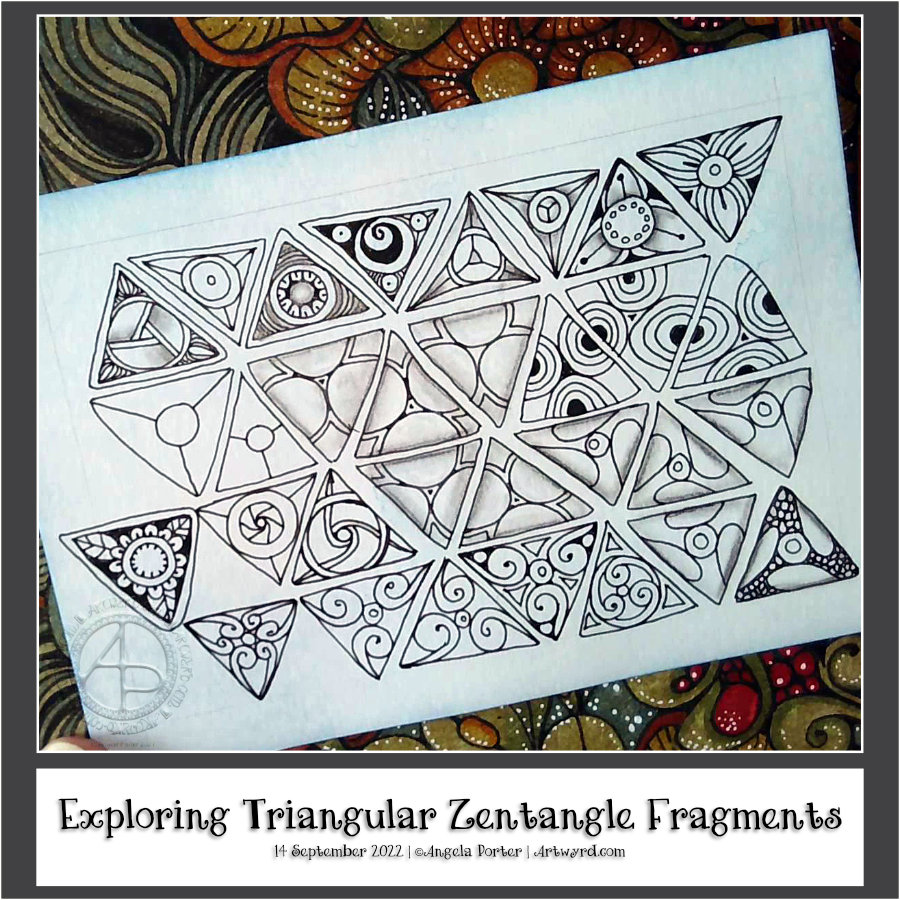
Exploring Triangular Zentangle Fragments

Click on this link to watch the accompanying YouTube drawing tutorial.

This morning I just wanted to mess around with some fragments, and triangular ones seemed the way to go! ‘Fragments’ is the Zentangle term for the cells that make up a repeating pattern.

I started with a simple fragment of a circle (orb in Zentangle-speak) inside a triangle. All of these fragments have orbs as part of them, and I’m not sure if I’ve done many of them before.

I’ve written it before, and no doubt will again, that exploring both fragments and tangle patterns is an absorbing activity. No matter how often I look at one particular fragment, there are endless variations that can result. Some may be of use in a ‘reticulum’ (Zentangle-ese for the grid upon which a pattern is formed), others may just be for the experience of being curious and seeing what happens if I do x, y or z…

This is also a great warm-up activity. It gets my hand-eye coordination and fine motor control working well. My creative brain gets flexed and exercised too. It is also an opportunity to try out new drawing tools and media.

Another big benefit of this practice is that there is no pressure to complete a finished artwork. There’s the implied permission to make mistakes, for things to not work out. Indeed, I learn more from those that don’t work out or where a mistake is made than anything that works out well.

I’m always amazed by how many fragments can be made from a simple start. In this case a circle within a triangle.

Narfello – A Zentangle Tangle Pattern Exploration.

Carrying on with the flowy pattern theme, I explore the Zentangle tangle pattern “Narfello” today.

This pattern is based on wavy lines and is easy to construct. The fun lies in all the variations that are possible. The first three steps in setting the tangle pattern up give an unusual grid that can be filled in so very, very many ways.

I always enjoy exploring patterns. It is, for me, a way of practising creativity, giving myself permission to draw without the end product being as nearly perfect as possible. It’s about trying things out to see what happens; if I don’t like what I’ve done, it’s no biggie! I can learn from it or, even better, work on how to change what I’ve done to make it something I like.

It doesn’t matter how many times I explore a pattern or fragment (the basic cell of a repeating pattern); there are always more things to discover and to use. It is quite addictive at times, that’s for sure!

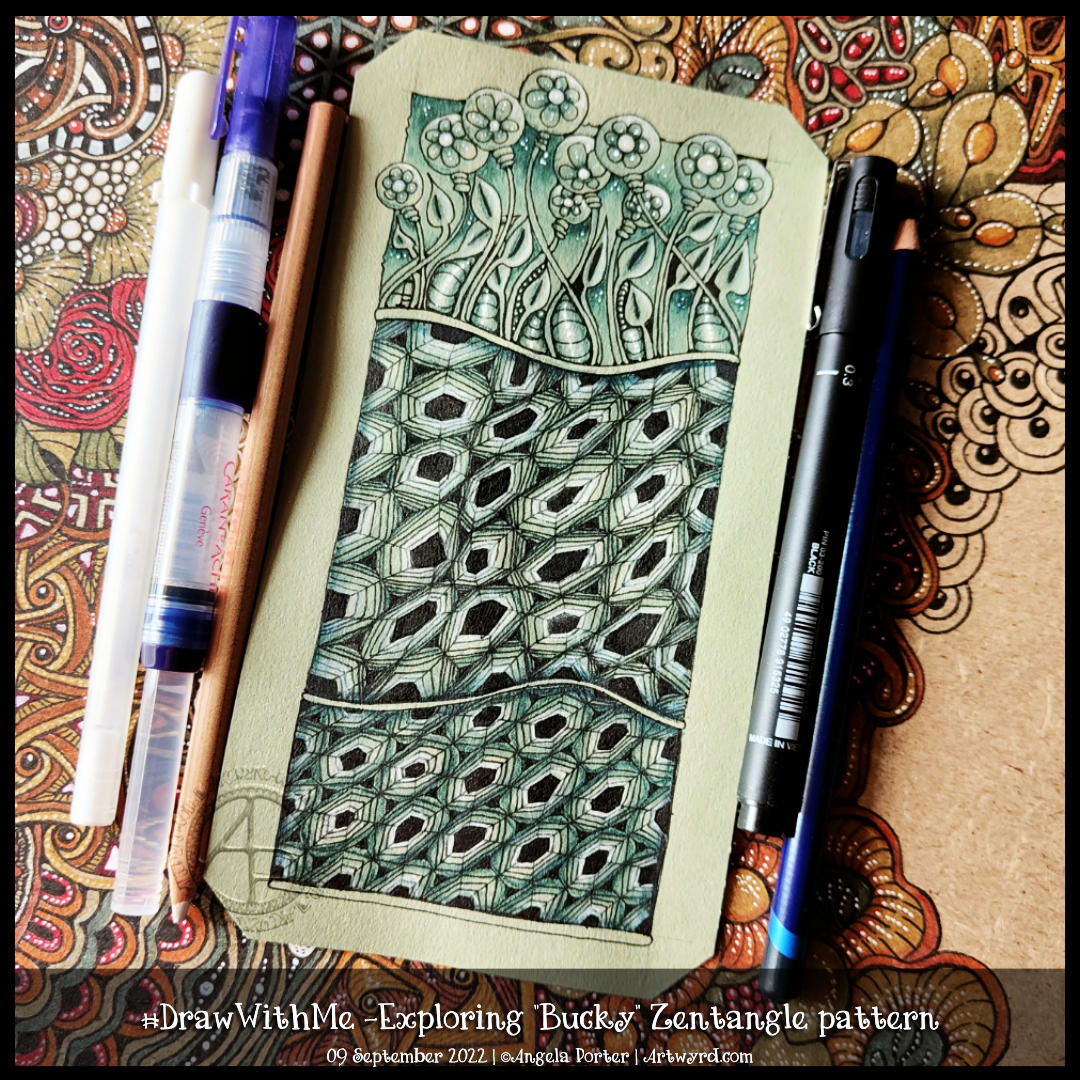
Exploring Zentangle Pattern ‘Bucky’ and some organic motifs

Click on this link to watch the accompanying #DrawWithMe video on YouTube.

This morning I had no idea what I wanted to draw, so I visited the random tangle generator on tanglelist.com, which suggested Bucky.

Bucky is an official Zentangle pattern that I’ve never drawn before. I had to look up the deconstruction, which you can find on Zentangle.com. So, in typical Angela style, I threw myself in at the deep end by using a ‘crazy’ asymmetric grid (the middle section in the artwork). It worked out fine in the end, but not with a few mis-strokes!

I thought I’d add some organic patterns/motifs to balance out the rather geometric Bucky pattern.

To add shade, I used an Iron Green Inktense pencil with a water brush to produce some colour gradients. I really wasn’t at all tidy and controlled about this. And you’d never really have known that if I’d not said it! I tried embracing the fluidity and random nature of a watery medium and it worked out just fine.

I used a white charcoal pencil and a paper stump/tortillon for the highlights. That meant I had to re-ink the black hexagons, but that was fine.

Finally, I drew Bucky in a more regular grid at the bottom. I didn’t film this part, but it worked out just fine, I think.

Indeed, I’m fairly happy with the overall result. I like the monochrome colour scheme; it gives coherence. The one thing I haven’t done is add shadow and highlight to the narrow bands between the sections.

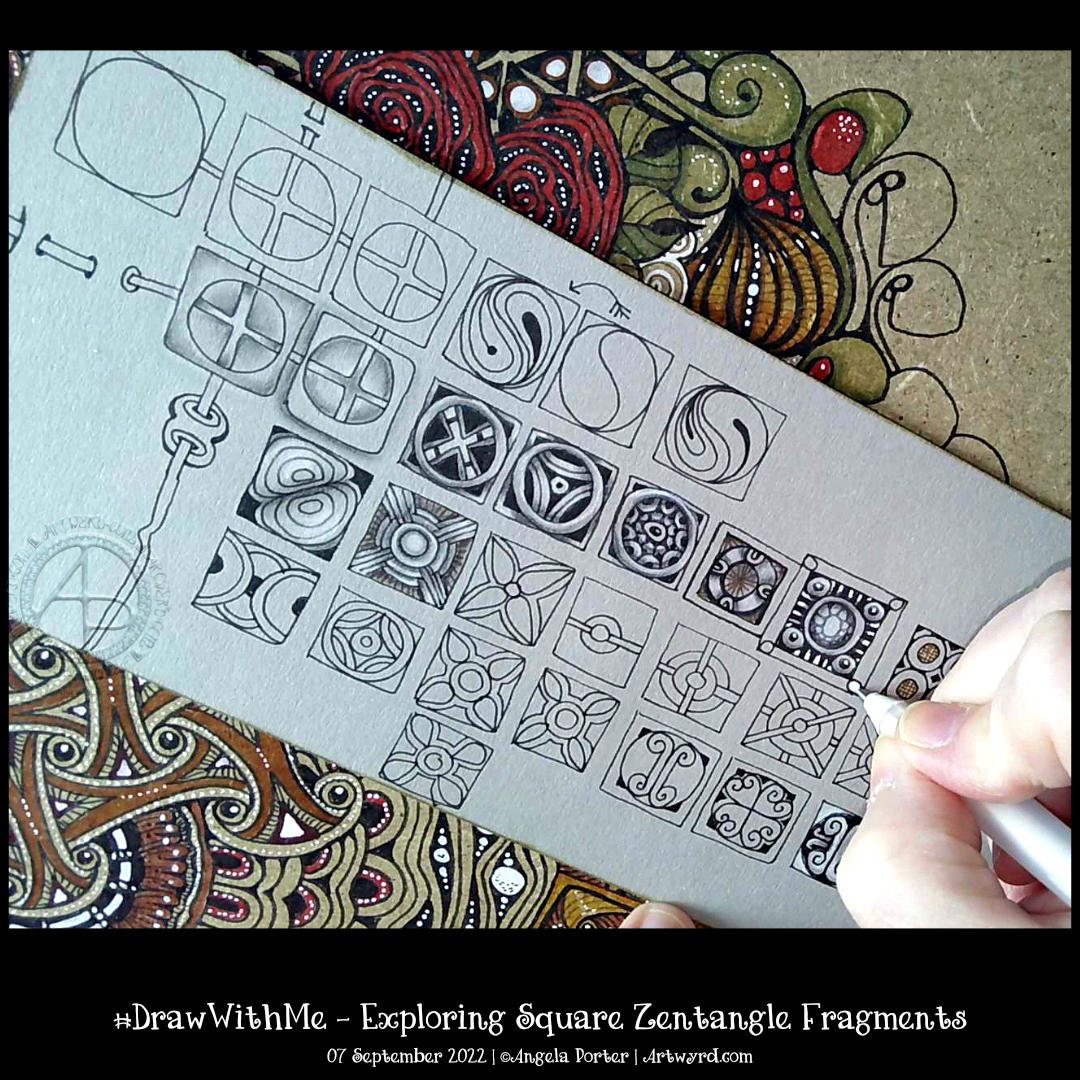
Exploring a square Zentangle fragment

Click on this link to view the accompanying video on YouTube.

Time seems to fly when I get engrossed in a task. Today, that was exploring a simple Zentangle fragment – a circle in a square.

In Zentangle terms, a fragment is the basic unit of a repeating pattern, whether repeated as is or rotated/reflected.

It is always a lot of fun to see what kinds of fragments I can develop using the chosen one to spark some creativity.

It’s always lovely, too, to work on toned paper, in this case, it’s from Fabriano and is in the colour ‘Clay’. Whenever I use toned paper, I realise I’m drawing in shadow and light; the paper is the mid-tone. This is why I love to colour plain paper with Distress Inks or NeoColor II water-soluble wax crayons. The colour immediately becomes the backdrop for dark and light and a strong contrast ‘twixt the two extremes.

In art, chiaroscuro is the term used for the use of high contrast between light and dark in a composition. In drawing, this is affected by using a coloured background, and black and white ink or media are used to create the drawing.

As I was typing this, I realized I’ve long loved working in this way. Since my early days of exploring my artistic nature that started some 20 years ago, I discovered I loved to use coloured paper with white and a black or much darker tone of the paper to draw with. It was far more fascinating to me to draw in light and shade rather than tones of grey graphite on white paper. It was my chosen way to work when I did some life drawing. When I go out and about sketching, I will colour the pages in my sketchbook with Distress Inks and use black and white pens/pencils to draw on them. The shapes of shadows and highlights fascinate me; everything becomes very architectural.

I’ve often mentioned the only oil paintings I’ve ever done and how three-dimensional they appear. When people see them for the first time, they’ll touch them because they think they are dimensional and are always surprised to find out they are totally flat. The high contrast I favour in my work creates the illusion of volume.

This little journey down the pathways of memory has allowed me to make some connections. I’m smiling as some pieces of the jigsaw puzzle that is me fall into place, clicking together satisfyingly.

There are times when I have to work with black pen on white paper, but there are many times when I can choose what colour paper to use. And going forward, I think much of my entangled drawing that isn’t for colouring books will be done on toned paper.