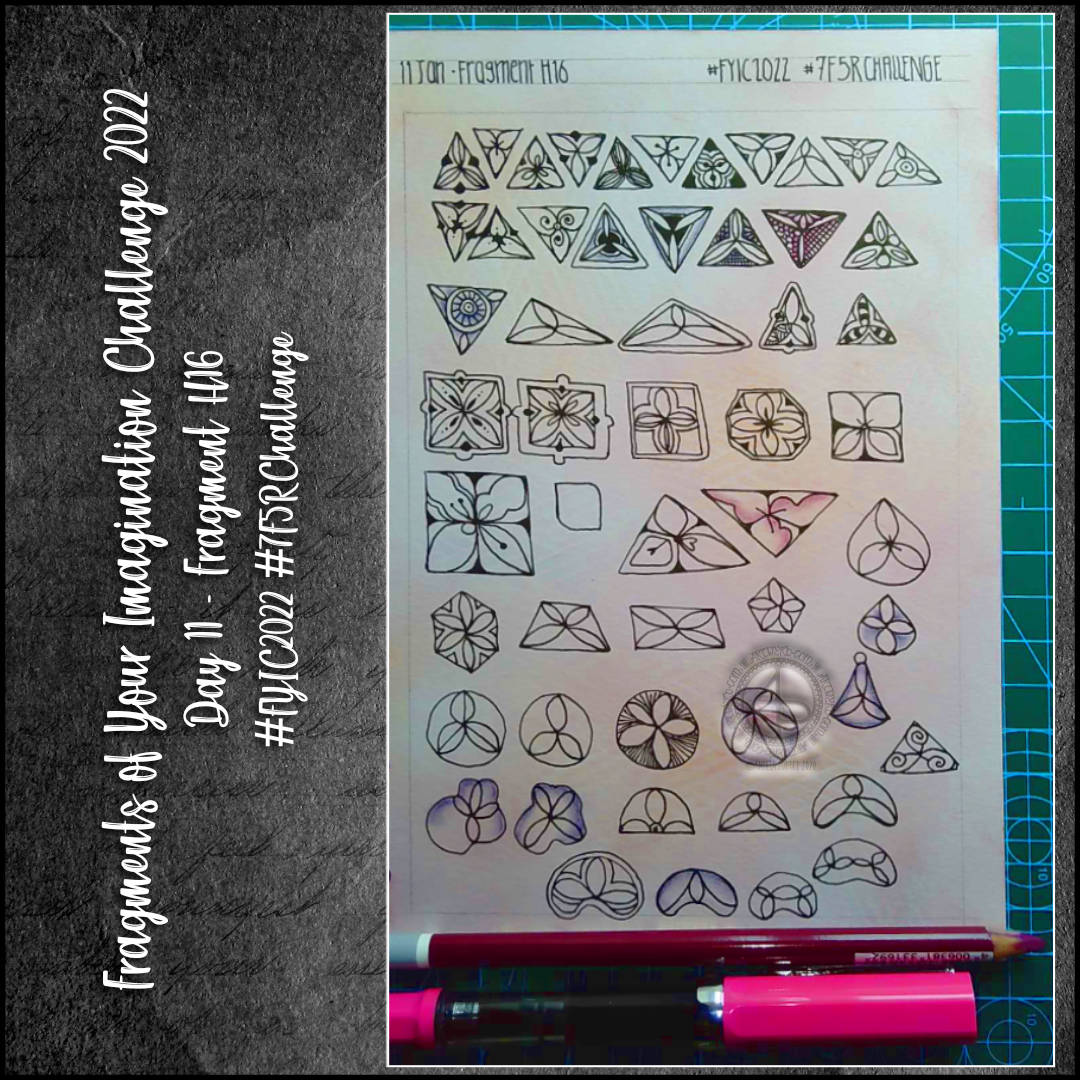
I’m rather fond of triangular fragments. Though the variations don’t have to remain triangular in shape! As long as the basic format, precept, of the fragment is adhered to: a central point and seed-shapes joining it to the points or sides of the shape.
I seem to say this everyday, but when I saw this fragment I did wonder what I could do with it. A fair amount it seems. Putting it together as a tangle pattern reminds me so much of agate.
I did record a video showing drawing some ideas on the smaller piece of paper, as well as adding shadow/colour to the main sheet.
It is definitely a fragment that deserves more of an exploration for sure.
Kaas, by Emiko Kaneko CZT, is not a tangle pattern I’m familiar with. So, first I had to wrangle with it to understand it’s construction. It’s a lovely pattern, but for some reason these kinds of patterns just don’t compute too well in my head.
Eventually, I kind of worked it out, and pencil lines are definitely needed for me to draw it well! So, go me!
At first look, I really wasn’t sure how I could vary this fragment. But as I started making small changes the ‘what would happen if I …’ thoughts started to come.
I like many of these variations, some not quite so much. There’s a fair few I’d like to see arranged in a grid pattern. Perhaps I’ll spend some of this afternoon/evening trying that out.
Naida, by Stephanie Jennifer CZT, is today’s fragment for the #FYIC2022 challenge run by #7F5RChallenge facebook group.
This is, like all so far, another lovely fragment to play with, and I quickly filled a page with variations.
In today’s YouTube video, I take a look at this page, along with days 1 to 7, before starting a new Zentangle Inspired drawing using Naida and Dream Dex variations to start the drawing off.
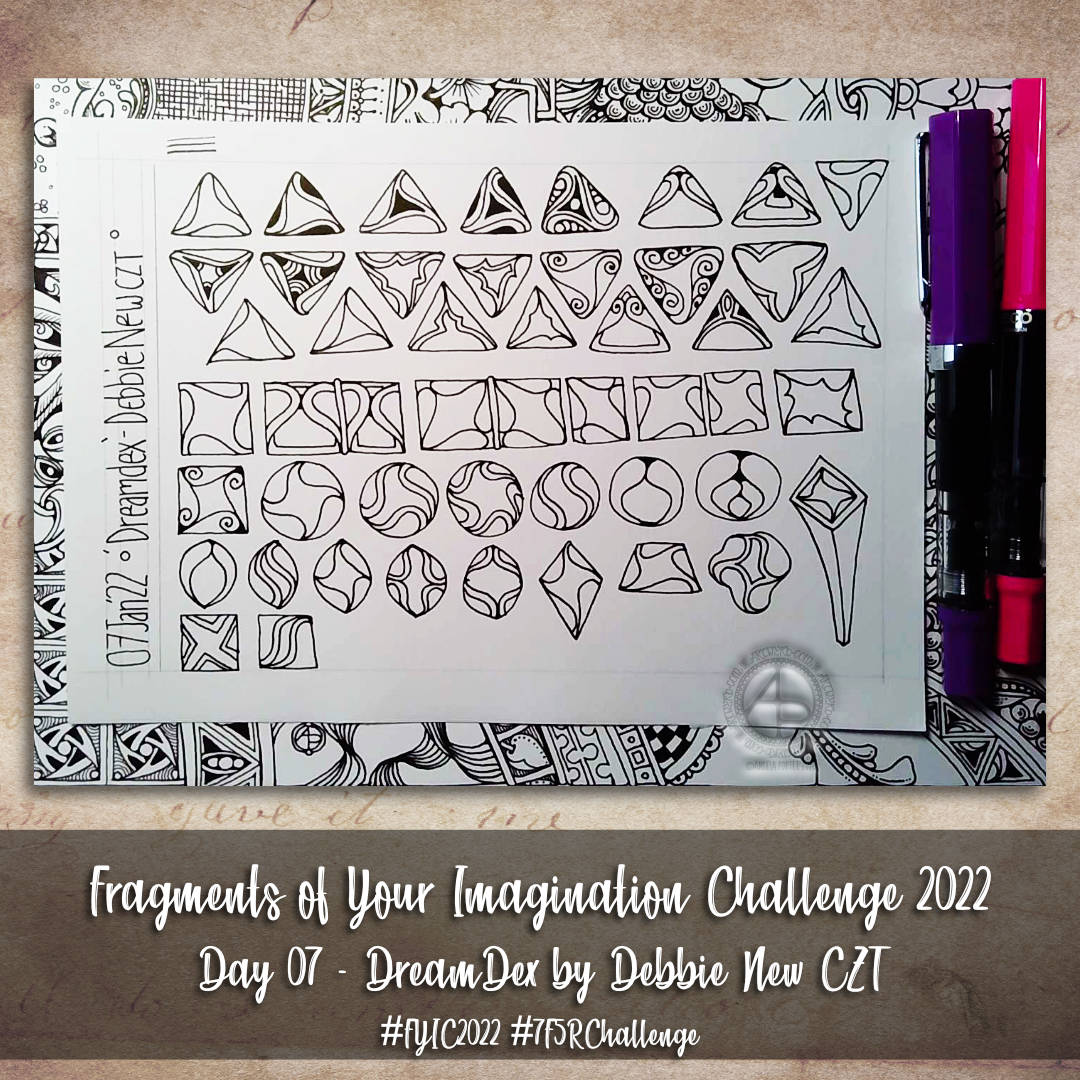
Oh, DreamDex turned out to be a bit of a dream fragment for me. So many variations ended up reminding me of La Tene / Early Celtic / Anglo-Saxon designs, which are probably my most favourite of all.
Again, I’m sure I’ve only scratched the surface of the variations that are possible. But it’s a start!
D23 has turned out to be a rather interesting fragment with some really fun and pleasing avenues to wander down. Yet again, I’ve only scratched the surface of variations of this one. No doubt it’ll be something I’ll return to.
The most important thing I’m learning through this challenge is about the ways to vary tangles, and also which ways will best suit different fragments. And, of course, that will translate to my other arty stuff too.
This was one of those fragments where I thought there wouldn’t be much I could do with. I wasn’t sure if it would transfer to other shapes and so on.
Turns out I need not have worried at all. Admittedly, some shapes and variations work better than others. Also, I’m aware I’ve barely scraped the surface.
This page also gave my TWSBI Eco fine nib fountain pen a work out. Treating Canson Imagine mixed media paper with Distress Ink does make it a bit more absorbent and the pen ink does result in a broader line. Such an effect wasn’t noticeable on the ClaireFontaine Paint On paper coloured with Distress Inks. It’s going to be a bit of trial and error process going on until I get the hang of it!
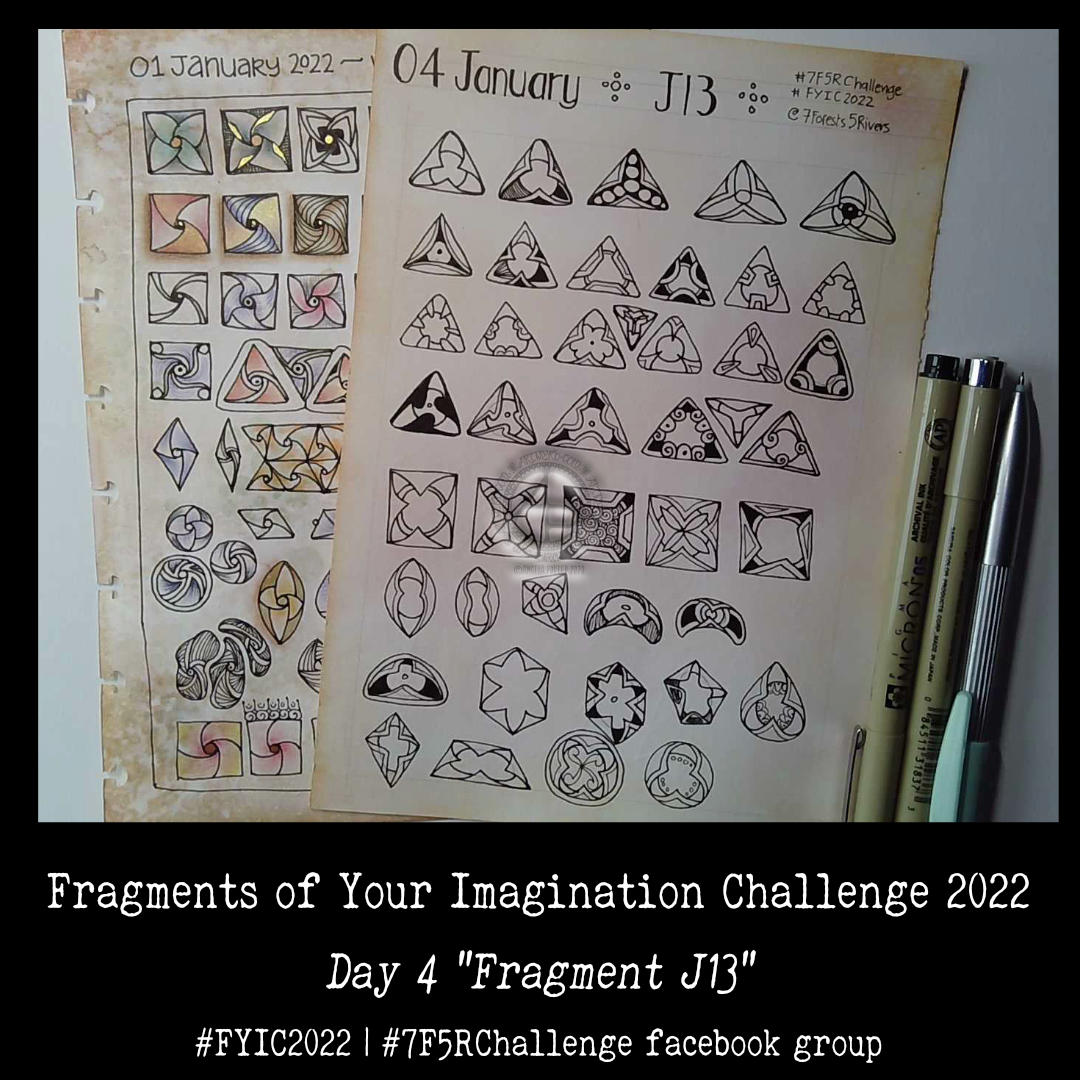
J13 is a fragment that is so full of possibility that I’ve barely touched the surface! This was fun to do and, no doubt, I’ll be re-visiting this fragment at some point.
I managed to get all the days muddled up in the challenge. That’s not a problem, I’ve been told, just work with a fragment a day, follow the list, ignore the list, all is fine and good!
Today, I chose to do fragment X7, which can be found in the Zentangle Primer book. It’s the circular version that is suggested today. But of course I had to work with other shapes and forms too! So much so I fairly quickly filled a page up.
The second sheet was done in today’s video. I had recorded the process of drawing the first sheet, but forgot to check that I was in frame. I wasn’t for way too much of the time. So, I just recorded a different video, including some other variations of the fragment.
Once you start exploring, you just can’t stop! Or so it seems in my case.
What a lovely way it’s been to spend a few hours today! Trying out variations of the Pokeleaf Zentangle fragment.
I didn’t think I’d run out of space on this page, but I did. And there’s a couple of new fragment shapes there as well!
I used iridescent gold pigment as a watercolour on some areas, sometimes with a little colour added with a chalk pastel. On other leaves, I used chalk pastels, sometimes with some embossed patterns too.
Again, the possibilities are endless – shape of fragment, shape of leaf, number of leaves, arrangement of leaves, background or filler patterns … and so much more! All that’s needed is a pen, some paper and some time and imagination.
Today’s video shows the drawing of many of these variations, but not quite all of them. Nor does it include much i the way of adding colour.
I hope that these variations will fire up your creativity and have you reaching for pen and paper to have a go yourselves.






 Art is the Adventure