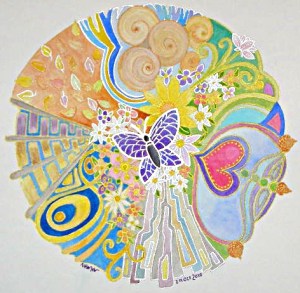
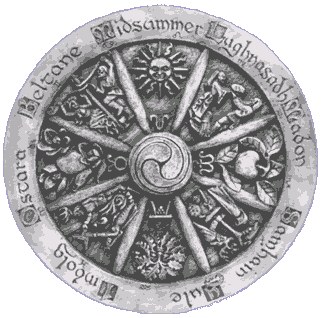
Winter Solstice 2010

All the very best of the Winter Solstice greetings and wishes to all!

The exact point of Solstice is at 23:38 UTC, which is when the Sun enters Capricorn.   In the Northern Hemisphere, this marks the longest night and also the gradual returning of light to the world as the days gradually lengthen once again.

What makes this year’s Winter Solstice extra special is that there is a Lunar Eclipse fall on the same day, for the first time since 1638.  Sadly, it was not possible for me to view the Lunar eclipse as the skies were cloudy here, and no doubt the hills would have obscured my view of the Moon in any case.

In my immediate environment, in the Northern Hemisphere, nature is in it’s annual dormancy and the return of the light from this day on is a reason enough to celebrate the continuation of nature’s seasonal cycle.  With the snow still covering the ground, life having slowed down due to the freeze here in the UK, there’s an even bigger sense of the big sleep of nature.

The Winter Solstice had, no doubt, great significance to prehistoric people, no doubt linked to the uncertainty of seeing life through the harsh winter months.  Evidence for this remains in the apparent alignments of Neolithic and Bronze Age sites such as Stonehenge (Winter Solstice 2010 at Stonehenge) in England and Newgrange (Winter Solstice at Newgrange 2010) in Ireland to astronomical events such as the Winter Solstice.  The lives of these people depended very much upon the seasons and weather and it must have been important for them to mark the cycles of the seasons in some way, just as we do still.

The Feast of Yule was a pre-Christian festival observed in Scandinavia.  At this time of year, fires were lit to symbolise the heat, light and life-giving properties of the returning Sun.  A Yule log was brought in and burned in the hearth in honour of the god Thor.  A piece of the log was kept to act as both a good luck token for the year and to act as kindling from which the next year’s Yule log was lit.  Ashes from the log were also collected to be spread on the fields to ensure a good harvest that year.

There are many festivals coinciding with the Winter Solstice around the world, as can be easily read about on the web – see for instance Wikipedia.

How will I be spending the day?  Well, not as I would in years past.  Normally, I’d replace my bundle of mistletoe at dawn, burning last year’s old bunch.   This will have to wait for a day or two until I can get out and about!   The mistletoe hung in the home acts as a protection against negative thoughts and deeds.  Burning it releases and purifies that which it has absorbed over the year.  Part of the day will be spent in meditation/quiet thought/reflection on the past year and particularly upon the progress I have made in achieving goals in life and giving thanks for all those people and circumstances which have aided me in my progress, whether they realised it or not, and whether I realised it or not at the time! Sometimes, the people and situations that vex us most are responsible for the greatest progress in our personal development.

How will you spend the day?

  1. Guardian – Article about the coincidence of Solstice and the Lunar Eclipse
  2. National Geographic – Article about the coincidence of the Solstice and the Lunar Eclipse
  3. Winter Solstice at Time and Date.com
  4. December Solstice Traditions at Time and Date.com
  5. Winter Solstice on Wikipedia
  6. Yule on the BBC website

Interwoven


Interwoven 1 © Angela Porter 2010


Interwoven 2 © Angela Porter 2010


Artistic endeavours

Above are two of my latest pieces of art, both worked on black card using Uni-Ball Signo metallic gel pens and Cosmic Shimmer iridescent watercolours.

The bottom one has a chain of circles/links that was inspired by looking at a La Tene or Early Celtic Art neck torc.  The rest of the patterns/shapes just flowed around the circles.

I’ve enjoyed doing these.  They give me a chance to just relax, go within myself, create and find some peace and pleasure during days when life seems a struggle at times.  Abstract art is perfect for me in doing this.  I tend to call these things ‘doodles’, but others see them as ‘effortless pieces of art, very creative and imaginative, a sure sense of colour’.  Perhaps because it is easy for me to do I find it hard to see why others would find it ‘precious’.  But as it flows from within, it does tend to be personal, and perhaps an outer representation of my inner emotional ‘weather’.

Feeling jaded, tired with teaching

This week the emotional weather has been very changeable, though there’s been a very tired and jaded weather system lingering.

I am tired and jaded with my job.  I have found it hard to get enthused about anything this week.  I find the constant disrespectful, confrontational, aggressive and/or histrionic attitudes wearying in the extreme.  There seems to be an almost constant battle that I have to fight in order to do my job.

It’s not all gloom and doom, however.  There are bright, sunny periods, where pupils with a willingness to learn, the grace to show kindness in their speech and in attitudes to others, and those full of joy to be around me.  But they are increasingly being overshadowed, once again, by the others.

I feel so much empathy for the pupils who are stuck in classes full of their peers who dominate the groups, disrupt the lessons, and carry an atmosphere of unsettledness in so many ways with them.

I’m beginning to really understand that I am too kind, caring, gentle to work in such an environment for much longer.  My kindness and gentleness make me a target for these aggressive, disrespectful, histrionic teens.  They see me as weak, pathetic, perhaps even too controlling of the class, or trying to be.  I want all to do well, to learn, to gain something positive from my lessons, and I know I expect way too much of myself in this, or perhaps not of myself but of them.

However, is it really too much to ask to have a polite response when asking a pupil to do something such as ‘get your pens and book out please’?  Is it too much to expect that I won’t be greeted with a volley of abusive language or a strident statement that either I’m picking on them, or I have an attitude problem.

I guess I should feel lucky that it’s just words and not furniture or knives or guns that are hurled at me.

Some of you may think it’s my fault I get treated like this.  I don’t think so.  I have to be true to myself.  When I’m not, then its so obvious that things get worse.  My kind, caring, empathic nature suits me working with children with special educational needs and these children rarely give me problems and respond and appreciate my nature, generally. There’s always an odd couple who don’t respond.

My issues are with mainstream pupils who generally don’t appreciate the kind, caring, supportive, encouraging approach.  Their attitudes mean I tend to distance myself from them to protect myself, though I try to help those who want my help, so long as I’m not having de-fuse situations about to explode, deal with disruption and so on.  Sometimes I feel more like a peace-keeper come baby-sitter than a teacher.  I’m absolutely sure it was never like this when I started teaching many years ago now.

Are my particular skills, talents and gifts being made the best use of  in work?  Definitely not.

Career change needed?

All of this has added to my personal problems that I am working on; and in many ways it delays me carrying out the personal work that I need to do by overshadowing that.  My biggest problem is what on earth could I do other than teach?  The other problem is that of financial security; I have a permanent contract, so I have as secure a job as is possible in the current financial climate.  However, the biggest problem is what else could I do?

What I think are my particular strengths, such as art, writing (that maybe doesn’t come across in this blog), a quickness of mind, an innate intelligence, true empathy for others, a deeply caring and kind nature, an ability to speak well and to entrance audiences, I have no particular qualifications for, nor do I have the time nor financial resources to return to university to gain them.

It is a right pickle …

But at least I get time to lose myself in art or writing or reading or playing my flute or meditating, activities that help to bring me peace and joy, and some of which others can gain joy from too if I share them.

Memories of my father’s passing

Something else that seems to have affected my emotional weather this week was the fact that it was the anniversary of my father’s passing.  Two years ago on the 10th November, around 9:20pm, I was sat with my father during the last moments of his life on Earth.  I’d most probably spent more time with him during the 8 months he was in hospital than for the rest of my life.  In fact, I spent more time with him during this time than I did with other human beings.  It was an interesting time; he had Alzheimer’s as well as cancer and diabetes and arthritis, and just old age.

His last evening on Earth was one where he struggled to breathe, where he was in and out of consciousness, and was very agitated.  I spoke to him about things I’d done, things I planned to do, and I was very tearful as I knew he was slipping away, even if the medical staff, my mother and other members of the family thought he’d be there for months longer.  There was a smell in the room, and I just knew it was time.

I’d never seen a real dead body before, let alone been with a person coming to the end of their mortal days.  I was scared, worried if I’d be a strong enough person to stay with my father through it.  I’d always told him I’d be there with him if he wanted me to be, whether he understood me or not.  As it happened, I was strong enough.

Despite his extreme confusion thanks to the Alzheimer’s, in the last few moments of his life he knew who I was and was able to say some things that meant a lot.  He knew he was dying and about to pass away and he wasn’t scared.  I asked him if he wanted me to stay with him, he said yes.  His passing was peaceful.  After speaking it was only a few minutes before he quietly slipped away, and I observed/felt things that have since helped me on my spiritual path. In fact, I experienced many things while visiting my father that gave me and still give me cause for thought.

After he passed, the room was filled with a feeling of such love, not sadness.  The sadness was that he was so ill and suffered so much before he passed.  I didn’t feel relief, just love and a sense of peace.

For that I thank my father deeply.  I feel he granted me a great privilege to be present as his passing, so many seem to choose to pass away when their loved ones have taken leave of them, and to witness so much I can’t, as a scientist, explain yet makes sense to me as a person finding their way along a spiritual path on the Earth.  I’d like to believe that my father is on the next stage of his spiritual journey, whatever form that may take.

What has surprised me is that my mind has wandered back to that time in the past few days, and it has brought up tears with the memories.   I believe I did my grieving in the months my father was declining towards his passing, and though I had tears for a day or two afterwards I think it was more to do with emotional exhaustion.  His passing left me with a need to adjust my spiritual beliefs, to re-examine them, and I used my bereavement leave to do this.

I have wondered if these memories are what I’ve used as an ‘excuse’ to avoid facing up to issues with work …

Happy All Hallows Eve (Hallowe’en or Samhain to you)!

Hallowe’en

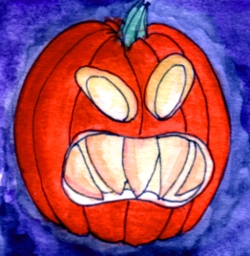
Punkie3 © Angela Porter 2010

Well, it’s that time of year again isn’t it?  And it’s another time to consider the truth vs. “The Truth“.  “The Truth” is that this is an ancient pagan holiday, mainly thanks to the writings of Frazer in ‘The Golden Bough’ where he cites this as The Truth, yet there is little evidence if any for it being so (see Hutton “The Stations of the Sun’ for more details)!

There were fairs and courts held in ancient Ireland at this time, a time called Samhain by them.

The Venerable Bede writes that this time of year was known as ‘Blod Monath’ which means Blood Month – the month where all unnecessary animals were slaughtered to save fodder and the people would feast on the parts that could not be preserved.

The truth is that it’s actually more of a Christian celebration in origin!  Today is the eve of a major Catholic festival – All Saints Day (1st November) which dates from the 8th Century.  All Souls Day (2nd November) was instituted around the year 1000 as a day to pray for the dead.  In England since the 19th Century, and increasingly in the 20th and 21st Centuries, it has gained a reputation as a night on which ghosts, witches and fairies are especially active.  Why this should be so is debatable, and returns to the truth vs. The Truth.

Different sections of society have claimed it for their own, or are rejecting it as being their own.  Who is right?  Everyone!  One thing is certain, Hallowe’en is big business, especially in America, and increasingly so here in Britain.

There are many traditional events and activities here that are overshadowed by the sheer bad behaviour and malice that a minority seem to partake in with delight.  It is an aspect of this time of year that I dislike…and I don’t need to say any more about that.

I do think it’s good that children can face their fears in a safe, measured and fun way.  We all like to be scared in a safe environment; if we didn’t then the horror films and books and games wouldn’t appeal to us.  It’s part of growing up, learning to manage our fears, to indulge in imagination, to experience a different world of wonder.  It’s not just Hallowe’en that allows children to explore this; the traditional fairy stories aren’t all sweetness and light are they?

As to it being a festival that promotes evil and satanism, well, I don’t think so.  Those who would be drawn to such systems would be regardless of Hallowe’en, lets be honest.

As much as I can be pedantic about ‘the truth’ and I like to know where the traditions and beliefs have come from (the scientist, researcher in me will not be denied), I also know that traditions change and evolve over time.  What is important, perhaps more than anything else, is that traditions link us together.  We can be sure that we are not the only ones having fun at this time, indulging in shared events, and it is that sharing that reaffirms that we are all connected in some way.

Auragraphs

Auragraph for Liz © Angela Porter 28 October 2010

Auragraphs are intuitive works of art that result from a sensitive person ‘tuning into’ another person’s energy, aura, being.  The colours, shapes, symbols and patterns all have meanings that can be interpreted, giving an insight into the recipients personality, life, and potential.  I’ve been experimenting with them for the last couple of months, and yesterday I was showing them to people at an open day at a local spiritual organisation.

A couple I had already done found their way to the people they were meant for.  Orders were taken for another couple, and all the proceeds are going into the organisations funds as donations.  It was an interesting experience for me in many ways.

Giving the interpretation (reading) for the recipient was interesting, and it was nice that they were so right.  Working with someone who wants one done for them and allowing the images/shapes to flow on to paper – just as sketches – and talking about why they are appearing and what they mean, and getting feed back on that was very interesting.

The two ordered have only been done as sketches; they will take around 12 hours each to complete, so that will keep me busy, as will writing down the readings for those verbally given will be interesting!  I really do need to carry my digital dictaphone with me more often I think.

The Ghost Train

Punkie1 © Angela Porter 2010I actually made it to the Pontypool and Blaenavon Railway yesterday, after the open day at Treforest.

I didn’t arrive until around 5:30pm and most of the visitors had been and gone.  I did get to read one story to one family.  And that was fine.  Though I did enjoy winding up small children in a nice way, as well as saving them from the scary vampire who was stalking the carriages!  I do hope I’ll get to read some more stories today …

I really enjoy story telling /reading.  It’s another shared activity that bonds people together, allows them to make connections, and it’s also an opportunity for imaginations to be used, something that isn’t done so often these days.

This may be my last time at the railway, however.  I find the connections I once thought I had there are now very weak, if not non-existent.  Things change, which leads me to …

What All Hallows Eve Means to Me

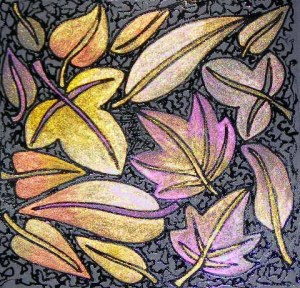
Autumm Leaves © Angela Porter 2010

I always think of All Hallows Eve (Hallowe’en to you!) as mid-Autumn.  It certainly is this year; the world is wearing its coat of glorious flaming Autumn hues!  I love it when I drive along through a flurry of leaves blown off the trees by a sudden gust of wind.  The warmth of the colours envelops me as I journey around the world, a warm memory is being stored to see me through the cold, dark days of Winter.

The Earth is preparing to sleep through those Winter days, taking a hard-earned rest before coming to life again in the Spring.  All that is unnecessary, finished with, complete  is being shed, the falling leaves being symbolic of that.

As this clearing out happens out in the world of Nature, so it happens within.  It’s time to look back on the year, to give thanks for what is complete, finish that which is almost complete, and let go of that which is finished, has served its purpose, that we have outgrown.  In doing so we make space in our lives for further personal growth.  And this is the potted version of how I relate to this particular spoke on the wheel of the year.

For me, it seems the railway is to go.  My SmartCar and all her problems have gone.  I may soon be finished with counselling … but we’ll see about that, there’s still my self-image, confidence, self-love to be worked on.  I’m not sure about anything else, but that will become apparent as time goes on.

Comets

“Comets are long-haired stars with flames, appearing suddenly, and presaging a change in sovereignty, or plague, or war, or winds or floods.”
Northumberland Bede, De Natura Rerum c. 725AD

Ancient Beliefs

The word comet comes from the Greek word kometes which means ‘long hair’.  Our ancestors thought comets were stars with hair trailing behind them.

In ancient times, people thought comets were ‘power rays’ of supernatural beings.  They also thought that comets contained fire because they were so bright in the sky.

Some people believed comets brought curses with them.  They believed that comets caused cattle to give birth to dead calves, princes to die,  natural disasters to occur, and disease and pestilence to spread across the land.  Emperor Nero of Rome had all possible successors to his throne executed in order to save him from the ‘curse of the comet’.

Not all people believed comets were bad omens; some believed they brought good fortune.  Others believed that they carried angels through the heavens.

Not so ancient beliefs …

In 1909 and 1910, the appearance of Halley’s Comet in the skies caused panic in cities around the world. Pedlars did a lot of  business selling ‘anti-comet sickness pills’ and umbrellas to protect people from the effects of the comet.

In March 1997, the members of a cult called ‘Heaven’s Gate’ committed suicide by drinking a cocktail of poisons.  They believed that the coming of comet Hale-Bopp was a sign that it was time for them to shed their Earthly bodies so that their spirits would take flight behind the comet and so be taken to a higher plane of existence.

More about Comet Hysteria can be found here.

Halley’s Comet

The Chinese recorded sightings of Halley’s Comet as far back as 240BC.

The famous Bayeux Tapestry shows Halley’s comet shining brightly in the sky before the Battle of Hastings in 1066.  Some people believed that the comet meant that King Harold of England would lose his throne to Duke William of Normandy in this battle, and he did!

Edmund Halley studied comets and developed a theory that the comets sighted in 1531, 1607 and 1682 were actually the same comet.  He successfully predicted the return of this comet in 1758, but sadly died 16 years before his prediction was proved correct.  Halley’s Comet is next due to return in 2061.

Other Cometary Scientists

In 1577, Tycho Brahe showed that comets travelled far beyond the Moon; prior to this, people believed comets travelled in the Earth’s atmosphere.

Sir Isaac Newton (1642 – 1727) discovered that comets travel in elliptical orbits around the Sun.  He also believed comets were members of the Solar System, like the planets, and that comets could return again and again – he was right!  Comets that are seen quite often, every 100 years or so, come from the Kuiper Belt.  Comets that we only see every few thousand years come from the Oort Cloud.

Meteor Showers

Comets leave a trail of debris behind them as they orbit the Sun.  If this trail crosses the Earth’s orbit, then at that point every year for a long time there will be a meteor shower.

The Perseid meteor shower occurs every year between the 9th and 13th of August as the Earth passes through the debris of the Swift-Tuttle comet.  The Orionid meteor shower occurs in October when the Earth passes through debris left by Halley’s Comet.  The Leonids, around 18th November, result from debris from comet Tempel-Tuttle which visits the inner Solar System every 33 years.

Hale-Bopp

On July 23, 1995, an unusually large and bright comet was seen outside of Jupiter’s orbit by Alan Hale of New Mexico and Thomas Bopp of Arizona. Careful analysis of Hubble Space Telescope images suggested that its intense brightness was due to its exceptionally large size. While the nuclei of most comets are about 1.6 to 3.2 km (1 to 2 miles) across, Hale-Bopp’s was estimated to be 40 km (25 miles) across. It was visible even through bright city skies, and may have been the most viewed comet in recorded history. Comet Hale-Bopp holds the record for the longest period of naked-eye visibility: an astonishing 19 months. It will not appear again for another 2,400 years.

Swift-Tuttle

This comet was first seen in July 1862 by American astronomers Lewis Swift and Horace Tuttle. As Comet Swift-Tuttle moves closer to the Sun every 120 years, it leaves behind a trail of dust debris that provides the ingredients for a spectacular fireworks display seen in July and August. As Earth passes through the remnants of this dust tail, we can see on a clear night the Perseid meteor shower. Comet Swift-Tuttle is noted as the comet some scientists predicted could one day collide with Earth because the two orbits closely intercept each other. The latest calculations show that it will pass a comfortable 24 million km (15 million miles) from Earth on its next trip to the inner Solar System.

Hyakutake

On January 30, 1996, Yuji Hyakutake (pronounced “hyah-koo-tah-kay”), an amateur astronomer from southern Japan, discovered a new comet using a pair of binoculars. In the spring of that year, this small, bright comet with a nucleus of 1.6 to 3.2 km (1 to 2 miles) made a close flyby of Earth — sporting one of the longest tails ever observed. The Hubble Space Telescope studied the nucleus of this comet in great detail. This is not Comet Hyakutake’s first visit to the inner Solar System. Astronomers have calculated its orbit and believe it was here about 8,000 years ago. Its orbit will not bring it near the Sun again for about 14,000 years.

Some interesting websites about comets and myth.

Comet Mythology from Astrononmy-Education.com

Comets, Meteors & Myth: New Evidence for Toppled Civilizations and Biblical TalesThis is an interesting article from space.com.

Folklore, a Fall and Storytelling

Yesterday evening, I travelled by train to Merthyr Tydfil where I was giving a talk.  My lil Smartiepants is still poorly; I’m awaiting a call back from my mechanic to get her fixed.  Anyways, on the way out I grabbed ‘The Folklore of Discworld’ by Terry Pratchett and Jacqueline Simpson and thoroughly enjoyed reading it again during my journey there and back again to Merthyr.

‘Some of the things in this book may well be familiar, and you will say ‘but everybody knows this’.  But the Discworld series, which on many occasions borrows from folklore and mythology, twisting and tangling it on the way …’

And that is what I love about Mr. P – the way the familiar is just twisted enough to fit into somewhere else, with humour and a sense of ridiculousness, and often with quite a deep perception of how things work on our world, and plenty of chuckles along the way.

‘…there are some things we shouldn’t forget, and mostly they add up to where we came from and how we got here and the stories we told ourselves on the way.  But folklore isn’t only about the past.  It grows, flowers and seeds every day, because of our innate desire to control our world by means of satisfying narratives.’

And don’t we live, or re-live, our lives by stories, by narratives?  When we relate to others what we have done, what we have experienced, what ‘they’ said, or share our thoughts and memories we are relating a story.  I know in my day job I often teach in a story-telling kind of way, and I try to tell enjoyable and memorable stories.  I love to hear other peoples’ stories too.  Stories about us will be passed down through the generations, changing subtly with each re-telling, just as folklore always has done.

And folklore and stories have power, more so than the mundane reality of the truth.

‘But there is the truth, and, then again, there is The Truth, in the face of which truth can only shrug and grin.’

People prefer, generally, to believe the fantastic, and to add mystery to something that is ordinary.  And I can relate an example of this in action.

A few years ago, while walking across the old Severn crossing, I fell and hit my temple on the ground.  A silly accident, I was bending over my bicycle to see if I could sort out the gears that had stuck in one place, next thing I know my face had made intimate contact with the tarmac of the path.  This old bridge is bouncy, especially when heavy lorries shudder their way across, and I think two must have crossed near me at the same time and set up an extra big bounce that unsettled my balance.  Once I’d recovered my composure, I could feel my eye swelling and I decided to ride my bike back to my car, load it in and then get home asap, which I did safely..

That afternoon I ended up in A&E having a head x-ray as my eye had swollen shut, I had a wonderful black eye beginning to develop, but the emergency phone advice service insisted I go get my head checked out in case I’d managed to crack my skull.  I hadn’t, but by the next morning I had a black eye that was really black and the bruising extended from my eyebrow to below my cheekbone!  It was an absolute corker!

Monday morning came, no pain, but the eye was even more spectacularly black than the day before.  I had to go to school, and on my arrival the headteacher, chair of governors and other staff were concerned that I shouldn’t be there.  I explained that it looked a LOT worse than it was, that there was only a little bit of pain if I touched my temple ‘just there’ and I had had x-rays and was fine.

When I went to my class to do registration, they were shocked with my appearance and asked what was happened.  I told them the truth – the fall, the trip to A&E.

Did they want to believe it?  No.  One 16 year old lad was convinced I’d been out ‘clubbing’ in Cardiff and had got involved in a fight (me? fighting? no way!!! I’m way to gentle and kind for that … I’m very peace-loving).  I said, no, I don’t ‘do’ night clubs, nor do I fight.  He wouldn’t have it, so I went along with him, making up answers to his questions.

“Who hit you?  A man or a woman?  Did you know them?” he asked.

“A man, over six foot tall and built like a brick out-house, and I didn’t know him,” I replied.

“What did you do?  ”

“I hit him back.  I knocked him out.”

“You knocked him out? Really?  What happened to him.”

“Yes. Really.  He’s still in hospital I think.”

“Wow.  Were the police there?”

“Yes, they were.”

“Did they arrest you?”

“No, they saw that he hit me first and I just pushed back in self-defence.  They let me go.  And he’s not pressing charges as he doesn’t want it known he got knocked out by a woman”.

“Wow.”

By the end of the week, there were all kinds of stories circulating about how I got my black eye.  I’d been ambushed by a pack of ninjas who I’d fought off but one got a lucky kick in at my eye.  I’d got shot by an arrow as I was taking part in a medieval battle re-enactment.  A Viking had caught me in his head as I was axe-fighting with him.

I had told each and every pupil the truth, that I’d fallen and hit my head.  But not one of them wanted to believe the mundane truth.  The wanted The Truth – a story with excitement, mystery, amazing powers or luck or magic.

The first lad accused me, on his last day of secondary school, of lying to him.  I said I never had, wondering what he was on about.  He said I’d never had a fight in a club (duh!).  I reminded him that I had told him the truth, but it was too ordinary for him to want it to believe it to be true.  He’d helped make up The Truth and preferred to believe that.  He accepted that!

So, there lies the power of narrative, or stories, of words … it can be used for entertainment, for fun, for good things.  However, it is used by others for manipulation, deception, to gain power over others and to do bad things.  And it can change, and be changed, depending on the point of view of the storyteller, their cultural background, their own beliefs and morals … and we can change our own stories too, which is an entirely different set of ideas!

We may not be able to change the events of our lives, but we can change how we view them, how they affect us, how we feel about them and our reactions to them.  In doing so we can change our reactions to similar circumstances that we come across now and in the future, so changing our ‘story’.  It’s not easy, it takes a lot of effort and a lot of courage to face these situations, to face our reactions to them, and then to view things in a different way, something I’m learning about in counselling.  It’s not easy as the inertia of The Truth as it applies to such situations is great, and the truth may not be apparent as all we have our our memories, emotional responses that memories can trigger in present/future experiences so that we are no longer bound by our old, negative, automatic thoughts and responses.  It’s not about making everything in the past lovey-dove, it’s about finding a way to deal with life without automatically blaming ourselves for other peoples attitudes, responses, actions.

Autumn Equinox

To Autumn  – William Blake

O Autumn, laden with fruit, and stained
With the blood of the grape, pass not, but sit
Beneath my shady roof, there thou may’st rest,
And tune thy jolly voice to my fresh pipe;
And all the daughters of the year shall dance,
Sing now the lusty song of fruits and flowers. 

Some Equinox Thoughts

At 04:09BST tomorrow morning, the Sun enters Libra and this event marks the Autumn Equinox, the start of Autumn in the Northern Hemisphere.  Equinox literally translates as ‘ equal night’, and the two equinoxes are the times in the year when the hours of light and dark are almost equally balanced – they may not be exactly the same length, but it’s the closest they get to being so!

I always find the Equinoxes and Solstices charged with a buzz, with energy.  A great sense of change is in the air.  Autumn is always a time to harvest that which has ripened, to clear away the chaff and dead leaves.  In doing so the land and the trees have their underlying supportive structure laid bare.  And so it is with life, as it seems to me.  It’s a time to celebrate that which has come to fruition, a time to clear away that which has served its purpose or has not grown, time to reveal what lies beneath the surface for contemplation as the Sun’s strength begins to wane and the night lengthens into day.  Letting go of things is not easy, even when they are complete, but it is necessary to make way for the  new that is to come.  It is also important to take time to reflect on what has been gained, learned and lost as that too brings a harvest of its own, and it is important, I think, to give thanks for this harvest of personal work done and progress made along our own way.  It is also a time to think to the future, to set new goals now that the space in which they may achieved is apparent.

Tomorrow, after a good nights sleep tonight, I will find time to sit in meditation and contemplate my personal harvest, what is complete, and my goals for the coming year, and to give thanks for all these things.

A curious custom – sin eating.

The newly restored grave of the last sin eater in England, Richard Munslow,  is to be celebrated with a church service – BBCNews.

“The Last Sin Eater (2003)”is a film starring Heath Ledger, one I enjoyed watching the once, but has not been watched again even though the DVD resides in my collection.  It’s not the only film with this title, “The Last Sin Eater (2007)” featured this old custom too.

Apples and Brambles

I’ve chosen apples and brambles for today’s blog as they always seem to go together.  I noticed the blackberries on the brambles ripening during my jolly around the Valley Lines last week.  I’ve not been blackberrying in years and years, most probably not since I was a child.  I remember the abundance of blackberry pies, blackberry and apple crumbles, blackberry jam, apple jelly and frozen blackberries in our home.  With six children, there were plenty of us to gather them!  There were also the trips to collect whinberries (blueberries), as well as visits to ‘pick your own’ farms to harvest strawberries, raspberries and loganberries.

In later years, it would be my father who collected crab apples and blackberries to make his wines – along with sloes and young nettle leaves, young oak shoots, rosehips, rose petals, dandelions, and anything else he could brew.  I never appreciated his brews – all except the raspberry wine he made one year which was sweet and still tasted of the fruit – though others thought they were wonderful.  I do remember spending long hours writing out labels for his wine; I’ve always had nice handwriting and dabbled with calligraphy in the past too.  Now that’s something I’d forgotten about.

A few years ago a friend suggested, quite strongly, that I should collect sloes and make sloe gin, as well as to harvest the fruits of nature.  Well, I’ve not done so yet…

There are many recipes on tinternet and in books for blackberries, apples and so on, so I’ll not repost them.  Mind you, I could say the same about superstitions, myths, herbalism and the like, but I’m pulling together information for myself from many diverse sources, perhaps for future reference or just because I’m interested in it in the here and now, I don’t know.

Crab Apple (Pyrus malus)

(c)Angela Porter 1 Sept 2010The crab apple tree is native to Britain and is the wild ancestor of all the cultivated varieties of apple trees.  Apples of some sort were abundant before the Norman Conquest and were probably introduced into Britain by the Romans.  Twenty-two varieties of apples were mentioned by Pliny; there are now around two thousand cultivars.  In the Old Saxon manuscripts there are many mentions of apples and cider.

The Encyclopedia of Bartholomeus Anglicus, printed in Cologne around 1470, has a chapter on the apple:

Malus Appyll tree is a tree yt bereth apples and is a grete tree in itself…it is more short than other trees of the wood wyth knottes and rinelyd Rynde.  And makyth shadowe wythe thicke bowes and branches; and fayr with dyurs blossomes, and floures of swetnesse and lykynge,; with goode fruyte and noble.  And is gracious in syght and in taste and vertuous in medecyne…some beryth frute and harde, and some ryght soure and some ryght swete, with a good savoure and mery. [1].

The apple has been used as a symbol for sin, sexual seduction, beauty, love, sensuality, love between two men.  In art, Venus is often shown holding an apple as a symbol of love.    Apples also feature in many fairy tales, Snow White perhaps being the best known example where a poisoned apple puts Snow White into a deep sleep.

In the Old Testament of the Bible, it represents man’s fall; in the New Testament it represents man’s redemption from that fall.  The phrases ‘the apple of one’s eye’ and ‘a word fitly spoken is like apples of gold in settings of silver’ both come from the Bible.

The larynx in the human male is called the ‘Adam’s Apple’ because of the folk-tale about the Forbidden Fruit sticking in Adam’s throat and causing a bulge.

Heracles, the Greek hero, as part of his Twelve Labours had to travel to the Garden of the Hesperides.  His task there was to pick the golden apples growing on the Tree of Life that could be found at the centre of the garden.

Eris, the Greek goddess of discord, was disgruntled after she was excluded from the wedding of Peleus and Thetis.  To retaliate, she tossed a golden apple that was inscribed with ‘Kallisti’ – for the most beautiful one – into the wedding party.  Hera, Athene and Aphrodite, three of the goddesses attending the party, claimed the apple.  Paris of Troy was chosen to select the recipient of the apple.  After being bribed by both Hera and Athena, Aphrodite tempted him with the most beautiful woman in the world, Helen of Sparta.  He awarded the apple to Aphrodite and in doing so indirectly caused the Trojan War.

Another Greek myth concerns Atlanta who raced all her suitors in an attempt to avoid marriage.  She outran all but Hippomenes (also known as Melanion) who defeated her not by cunning but by speed.  Hippomenes knew he could not win in a fair race, so he used three golden apples, which were gifts from Aphrodite, the goddess of love, to distract Atlanta.  It took all three apples and all of his speed, but Hippomenes was successful, winning the race and Atlanta’s hand.

In Norse mythology, Iduna, the goddess of Spring and youth, nurtures an apple orchard in Asgard.  Every evening she would feed an apple to the gods and goddess in order to keep their youthfulness.

In Celtic mythology, Conle receives an apple which feeds him for a year, but alsogives him an irresistible desire for fairyland.

The mystical Isle of Avalon, the famed placed of eternal rest for Celtic heroes, including King Arthur, literally means ‘apple land’ or ‘apple island’.

Isaac Newton, according to popular legend, came up with the theory of universal gravitation after observing an apple falling from a tree.

Wassailing the orchard trees on Christmas Eve, or the Eve of the Epiphany, is still practiced in Britain.  Herrick mentioned it among his ‘Ceremonies of Christmas Eve’:

Wassaile the trees, that they may beare
You many a Plum and many a Peare:
For more or lesse fruits they will bring,
As you do give them Wassailing

The Wassailing ceremony consisted of the farmer, his family and labourers going out into the orchard after supper, bearing with them a jug of cider and hot cakes.  The latter were placed in the boughs of the oldest of best bearing trees in the orchard, while the cider was flung over the trees after the farmer had drunk their health in some such fashion as the following:

Here’s to thee, old apple-tree!
Whence thou may’st bud, and whence thou may’st blow.
Hats full!  Cap full!
Bushel – bushel bags full!
And my pockets full too! Huzzah!

The toast was repeated three times, the men and boys often firing off guns and pistols, the women and children shouting loudly.

Roasted apples were usually placed in the pitcher of cider and were thrown at the trees with the liquid.

A mixture of hot spiced ale, wine or cider with apples and bits of toast floating in it was known as ‘lamb’s wool’.  The name is derived from the Irish ‘la mas nbhal‘ meaning ‘the feast of the apple gathering’ (All Hallow’s Eve), which is pronounced something like ‘lammas-ool’ and this became corrupted into ‘lamb’s wool’.  Each person who drank the spicy beverage would also take out an apple, wish good luck to the company, and eat it.

It was believed that if an apple tree blossomed out of season then misfortune or death was foretold.

If the Sun shone through the branches of apple trees on Christmas Day, or Old Christmas Day, then there would be an abundant crop of apples.

Peel an apple so that the peel remains in one long strip.  Throw the strip over the shoulder to form the initial of a potential husband on the ground.  This is an activity that is performed particularly at Hallowe’en.

To indicate the direction of a lover’s home, flick an apple pip into the air while reciting  ‘North, south, east, west, tell me where my love does rest‘.

Children were warned that Awd Goggie and Lazy Lawrence were nursery bogies that protected orchards and unripe fruit.

The proverb ‘An apple a day keeps the doctor away’ seems to have been first recorded in the form ‘Eat an apple on going to bed and you’ll keep the doctor from earning his bread’.

Bramble or blackberry (Rubus fruticosus)

Blackberry (c)Angela Porter 31 Aug 2010The shoots of bramble have the ability to root where they touch the ground thus forming an arch.  Sufferers from boils, rheumatism and hernia were passed through the arch formed in this way.  Sometimes, a child suffering from whooping cough was passed under the arch seven times.  The cough was then thought to leave the child and stay within the bramble.

In the Highlands of Scotland, people used a length of bramble shoot entwined with ivy and rowan to ward off evil spirits.

Eating blackberries after the first frost was considered unlucky. In the UK, superstition says that blackberries should not be picked after Michaelmas (29 September), or the 10 October (Michaelmas by the old calendar).  It is said the devil has claimed them by urinating over them, spitting on them, stamping on them or wagged his tail over them and so leaving his mark on the leaves.  The link with Michaelmas is because this feast celebrates the battle when Archangel Michael drove Satan out of Heaven and hurled him down to Earth; perhaps the joke is that he landed in a bramble bush, but this is not clear.

Note to self…and other reflections

More art to do!  Yay!  Got some ideas … maybe … need to work on my more stylised, black-line and colour work …using acrylic inks or paints for the vibrancy of colour …

I’m so glad I started a blog, regardless of whether anyone reads it or not.  It’s given me a focus to both research, write and be inspired to create art.

If I’m honest I’ve been seriously lacking that focus and impetus for a long while thanks to my emotional state … I do tend towards depression, though I do my best to ameliorate it by engaging in activities that give me pleasure, but lately nothing much has done that … I’ve felt like I’ve been going through the motions, with no real purpose to them.  Not that everything needs a purpose, and doing something for the sake of the joy or contentment it brings is purpose enough.  However, I’ve been struggling with allowing myself to do pleasurable things, to feel the joy they bring … and perhaps the recognition of this this morning will help me move forward with my therapy, and in allowing myself to feel joy and pleasure.

As I look back at earlier entries, I can see how my approach is slowly evolving in terms of how I present information.  I’ll eventually work out a consistent ‘format’ that suits me in terms of colours of ‘quotes’, illustrations, references, hyperlinks.

  1. Botanical.com
  2. Apple symbolism on Wikipedia
  3. Roy Vickery – Plant-lore
  4. Bramble on HubPages
  5. Steve Roud – The Penguin Guide to the Superstitions of Britain and Ireland.
  6. Jacqueline Simpson and Steve Roud – A Dictionary of English Folklore.

Beech and Sycamore Plant-lore

A bit more trolling round the world weird web, as well as my reference books, for information on some of the plants I saw on my travels on Friday.  I get lost far too easily in the search for knowledge and information, but it’s always an enjoyable journey.

Beech (Fagus sylvatica)

Around the UK wishes can often be seen tied to beech trees.  This custom has it’s origins in Celtic tree mythology where the beech is known as the tree of wishes.  Fallen beech branches were seen as invitations to make a wish by writing it on a beech twig and then pushing the twig deep into the ground.  The wish would then be taken by the wishing fairies to the Fairy Queen who would consider it. [1] Rods of beech are often favoured by water diviners. [2]

The Greek deities Apollo and Athena were said to have sat, as vultures, in the branches of an oak or a beech tree to watch the war between the Trojans and the Greeks. [3, 4]

Beech nuts are known as mast [5].

Norse tradition says that tablets of beech were used to make the very first writing tablets for the runes.  It is also a sacred wood of the Summer Solstice [10].

Sycamore (Acer pseudoplatanus)

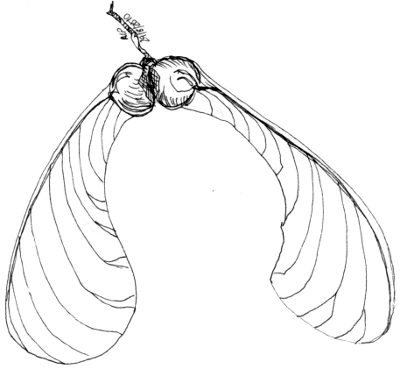
The Sycamore is also known as the Great Maple [5].  The winged seeds of the sycamore are called helicopters and were used in flying competitions by children.  The sycamore was the favoured wood for making love spoons in Wales, which are made from a single piece of wood [6].

In Montgomeryshire there was a belief that sycamore trees kept the fairies away and stopped them from spoiling the milk [7].

In Scotland the feudal lairds used sycamore tress, known as dool or joug trees, as their gallows.  Further south, in Wiltshire, sycamores had unlucky associations, perhaps because they were also sometimes known as ‘hanging trees’ [8].

The Sycamore is sometimes called the Martyrs’ tree after the Tolpuddle Martyrs who first met beneath a sycamore tree in 1843 and formed a secret society to fight starvation and poor wages.  Unfortunately, they were caught and sentenced to seven years transportation to Australia.  They were pardoned after two years and returned home [9].

  1. Tumbling Woods
  2. Oaken Woods
  3. Mystical World Wide Web
  4. messagenetcommresearch.com
  5. Botanical.com
  6. The Woodland Trust
  7. members.multimania.co.uk
  8. Roy Vickery – Plant Lore
  9. Forest of Leeds
  10. Spiritual Forums

Trains and seasonal stations

Riding the rails

Sir Nigel Gresley from http://www.copyright-free-photos.org.uk

Yesterday was a bit of a day.  I have a weekly morning appointment that often leaves me feeling very emotional.  I’ve been travelling there and back by train while I’ve been on holiday.  However, next week I return to work and the early morning train journeys will cease as I will have to get to work asap after my appointment.  I went to the Forum Coffee Lounge in Merthyr Tydfil for a pot of tea and some cake – I settled on a flapjack this week.  It has to be said, the Forum has the most gorgeous home-made cakes and traditional puddings, and they are very reasonably priced.

After enjoying the tea and nibble and recording my thoughts in my Luddite-journal,I decided to get a Day Ranger ticket,  and travel around South Wales.  The day was turning out to be a beautiful late summer day, the world lit with a soft golden light that presages Autumn so wonderfully.  I thought it would be nice to just to watch the world go by and for nothing more than the joy of moving from place to place, a chance to get my thoughts and emotions back into order, and to take a day out.  And so I did.  And it was lovely and relaxing.  I wish my train had been a steam train, like Sir Nigel Gresley, an A4 Pacific.  But the haulage by various diesel units was adequate and did the job of allowing me to relax.

I do find train travel relaxing.  I can’t run away from what I need to examine internally or work on creatively while travelling in such a way.  I have my journal with me, I write in it as I need to and work my way through things and find my balance once again.  Steam engines I love, but any locomotive will do in such circumstances.

Changing seasons

Rosebay Willowherb

The world is certainly moving towards Autumn in these here necks of the woods.  The quality of the light is changing, becoming more golden as the Sun’s strength wanes as we move further away from the Summer Solstice towards the Autumn Equinox.  There’s plenty of strength in the Sun to warm the Earth during the day, but the early mornings, late evenings and nights have that wonderful chill that heralds the coming of the magnificence of Autumn.

It really is my favourite time of year.  I adore the glowing warm colours and I start to eagerly look around me for signs of the changes, and yesterday I saw them.

The profusion of red haws on the hawthorn trees like seeds of the fire that will blaze soon.  There were the very occasional flash of  bright yellow leaves on the beech trees.  My ‘flame’ trees (some kind of maple or sycamore I think) were crowned with darker green leaves that had hints of a deep burgundy in them.  Ferns were beginning to turn yellow and then brown after being baked by the Summer Sun.  Fluffy seeds from rosebay willow herb.  Just hints, promises of the beauty of the colours yet to come.

The cycle of the seasons

I’ve always felt a close connection to the cycle of the seasons.  Without knowing why, I’ve always felt a deep ‘attachment’ to the solstices and equinoxes and have had an understanding of how they link to the cycles of human life and experience.

I have my own way of observing these astronomical (and astrological) stations of the year, ways that have developed over the past few years since I started to explore and find ways of expressing my spirituality and beliefs.  It has always seemed natural to me to acknowledge these stations of the year in some way.  As I’ve developed, so have my practices, sometimes I feel guilty about not spending as much time on them, having abbreviated them to the pure essence of what they are about, but I work hard on reminding myself that as we change, grow, develop, so must our practices and the way we do things.  When we learn something new, we do it with great attention to all the details, learning from this, but as our understanding and skill develops, we learn what is truly essential and leave out those parts that are superfluous to ourselves, our individuality.  Of course, they may be incorporated once again later if they are found to be required once again, but I do believe that by cutting away a lot of the faff and fluff you get to the core of the practice and the focus and intent is greater as a result.  The more in tune you are with the process, the less fuss is needed to make the connections that are needed.  But that’s me …simplicity wherever possible.