D23 has turned out to be a rather interesting fragment with some really fun and pleasing avenues to wander down. Yet again, I’ve only scratched the surface of variations of this one. No doubt it’ll be something I’ll return to.
The most important thing I’m learning through this challenge is about the ways to vary tangles, and also which ways will best suit different fragments. And, of course, that will translate to my other arty stuff too.
This was one of those fragments where I thought there wouldn’t be much I could do with. I wasn’t sure if it would transfer to other shapes and so on.
Turns out I need not have worried at all. Admittedly, some shapes and variations work better than others. Also, I’m aware I’ve barely scraped the surface.
This page also gave my TWSBI Eco fine nib fountain pen a work out. Treating Canson Imagine mixed media paper with Distress Ink does make it a bit more absorbent and the pen ink does result in a broader line. Such an effect wasn’t noticeable on the ClaireFontaine Paint On paper coloured with Distress Inks. It’s going to be a bit of trial and error process going on until I get the hang of it!
I managed to get all the days muddled up in the challenge. That’s not a problem, I’ve been told, just work with a fragment a day, follow the list, ignore the list, all is fine and good!
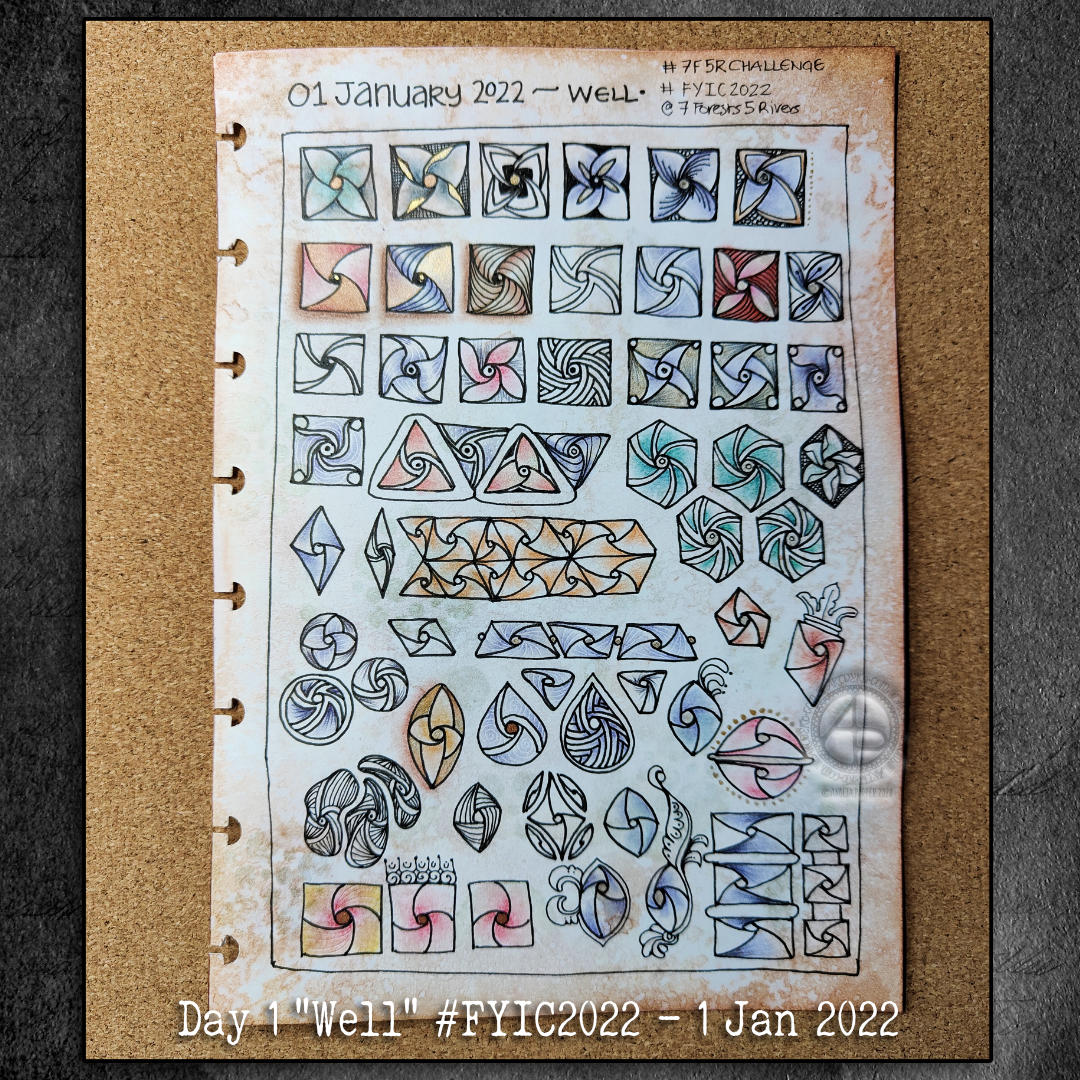
Today, I chose to do fragment X7, which can be found in the Zentangle Primer book. It’s the circular version that is suggested today. But of course I had to work with other shapes and forms too! So much so I fairly quickly filled a page up.
The second sheet was done in today’s video. I had recorded the process of drawing the first sheet, but forgot to check that I was in frame. I wasn’t for way too much of the time. So, I just recorded a different video, including some other variations of the fragment.
Once you start exploring, you just can’t stop! Or so it seems in my case.
This is the first time I’m taking part in this particular month-long challenge. It’s being run by 7Forests5Rivers on facebook. Each day, there’s a different tangle pattern fragment to work with. And, with me being me, that means I’m most likely to create a page of lots of variations on a theme!
A fragment is a small, self-contained pattern-cell that can be repeated to create a grid pattern. The grid is called, in zentangle-speak, a reticulum. Within the reticulum, the fragments can be placed all in the same way, or they can be rotated and/or mirrored to create a pattern.
So, with just one simple fragment – the basic ‘cell’ of a repeating pattern – a whole host of patterns can be created. If the basic cell is changed by simple variations, then even more patterns can be created!
With me being me, I’ve created a page full of variations of the basic fragment for “Well”, which happens to be one of my favourite tangle patterns.
Some of the variations are different shapes for the fragment and ways of spacing and joining them. I couldn’t resist a few of my medieval-style flourishes too.



 Art is the Adventure