Lazy days…

So tired

This has been another weekend of sheer laziness.  All I’ve done, mostly, is sleep or read or just potter and potch around the place.  All I can say is I must need this quiet time for whatever reason.  I’m most probably emotionally exhausted after a long term and a long year at school, as well as from such a busy fortnight with things happening in the evening.  No, not partying, but various classes and workshops and talks.  It all tires one out.  Perhaps this quiet time will mean that I recover sooner in the summer hols so that I can enjoy more of them.

Part of me is being hard on me for not using the time more productively, for not being busy, busy, busy.  Part of me is patting myself on the back for listening to myself and taking time out.  I wouldn’t sleep if I wasn’t tired or didn’t need it.  I’d have the inspiration to create if I was fully charged.  And if I catch up somewhat with myself I’ll have time in the summer hols to find the inspiration and lose myself in things that bring me pleasure.

Harry Potter and the Deathly Hallows – Part 2

I went to see this on Friday afternoon.  It was good, but somehow anticlimactic.  I can’t put my finger on it, perhaps it’s simply because the book had so much more in it, or my imagination is so much more vivid.  Or maybe it’s because it’s come to an end, for now.  I have a feeling we’ll be hearing more of the wizarding world in the future; I don’t think J K Rowling can keep away from it for much longer!

Fallen Books

I’ve been reading these books by Lauren Kate.  It took a while to get into Fallen, but since I have done so I’ve been engrossed by them (hence the weekend of reading!).  I read Fallen in three or four days, Torment took just two days, and I’m stuck into Passion now.  All I can say is I’d never thought I’d be reading and enjoying books that had angels in them!  Wizards, witches, sorcerors, orcs, elves, fairies, nac-mac-feegles, and others yes, but angels?  I’d recommend the books as a lovely escape with exciting and heart-wrenching moments, as well as moments of that perfect, romantic, sensual love that can only exist in dreams (I think – though if anyone can offer me hard proof that such a love exists, then please tell me; I’ve never experienced it!).

Arty stuff.

My artistic endeavours this week have centred around my latest sketchbook which has pages being filled with work inspired by a photograph of a leaf skeleton.  I’m working with different media, developing shapes and patterns and colours and so on with the aim of producing some textile work.  All I know is that I’m enjoying the time I get to spend on it, which isn’t enough really.  It’s not long, though, until the long holidays…not long to go.  I just need to remember to borrow back my books of inspiration, particularly “Drawn to Stitch” by Gwen Hedley.

I’ve been asked to create a piece of textile art similar to this one for someone at school.  That’s a summer holiday project I’m sure!  Other projects will come from my sketchbook work, I think.  I’d also like to spend time trying to work out how to do landscapes…my way.

Weight loss…

I’m considering joining Slimming World to kickstart myself into eating healthily, taking care of my body via the food I eat, and losing weight.  Over the past couple of years my weight has steadily increased and I’m now where I was the summer after I finished with the long ago ex, which was some 13 years ago now.  I’ll have to be incredibly brave and firm with myself to actually go to a meeting, and then incredibly strong and firm with myself afterwards … and forgiving should I lapse momentarily too.  Believing I deserve to look after myself, treat myself well, be kind to myself is still a huge stumbling block for me.

I’m hoping that the work that has been done with me over the past three years or so will have done the equivalent of ctrl-alt-del and restarted the programs that are ‘me’ as they should run, well most of them; kind of like having the viruses removed, or at least the ones that have been identified.

Words and Art Combined

Earth

Earth © Angela Porter 2011

Watercolours, pen and ink on cartridge paper.  24cm x 18cm.

I completed this picture as a kind of experiment.  A dear friend of mine suggested that instead of filling the curlicues of my current very spiral art with more curlicues and spirals that I should add words instead.  I have lots of ideas of what to do with this, perhaps, eventually.  But this was the first of it’s kind.

I wanted to put together a painting that had words and symbols and images that go with the esoteric element of earth, but the words I chose haven’t quite worked out.  However, I am pleased with the apple/wheat/leaf border and the ivy border too.  I’m also pleased that I left empty space, not because I got fed up of this, but because I felt it was all finished and balanced.

This will be an idea I come back to, that of the four elements I mean.  Words have been important in creating my latest pieces of art.

PF Summer Camp, Late May Bank Holiday Weekend 2011

PF Summer Camp 2011 © Angela Porter 2011Watercolours, metallic watercolours, Zig Art and Graphic pens, Rotring pens with black ink on watercolour paper.  9cm x 18cm.

Last weekend, I gave a talk entitled ‘Death and disposal in the Bronze Age’.  In the talk, I concentrated, it turned out, on how the landscape in which the monuments are set can and other factors such as time of day, season or weather have an effect upon how people experience the site.  I drew on the work of archaeologists such as George Nash and Ann Woodward’s book ‘British Barrows‘ who discuss such things.  I have found it a fascinating, if a little brief study by myself, but I already have books on order for when I have the time to dig deeper into such matters.

I mention this because it may be that the barrows could have acted as ‘mnemonics’ for reciting the history of the clan who were the barrow-wrights.  Terry Pratchett and Jacqueline Simpson, in ‘The Folklore of Discworld’ write:

“The landscape is full of stories.”

What I set out to do in this particular painting was to put words in that act as memories of the weekend, especially the ‘bardic circle round the camp fire’ in the evening, where there were songs and stories and friendly banter and chatter.  This is something I have never done, the camp fire thing that is.  I loved it and want to take part in one again.  I may even be able to take my flute and play something, or tell a story; I think the informal and non-judgemental nature of such a gathering would allow me to do this.

I wander off topic here.  The colours and shapes I chose to represent the flow of ideas, talk, music as well as an opening of the mind and an igniting of certain things for me.  I am really quite pleased with how it has turned out, and it was another experiment as I used Zig Art and Graphic Pens to draw the design with; they are water soluble and bled into the watercolour paints.  It has turned out to be a happy accident, as I’m pleased with the colours in places which give an aged feel to the work, kind of like an old, hand coloured etching.  This is how a lot of my work tends to be, but I really want more vibrant colours so that black doesn’t swamp them.

Time

Time 1 © Angela Porter 2011Watercolour, Zig pens and Rotring pens with black ink on cartridge paper.  7.5cm x 15cm.

This was an experiment, again.  I started it last week and left it for a few days to ponder what to do with it.  The colours I had used seemed quite insipid and I wasn’t at all sure where it was going.  The purchase and subsequent playing with the Zig pens a couple of days ago gave me another technique to use in my art, and in this case it’s worked out well, I think.  Things aren’t as irritatingly perfect as my work has been in the past, but I think that adds something to the work.  I like the way the Zig pens add depth and intensity of colour, while being able to be washed out with a damp to wet brush to very subtle shades.  I feel I’m going to love using them in this way!

The adage ‘Time heals all wounds’ is, of course, not entirely true.  There are some wounds that never heal, unless it’s the final journey to whatever awaits us after this earthly existence.  I do think the words are particularly pertinent to me at this point in my personal progress.  I have been having counselling for a number of years now to help me heal the emotional wounds of the past and the damage it has done to my self-image.  It’s a long, slow process it seems.  I often feel guilty for talking so long, to be going round and round in circles, and there have been moments when we almost believed it was time for me to cut loose, then something happens to knock me back a few steps.  As I’ve been told, you can’t heal the damage done over 40-something years overnight, it takes time to undo the learned concepts and to replace them with new ones.  I am getting there, though, even though some days, or weeks, I feel I’m back to where I was.   Art helps me to relax, de-stress to bring joy into my life, and it’s a great re-balancer for me.  I am so grateful I have discovered this gift, and that I have people who encourage me to explore new ways, as I’m still not able to be self-motivating or to find the inspiration that sometimes I lack.

Cemetery musings

Friday 8th April 2011, 1524 BST – Sat on a bench over looking the Lawn Garden in Glyntaff Cemetery, Pontypridd.

It is a beautiful, sunny, warm spring day. There are bumble bees busily buzzing around on their business. Birds are tweeting, the corvids are cawing. The Friday afternoon traffic on the nearby A470 is a loud hum in the background.

I find cemeteries peaceful places to visit amongst the hubub of the modern world; the sounds of the living, man-made world fade into the background and the sounds of nature have a chance to come to the fore.

Today, especially after such a busily manic week at work, I find it peaceful to sit here after a brisk walk through the older part of the cemetery, with a chance to sit and write my reflections on being here, now. I must admit that I’m finding the Sun a tad bright and warm!

As I walked through the old part, I noticed that many of the gravestones are now leaning at odd angles, and some of the taller ones have even shattered thanks to the endless work of the elements. What once must have been a very orderly, regimented citadel of the dead now looks quite higgledy piggledy with drunken looking weeping angels, architectural chess pieces lopsidedly discarded after a long-ago game, veiled urns looking most precarious on the top of their columns.

Some thirty six years ago, I used to walk to and from school through this cemetery. I’m sure some of the monuments were lopsided, but perhaps as a younger person I didn’t pay that much attention to them. I found the names and places interesting, the weeping angels bemused me, and the Jewish section was something that was hidden and secretive to discover as if by surprise, I read the pages that were open in the Book of Remembrance, and the columbarium was somewhere to quietly pop into and browse through everything there with a sense of spooky wonder. I spent time reading the tags on the floral tributes and flowers left after someone had been cremated, wondering what kind of a person they were, what they did in life, what they would be most remembered for. I never plucked up enough courage, however, to look in one of the two chapels at the crematorium.

On nice days I’d stop on my way home and sit and just listen to the quietness. On gloomy days I’d linger on my way home enjoying the different ‘feel’ of the cemetery. In the Winter I’d be walking to and from school in near darkness and I was never scared of my walk through the cemetery, though I admit to feeling a bit nervous about being stuck in there in the night on my own.

I still find cemeteries interesting places to visit – the older the better, especially when the gravestones tell something of the life of the person whose mortal remains are at rest beneath it. They are havens of peace and quiet in a turbulent, hectic, loud, rushed world.

As I sit on the bench in the sunshine today, I ponder the change in the memorials erected over the remains of the once living. Many are small, almost insignificant in nature, simple statements of who was interred in this plot of hallowed ground. Some are even simpler with a rusted, weathered iron marker with a number on marking the grave, with no clue as to who is eternally sleeping beneath the covering of green grass. Why has no one erected some kind memorial for them?

Others are grander, erections of various heights pointing heavenwards as if showing the direction that the souls of the deceased should take to find their eternal and hallowed home amongst the heavenly hosts. Or are they a very visible and strong statement that that is where the souls have gone, even if you don’t think they have having worked under their iron hand in the early industries of the area. Perhaps the loftiness of the memorial is some kind of testament to the importance of that person while they were alive, to their family at least. Maybe a kind of one-upmanship to those whose pitifully smaller memorials surround them. Some of the largest are huge obelisk-like structures that seem to be like the finger that is used to punctuate the rhetoric of a political orator/activist as they proclaim ‘That’s where I am, that’s where I deserve to be’.

Or perhaps it is a sign that their true legacy, their descendants who share familial DNA, no longer feel a connection to them, to their past, and see no point in spending their own hard earned cash on the upkeep of a monument that means nothing to them. The ancestors were laid to rest, now their monuments are, in many cases, laid to rest on top of them as they become unstable and unsafe to leave upright. In the past people spent money on ensuring their souls would find a place in heaven, working hard on attending church each week and donating to the funds of the parish believing this would guarantee them a place in heaven.

What God do their descendants worship, I wonder? Is it a deity of materialism whose churches are the malls and shop-filled streets and out of town retail parks and the altars are the checkout tills? Consumerism seems to rule, where designer labels and having the right look count for everything. Pleasure in the now is the thing, because another visit to the church of consumerism will provide another fix as the offering is handed over at the till. Where is the attention to what lies within each of us; where is the acknowledgement that we are each more than what is on the outer surface? Is the emptiness that each of us can feel being filled by consumption of one external things of kind or another – possessions, clothes, food, drink, sex, drugs, and so on – rather than by us finding ways of filling the emptiness from within us?

As I sit here and look around at the more modern gravestones, memorial plaques and various memorials there is a change over time. Those in the past, though varying in height and sculptural complexity, have a restrained approach to the words displayed about the people whose remains are interred beneath them. Over time, the words have become more sentimental, more openly emotional. The memorials themselves have, in many places, become more showy, some even gaudy, to attract the attention of anyone who passes by. Grief, loss, emotions are becoming displayed more and more publicly.

I wonder if this goes hand in had with the way society seems to be more concerned about how someone looks than what is beneath the displayed front. I wonder if all the words were said to the person while they were alive, or is this show one that masks a kind of guilt that the words and sentiments weren’t shown to the person while they were alive and they are trying to make it up now with this display. Has the death of the person made them realise just how much they cared for them and now they feel they need to say all that wasn’t said? Is it guilt because they didn’t care for the person perhaps as much as they should have? Is it another kind of one-upmanship where the message is ‘we cared more about our relative than you do because we’ve covered their grave with flowers and toys and balloons and windmills and candles and artificial flowers and sculptures of the saints’?

Am I cynical? Yes, I am, but I do find it interesting to muse about what funereal practices show about us as a society. I may be horribly wrong of course, and these are just personal observations from one who is uncomfortable with her own emotions and showing them. No offence is meant, and comments or observations are welcomed.

Just as I was about to get up and leave, a beautiful butterfly landed close to my feet.  It folded it’s wings up, basking in the warm spring sunshine and remained with me for what seemed like many minutes.   Eventually, it spread it’s wings and launched itself into the air and the wind, carrying on about its business.  Moments like this bring great pleasure to me, moments when nature is unafraid to be close to me.

It was quite apt that it was a butterfly that kept me company as the transformation from caterpillar to butterfly via the resting phase of the chrysalis is seen as a metaphor for the rebirth of the soul after the physical body dies.

In Britain, Europe, North America and the Pacific, the butterfly was a symbol of the soul and it’s attraction to the light.  It was often thought that the human soul left the body in the form of a butterfly.

In Gaelic areas it was said the soul of a newly dead person could sometimes be seen hovering over the corpse in the form of a butterfly.

As an aside, I never knew some of an episode of the new Dr Who series was filmed here!

  1. Anna Franklin ‘Familiars.  Animal Powers of Britain.’

Flowers, folklore and folk-medicine

Our Fathers of Old

Excellent herbs had our fathers of old –
Excellent herbs to ease their pain –
Alexanders and Marigold,
Eyebright, Orris and Elecampane –
Basil, Rocket, Valerian, Rue
(Almost singing themselves they run)
Vervain, Dittany, Call-me-to-you –
Cowslip, Melilot, Rose of the Sun.
Anything green that grew out of the mould
Was an excellent herb to our fathers of old.

Wonderful tales had our fathers of old,
Wonderful tales of the herbs and the stars –
The Sun was Lord of the Marigold,
Basil and Rocket belonged to Mars.
Pat as a sum in a division it goes –
(Every herb had a planet bespoke) –
Who but Venus should govern the Rose?
Who but Jupiter own the Oak?
Simply and gravely the facts are told
In the wonderful books of our fathers of old.

Wonderful little, when all is said,
Wonderful little our fathers knew.
Half their remedies cured you dead –
Most of their teaching was quite untrue –
“Look at the stars when a patient is ill.
(Dirt has nothing to do with disease),
Bleed and blister as much as you will,
Blister and bleed him as oft as you please.”
Whence enormous and manifold
Errors were made by our fathers of old.

Yet when the sickness was sore in the land,
And neither planets nor herbs assuaged,
They took their lives in their lancet-hand
And, oh, what a wonderful war they waged!
Yes, when the crosses were chalked on the door –
(Yes, when the terrible dead-cart rolled!)
Excellent courage our fathers bore –
None too learned, but nobly bold
Into the fight went our fathers of old.

If it be certain, as Galen says –
And sage Hippocrates holds as much –
“That those afflicted by doubts and dismays
Are mightily helped by a dead man’s touch,”
Then, be good to us, stars above!
Then, be good to us, herbs below!
We are afflicted by what we can prove,
We are distracted by what we know
So-ah, so!
Down from your heaven or up from your mould
Send us the hearts of our Fathers of old!

Rudyard Kipling


Yes, there were some dreadful examples of medicine in days long ago, yet there were also many examples of folk-medicine that did work and that we use today.

For example research in biomedical Egyptology shows that many were effective and that some 67% of the cures recorded in various papyri complied with the 1973 Edition of the British Pharmaceutical Codex. They used honey, a natural antibiotic, to dress wounds and treat throat irritations, for instance, and aloe vera was used to treat blisters, burns, ulcers and skin diseases. They also used mouldy bread to treat infections; one of the moulds that grows on bread is penicillin!

There are many more examples of cures that worked and the active ingredients are used in modern medicine. Indeed, there is a branch of science called ethnobotany or ethnopharmacology that studies folk-medicines with the hope of finding new and active ingredients to treat the plethora of diseases still suffered by humanity.

Regardless of whether they worked or not, reading and researching about the uses of plants and other materials in folk medicine as well as the theories our fathers of old had about illness is something that I find fascinating, when I have the time to dig and delve into it. I find lots of interesting tales about where the names of plants come from, so I learn more about etymology, history, folklore, legend and myth. I get to look at photographs and illustrations of the plants used, so widening my knowledge and experience of art and so inspiring me to create my own. One day, the tales may even help to inspire me to do my own creative writing, maybe poetry, about all the wonderful lore that surrounds our most familiar plants, crystals, rocks, horseshoes, and so on.

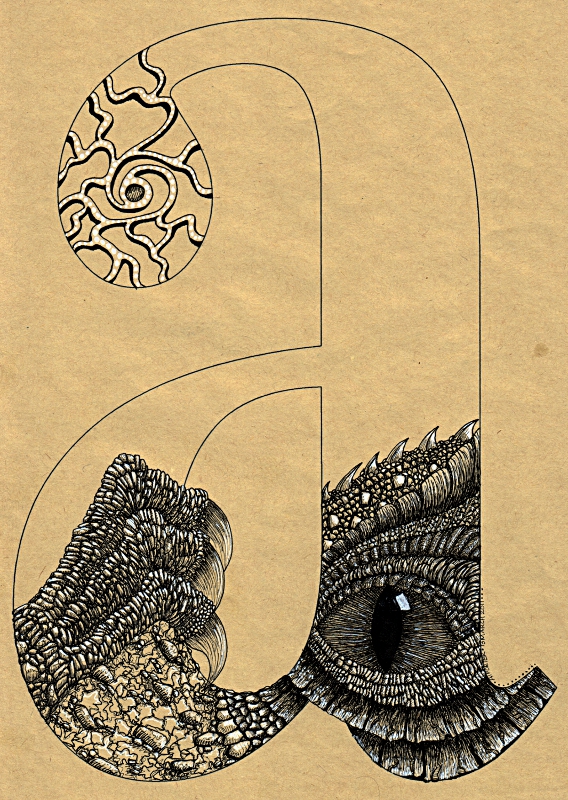
Second Dragon ‘a’

Dragon a 13 March 2011 © Angela Porter 2011

I finished this one not very long ago – and it is finished!  I decided not to fill the whole of the outline in with this one, though I am pondering thickening the outline to make it look more like a window frame made of stone, but maybe not.  I do like the empty space – it’s not so busily confusing.

It’s a little less than A4 in size, worked using black in in Rotring Rapidograph pens and white Pilot Uniball and Sakura Souffle pens on brown paper.

Other things …

I’ve been off work since Thursday.  Sore throat and cough, and that turned into a raging upset tummy-tum-tum yesterday, so I’m feeling just a little ‘drained’ today.  I’ll see how I am in the morning before I decide whether or not I’m up to facing the concentrations of confrontation/defiance/disrespect/aggression that are also known as pupils.

The time away has given me a chance to complete the ‘a’ above – it’s always a pleasure to lose myself in art – to do some work on negative automatic thoughts (NATs) and to find out where my deficiencies lie so that myself and my marble-sticker-in-place (counsellor) can work on dispelling the NATs and coming up with strategies to help me change them to PATs (positive automatic thoughts) as well as find the reasons for me to put strategies in place to help me treat myself in a good way, to lead myself to having a healthy lifestyle, and to intervene gently and positively with my comfort eating.  The NATs that are left are ones that lurk deep and have great power still, even though they don’t shout; their messages to sabotage me and my efforts at self-love are fare more devious and catching them in the act will take a lot of stealth on my part too.  They’re likely to be pretty ugly when I finally catch them at it.

No, I’m not mad.  I’m assured I’m not.  I just try to use my imagination to help me find my way through this counselling and on the way to becoming comfortable with who I am, caring for me, loving me in a healthy way, and imagining the NATs as some kind of beings that I call my inner beasties helps me in identifying and confronting them.  I do believe that underneath all the rubbish and poop that has stuck to them over my life time there is a shining, positive version of them, so self-hate is really self-love, and all the work I’m doing and have been doing is cleaning them up, layer by painstaking layer.  However, the deeper down the layers one goes, the longer they have been there and the harder they have stuck; as the layers have been removed, I have become stronger so I’m sure I’ll get to the shining positives beneath.


Proudly presenting the letter ‘i’ (and some jewellery)

The letter ‘i’

Initial 'i' © Angela Porter 21 Feb 2011

Approx. 5cm x 13 cm worked using wires, metallic threads, beads and custom made ‘sequins’ on black felt.  The colours are silvers, blues, greens and purples.  Again, my poor photographic skills do this a disservice, but then again, no photography would capture the way this shimmers and shines and catches the light in different ways as you view it from slightly different angles.

I’m quite pleased with it.  The letters are a much more rigid format than I’m used to working with, but there’s still scope for so much embellishment and patterns within them.

The bonus is that it’s very relaxing for me to do this, almost meditative in nature.  That can only be of benefit to me.  Also, it’s been nice to be cwtched up under a fleecy blanket whilst working both this letter and the jewellery.  It’s a chilly day here, with heavy rain from time to time.  It’s nice to hear the rain on the windows and know that I do not need to go out in it.  It was doubly nice this morning as I was sat in bed, the purrfurrball (cat) draped over my legs, purring loudly, as I could hear the rain on the windows.  It was a very comforting place to be.  Also, it is the only place that the cat will sit on my legs/lap – his favoured spot is upon my chest, head nuzzled into my neck or shoulder, and that brings an end to anything that involves using my hands!

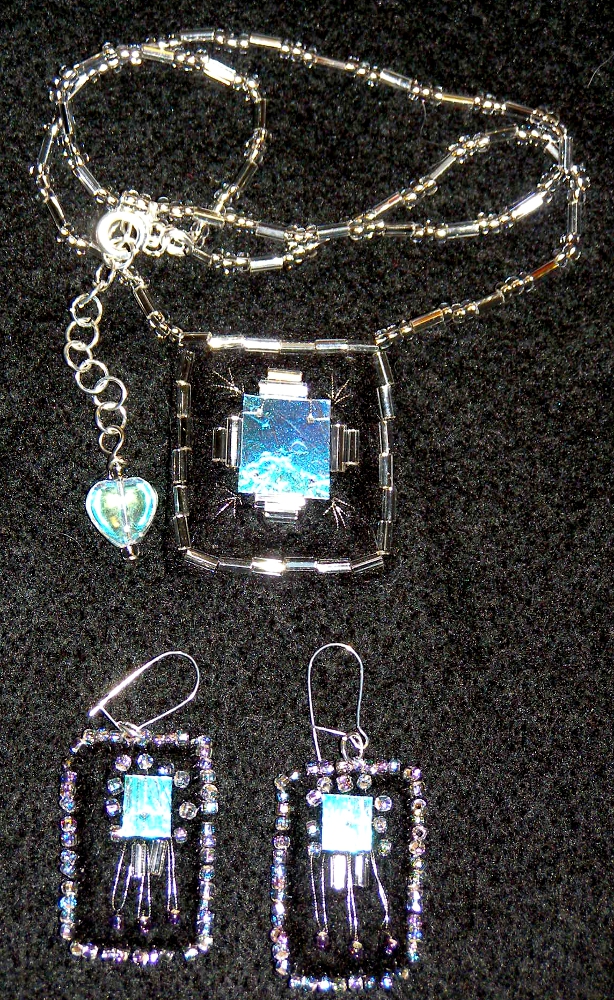
The Jewellery

Jewellery 21 Feb 2011 © Angela Porter 2011
The earrings are approx 2cm x 3cm.

The pendant is approx 3cm x 3.5cm.

Both worked with silver beads, purple/green iridescent ‘sequins’, silver threads.  The earrings have purple beads on them.

Just a few little items made for a friends’ daughters’ birthday this week … they didn’t take too long to do either, just a couple of hours, simply because I kept the design simple and not over embellished.  The pendant has a different ‘edging’ to  my usual over-stitched beads; I’ve used bugle beads sewn close to the edge of the felt so that there is a black border around them.  I don’t know if it works well, I’ll see what the feedback is from my friend!

Some Textile Art

I apologise in advance for the not very good photos of my textile work.  I’ve not worked out how to get good photos of it – the sparkles, shimmers and iridescence don’t make it easy, that’s for sure.

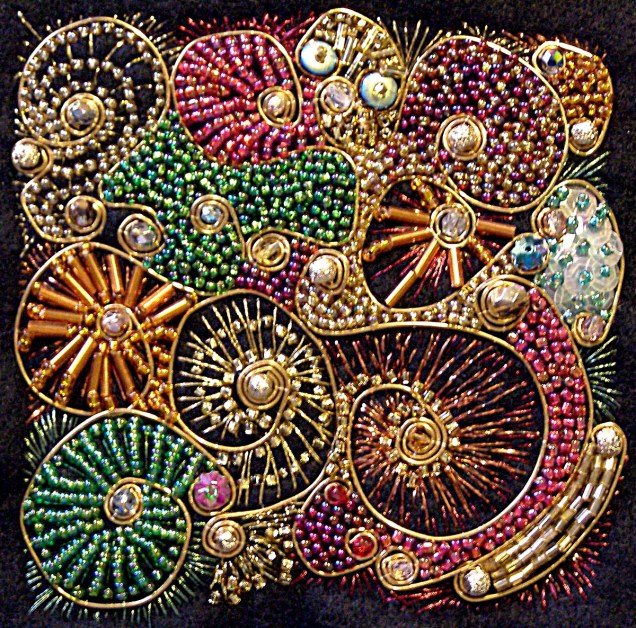
For the Princess Royal

This was presented to the Princess Royal when she opened a new care home near the school where I teach on 14th Feb 2011.  I hope to have pictures of it being presented to her sometime soon …

I was asked to make a small piece for her on the Tuesday before and it had to be finished by the Friday for framing.  So, a lot of time was spent on this.  It took around 15 to 20 hours of work, and it seems every available spare moment I had when I wasn’t sleeping, eating, driving or working was used.   It is just 9cm x 9cm in size.

I am pleased with the final work, and the photograph really does not do it justice at all (and for me to say that is a huge step forward in my self-esteem and self-belief!).

Looking for a title…

I finished this one not long ago.  It’s around 7cm x 14cm.  It’s been a source of relaxation and pleasure during a major stress-out this week.  I think think my stress levels have been steadily rising over the last few weeks, between one thing and another at the ‘college of knowledge’, mostly the behaviour/attitude of the pupils.  I’ve never known it be so bad.  Yesterday I hit my limit of stress, and passed through that barrier to release it, and last night and today I have paid the price for it – headache, upset tummy, extreme tiredness.  So, today I have spent completing the above piece of de-stressing, relaxtion therapy.  Over the past several days it has taken around 20 hours or so to complete.  I’ve stumbled across a way to make the large, rectangular ‘sequins’ on the picture.  The photo doesn’t show how the colours change and the work shimmers and sparkles as you view it from different angles.

Warming Winter Stew

Aaargh!  Today!

Today has been a frantic day in work.  Problems with mobile phones on in class, one madam actually was on Facebook!  Confiscation and all the hassle that causes ensued.  The noise today has been … almost totally unbearable, as has been the general lack of cooperation and respect.  I’m beginning to think there should be a total blanket ban on mobile phones in school.  They’re causing no end of trouble and disruption to lessons now.  The school does have a telephone system itself and if there is a reason to contact parents, or a reason for parents to contact their little darlings then it can be done via that system.  It always used to work perfectly fine as I remember.  The rules about having phones turned off (not just to silence) during lessons don’t seem to work, and the problems/issues that result from this …

So, I am so glad to be home.  I was met, unusually, by my pusscat who purred and fussed around me until I followed him upstairs to make a huge fuss of him (and he of me) before he settled back down to sleep.

Now, I am sat tippytapping at the ‘puter keyboard and my nose is being comforted by the delicious smell of a winter veggie stew cooking on the hob.

There is nothing like a hearty stew to warm the cockles of ones heart, or to comfort an over stressed me.  I will be making dumplings to go in it a bit later on in it’s cooking.  Then, when all is cooked to perfection, I shall enjoy eating it while cwtched up under a cuddly and warm fleecy blanket.  I’m sure the warmth and the goodness will sooth my frazzled emotions, will calm my jittery nerves, and I will feel so much better.  I already do, in fact, as the process of caring for another living creature and then taking the time to create a healthy, hearty feast for myself has been an example of self-caring.

Stew Recipe

No quantities will be given,  just ingredients … I’m very much an instinctive cook and just seem to know how much to put in by looking.  Of course, I vary the ingredients depending on what I have available or what I fancy.

Onions, fried in vegetable oil.  Today I added some Quorn Steak Strips and fried them until they were browned.  Next I added some roughly diced swede, parsnip carrot and potato and coated them all in the quorn and onions.  Red split lentils and pearl barley were then added and stirred around to coat them in the cooking juices.  Pepper and salt were added and then boiling water.  A couple of Just Bouillon veggie stock cubes, a sprinkling of mixed herbs, a couple of cloves of garlic finely sliced (they’ll disintegrate during cooking) and a healthy dollop of English Mustard.

It will take around 45 mins to 1 hour for the lentils and pearl barley to cook.  Around 20 minutes before the end of this time I will add dessert spoons of dumpling mixture – approx. 4oz of self-raising flower mixed with 2oz of veggie suet, salt and pepper to taste and maybe a few more mixed herbs.  A little milk and water is used to mix it to a sticky dough.  The lid is replaced on the pan and it’s all left to cook for 20 mins or so.

Served with a good shaking of veggie worcestershire sauce, it is one of the most comforting winter dishes I know!

I like to have more parsnips than swede and carrots; they give such a lovely, sweet flavour.  Sometimes I will add brussel sprouts and mushrooms to the veggie mix, but not today.  Sometimes I don’t use the Quorn.  Sometimes instead of putting potato in the stew, I’d boil or bake potatoes separately.  Today it’s a one-pot feast!  And there’s plenty there for tomorrow too!

And now I definitely feel a lot better!

Crystals and other things

The return to work … and stress…

Well, it’s just over a fortnight into the month and me being back and work and juggling everything else that goes on in my life such as taking and going to meditation classes, meetings, workshops, talks has meant that the time I have spent at home has been almost total ‘down time’.  Chilling with mugs of tea and a DVD or several is about all I’ve been able to do.  It may be a good sign that I am taking that time out and not filling my time up with busy-ness.

Stress hit a high on Friday with a confrontation with a pupil … and the fear that I may have done something wrong, that I will end up being told off for it, and yet common sense tells me that I did nothing wrong (apart from shout a little loudly). I was annoyed and angry with myself for letting my temper ooze out, though I regained control very quickly, and gained a stress-headache as a result of keeping things in.  There was no chance to let the temper out as I was on the roller-coaster of lessons yet again.  I wish I could have a ‘get out of lessons free card’ like some of the pupils, just for a few mins to gather myself back together.  I now have another set of negative automatic thoughts and reactions that now need de-programming, or perhaps that need revisiting in the light of some further insight.

Having said that, this was a lesson I had to take as soon as I got to work after a counselling session that ended just half an hour or so before the lesson.  It was an emotional session, with me trying to face up to my emotional eating, self-image, self-confidence, self-esteem and weight issues … sometimes I think I should just phone in ill.  I have leave of absence for these sessions simply because I give up my non-contact time in the week to attend them so that I have no classes to be covered.

Any suggestions for a career change for me?

I think this may be the only way out of what seems to be constant source of stress in my life, and with the way attitudes towards education have changed, both among parents and pupils and the low value placed on education and the lack of respect for teachers from parents, pupils, government and the wider society it’s not going to change, is it?  A way out, but I have no idea what else I would like to do or could do (bearing in mind I do need a certain income to pay the bills …).

Crystals

Thinking about stress, I’m always trying to find ways that work for me to relieve stress in my life and so stop me becoming totally drained and heading towards a dark place.

Meditation certainly helps no end, but that takes a fair amount of time, time I don’t have in the normal school day.  Morning and night not a problem, but during the school day … not even at lunchtime do I have time that is mine.  So, I do look at other things.  Square breathing that can be done ‘on the fly’ to regain control of some part of myself and my emotions, for instance.

Crystals may be another way of helping myself … though I’m not always convinced about such things.  I also have mixed views about the rape of our planet, our home in the Universe, for it’s precious resources that cannot be replaced, well not in our life-time at any rate.

I did have an interesting experience with a tumbled piece of sodalite that I purchased after a particularly emotionally harrowing counselling session a year and a half ago.  I was fondling it while having a make-over in the Body Shop.  There was a cracking sound and a piece of the sodalite had broken off and crumbled.  Now, I’m not strong enough to do that, there were no obvious flaws that I could see in the mineral, and it would most likely have broken into two pieces if that were the case, but to crumble into what looked like blue sand …

Crystal therapists and ‘experts’ I’ve related this tale to tell me that was a sign that some powerful healing had happened, and that such breakages are not uncommon.

The scientist in me is very sceptical about anything like this, even though I know that I did end up feeling better sooner than I thought.  There was a sudden easing of my emotional distress, whether that was due to the crystal or the make-over or just a little bit of time and space I don”t know – too many variables to say which one it was!  Or maybe it was just a combination of them all.

Sodalite

Sodalite from www.exquisiteearth.co.uk
Sodalite from http://www.exquisiteearth.co.uk

Sodalite unites logic with intuition and opens spiritual perception, bringing information from the higher mind down to the physical level.  When used in meditation, the mind can be used to understand the circumstances you find yourself in.  This stone instills a drive for truth and an urge towards idealism, making it possible to remain true to yourself and stand up for your beliefs.

Sodalite eliminates mental confusion and intellectual bondage.  It encourages rational thought, objectivity, truth and intuitive perception along with the verbalisation of feelings.  As it calms the mind it allows new information to be received.  Sodalite stimulates the release of old mental conditioning and rigid mind-sets, creating space to put new insights into practice.

Psychologically, this stone brings about emotional balance and calms panic attacks.  It can transform a defensive or oversensitive personality, releasing the core fears, phobias, guilt and control mechanisms that hold you back from being who you truly are.  It enhances self-esteem, self-acceptance and self-trust.

Sodalite aids, among other things, the throat, vocal cords and larynx and is helpful for hoarseness and digestive disorders.  From The Crystal Bible, Judy Hall.

Well, that most probably covers all I’ve mentioned in my experience of sodalite, as well as issues I’m working on.  I do remember just finding myself attracted to the sodalite in the display of crystals in the shop, which was Exquisite Earth in Merthyr Tydfil.  I also remember the owner telling me to look up the crystal in a copy of ‘The Crystal Bible’ by Judy Hall and at the time it perfectly suited the situation I found myself in, and still do.  However, I am working my way through to the other side, and I am certainly a lot, lot better than I was back then!

Art

Art has taken a bit of a back seat to life in general lately.  I am hoping to lose myself in some art in the very near future – such as as soon as I’ve finished this blog entry and got a mug of tea!  I don’t have a lot of time this afternoon as I have a talk to do tonight.

Currently reading …

My reading list is really odd at the moment :

‘I can make you thin’ by Paul McKenna

‘The Spook’s Battle’ by Joseph Delaney

‘After Death Communication’ by Emma Heathcote-James

‘The Physicists’ View of Nature, Part 2: The Quantum Revolution’ by Amit Goswani

So, you can go figure!

The Calendar

Time to change your calendars and diaries over!  Happy new calendar day for MMXI!

The Sun and the Year

It takes the Earth 365.24219 mean solar days to orbit the Sun once.  This is slightly more than our nominal 365 day long year, so every four days we have a leap year, with 29 days in February instead of the usual 28.  This still isn’t quite right, so the last year of every century is not a leap year unless the year is divisible by 400, which is why 2000 was a leap year but 1900 wasn’t.

There are four key points in the Earth’s yearly journey around the Sun.

The Solstices are where the Sun appears to stand still at solar noon for a few days, this means that it is in the same position in the sky at solar noon.  Solstice comes from the Latin sol for Sun and sistere which means to stand still.  Around the 21st December each year, the Sun is the furthest south from the equator in the sky and we in the northern hemisphere experience the Winter Solstice, the shortest day in the year.  Around the 21st June, the northern hemisphere’s Summer Solstice occurs, with the Sun being at it’s most northerly from the equator.  This is the longest day of the year for us.

The Equinoxes occur in between these points.  The Vernal Equinox occurs around the 21st March and the Autumnal Equinox around the 21st September each year.  On these days, the Sun is directly over the equator.  These are days where the hours of daylight and night are approximately equal, and the word equinox comes from the Latin equi meaning equal and nox meaning night.

To our modern eyes, the cycles of the Sun are important in terms of determining the seasons, the weather, agricultural practices and so on.  But that wasn’t always so.

The Moon and the Year

To early man, it was the Moon, with its cyclical waxing and waning that was the more obvious object to use to measure time and all the earliest known calendars are lunar, based on the phases of the Moon.  Indeed, the word month comes from the use of the phases of the Moon to split the year up into segments.

It takes long and complicated sums to link the cycles of the Moon to those of the Sun.  A lunar month is 29.5306 days long, so a twelve month lunar year would last just over 354 days and so is around 11 days out of step with the Solar year.  If we were to follow a lunar calendar, it would take just about 16 years for the seasons to be completely reversed.

Julius Caesar and the 1st January

Whatever the religious reasons may have been to keep to a lunar calendar, it must have been obvious that it was the cycles of the Sun that had the biggest effect upon human activity.  It was the turning of the seasons that determined when crops were to be sown, when they were due to be harvested, when the weather would be good enough to set sail, and for so many other things too, yet the lunar calendar was still in use, with all the problems of errors and corrections that needed to be made until the Julian calendar was introduced by Julius Caesar in 45BC.

Caesar learned of this calendar from the Egyptians.  Legend has it it was at a party thrown by Cleopatra in his honour.  The Julian calendar was based on a 365 day year, with an extra day thrown in every 4 years.  Each year had twelve months with thirty or thirty-one days, except February, and the 1st January was set as the beginning of the year.

The calendar as we know it today was now more or less in place.  It was regular, secular and based on the real movements of the Sun.

Dark Times

Emperor Constantine (d. AD377) imposed Christianity as the major religion of the Roman Empire and he placed the design of the calendar back in the hands of religious groups who were still wedded to the traditional lunar movements for their major festivals.  After the collapse of the Roman Empire, the Christian church was the nearest thing to an international controlling committee and the West entered a long, dark time where scientific enquiry was frowned upon at best and considered heresy at worst.

The Gregorian Calendar

By the C16th, the western world was stable enough to attempt to reform the calendar.  The small errors from the Julian calendar had now become noticeable and annoying.  In 1582 Pope Gregory finally announced changes in the calendar to correct these faults and prevent them from happening again, including the 400 year rule for leap years mentioned previously.

He introduced what became known as the Gregorian Calendar, and ordained that 5th October should become 15th October to bring the calendar back in line with the physical world.  This was a much needed and a sensible solution to the problem of the calendar.

However, the changes were not universally accepted, especially in Protestant countries such as Britain.  The changes were declared to be a ‘Popish plot’ designed to undermine their credibility.  For more than a century following this Papal decree, half of Europe was 10 days ahead of the other half!

It took Britain until 1752 to adopt the changes, by which time it had to correct the calendar by 11 days to bring it back into line with Gregorian calendar.   Philip Stanhope, fourth Earl of Chesterfield, initiated this move by introducing a Bill to correct the ‘inconvenient and disgraceful errors of our present calendar’.  This Bill was signed into law by George II on 22nd May 1752.  Chesterfield’s Act  decreed that Wednesday 2 September 1752 be followed immediately by 14 September 1752 and also that the New Year was to start officially on 1st January.