Labels, work, stress and knits.

Jam Jar Labels.

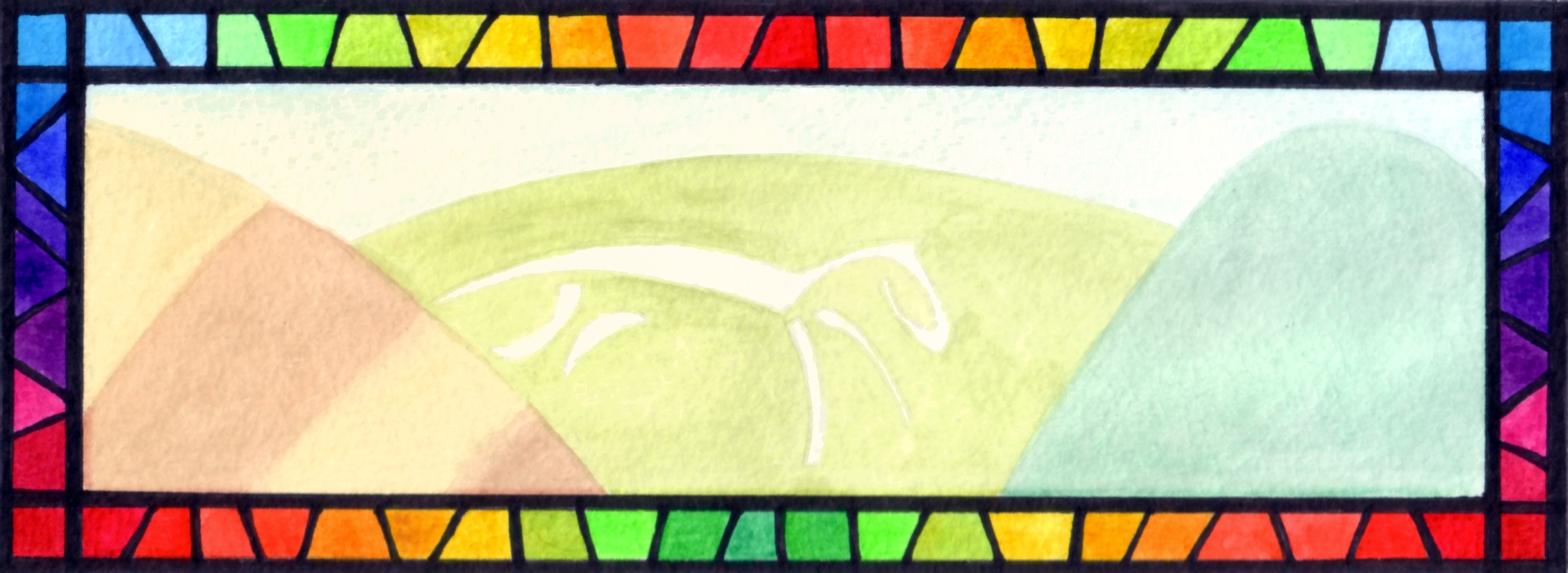
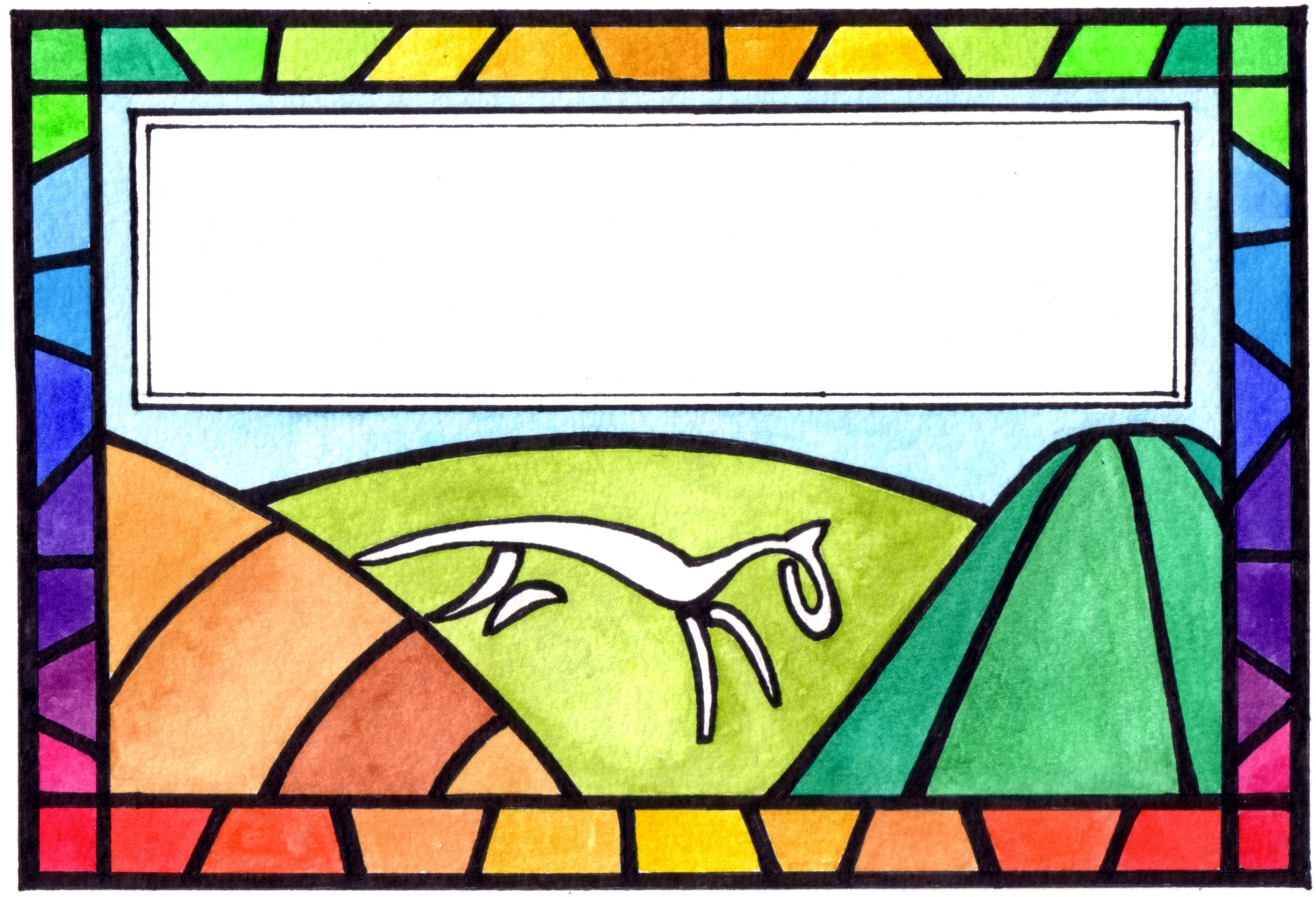
I got some labels done for a friend for their home made jams and chutneys.  They are chuffed with them, and I’m pleased that they like.  They liked my illustration for my Harvest Moon blog entry, and wanted their labels in a similar style.   The first one below is for the larger jars, the second for he smaller jars.  It took a while to get the first one ‘fit for purpose’, but I’m really pleased with it.  It gives visual hints as to where the produce was grown and collected for the preserves.  I also am pleased that my rather simplified style of art has found a ‘niche’.  The smaller label works just fine too, similar design, but the landscape faded out so the information about the contents can be typed over it.

A friend at work asked if I’d design some for a relative of hers as a Christmas present, as they are always making jams and preserves too.  So of course I’ll do that.
Work, stress and knitting.

Three weeks back at the chalkface (though no one uses chalk in the classroom anymore!) and the stresses of dealing with uncooperative, disrespectful teens and managing a workday that is like climbing on a treadmill that has been set by someone else who is calling the tune, and running to keep up with the changes in pace until eventually you are thrown off as your feet get in a tangle.  Well, that’s how it feels once more at the moment…despite the help I have once a week, I’m not yet able to break the cycle I’ve managed to get myself caught up in over a lifetime, and of course when things go wrong, or at least aren’t perfect, then I blame myself and beat myself up with it once again.  But it’s not as bad as it used to be, it just seems a long journey to get to where I’d like to be.  And one straw was added to the burden that’s built up since the return to work on Thursday that caused me to lose my temper briefly.  That led to me having a very upset digestive system for the rest of the day night, and a thumping headache that was with me most of Friday, Ibuprofen only just taking the edge off it.

This lead me to feeling I needed to find an activity in the evenings that relaxed me, didn’t require a lot of concentration and that I could just pick up and put down at will.  I love art, but when I start on an art project I can get consumed by it, stay up later than is wise for me as I totally lose track of the time.  I wanted something that wouldn’t need my eyes to work in sharp focus (note to self – opticians!). Something that didn’t need a lot of concentration.  Something that kept my hands and eyes busy but left my mind free to think or to follow a film.  And that reminded me of why I used to love to knit and crochet so much.  I was doing something, something creative, but something that let me be still and calm, to just ‘be’.  I knew I needed projects that could be either finished quickly or were made up of smaller individual pieces which could be finished quickly.  Projects where I could utilise my own creativity, perhaps even learn about free-form work, and maybe even combine all of this with other forms of art that I love to do to create mixed media works or jewellery.   I wanted things I could do while too tired, too stressed out to settle to anything else.  Something that would help me settle when like this, and perhaps small enough that I could carry it with me.

Well, in quite a synchronistic manner, one of those emails containing recommendations of books from Amazon appeared in my in-box, and on it were books of knitting and crochet.  I followed them, and added a large number of books to my large-ish Amazon wishlist, and I ordered two books that really caught my eye.

One was the ‘Prayer Shawl Companion’ by Janet Bristow, which caught my attention because of the contemplative, spiritual aspect of knitting, and gathering together with other like minded souls to create to gift to others in need, to send out thoughts for healing, love, peace and help to where it is most needed.

The other was ‘Mindful Knitting by Tara Jon Manning’ which appealed because it talks of the contemplative, meditative aspects of knitting.

Both of these books are on their way to me, and I hope that they are what I hope them to be.  I may post pictures of the projects here.  And it may be that like-minded people may gather together with me to create to help others.  I don’t know…yet.

I do know a friend at work has asked me to teach them to crochet.  So, after work on Thursday, I wandered through my local town to the only shop that now sells yarns, knitting needles and crochet hooks, to get some light coloured chunky wool, a large hook so she can see easily what to do, and can hold it more easily in her hands – she has rheumatoid arthritis, but she thinks this will help to exercise her hands and give her something creative to do.

Of course, I have been knitting squares of various stitch patterns and using coloured yarns, all of a similar size, just to keep me occupied while I await the arrival of the books.  And hopefully the books will also inspire me to be confident in creating my own things.  I’m particularly intrigued by ‘free-form’ crochet, as I am with ‘free-form’ beading.  But, we shall see what comes of this.

I do create textile jewellery from time to time – many examples can be seen at Artwyrd.deviantart.com, though I’ve not created any for a long while now, having a stock of them and nothing to do with them!  Finding the right market for them is a problem as they are so unique I suppose.  Maybe I can make use of my knitting/crochet skills to create different ways of wearing my beaded/wire/textile art … that’s something to think about at least!

I did have an interesting time trawling through eBay looking at the knitting yarns available and seeing some rather exquisite, and expensive, examples.  And with some of them my mind went to making small, heartfelt gifts not to wear but to keep.  Something to do for Yuletide/Christmas gifts p’raps.  Now that’s a thought.  And it’s more or less time for me to start thinking about creating my Yule cards.  For a good few years now I’ve made my own cards for that time of year, and it does take quite a bit of time to create them!

Lessons of the week

Busy, busy, busy … tired, tired tired.

Talk about busy!  I barely seem to have had time to catch my breath, or that’s how it seems.  And when I have I’ve just fallen asleep.  I seem to have spun from bed to work to home to class or talk and home to bed again.  Add to that a very upset tummy last night, and  waking at stupid o’clock most nights and not able to get back to sleep unless I take a little guided meditation time.  No wonder I feel shattered this morning.

Lesson is that I need to learn to manage my time better in the future – not to overbook myself with  classes and talks and to make sure I come home in time to spend time unwinding and relaxing before bed.

Unlearning what has been learned.

The car is still out of action, and will be until after pay-day at the end of the month.  I am hoping it will be fixed relatively easily and cheaply too, though with a SmartCar cheap isn’t often the word used to describe parts nor jobs easy.  But I love my SmartiePants very much, even when, as at the moment, she is just ‘pants’!

Not having a car really clips my wings, in many ways, but it’s also making me ask others for help – something that does not come easily to my sheer bloody-mindedly independent nature, something I learned to be early on in life as the people you count on in life at a young age such as parents and siblings just didn’t want to know unless it was to make yet more fun of me.

I am learning to unlearn the lessons of my past, however, little by little.  It’s surprised me how people are willing to help me.  And the realisation is that people do just as I do for others, except that I don’t ask for help or expect help nor do I believe that I deserve their help.  Or that used to be so.  As a child I learned not to bother asking for help because those around me as a child were unwilling to help (unless it gave them glory by doing so), and I’ve never unlearned that lesson so that I no longer assume that others are like my family of blood were as I grew up.

Mind you, help has been offered even when it’s not directly sought.  For instance, I have a talk to do next week in the Aberdare area.  Getting there by public transport is not a problem, but getting home again is.  I phoned the people who organised this evening, explaining about my poorly SmartiePants and they just told me not to worry, they’d come and get me, from home too, and I wasn’t even to think about getting partway there by train.  Now, I’d’ve offered to do that for someone, but just never expect others to do that for me … lessons to be learned here methinks.

Another example of helped unlooked for yet given was when I was telling my friend who I’m sharing travel with to and from work until SmartiePants is fixed about my worry about getting to my weekly appointment on a Friday and to school in time for my first lesson of the day.  She asked me about the time of my appointment and suggested that I go with her to work then take her car to get to the appointment and back and just replace the petrol I’ve used in doing so.  How kind of her.

Bit by bit, I’m learning about accepting help and letting others into my life.

Arty stuff

Nothing new this week, not really.  But I do have a ‘commission’ to do for a friend this week.  They’re making jams and chutneys like crazy with the bounty of nature and they plan to sell their excess.  They loved my ‘Harvest Moon’ painting of last week, and have asked if I’d design labels for their jars in a similar style…and I have ideas already what to do, so long as they will fit in the dimensions I’ve been given, as well as the words they want on the label and space for the contents of the jar.

And that brought to mind the memories I had last week of writing labels for my fathers home-made wine and beer.  Funny coincidences, synchronicities

Harvest customs

Harvest Wheat (c) Angela Porter 2010

Pre-amblings

This is no way a definitive account!  I wrote/collated the main body of it last year when I was due to give a talk at a ‘harvest supper’ in a church, and I thought it would be appropriate to give a little of the history and customs of Harvest, particularly in Wales.  I’m not quite sure how the talk was received, as it certainly wasn’t the usual ‘Chicken Soup for the Soul’ or ‘Silver Birch’ that they are used to.  I am, if nothing else, more than a tad anarchic when it comes to my choice of ‘readings’ under such circumstances!

Harvest Customs

People have been giving thanks for the harvest since farming first began in the Neolithic, and the custom is still thriving today in many countries of the world.

In 1912, Alfred Williams, Wiltshire, wrote:

“The in-gathering of the corn-harvest is by far the most important feature of the farm year, especially where there is much arable land, or perhaps it may be all corn in some places, as on the Downs, for instance.  If the weather is wet in hay-time and the crop spoiled that may not matter very much; but in the harvest, that is truly tragic!  Who does not deeply grieve, apart from the monetary loss involved, to see all that is left of the beautiful corn blackening and rotting in the fields, under the dark rainy skies of October and November, as is sometimes the case, utterly useless for anything but litter and manure, and the ground too wet and sodden to admit of collecting it for that purpose even?  It seems as though you have lived the year for nothing then; that all the bloom and sunshine of the spring and summer were mockery; that Nature brought forth her beautiful children but to destroy them.”

In centuries past, the whole life of the Nation of Britain and its agricultural economy depended on the harvest.  Even when the harvest had lost some of its economic importance, it still had a deep psychological effect on rural communities.

Autumn Wheat (c) Angela Porter 2010The word harvest comes from the Anglo-Saxon word ‘haerfest’ which meant autumn. According to the Venerable Bede, writing in the seventh to eight centuries, September was known to the pagan Anglo-Saxons as ‘Haleg-Monath’, which meant Holy Month, and it can be surmised that this was derived from the religious ceremonies that followed the harvest. However, no records of these ceremonies survived into Bede’s time.

In the Christian calendar, harvest traditionally started at Lammas tide (August 1), when the first corn of the new crop was made into bread and taken to church to be blessed. It finished at Michaelmas (September 29).

The harvest was the time of the agricultural year that the farmer needed the full cooperation of his workers.  Thirteenth Century Manorial records show that it was the custom that tenants were paid with refreshments to harvest the lord’s crops, and that in some areas there was a communal meal at the end of the harvest, and these are the earliest surviving records of this practice.

The workers knew that a successful harvest was needed for the economic well-being of the community, and a bad one would harm their chances of employment the following year.  During harvest, their wages doubled as the amount of work doubled.  Many customs and usages developed over the years which helped to keep the workers amused, gave further financial rewards, or celebrated their successful harvest.  The idea that these customs are direct survivors of pre-Christian times, of beliefs in corn goddesses and vegetation spirits, is not supported by the documentary record.

Prior to mechanisation, the mutual aid that existed between farmers and neighbours in the community was vital to the reaping of the crops. The fedel wenith, or reaping party, drew on the pattern of Cymhortha (from cymhorthu – to help), a characteristic of Welsh medieval society. Small-holders would help each other and also the large farms, in exchange for various things they had to give, like the loan of transport or a few rows of potatoes. In this way a system of goodwill and co-operation was built up within the community.

As soon as the last load of grain had been brought into the barn, the reapers and other workers were treated to a feast – the Harvest Supper – provided by the farmer for whom they had worked. In the eastern counties of England this feast was known as a Horkey Supper, while in Wales it was known as ffest y pen, cwrw cyfeddach or boddi’r cynhaeaf.

Whitlock says that in Wiltshire, the golden years of the Harvest Supper were during the second half of the 19th century and suggests that they had largely died out by the turn of that century. The suppers seem to have been quite lavish – or at least they seemed so to the farm workers who attended them. Food was plentiful. In Sussex caraway seed cake was traditional and was served to the workers throughout the harvesting because it was believed that the caraway seed provided the workers with strength and increased their loyalty to their employer, thus ensuring that they could not be enticed away by a neighbouring farmer offering higher wages. As well as seed cake, pumpkin pie and large apple turnovers called “Brown Georges” were served at Sussex harvest suppers.

In Carmarthenshire the supper included a dish called whipod which included rice, white bread, raisins, currants and treacle. In nearby Cardiganshire in 1760, a farmer reported that the feast following the reaping of his rye by about 50 neighbours consisted of ‘a brewing pan of beef and mutton, with arage and potatoes and pottage, and pudding of wheaten flour, about 20 gallons of light ale and over twenty gallons of beer’. After the meal, there was usually dancing to the music of the fiddle, with a plentiful supply of beer and tobacco.

Also in Wales, was the custom known as the caseg fedi, or harvest mare. When all the corn had been reaped except for the very last sheaf, the sheaf would be divided into three and plaited. The reapers would then take it in turns to throw their reaping hooks at it from a set distance and the one who succeeded in cutting it down would recite a verse:

Bore y codais hi,
Hwyr y dilyn hi,
Mi ces hi, mi ces hi!

[Early in the morning I got on her track,
late in the evening I followed her,
I have had her, I have had her!]

The other reapers would then respond with:

Beth gest ti?

[What did you have?]

and the reply was:

Gwrach! gwrach, gwrach!

[A hag, a hag, a hag!]

It was seen as an honour in Wales to be the one to bring down the caseg fedi, and the man who did so was often rewarded.

The plaited sheaf presided at the Harvest Supper, and was often hung in the house to show that all the corn had been gathered in. It could also, in one part of Wales, be put on the cross-beam of the barn or in the fork of a tree.

The ‘caseg fedi’ may have represented the fertility of the harvest condensed into the final sheaf. In one part of Wales, it was recorded that seed from it was mixed with the seed at planting time ‘in order to teach it to grow’. In other parts of Britain, this last sheaf was buried on Plough Monday, the first Monday after Epiphany (6 January) so that it could work its magic on the growing corn. It is possible that this association of the gwrach, a creature known to steal food, with the cutting down of the last sheaf, represents the triumph of the human forces of agriculture against the chaotic or malevolent forces of nature represented by the gwrach.

Once the grain harvest proper and the Harvest Supper was over, the women could begin gleaning, i.e. scouring the fields for the leftover ears of corn which they could claim and keep for themselves. In many places they elected a Harvest Queen to oversee the gleaning whose role was to ensure that everyone got fair shares. This she did by regulating the start and finish of work either by ringing a hand bell or by giving the word when the church bells rang. The Harvest Queen also had the right to initiate newcomers to the gleaning field by tapping the soles of their boots with a stone.

Today, most churches and many schools hold a service of thanksgiving for the harvest and hold their Harvest Festival on the first Sunday following the Full Moon closest to the Autumn Equinox. However, this custom only became popular in Victorian times.

In 1843 the Reverend R. S. Hawker had the idea of holding a special service on the first Sunday in October in his Cornwall parish. The idea caught on and soon it became the custom to decorate churches with fruit, vegetables and flowers and to sing the harvest hymns written for the occasion.

Harvest has now become a time when people come together to give food to the needy, or to raise money for worthy causes. Thus Harvest still commemorates not just the gathering of the fruits of the Earth, but also the community cooperation that exists and the desire of our own spirits to help worthy causes and to spread the abundance of gifts of all kinds to wherever there is a lack. It is also a time when we can reflect on the successes of our own endeavours, and reap the fruits of our own labours and count our blessings for all that we have in our lives.

  1. Steve Round – The English Year
  2. Sue Dale-Tunnicliffe – TES Magazine, 24 Sept 1999
  3. Raven – White Dragon Website
  4. Hillaire Wood – Harvest Customs in Wales
  5. Ronald Hutton – The Stations of the Sun

Memories and sloes

Memories

I’ve mentioned this before, but memories of my father include his wine making and beer brewing hobby.  Most of what he created, to my taste buds, was vile, but others seemed to relish it.  The only brew of his I liked was a raspberry wine that still tasted of raspberries and was quite sweet.  He’d spend hours and hours in his wine-shed (literally a concrete block/brick shed that was attached to the house) filtering and bottling and labelling.  And tasting it.  Never forget the tasting it.  He’d often spend much of the day tiddly from it!

Tea would be delivered to the shed door, empty mugs whisked away.  Scottish bagpipe or marching military band music would ooze out of the door, alerting everyone to what he was up to.  Occasionally, the music would stop and he would come out to declare he was feeling woozy.  We’d feed him some sugary snack suitable for a diabetic and then feed him properly, he’d recover and off he’d go back to his brewing.  You couldn’t get him to stop and eat when he was in the middle of something, nor would he eat any food delivered to him.

He had a brewing passion for years, and before it consumed his waking moments he would spend his days working on fixing and welding cars.  Tea would be left on the wall, empty mugs removed.  We often said he’d pass away while under a car and the only way anyone would notice was that un-drunk mugs of tea would line up on the wall.  As it was, he passed away in hospital from Alzheimers’, cancer, arthritis, diabetes and high blood pressure.  And that is an entirely different story.  And there are many tales of my father and his blinkered missions to do things or collect things from nature or his DIY diasasters.  He meant well, though he was very proud and couldn’t be told there was trouble ahead if he carried on doing what he was doing.

Perhaps I’ll relate tales and memories of my father in this blog.

Sloe, fruit of the Blackthorn (Prunus spinosa)

Sloe comes from the Old English slāh. It is the fruit of the blackthorn or sloe tree that has a pale-blue waxy bloom on its surface.  Sloes ripen in the Autumn and, in Britain, are traditionally collected after the first frosts in October or November.  The fruit is used to make jams and preserves, and they are used to make sloe ‘gin’ – a liqueur made by infusing sloes and sugar in gin, vodka or neutral spirits.

Straight blackthorn stems have traditionally been made into walking sticks.  Shillelaghs, blackthorn sticks, were favoured as weapons in faction fights in C19th. Ireland.  Commissioned officers of the Irish regiments of the British Army carry blackthorn sticks.

Blackthorn is generally considered unlucky to bring indoors, and in some areas of Britain it meant a death would follow.

The flowering of blackthorn is said to coincide with a spell of cold weather.  In areas it was considered wise to plant no tender plants outside until the blackthorn has finished flowering.   The best time for sowing barley was when the blackthorn flowered.  Two country rhymes follow, the first from North-East England and South-East Scotland, the second from Gloucestershire.

When the slae tree is white as a sheet
Sow your barley, wither it be dry or wet.

When the blckthorn blossom’s white
Sow your barley day and night.

In Sandwich, Kent, each incoming Town Mayor is present with a blackthorn stick.

In Herefordshire and Worcestershire, a wreath or globe of Blackthorn twigs would be scorched on a fire on New Year’s morning and then burned in a wheatfield in the furrows and its ashes scattered over the wheat. Then a new globe or wreath would be made and hung in the farmhouse kitchen ready for next year. It was believed that this ritual would rid the field of the devil. In a similar vein, Blackthorn would be scorched and hung up with mistletoe for good luck.

  1. Roy Vickery – Dictionary of Plant-Lore
  2. The English Cottage Garden Nursery

… and home again!

Thank goodness!  After the break I’m really not used to being with people …but it was a short day, and no pupils.  Home, tea brewing … blessed, twice and thrice blessed tea!

Trains and seasonal stations

Riding the rails

Sir Nigel Gresley from http://www.copyright-free-photos.org.uk

Yesterday was a bit of a day.  I have a weekly morning appointment that often leaves me feeling very emotional.  I’ve been travelling there and back by train while I’ve been on holiday.  However, next week I return to work and the early morning train journeys will cease as I will have to get to work asap after my appointment.  I went to the Forum Coffee Lounge in Merthyr Tydfil for a pot of tea and some cake – I settled on a flapjack this week.  It has to be said, the Forum has the most gorgeous home-made cakes and traditional puddings, and they are very reasonably priced.

After enjoying the tea and nibble and recording my thoughts in my Luddite-journal,I decided to get a Day Ranger ticket,  and travel around South Wales.  The day was turning out to be a beautiful late summer day, the world lit with a soft golden light that presages Autumn so wonderfully.  I thought it would be nice to just to watch the world go by and for nothing more than the joy of moving from place to place, a chance to get my thoughts and emotions back into order, and to take a day out.  And so I did.  And it was lovely and relaxing.  I wish my train had been a steam train, like Sir Nigel Gresley, an A4 Pacific.  But the haulage by various diesel units was adequate and did the job of allowing me to relax.

I do find train travel relaxing.  I can’t run away from what I need to examine internally or work on creatively while travelling in such a way.  I have my journal with me, I write in it as I need to and work my way through things and find my balance once again.  Steam engines I love, but any locomotive will do in such circumstances.

Changing seasons

Rosebay Willowherb

The world is certainly moving towards Autumn in these here necks of the woods.  The quality of the light is changing, becoming more golden as the Sun’s strength wanes as we move further away from the Summer Solstice towards the Autumn Equinox.  There’s plenty of strength in the Sun to warm the Earth during the day, but the early mornings, late evenings and nights have that wonderful chill that heralds the coming of the magnificence of Autumn.

It really is my favourite time of year.  I adore the glowing warm colours and I start to eagerly look around me for signs of the changes, and yesterday I saw them.

The profusion of red haws on the hawthorn trees like seeds of the fire that will blaze soon.  There were the very occasional flash of  bright yellow leaves on the beech trees.  My ‘flame’ trees (some kind of maple or sycamore I think) were crowned with darker green leaves that had hints of a deep burgundy in them.  Ferns were beginning to turn yellow and then brown after being baked by the Summer Sun.  Fluffy seeds from rosebay willow herb.  Just hints, promises of the beauty of the colours yet to come.

The cycle of the seasons

I’ve always felt a close connection to the cycle of the seasons.  Without knowing why, I’ve always felt a deep ‘attachment’ to the solstices and equinoxes and have had an understanding of how they link to the cycles of human life and experience.

I have my own way of observing these astronomical (and astrological) stations of the year, ways that have developed over the past few years since I started to explore and find ways of expressing my spirituality and beliefs.  It has always seemed natural to me to acknowledge these stations of the year in some way.  As I’ve developed, so have my practices, sometimes I feel guilty about not spending as much time on them, having abbreviated them to the pure essence of what they are about, but I work hard on reminding myself that as we change, grow, develop, so must our practices and the way we do things.  When we learn something new, we do it with great attention to all the details, learning from this, but as our understanding and skill develops, we learn what is truly essential and leave out those parts that are superfluous to ourselves, our individuality.  Of course, they may be incorporated once again later if they are found to be required once again, but I do believe that by cutting away a lot of the faff and fluff you get to the core of the practice and the focus and intent is greater as a result.  The more in tune you are with the process, the less fuss is needed to make the connections that are needed.  But that’s me …simplicity wherever possible.