Punky Night – A Somerset Custom

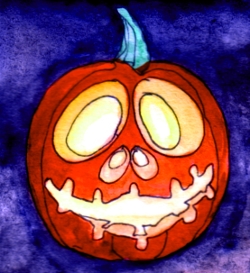
Pumpkin3 © Angela Porter October 2010

It’s Punky Night tonight
Give us a candle, give us a light
It’s Punky Night tonight!

This is one of the verses of a song changed by children as they carry their ‘punkies’, or Jack O’ Lanterns around villages in Somerset, England, UK and, in times past, begging for candles.  In the village of Hinton St George, Punky, or Punkie, Night is the last Thursday in October.

Other variations on the verse include,

It’s Punky Night tonight
Adam and Eve would not believe
It’s Punky Night tonight!

It’s Punky Night tonight
Give me a candle, give me a light

If you don’t, you’ll get a fright!
It’s Punky Night tonight

It’s Punky Night tonight
Give me a candle, give me a light
If you haven’t a candle, a penny’s alright

It’s Punky Night Tonight!

If you want to sing-a-long with the words, visit “The Punky Night Song” webpage!

The threat of something not nice happening if a person didn’t give the children something compares to the more modern tradition of ‘trick or treat’.

Punkies are made from a mangold-wurzel, or a large turnip, in a similar manner to modern Hallowe’en pumpkins.  The top is cut off, the insides scooped out and designs are cut into the outer skin, leaving a thin membrane intact.  Scary faces are common, but there are many examples of more creative designs.  A lighted candle is then placed inside to shine through the cuts.

Despite the usual assumptions that this custom is an ancient one, there is little evidence of its existence before the C20th.  Various nights in late October served for this custom, but Hinton St George eventually settled on the last Thursday in October.  At one time, it seems to have been a simple house-visiting custom, but members of the local Women’s Institute reorganized it in the mid twentieth century.  It is now celebrated by a procession of children carrying their punkies, and a party where prizes for the best designs are given, a Punkie King and Punkie Queen are crowned and money is raised for charity.

A local legend purports to explain the custom’s origin.  One version of the legend is that the village menfolk went to Chiselborough Fair, and got too drunk to find their way home.  Their wives fashioned lanterns out of mangold-wurzels and went to fetch them.   There are variations on the tale, in some the menfolk make the lanterns, in others the drunken menfolk are scared by the lanterns scary faces believing them to be ghosts of dead children returning to the Earth until Hallowe’en.  The neighbouring village of Lopen claims the custom (and legend) as their own, and other villages have started their own punkie nights.

As a child, I remember helping to carve Jack O’ Lanterns from swedes.  Pumpkins were not a common item then.  It wasn’t easy work either, and my father usually took control of matters very quickly, at least by hollowing out the swede so that we could carve the designs into the shell more easily and with less likelihood of us cutting off our fingers, or worse!  The smell of cooking swede pervaded the house once the candle was lit; whenever I smell cooking swede I get get flashbacks to childhood Hallowe’en, before it became dominated by ‘trick or treat’ and the various forms of antisocial behaviour that occur on that night, and the surrounding nights.  We had our own Hallowe’en party in our home, with local friends visiting with us.  The living room was decorated with blood-red crepe paper streamers, home-made black bats and spiders and webs.  Candle light was the order of the evening.  We made ghoulish food that involved a lot of food dye!  Ducking apples, bobbing apples were always played. And the climax of the proceedings involved the  delivery and display of Captain Blood’s Cake, dripping with blood-coloured icing and ghastly green writing and a single candle placed in the middle of the cake.  This heralded the beginning of ghostly and ghoulish stories.  They would start with a tale about Captain Blood, and then would go onto other things as we children would exercise our imaginations to tell tales, add to the tale being told, and scaring ourselves with what we found most fearful.  It must be said there was a lot of laughing as well!  These were perhaps some of the best times of my childhood … even though I was most probably too shy to tell the tales, my imagination would run away with me and everyone would make fun of me, and I still bear those scars today, finding it hard to tell stories, write tales, be imaginative.  I’ll get over it though.  I will.

The drawing of a pumpkin punkie was done using a very fine technical drawing pen (0.1mm) and watercolour paints on cartridge paper.  The sketch was completed very quickly, the painting took a little longer as the white purry-furry one wanted to help/hinder by demanding cuddles and fusses!   I then fiddled with it in GIMP2 to make it more vibrant in colour, more blurry and better looking than the original!  I have a couple more done that I’ll use to decorate any entries I do about Hallowe’en.

  1. Steve Roud, “The English Year”
  2. Punkie Night at information-britain.co.uk
  3. Punkie Night at Monstrous.com
  4. It’s Punky Night! at wyrdwords.vispa.com
  5. Ronald Hutton, “The Stations of the Sun”
  6. Punkie Night at wikipedia
  7. Jack o’ Lanterns at wikipedia
  8. Jacqueline Simpson and Steve Roud, “A Dictionary of English Folklore”

Michaelmas

Hiring, firing and pack rag days

Today is the feast of St Michael the Archangel.  It is one of the four Quarter Days, important times in legal and economic matters from at least medieval times to the late C19th.  Today was a day for the payment of rents and the beginning or ending of hiring engagements.  As these contracts came to an end, many local families were busy packing their belongings and moving home on this day, and it became known as ‘Pack Rag Day’.  Also, local courts were often held on this day.

Michaelmas Roast Goose

It was also a day for feasting, traditionally on goose.  The goose had been fattened on the stubble fields.  Sometimes, these geese were presented by the tenant farmers to their landlords.  It was said that ‘if you eat goose on Michaelmas Day you will never lack money all year.

Blackberries

Blackberries were bad, or even poisonous, after this date.  The exact date varies from Michaelmas to the 10th or 11th October, depending on the area.  The latter dates equate to the 29th September before the change in calendar in 1752.

The reason for the blackberries’ sudden decline was that the Devil interfered with them in some way on this date – putting his foot on them, wiping his tail or club on them, spitting on them, urinating or defecating upon them.

Election of the Lord Mayor of London

The Lord Mayor of London is the head of the Corporation of London, the authority that governs the City of London.  This is not to be confused with the Mayor of London, a post created in 2000 for the head of the Greater London Authority.  The Lord Mayor of London is a position that dates from around the year 1192.

The Lord Mayor is elected on 29 September, presents himself to the Lord Chancellor at the House of Lords in October for royal approval, and finally takes office on the second Friday in November.

The Lord Mayor is still an extremely important person in the nation, and in many situations is second only in precedence to the monarch.  As well as all the ceremonial duties, the Lord Mayor chairs the Court of Aldermen and the Court of Common Council and serves as Admiral of the Port of London, Chief Magistrate of the City and Chancellor of the City University.

  1. Steve Roud – The English Year
  2. Jacqueline Simpson and Steve Roud – A Dictionary of English Folklore

Harvest customs

Harvest Wheat (c) Angela Porter 2010

Pre-amblings

This is no way a definitive account!  I wrote/collated the main body of it last year when I was due to give a talk at a ‘harvest supper’ in a church, and I thought it would be appropriate to give a little of the history and customs of Harvest, particularly in Wales.  I’m not quite sure how the talk was received, as it certainly wasn’t the usual ‘Chicken Soup for the Soul’ or ‘Silver Birch’ that they are used to.  I am, if nothing else, more than a tad anarchic when it comes to my choice of ‘readings’ under such circumstances!

Harvest Customs

People have been giving thanks for the harvest since farming first began in the Neolithic, and the custom is still thriving today in many countries of the world.

In 1912, Alfred Williams, Wiltshire, wrote:

“The in-gathering of the corn-harvest is by far the most important feature of the farm year, especially where there is much arable land, or perhaps it may be all corn in some places, as on the Downs, for instance.  If the weather is wet in hay-time and the crop spoiled that may not matter very much; but in the harvest, that is truly tragic!  Who does not deeply grieve, apart from the monetary loss involved, to see all that is left of the beautiful corn blackening and rotting in the fields, under the dark rainy skies of October and November, as is sometimes the case, utterly useless for anything but litter and manure, and the ground too wet and sodden to admit of collecting it for that purpose even?  It seems as though you have lived the year for nothing then; that all the bloom and sunshine of the spring and summer were mockery; that Nature brought forth her beautiful children but to destroy them.”

In centuries past, the whole life of the Nation of Britain and its agricultural economy depended on the harvest.  Even when the harvest had lost some of its economic importance, it still had a deep psychological effect on rural communities.

Autumn Wheat (c) Angela Porter 2010The word harvest comes from the Anglo-Saxon word ‘haerfest’ which meant autumn. According to the Venerable Bede, writing in the seventh to eight centuries, September was known to the pagan Anglo-Saxons as ‘Haleg-Monath’, which meant Holy Month, and it can be surmised that this was derived from the religious ceremonies that followed the harvest. However, no records of these ceremonies survived into Bede’s time.

In the Christian calendar, harvest traditionally started at Lammas tide (August 1), when the first corn of the new crop was made into bread and taken to church to be blessed. It finished at Michaelmas (September 29).

The harvest was the time of the agricultural year that the farmer needed the full cooperation of his workers.  Thirteenth Century Manorial records show that it was the custom that tenants were paid with refreshments to harvest the lord’s crops, and that in some areas there was a communal meal at the end of the harvest, and these are the earliest surviving records of this practice.

The workers knew that a successful harvest was needed for the economic well-being of the community, and a bad one would harm their chances of employment the following year.  During harvest, their wages doubled as the amount of work doubled.  Many customs and usages developed over the years which helped to keep the workers amused, gave further financial rewards, or celebrated their successful harvest.  The idea that these customs are direct survivors of pre-Christian times, of beliefs in corn goddesses and vegetation spirits, is not supported by the documentary record.

Prior to mechanisation, the mutual aid that existed between farmers and neighbours in the community was vital to the reaping of the crops. The fedel wenith, or reaping party, drew on the pattern of Cymhortha (from cymhorthu – to help), a characteristic of Welsh medieval society. Small-holders would help each other and also the large farms, in exchange for various things they had to give, like the loan of transport or a few rows of potatoes. In this way a system of goodwill and co-operation was built up within the community.

As soon as the last load of grain had been brought into the barn, the reapers and other workers were treated to a feast – the Harvest Supper – provided by the farmer for whom they had worked. In the eastern counties of England this feast was known as a Horkey Supper, while in Wales it was known as ffest y pen, cwrw cyfeddach or boddi’r cynhaeaf.

Whitlock says that in Wiltshire, the golden years of the Harvest Supper were during the second half of the 19th century and suggests that they had largely died out by the turn of that century. The suppers seem to have been quite lavish – or at least they seemed so to the farm workers who attended them. Food was plentiful. In Sussex caraway seed cake was traditional and was served to the workers throughout the harvesting because it was believed that the caraway seed provided the workers with strength and increased their loyalty to their employer, thus ensuring that they could not be enticed away by a neighbouring farmer offering higher wages. As well as seed cake, pumpkin pie and large apple turnovers called “Brown Georges” were served at Sussex harvest suppers.

In Carmarthenshire the supper included a dish called whipod which included rice, white bread, raisins, currants and treacle. In nearby Cardiganshire in 1760, a farmer reported that the feast following the reaping of his rye by about 50 neighbours consisted of ‘a brewing pan of beef and mutton, with arage and potatoes and pottage, and pudding of wheaten flour, about 20 gallons of light ale and over twenty gallons of beer’. After the meal, there was usually dancing to the music of the fiddle, with a plentiful supply of beer and tobacco.

Also in Wales, was the custom known as the caseg fedi, or harvest mare. When all the corn had been reaped except for the very last sheaf, the sheaf would be divided into three and plaited. The reapers would then take it in turns to throw their reaping hooks at it from a set distance and the one who succeeded in cutting it down would recite a verse:

Bore y codais hi,
Hwyr y dilyn hi,
Mi ces hi, mi ces hi!

[Early in the morning I got on her track,
late in the evening I followed her,
I have had her, I have had her!]

The other reapers would then respond with:

Beth gest ti?

[What did you have?]

and the reply was:

Gwrach! gwrach, gwrach!

[A hag, a hag, a hag!]

It was seen as an honour in Wales to be the one to bring down the caseg fedi, and the man who did so was often rewarded.

The plaited sheaf presided at the Harvest Supper, and was often hung in the house to show that all the corn had been gathered in. It could also, in one part of Wales, be put on the cross-beam of the barn or in the fork of a tree.

The ‘caseg fedi’ may have represented the fertility of the harvest condensed into the final sheaf. In one part of Wales, it was recorded that seed from it was mixed with the seed at planting time ‘in order to teach it to grow’. In other parts of Britain, this last sheaf was buried on Plough Monday, the first Monday after Epiphany (6 January) so that it could work its magic on the growing corn. It is possible that this association of the gwrach, a creature known to steal food, with the cutting down of the last sheaf, represents the triumph of the human forces of agriculture against the chaotic or malevolent forces of nature represented by the gwrach.

Once the grain harvest proper and the Harvest Supper was over, the women could begin gleaning, i.e. scouring the fields for the leftover ears of corn which they could claim and keep for themselves. In many places they elected a Harvest Queen to oversee the gleaning whose role was to ensure that everyone got fair shares. This she did by regulating the start and finish of work either by ringing a hand bell or by giving the word when the church bells rang. The Harvest Queen also had the right to initiate newcomers to the gleaning field by tapping the soles of their boots with a stone.

Today, most churches and many schools hold a service of thanksgiving for the harvest and hold their Harvest Festival on the first Sunday following the Full Moon closest to the Autumn Equinox. However, this custom only became popular in Victorian times.

In 1843 the Reverend R. S. Hawker had the idea of holding a special service on the first Sunday in October in his Cornwall parish. The idea caught on and soon it became the custom to decorate churches with fruit, vegetables and flowers and to sing the harvest hymns written for the occasion.

Harvest has now become a time when people come together to give food to the needy, or to raise money for worthy causes. Thus Harvest still commemorates not just the gathering of the fruits of the Earth, but also the community cooperation that exists and the desire of our own spirits to help worthy causes and to spread the abundance of gifts of all kinds to wherever there is a lack. It is also a time when we can reflect on the successes of our own endeavours, and reap the fruits of our own labours and count our blessings for all that we have in our lives.

  1. Steve Round – The English Year
  2. Sue Dale-Tunnicliffe – TES Magazine, 24 Sept 1999
  3. Raven – White Dragon Website
  4. Hillaire Wood – Harvest Customs in Wales
  5. Ronald Hutton – The Stations of the Sun

Memories and sloes

Memories

I’ve mentioned this before, but memories of my father include his wine making and beer brewing hobby.  Most of what he created, to my taste buds, was vile, but others seemed to relish it.  The only brew of his I liked was a raspberry wine that still tasted of raspberries and was quite sweet.  He’d spend hours and hours in his wine-shed (literally a concrete block/brick shed that was attached to the house) filtering and bottling and labelling.  And tasting it.  Never forget the tasting it.  He’d often spend much of the day tiddly from it!

Tea would be delivered to the shed door, empty mugs whisked away.  Scottish bagpipe or marching military band music would ooze out of the door, alerting everyone to what he was up to.  Occasionally, the music would stop and he would come out to declare he was feeling woozy.  We’d feed him some sugary snack suitable for a diabetic and then feed him properly, he’d recover and off he’d go back to his brewing.  You couldn’t get him to stop and eat when he was in the middle of something, nor would he eat any food delivered to him.

He had a brewing passion for years, and before it consumed his waking moments he would spend his days working on fixing and welding cars.  Tea would be left on the wall, empty mugs removed.  We often said he’d pass away while under a car and the only way anyone would notice was that un-drunk mugs of tea would line up on the wall.  As it was, he passed away in hospital from Alzheimers’, cancer, arthritis, diabetes and high blood pressure.  And that is an entirely different story.  And there are many tales of my father and his blinkered missions to do things or collect things from nature or his DIY diasasters.  He meant well, though he was very proud and couldn’t be told there was trouble ahead if he carried on doing what he was doing.

Perhaps I’ll relate tales and memories of my father in this blog.

Sloe, fruit of the Blackthorn (Prunus spinosa)

Sloe comes from the Old English slāh. It is the fruit of the blackthorn or sloe tree that has a pale-blue waxy bloom on its surface.  Sloes ripen in the Autumn and, in Britain, are traditionally collected after the first frosts in October or November.  The fruit is used to make jams and preserves, and they are used to make sloe ‘gin’ – a liqueur made by infusing sloes and sugar in gin, vodka or neutral spirits.

Straight blackthorn stems have traditionally been made into walking sticks.  Shillelaghs, blackthorn sticks, were favoured as weapons in faction fights in C19th. Ireland.  Commissioned officers of the Irish regiments of the British Army carry blackthorn sticks.

Blackthorn is generally considered unlucky to bring indoors, and in some areas of Britain it meant a death would follow.

The flowering of blackthorn is said to coincide with a spell of cold weather.  In areas it was considered wise to plant no tender plants outside until the blackthorn has finished flowering.   The best time for sowing barley was when the blackthorn flowered.  Two country rhymes follow, the first from North-East England and South-East Scotland, the second from Gloucestershire.

When the slae tree is white as a sheet
Sow your barley, wither it be dry or wet.

When the blckthorn blossom’s white
Sow your barley day and night.

In Sandwich, Kent, each incoming Town Mayor is present with a blackthorn stick.

In Herefordshire and Worcestershire, a wreath or globe of Blackthorn twigs would be scorched on a fire on New Year’s morning and then burned in a wheatfield in the furrows and its ashes scattered over the wheat. Then a new globe or wreath would be made and hung in the farmhouse kitchen ready for next year. It was believed that this ritual would rid the field of the devil. In a similar vein, Blackthorn would be scorched and hung up with mistletoe for good luck.

  1. Roy Vickery – Dictionary of Plant-Lore
  2. The English Cottage Garden Nursery

Fruitful art?

Arty things

Well, I’ve just scanned in and added a pen and watercolour wash illustration of crab apples to yesterday’s post.  I got the bramble one done yesterday, though I’m not at all sure about using acrylic paints.  I do like the vibrancy of colour they give, but I also like the subtlety of watercolours too.  And working out how to use black ink with the colours so it looks ‘grown up’ and not childish/cartoony to me is a bit of a challenge, and I’m not at all sure that I’m succeeding.  But it is making for interesting art experiments I suppose.  Not sure what next though …

Awake too early

I woke up at stupid o’clock this morning, mind rushing, unable to settle to read, to meditate or anything.  I think that may be to do with today being the last day of my summer holidays and the return to work is really looming large.  I’ve had a rough few years at work, battling with stress/depression and other things, and though I am getting better, there’s still a way to go.  I don’t quite know how things will pan out – I’m doing my best to be positive about things, but the pressures involved in spending time with people, the noise, the fuss, the bustle, and that’s only the first day without the pupils back!  I do want to change careers but I have no idea what to … I’d like to work with my creativity, something that involves writing, art, imagination, working with people I can relate to, where there’s a level of respect and warmth would be good, where there are people I can bounce ideas off …exactly what that would be, I don’t know, but when I’m ready to make that move all will be apparent I’m sure.

I had an interesting time last night where I was showing some of my art to friends at my healing group.  They were pressuring me to frame my art, hang it, sell it, take it to galleries and hotels and libraries and craft centres and and and to display and sell it.  In the future I may be able to do that, but I find it so hard to show my art to people I know (unless it’s through the relative anonymity of t’interweb) and the thought of promoting it myself is … painful.  I found myself becoming quite angry and agitated as they kept repeating what I should do … and I tried to explain why I can’t do it…the financial cost of exhibiting is prohibitive for me at this time in my life.

Anyone know an agent who would represent me, or any other suggestions that don’t involve me pushing way too far outside my comfort zone?

A new month

Today is St Giles’ Day. St Giles died around the year 710.  During his lifetime he founded a monastery in Provence, near Arles, and that is about all that is known about his life.  The medieval myth makers, however, provided a colourful set of incidents for his life, including an explanation of how he was given the money to found the monastery.  When he was living as a hermit he had pet doe who provided milk for his nourishment.  Unfortunately, the King’s huntsmen loved to chase the doe and eventually they trapped her in the dense thicket in which Giles lived.  The doe was protected by harm by Giles’ prayers but he was wounded by a huntsman’s arrow.  The King recognised Giles’ holiness and bestowed many gifts upon him which he used to found the monastery.  Giles’ was also reputed to have remarkable healing powers as well as the ability to get a pardon for people’s sins, no matter how great or small, by praying.  These tales contributed to his fame, and Giles was widely popular in medieval England and many churches were dedicated to him.  His feast day was conveniently placed in the year for outdoor events, particularly local fairs, feasts and revels. [1]

  1. Steve Roud – The English Year

Apples and Brambles

I’ve chosen apples and brambles for today’s blog as they always seem to go together.  I noticed the blackberries on the brambles ripening during my jolly around the Valley Lines last week.  I’ve not been blackberrying in years and years, most probably not since I was a child.  I remember the abundance of blackberry pies, blackberry and apple crumbles, blackberry jam, apple jelly and frozen blackberries in our home.  With six children, there were plenty of us to gather them!  There were also the trips to collect whinberries (blueberries), as well as visits to ‘pick your own’ farms to harvest strawberries, raspberries and loganberries.

In later years, it would be my father who collected crab apples and blackberries to make his wines – along with sloes and young nettle leaves, young oak shoots, rosehips, rose petals, dandelions, and anything else he could brew.  I never appreciated his brews – all except the raspberry wine he made one year which was sweet and still tasted of the fruit – though others thought they were wonderful.  I do remember spending long hours writing out labels for his wine; I’ve always had nice handwriting and dabbled with calligraphy in the past too.  Now that’s something I’d forgotten about.

A few years ago a friend suggested, quite strongly, that I should collect sloes and make sloe gin, as well as to harvest the fruits of nature.  Well, I’ve not done so yet…

There are many recipes on tinternet and in books for blackberries, apples and so on, so I’ll not repost them.  Mind you, I could say the same about superstitions, myths, herbalism and the like, but I’m pulling together information for myself from many diverse sources, perhaps for future reference or just because I’m interested in it in the here and now, I don’t know.

Crab Apple (Pyrus malus)

(c)Angela Porter 1 Sept 2010The crab apple tree is native to Britain and is the wild ancestor of all the cultivated varieties of apple trees.  Apples of some sort were abundant before the Norman Conquest and were probably introduced into Britain by the Romans.  Twenty-two varieties of apples were mentioned by Pliny; there are now around two thousand cultivars.  In the Old Saxon manuscripts there are many mentions of apples and cider.

The Encyclopedia of Bartholomeus Anglicus, printed in Cologne around 1470, has a chapter on the apple:

Malus Appyll tree is a tree yt bereth apples and is a grete tree in itself…it is more short than other trees of the wood wyth knottes and rinelyd Rynde.  And makyth shadowe wythe thicke bowes and branches; and fayr with dyurs blossomes, and floures of swetnesse and lykynge,; with goode fruyte and noble.  And is gracious in syght and in taste and vertuous in medecyne…some beryth frute and harde, and some ryght soure and some ryght swete, with a good savoure and mery. [1].

The apple has been used as a symbol for sin, sexual seduction, beauty, love, sensuality, love between two men.  In art, Venus is often shown holding an apple as a symbol of love.    Apples also feature in many fairy tales, Snow White perhaps being the best known example where a poisoned apple puts Snow White into a deep sleep.

In the Old Testament of the Bible, it represents man’s fall; in the New Testament it represents man’s redemption from that fall.  The phrases ‘the apple of one’s eye’ and ‘a word fitly spoken is like apples of gold in settings of silver’ both come from the Bible.

The larynx in the human male is called the ‘Adam’s Apple’ because of the folk-tale about the Forbidden Fruit sticking in Adam’s throat and causing a bulge.

Heracles, the Greek hero, as part of his Twelve Labours had to travel to the Garden of the Hesperides.  His task there was to pick the golden apples growing on the Tree of Life that could be found at the centre of the garden.

Eris, the Greek goddess of discord, was disgruntled after she was excluded from the wedding of Peleus and Thetis.  To retaliate, she tossed a golden apple that was inscribed with ‘Kallisti’ – for the most beautiful one – into the wedding party.  Hera, Athene and Aphrodite, three of the goddesses attending the party, claimed the apple.  Paris of Troy was chosen to select the recipient of the apple.  After being bribed by both Hera and Athena, Aphrodite tempted him with the most beautiful woman in the world, Helen of Sparta.  He awarded the apple to Aphrodite and in doing so indirectly caused the Trojan War.

Another Greek myth concerns Atlanta who raced all her suitors in an attempt to avoid marriage.  She outran all but Hippomenes (also known as Melanion) who defeated her not by cunning but by speed.  Hippomenes knew he could not win in a fair race, so he used three golden apples, which were gifts from Aphrodite, the goddess of love, to distract Atlanta.  It took all three apples and all of his speed, but Hippomenes was successful, winning the race and Atlanta’s hand.

In Norse mythology, Iduna, the goddess of Spring and youth, nurtures an apple orchard in Asgard.  Every evening she would feed an apple to the gods and goddess in order to keep their youthfulness.

In Celtic mythology, Conle receives an apple which feeds him for a year, but alsogives him an irresistible desire for fairyland.

The mystical Isle of Avalon, the famed placed of eternal rest for Celtic heroes, including King Arthur, literally means ‘apple land’ or ‘apple island’.

Isaac Newton, according to popular legend, came up with the theory of universal gravitation after observing an apple falling from a tree.

Wassailing the orchard trees on Christmas Eve, or the Eve of the Epiphany, is still practiced in Britain.  Herrick mentioned it among his ‘Ceremonies of Christmas Eve’:

Wassaile the trees, that they may beare
You many a Plum and many a Peare:
For more or lesse fruits they will bring,
As you do give them Wassailing

The Wassailing ceremony consisted of the farmer, his family and labourers going out into the orchard after supper, bearing with them a jug of cider and hot cakes.  The latter were placed in the boughs of the oldest of best bearing trees in the orchard, while the cider was flung over the trees after the farmer had drunk their health in some such fashion as the following:

Here’s to thee, old apple-tree!
Whence thou may’st bud, and whence thou may’st blow.
Hats full!  Cap full!
Bushel – bushel bags full!
And my pockets full too! Huzzah!

The toast was repeated three times, the men and boys often firing off guns and pistols, the women and children shouting loudly.

Roasted apples were usually placed in the pitcher of cider and were thrown at the trees with the liquid.

A mixture of hot spiced ale, wine or cider with apples and bits of toast floating in it was known as ‘lamb’s wool’.  The name is derived from the Irish ‘la mas nbhal‘ meaning ‘the feast of the apple gathering’ (All Hallow’s Eve), which is pronounced something like ‘lammas-ool’ and this became corrupted into ‘lamb’s wool’.  Each person who drank the spicy beverage would also take out an apple, wish good luck to the company, and eat it.

It was believed that if an apple tree blossomed out of season then misfortune or death was foretold.

If the Sun shone through the branches of apple trees on Christmas Day, or Old Christmas Day, then there would be an abundant crop of apples.

Peel an apple so that the peel remains in one long strip.  Throw the strip over the shoulder to form the initial of a potential husband on the ground.  This is an activity that is performed particularly at Hallowe’en.

To indicate the direction of a lover’s home, flick an apple pip into the air while reciting  ‘North, south, east, west, tell me where my love does rest‘.

Children were warned that Awd Goggie and Lazy Lawrence were nursery bogies that protected orchards and unripe fruit.

The proverb ‘An apple a day keeps the doctor away’ seems to have been first recorded in the form ‘Eat an apple on going to bed and you’ll keep the doctor from earning his bread’.

Bramble or blackberry (Rubus fruticosus)

Blackberry (c)Angela Porter 31 Aug 2010The shoots of bramble have the ability to root where they touch the ground thus forming an arch.  Sufferers from boils, rheumatism and hernia were passed through the arch formed in this way.  Sometimes, a child suffering from whooping cough was passed under the arch seven times.  The cough was then thought to leave the child and stay within the bramble.

In the Highlands of Scotland, people used a length of bramble shoot entwined with ivy and rowan to ward off evil spirits.

Eating blackberries after the first frost was considered unlucky. In the UK, superstition says that blackberries should not be picked after Michaelmas (29 September), or the 10 October (Michaelmas by the old calendar).  It is said the devil has claimed them by urinating over them, spitting on them, stamping on them or wagged his tail over them and so leaving his mark on the leaves.  The link with Michaelmas is because this feast celebrates the battle when Archangel Michael drove Satan out of Heaven and hurled him down to Earth; perhaps the joke is that he landed in a bramble bush, but this is not clear.

Note to self…and other reflections

More art to do!  Yay!  Got some ideas … maybe … need to work on my more stylised, black-line and colour work …using acrylic inks or paints for the vibrancy of colour …

I’m so glad I started a blog, regardless of whether anyone reads it or not.  It’s given me a focus to both research, write and be inspired to create art.

If I’m honest I’ve been seriously lacking that focus and impetus for a long while thanks to my emotional state … I do tend towards depression, though I do my best to ameliorate it by engaging in activities that give me pleasure, but lately nothing much has done that … I’ve felt like I’ve been going through the motions, with no real purpose to them.  Not that everything needs a purpose, and doing something for the sake of the joy or contentment it brings is purpose enough.  However, I’ve been struggling with allowing myself to do pleasurable things, to feel the joy they bring … and perhaps the recognition of this this morning will help me move forward with my therapy, and in allowing myself to feel joy and pleasure.

As I look back at earlier entries, I can see how my approach is slowly evolving in terms of how I present information.  I’ll eventually work out a consistent ‘format’ that suits me in terms of colours of ‘quotes’, illustrations, references, hyperlinks.

  1. Botanical.com
  2. Apple symbolism on Wikipedia
  3. Roy Vickery – Plant-lore
  4. Bramble on HubPages
  5. Steve Roud – The Penguin Guide to the Superstitions of Britain and Ireland.
  6. Jacqueline Simpson and Steve Roud – A Dictionary of English Folklore.

Beech and Sycamore Plant-lore

A bit more trolling round the world weird web, as well as my reference books, for information on some of the plants I saw on my travels on Friday.  I get lost far too easily in the search for knowledge and information, but it’s always an enjoyable journey.

Beech (Fagus sylvatica)

Around the UK wishes can often be seen tied to beech trees.  This custom has it’s origins in Celtic tree mythology where the beech is known as the tree of wishes.  Fallen beech branches were seen as invitations to make a wish by writing it on a beech twig and then pushing the twig deep into the ground.  The wish would then be taken by the wishing fairies to the Fairy Queen who would consider it. [1] Rods of beech are often favoured by water diviners. [2]

The Greek deities Apollo and Athena were said to have sat, as vultures, in the branches of an oak or a beech tree to watch the war between the Trojans and the Greeks. [3, 4]

Beech nuts are known as mast [5].

Norse tradition says that tablets of beech were used to make the very first writing tablets for the runes.  It is also a sacred wood of the Summer Solstice [10].

Sycamore (Acer pseudoplatanus)

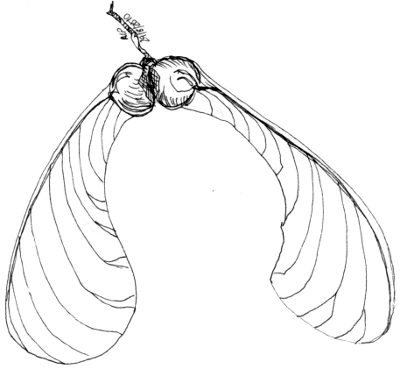
The Sycamore is also known as the Great Maple [5].  The winged seeds of the sycamore are called helicopters and were used in flying competitions by children.  The sycamore was the favoured wood for making love spoons in Wales, which are made from a single piece of wood [6].

In Montgomeryshire there was a belief that sycamore trees kept the fairies away and stopped them from spoiling the milk [7].

In Scotland the feudal lairds used sycamore tress, known as dool or joug trees, as their gallows.  Further south, in Wiltshire, sycamores had unlucky associations, perhaps because they were also sometimes known as ‘hanging trees’ [8].

The Sycamore is sometimes called the Martyrs’ tree after the Tolpuddle Martyrs who first met beneath a sycamore tree in 1843 and formed a secret society to fight starvation and poor wages.  Unfortunately, they were caught and sentenced to seven years transportation to Australia.  They were pardoned after two years and returned home [9].

  1. Tumbling Woods
  2. Oaken Woods
  3. Mystical World Wide Web
  4. messagenetcommresearch.com
  5. Botanical.com
  6. The Woodland Trust
  7. members.multimania.co.uk
  8. Roy Vickery – Plant Lore
  9. Forest of Leeds
  10. Spiritual Forums

Trains and seasonal stations

Riding the rails

Sir Nigel Gresley from http://www.copyright-free-photos.org.uk

Yesterday was a bit of a day.  I have a weekly morning appointment that often leaves me feeling very emotional.  I’ve been travelling there and back by train while I’ve been on holiday.  However, next week I return to work and the early morning train journeys will cease as I will have to get to work asap after my appointment.  I went to the Forum Coffee Lounge in Merthyr Tydfil for a pot of tea and some cake – I settled on a flapjack this week.  It has to be said, the Forum has the most gorgeous home-made cakes and traditional puddings, and they are very reasonably priced.

After enjoying the tea and nibble and recording my thoughts in my Luddite-journal,I decided to get a Day Ranger ticket,  and travel around South Wales.  The day was turning out to be a beautiful late summer day, the world lit with a soft golden light that presages Autumn so wonderfully.  I thought it would be nice to just to watch the world go by and for nothing more than the joy of moving from place to place, a chance to get my thoughts and emotions back into order, and to take a day out.  And so I did.  And it was lovely and relaxing.  I wish my train had been a steam train, like Sir Nigel Gresley, an A4 Pacific.  But the haulage by various diesel units was adequate and did the job of allowing me to relax.

I do find train travel relaxing.  I can’t run away from what I need to examine internally or work on creatively while travelling in such a way.  I have my journal with me, I write in it as I need to and work my way through things and find my balance once again.  Steam engines I love, but any locomotive will do in such circumstances.

Changing seasons

Rosebay Willowherb

The world is certainly moving towards Autumn in these here necks of the woods.  The quality of the light is changing, becoming more golden as the Sun’s strength wanes as we move further away from the Summer Solstice towards the Autumn Equinox.  There’s plenty of strength in the Sun to warm the Earth during the day, but the early mornings, late evenings and nights have that wonderful chill that heralds the coming of the magnificence of Autumn.

It really is my favourite time of year.  I adore the glowing warm colours and I start to eagerly look around me for signs of the changes, and yesterday I saw them.

The profusion of red haws on the hawthorn trees like seeds of the fire that will blaze soon.  There were the very occasional flash of  bright yellow leaves on the beech trees.  My ‘flame’ trees (some kind of maple or sycamore I think) were crowned with darker green leaves that had hints of a deep burgundy in them.  Ferns were beginning to turn yellow and then brown after being baked by the Summer Sun.  Fluffy seeds from rosebay willow herb.  Just hints, promises of the beauty of the colours yet to come.

The cycle of the seasons

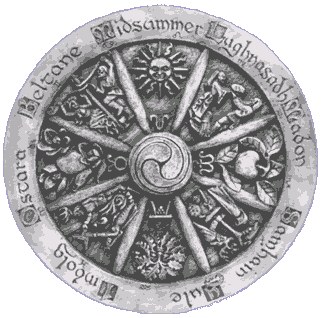
I’ve always felt a close connection to the cycle of the seasons.  Without knowing why, I’ve always felt a deep ‘attachment’ to the solstices and equinoxes and have had an understanding of how they link to the cycles of human life and experience.

I have my own way of observing these astronomical (and astrological) stations of the year, ways that have developed over the past few years since I started to explore and find ways of expressing my spirituality and beliefs.  It has always seemed natural to me to acknowledge these stations of the year in some way.  As I’ve developed, so have my practices, sometimes I feel guilty about not spending as much time on them, having abbreviated them to the pure essence of what they are about, but I work hard on reminding myself that as we change, grow, develop, so must our practices and the way we do things.  When we learn something new, we do it with great attention to all the details, learning from this, but as our understanding and skill develops, we learn what is truly essential and leave out those parts that are superfluous to ourselves, our individuality.  Of course, they may be incorporated once again later if they are found to be required once again, but I do believe that by cutting away a lot of the faff and fluff you get to the core of the practice and the focus and intent is greater as a result.  The more in tune you are with the process, the less fuss is needed to make the connections that are needed.  But that’s me …simplicity wherever possible.

Raining…daisies?

It’s started to rain steadily and quite heavily here. It’s also feeling rather chilly for an August day. The rain prompted me to look at folklore and superstitions mentioning rain. As I was sat at the ‘puter it was easier to go and do a Google than to go looking for my books on such topics.

There’s a good list of weather-lore at Down Gardening Services, and a lot more on the world weird web.

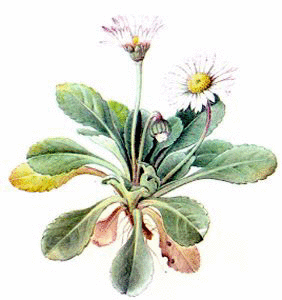
I like ‘The daisy shuts its eye before rain’ simply because I like daisies! I always think they look bright stars set in a green firmament. They always cheer one up!

The name daisy comes from the Old English ‘dæges eage‘ which means ‘day’s eye’ because the petals open at dawn and close at dusk (unless it’s about to rain!).   In Welsh they are called ‘Llygad y Dydd‘, which also means ‘eye of the day’.  It’s scientific name is Bellis perennis.

According to Roman mythology, Vertumnus, the guardian deity of orchards, pursued a young tree nymph named Belides after he saw her dancing with the other nymphs at the edge of the orchard.  Belides did not want his attention and so she asked the gods for help to escape Vertumnus.  As the powerful King of Argos was grandfather to Belides, the gods agreed to help.  They transformed her into a tiny flower called Bellis, and so she escaped a terrible fate.

The Celts had a legend that daisies were the spirits of babies who had died during birth. The daisies grew to help relieve their parents’ grief with their simple beauty and innocence.

Making daisy chains was a childhood activity enjoyed by many of us. I wonder how many of us knew at those tender ages that parents used to put daisy chains around children’s necks to prevent them being stolen by fairies. Apparently, daisy chains should always have their ends joined so that they form a circle that represents the Sun, the Earth and the cycle of life.

Plucking the petals from a daisy, one by one, and reciting ‘s/he loves me, s/he loves me not’ is a common divinatory superstition. Placing the root of a daisy under one’s pillow is said to produce a dream or a vision of one’s future love/partner.

The symbolic and legendary meanings of flowers dates back to Elizabethan times, however it was the Victorians who assigned simple messages to flowers. It was a period in time when social etiquette meant that men and ladies could not express their feelings openly and so the use of the colour and type of flower to express what they could not say or show became popular. The daisy was associated with simplicity and modesty. The message of the daisies in the language of flowers is that of gentleness, innocence and purity in both the giver and receiver.