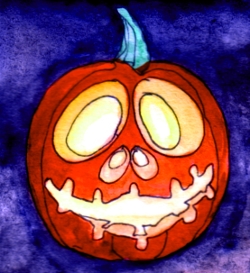
Punky Night – A Somerset Custom

Pumpkin3 © Angela Porter October 2010

It’s Punky Night tonight
Give us a candle, give us a light
It’s Punky Night tonight!

This is one of the verses of a song changed by children as they carry their ‘punkies’, or Jack O’ Lanterns around villages in Somerset, England, UK and, in times past, begging for candles.  In the village of Hinton St George, Punky, or Punkie, Night is the last Thursday in October.

Other variations on the verse include,

It’s Punky Night tonight
Adam and Eve would not believe
It’s Punky Night tonight!

It’s Punky Night tonight
Give me a candle, give me a light

If you don’t, you’ll get a fright!
It’s Punky Night tonight

It’s Punky Night tonight
Give me a candle, give me a light
If you haven’t a candle, a penny’s alright

It’s Punky Night Tonight!

If you want to sing-a-long with the words, visit “The Punky Night Song” webpage!

The threat of something not nice happening if a person didn’t give the children something compares to the more modern tradition of ‘trick or treat’.

Punkies are made from a mangold-wurzel, or a large turnip, in a similar manner to modern Hallowe’en pumpkins.  The top is cut off, the insides scooped out and designs are cut into the outer skin, leaving a thin membrane intact.  Scary faces are common, but there are many examples of more creative designs.  A lighted candle is then placed inside to shine through the cuts.

Despite the usual assumptions that this custom is an ancient one, there is little evidence of its existence before the C20th.  Various nights in late October served for this custom, but Hinton St George eventually settled on the last Thursday in October.  At one time, it seems to have been a simple house-visiting custom, but members of the local Women’s Institute reorganized it in the mid twentieth century.  It is now celebrated by a procession of children carrying their punkies, and a party where prizes for the best designs are given, a Punkie King and Punkie Queen are crowned and money is raised for charity.

A local legend purports to explain the custom’s origin.  One version of the legend is that the village menfolk went to Chiselborough Fair, and got too drunk to find their way home.  Their wives fashioned lanterns out of mangold-wurzels and went to fetch them.   There are variations on the tale, in some the menfolk make the lanterns, in others the drunken menfolk are scared by the lanterns scary faces believing them to be ghosts of dead children returning to the Earth until Hallowe’en.  The neighbouring village of Lopen claims the custom (and legend) as their own, and other villages have started their own punkie nights.

As a child, I remember helping to carve Jack O’ Lanterns from swedes.  Pumpkins were not a common item then.  It wasn’t easy work either, and my father usually took control of matters very quickly, at least by hollowing out the swede so that we could carve the designs into the shell more easily and with less likelihood of us cutting off our fingers, or worse!  The smell of cooking swede pervaded the house once the candle was lit; whenever I smell cooking swede I get get flashbacks to childhood Hallowe’en, before it became dominated by ‘trick or treat’ and the various forms of antisocial behaviour that occur on that night, and the surrounding nights.  We had our own Hallowe’en party in our home, with local friends visiting with us.  The living room was decorated with blood-red crepe paper streamers, home-made black bats and spiders and webs.  Candle light was the order of the evening.  We made ghoulish food that involved a lot of food dye!  Ducking apples, bobbing apples were always played. And the climax of the proceedings involved the  delivery and display of Captain Blood’s Cake, dripping with blood-coloured icing and ghastly green writing and a single candle placed in the middle of the cake.  This heralded the beginning of ghostly and ghoulish stories.  They would start with a tale about Captain Blood, and then would go onto other things as we children would exercise our imaginations to tell tales, add to the tale being told, and scaring ourselves with what we found most fearful.  It must be said there was a lot of laughing as well!  These were perhaps some of the best times of my childhood … even though I was most probably too shy to tell the tales, my imagination would run away with me and everyone would make fun of me, and I still bear those scars today, finding it hard to tell stories, write tales, be imaginative.  I’ll get over it though.  I will.

The drawing of a pumpkin punkie was done using a very fine technical drawing pen (0.1mm) and watercolour paints on cartridge paper.  The sketch was completed very quickly, the painting took a little longer as the white purry-furry one wanted to help/hinder by demanding cuddles and fusses!   I then fiddled with it in GIMP2 to make it more vibrant in colour, more blurry and better looking than the original!  I have a couple more done that I’ll use to decorate any entries I do about Hallowe’en.

  1. Steve Roud, “The English Year”
  2. Punkie Night at information-britain.co.uk
  3. Punkie Night at Monstrous.com
  4. It’s Punky Night! at wyrdwords.vispa.com
  5. Ronald Hutton, “The Stations of the Sun”
  6. Punkie Night at wikipedia
  7. Jack o’ Lanterns at wikipedia
  8. Jacqueline Simpson and Steve Roud, “A Dictionary of English Folklore”

Folklore, a Fall and Storytelling

Yesterday evening, I travelled by train to Merthyr Tydfil where I was giving a talk.  My lil Smartiepants is still poorly; I’m awaiting a call back from my mechanic to get her fixed.  Anyways, on the way out I grabbed ‘The Folklore of Discworld’ by Terry Pratchett and Jacqueline Simpson and thoroughly enjoyed reading it again during my journey there and back again to Merthyr.

‘Some of the things in this book may well be familiar, and you will say ‘but everybody knows this’.  But the Discworld series, which on many occasions borrows from folklore and mythology, twisting and tangling it on the way …’

And that is what I love about Mr. P – the way the familiar is just twisted enough to fit into somewhere else, with humour and a sense of ridiculousness, and often with quite a deep perception of how things work on our world, and plenty of chuckles along the way.

‘…there are some things we shouldn’t forget, and mostly they add up to where we came from and how we got here and the stories we told ourselves on the way.  But folklore isn’t only about the past.  It grows, flowers and seeds every day, because of our innate desire to control our world by means of satisfying narratives.’

And don’t we live, or re-live, our lives by stories, by narratives?  When we relate to others what we have done, what we have experienced, what ‘they’ said, or share our thoughts and memories we are relating a story.  I know in my day job I often teach in a story-telling kind of way, and I try to tell enjoyable and memorable stories.  I love to hear other peoples’ stories too.  Stories about us will be passed down through the generations, changing subtly with each re-telling, just as folklore always has done.

And folklore and stories have power, more so than the mundane reality of the truth.

‘But there is the truth, and, then again, there is The Truth, in the face of which truth can only shrug and grin.’

People prefer, generally, to believe the fantastic, and to add mystery to something that is ordinary.  And I can relate an example of this in action.

A few years ago, while walking across the old Severn crossing, I fell and hit my temple on the ground.  A silly accident, I was bending over my bicycle to see if I could sort out the gears that had stuck in one place, next thing I know my face had made intimate contact with the tarmac of the path.  This old bridge is bouncy, especially when heavy lorries shudder their way across, and I think two must have crossed near me at the same time and set up an extra big bounce that unsettled my balance.  Once I’d recovered my composure, I could feel my eye swelling and I decided to ride my bike back to my car, load it in and then get home asap, which I did safely..

That afternoon I ended up in A&E having a head x-ray as my eye had swollen shut, I had a wonderful black eye beginning to develop, but the emergency phone advice service insisted I go get my head checked out in case I’d managed to crack my skull.  I hadn’t, but by the next morning I had a black eye that was really black and the bruising extended from my eyebrow to below my cheekbone!  It was an absolute corker!

Monday morning came, no pain, but the eye was even more spectacularly black than the day before.  I had to go to school, and on my arrival the headteacher, chair of governors and other staff were concerned that I shouldn’t be there.  I explained that it looked a LOT worse than it was, that there was only a little bit of pain if I touched my temple ‘just there’ and I had had x-rays and was fine.

When I went to my class to do registration, they were shocked with my appearance and asked what was happened.  I told them the truth – the fall, the trip to A&E.

Did they want to believe it?  No.  One 16 year old lad was convinced I’d been out ‘clubbing’ in Cardiff and had got involved in a fight (me? fighting? no way!!! I’m way to gentle and kind for that … I’m very peace-loving).  I said, no, I don’t ‘do’ night clubs, nor do I fight.  He wouldn’t have it, so I went along with him, making up answers to his questions.

“Who hit you?  A man or a woman?  Did you know them?” he asked.

“A man, over six foot tall and built like a brick out-house, and I didn’t know him,” I replied.

“What did you do?  ”

“I hit him back.  I knocked him out.”

“You knocked him out? Really?  What happened to him.”

“Yes. Really.  He’s still in hospital I think.”

“Wow.  Were the police there?”

“Yes, they were.”

“Did they arrest you?”

“No, they saw that he hit me first and I just pushed back in self-defence.  They let me go.  And he’s not pressing charges as he doesn’t want it known he got knocked out by a woman”.

“Wow.”

By the end of the week, there were all kinds of stories circulating about how I got my black eye.  I’d been ambushed by a pack of ninjas who I’d fought off but one got a lucky kick in at my eye.  I’d got shot by an arrow as I was taking part in a medieval battle re-enactment.  A Viking had caught me in his head as I was axe-fighting with him.

I had told each and every pupil the truth, that I’d fallen and hit my head.  But not one of them wanted to believe the mundane truth.  The wanted The Truth – a story with excitement, mystery, amazing powers or luck or magic.

The first lad accused me, on his last day of secondary school, of lying to him.  I said I never had, wondering what he was on about.  He said I’d never had a fight in a club (duh!).  I reminded him that I had told him the truth, but it was too ordinary for him to want it to believe it to be true.  He’d helped make up The Truth and preferred to believe that.  He accepted that!

So, there lies the power of narrative, or stories, of words … it can be used for entertainment, for fun, for good things.  However, it is used by others for manipulation, deception, to gain power over others and to do bad things.  And it can change, and be changed, depending on the point of view of the storyteller, their cultural background, their own beliefs and morals … and we can change our own stories too, which is an entirely different set of ideas!

We may not be able to change the events of our lives, but we can change how we view them, how they affect us, how we feel about them and our reactions to them.  In doing so we can change our reactions to similar circumstances that we come across now and in the future, so changing our ‘story’.  It’s not easy, it takes a lot of effort and a lot of courage to face these situations, to face our reactions to them, and then to view things in a different way, something I’m learning about in counselling.  It’s not easy as the inertia of The Truth as it applies to such situations is great, and the truth may not be apparent as all we have our our memories, emotional responses that memories can trigger in present/future experiences so that we are no longer bound by our old, negative, automatic thoughts and responses.  It’s not about making everything in the past lovey-dove, it’s about finding a way to deal with life without automatically blaming ourselves for other peoples attitudes, responses, actions.

Lessons of the week

Busy, busy, busy … tired, tired tired.

Talk about busy!  I barely seem to have had time to catch my breath, or that’s how it seems.  And when I have I’ve just fallen asleep.  I seem to have spun from bed to work to home to class or talk and home to bed again.  Add to that a very upset tummy last night, and  waking at stupid o’clock most nights and not able to get back to sleep unless I take a little guided meditation time.  No wonder I feel shattered this morning.

Lesson is that I need to learn to manage my time better in the future – not to overbook myself with  classes and talks and to make sure I come home in time to spend time unwinding and relaxing before bed.

Unlearning what has been learned.

The car is still out of action, and will be until after pay-day at the end of the month.  I am hoping it will be fixed relatively easily and cheaply too, though with a SmartCar cheap isn’t often the word used to describe parts nor jobs easy.  But I love my SmartiePants very much, even when, as at the moment, she is just ‘pants’!

Not having a car really clips my wings, in many ways, but it’s also making me ask others for help – something that does not come easily to my sheer bloody-mindedly independent nature, something I learned to be early on in life as the people you count on in life at a young age such as parents and siblings just didn’t want to know unless it was to make yet more fun of me.

I am learning to unlearn the lessons of my past, however, little by little.  It’s surprised me how people are willing to help me.  And the realisation is that people do just as I do for others, except that I don’t ask for help or expect help nor do I believe that I deserve their help.  Or that used to be so.  As a child I learned not to bother asking for help because those around me as a child were unwilling to help (unless it gave them glory by doing so), and I’ve never unlearned that lesson so that I no longer assume that others are like my family of blood were as I grew up.

Mind you, help has been offered even when it’s not directly sought.  For instance, I have a talk to do next week in the Aberdare area.  Getting there by public transport is not a problem, but getting home again is.  I phoned the people who organised this evening, explaining about my poorly SmartiePants and they just told me not to worry, they’d come and get me, from home too, and I wasn’t even to think about getting partway there by train.  Now, I’d’ve offered to do that for someone, but just never expect others to do that for me … lessons to be learned here methinks.

Another example of helped unlooked for yet given was when I was telling my friend who I’m sharing travel with to and from work until SmartiePants is fixed about my worry about getting to my weekly appointment on a Friday and to school in time for my first lesson of the day.  She asked me about the time of my appointment and suggested that I go with her to work then take her car to get to the appointment and back and just replace the petrol I’ve used in doing so.  How kind of her.

Bit by bit, I’m learning about accepting help and letting others into my life.

Arty stuff

Nothing new this week, not really.  But I do have a ‘commission’ to do for a friend this week.  They’re making jams and chutneys like crazy with the bounty of nature and they plan to sell their excess.  They loved my ‘Harvest Moon’ painting of last week, and have asked if I’d design labels for their jars in a similar style…and I have ideas already what to do, so long as they will fit in the dimensions I’ve been given, as well as the words they want on the label and space for the contents of the jar.

And that brought to mind the memories I had last week of writing labels for my fathers home-made wine and beer.  Funny coincidences, synchronicities

Memories and sloes

Memories

I’ve mentioned this before, but memories of my father include his wine making and beer brewing hobby.  Most of what he created, to my taste buds, was vile, but others seemed to relish it.  The only brew of his I liked was a raspberry wine that still tasted of raspberries and was quite sweet.  He’d spend hours and hours in his wine-shed (literally a concrete block/brick shed that was attached to the house) filtering and bottling and labelling.  And tasting it.  Never forget the tasting it.  He’d often spend much of the day tiddly from it!

Tea would be delivered to the shed door, empty mugs whisked away.  Scottish bagpipe or marching military band music would ooze out of the door, alerting everyone to what he was up to.  Occasionally, the music would stop and he would come out to declare he was feeling woozy.  We’d feed him some sugary snack suitable for a diabetic and then feed him properly, he’d recover and off he’d go back to his brewing.  You couldn’t get him to stop and eat when he was in the middle of something, nor would he eat any food delivered to him.

He had a brewing passion for years, and before it consumed his waking moments he would spend his days working on fixing and welding cars.  Tea would be left on the wall, empty mugs removed.  We often said he’d pass away while under a car and the only way anyone would notice was that un-drunk mugs of tea would line up on the wall.  As it was, he passed away in hospital from Alzheimers’, cancer, arthritis, diabetes and high blood pressure.  And that is an entirely different story.  And there are many tales of my father and his blinkered missions to do things or collect things from nature or his DIY diasasters.  He meant well, though he was very proud and couldn’t be told there was trouble ahead if he carried on doing what he was doing.

Perhaps I’ll relate tales and memories of my father in this blog.

Sloe, fruit of the Blackthorn (Prunus spinosa)

Sloe comes from the Old English slāh. It is the fruit of the blackthorn or sloe tree that has a pale-blue waxy bloom on its surface.  Sloes ripen in the Autumn and, in Britain, are traditionally collected after the first frosts in October or November.  The fruit is used to make jams and preserves, and they are used to make sloe ‘gin’ – a liqueur made by infusing sloes and sugar in gin, vodka or neutral spirits.

Straight blackthorn stems have traditionally been made into walking sticks.  Shillelaghs, blackthorn sticks, were favoured as weapons in faction fights in C19th. Ireland.  Commissioned officers of the Irish regiments of the British Army carry blackthorn sticks.

Blackthorn is generally considered unlucky to bring indoors, and in some areas of Britain it meant a death would follow.

The flowering of blackthorn is said to coincide with a spell of cold weather.  In areas it was considered wise to plant no tender plants outside until the blackthorn has finished flowering.   The best time for sowing barley was when the blackthorn flowered.  Two country rhymes follow, the first from North-East England and South-East Scotland, the second from Gloucestershire.

When the slae tree is white as a sheet
Sow your barley, wither it be dry or wet.

When the blckthorn blossom’s white
Sow your barley day and night.

In Sandwich, Kent, each incoming Town Mayor is present with a blackthorn stick.

In Herefordshire and Worcestershire, a wreath or globe of Blackthorn twigs would be scorched on a fire on New Year’s morning and then burned in a wheatfield in the furrows and its ashes scattered over the wheat. Then a new globe or wreath would be made and hung in the farmhouse kitchen ready for next year. It was believed that this ritual would rid the field of the devil. In a similar vein, Blackthorn would be scorched and hung up with mistletoe for good luck.

  1. Roy Vickery – Dictionary of Plant-Lore
  2. The English Cottage Garden Nursery

Apples and Brambles

I’ve chosen apples and brambles for today’s blog as they always seem to go together.  I noticed the blackberries on the brambles ripening during my jolly around the Valley Lines last week.  I’ve not been blackberrying in years and years, most probably not since I was a child.  I remember the abundance of blackberry pies, blackberry and apple crumbles, blackberry jam, apple jelly and frozen blackberries in our home.  With six children, there were plenty of us to gather them!  There were also the trips to collect whinberries (blueberries), as well as visits to ‘pick your own’ farms to harvest strawberries, raspberries and loganberries.

In later years, it would be my father who collected crab apples and blackberries to make his wines – along with sloes and young nettle leaves, young oak shoots, rosehips, rose petals, dandelions, and anything else he could brew.  I never appreciated his brews – all except the raspberry wine he made one year which was sweet and still tasted of the fruit – though others thought they were wonderful.  I do remember spending long hours writing out labels for his wine; I’ve always had nice handwriting and dabbled with calligraphy in the past too.  Now that’s something I’d forgotten about.

A few years ago a friend suggested, quite strongly, that I should collect sloes and make sloe gin, as well as to harvest the fruits of nature.  Well, I’ve not done so yet…

There are many recipes on tinternet and in books for blackberries, apples and so on, so I’ll not repost them.  Mind you, I could say the same about superstitions, myths, herbalism and the like, but I’m pulling together information for myself from many diverse sources, perhaps for future reference or just because I’m interested in it in the here and now, I don’t know.

Crab Apple (Pyrus malus)

(c)Angela Porter 1 Sept 2010The crab apple tree is native to Britain and is the wild ancestor of all the cultivated varieties of apple trees.  Apples of some sort were abundant before the Norman Conquest and were probably introduced into Britain by the Romans.  Twenty-two varieties of apples were mentioned by Pliny; there are now around two thousand cultivars.  In the Old Saxon manuscripts there are many mentions of apples and cider.

The Encyclopedia of Bartholomeus Anglicus, printed in Cologne around 1470, has a chapter on the apple:

Malus Appyll tree is a tree yt bereth apples and is a grete tree in itself…it is more short than other trees of the wood wyth knottes and rinelyd Rynde.  And makyth shadowe wythe thicke bowes and branches; and fayr with dyurs blossomes, and floures of swetnesse and lykynge,; with goode fruyte and noble.  And is gracious in syght and in taste and vertuous in medecyne…some beryth frute and harde, and some ryght soure and some ryght swete, with a good savoure and mery. [1].

The apple has been used as a symbol for sin, sexual seduction, beauty, love, sensuality, love between two men.  In art, Venus is often shown holding an apple as a symbol of love.    Apples also feature in many fairy tales, Snow White perhaps being the best known example where a poisoned apple puts Snow White into a deep sleep.

In the Old Testament of the Bible, it represents man’s fall; in the New Testament it represents man’s redemption from that fall.  The phrases ‘the apple of one’s eye’ and ‘a word fitly spoken is like apples of gold in settings of silver’ both come from the Bible.

The larynx in the human male is called the ‘Adam’s Apple’ because of the folk-tale about the Forbidden Fruit sticking in Adam’s throat and causing a bulge.

Heracles, the Greek hero, as part of his Twelve Labours had to travel to the Garden of the Hesperides.  His task there was to pick the golden apples growing on the Tree of Life that could be found at the centre of the garden.

Eris, the Greek goddess of discord, was disgruntled after she was excluded from the wedding of Peleus and Thetis.  To retaliate, she tossed a golden apple that was inscribed with ‘Kallisti’ – for the most beautiful one – into the wedding party.  Hera, Athene and Aphrodite, three of the goddesses attending the party, claimed the apple.  Paris of Troy was chosen to select the recipient of the apple.  After being bribed by both Hera and Athena, Aphrodite tempted him with the most beautiful woman in the world, Helen of Sparta.  He awarded the apple to Aphrodite and in doing so indirectly caused the Trojan War.

Another Greek myth concerns Atlanta who raced all her suitors in an attempt to avoid marriage.  She outran all but Hippomenes (also known as Melanion) who defeated her not by cunning but by speed.  Hippomenes knew he could not win in a fair race, so he used three golden apples, which were gifts from Aphrodite, the goddess of love, to distract Atlanta.  It took all three apples and all of his speed, but Hippomenes was successful, winning the race and Atlanta’s hand.

In Norse mythology, Iduna, the goddess of Spring and youth, nurtures an apple orchard in Asgard.  Every evening she would feed an apple to the gods and goddess in order to keep their youthfulness.

In Celtic mythology, Conle receives an apple which feeds him for a year, but alsogives him an irresistible desire for fairyland.

The mystical Isle of Avalon, the famed placed of eternal rest for Celtic heroes, including King Arthur, literally means ‘apple land’ or ‘apple island’.

Isaac Newton, according to popular legend, came up with the theory of universal gravitation after observing an apple falling from a tree.

Wassailing the orchard trees on Christmas Eve, or the Eve of the Epiphany, is still practiced in Britain.  Herrick mentioned it among his ‘Ceremonies of Christmas Eve’:

Wassaile the trees, that they may beare
You many a Plum and many a Peare:
For more or lesse fruits they will bring,
As you do give them Wassailing

The Wassailing ceremony consisted of the farmer, his family and labourers going out into the orchard after supper, bearing with them a jug of cider and hot cakes.  The latter were placed in the boughs of the oldest of best bearing trees in the orchard, while the cider was flung over the trees after the farmer had drunk their health in some such fashion as the following:

Here’s to thee, old apple-tree!
Whence thou may’st bud, and whence thou may’st blow.
Hats full!  Cap full!
Bushel – bushel bags full!
And my pockets full too! Huzzah!

The toast was repeated three times, the men and boys often firing off guns and pistols, the women and children shouting loudly.

Roasted apples were usually placed in the pitcher of cider and were thrown at the trees with the liquid.

A mixture of hot spiced ale, wine or cider with apples and bits of toast floating in it was known as ‘lamb’s wool’.  The name is derived from the Irish ‘la mas nbhal‘ meaning ‘the feast of the apple gathering’ (All Hallow’s Eve), which is pronounced something like ‘lammas-ool’ and this became corrupted into ‘lamb’s wool’.  Each person who drank the spicy beverage would also take out an apple, wish good luck to the company, and eat it.

It was believed that if an apple tree blossomed out of season then misfortune or death was foretold.

If the Sun shone through the branches of apple trees on Christmas Day, or Old Christmas Day, then there would be an abundant crop of apples.

Peel an apple so that the peel remains in one long strip.  Throw the strip over the shoulder to form the initial of a potential husband on the ground.  This is an activity that is performed particularly at Hallowe’en.

To indicate the direction of a lover’s home, flick an apple pip into the air while reciting  ‘North, south, east, west, tell me where my love does rest‘.

Children were warned that Awd Goggie and Lazy Lawrence were nursery bogies that protected orchards and unripe fruit.

The proverb ‘An apple a day keeps the doctor away’ seems to have been first recorded in the form ‘Eat an apple on going to bed and you’ll keep the doctor from earning his bread’.

Bramble or blackberry (Rubus fruticosus)

Blackberry (c)Angela Porter 31 Aug 2010The shoots of bramble have the ability to root where they touch the ground thus forming an arch.  Sufferers from boils, rheumatism and hernia were passed through the arch formed in this way.  Sometimes, a child suffering from whooping cough was passed under the arch seven times.  The cough was then thought to leave the child and stay within the bramble.

In the Highlands of Scotland, people used a length of bramble shoot entwined with ivy and rowan to ward off evil spirits.

Eating blackberries after the first frost was considered unlucky. In the UK, superstition says that blackberries should not be picked after Michaelmas (29 September), or the 10 October (Michaelmas by the old calendar).  It is said the devil has claimed them by urinating over them, spitting on them, stamping on them or wagged his tail over them and so leaving his mark on the leaves.  The link with Michaelmas is because this feast celebrates the battle when Archangel Michael drove Satan out of Heaven and hurled him down to Earth; perhaps the joke is that he landed in a bramble bush, but this is not clear.

Note to self…and other reflections

More art to do!  Yay!  Got some ideas … maybe … need to work on my more stylised, black-line and colour work …using acrylic inks or paints for the vibrancy of colour …

I’m so glad I started a blog, regardless of whether anyone reads it or not.  It’s given me a focus to both research, write and be inspired to create art.

If I’m honest I’ve been seriously lacking that focus and impetus for a long while thanks to my emotional state … I do tend towards depression, though I do my best to ameliorate it by engaging in activities that give me pleasure, but lately nothing much has done that … I’ve felt like I’ve been going through the motions, with no real purpose to them.  Not that everything needs a purpose, and doing something for the sake of the joy or contentment it brings is purpose enough.  However, I’ve been struggling with allowing myself to do pleasurable things, to feel the joy they bring … and perhaps the recognition of this this morning will help me move forward with my therapy, and in allowing myself to feel joy and pleasure.

As I look back at earlier entries, I can see how my approach is slowly evolving in terms of how I present information.  I’ll eventually work out a consistent ‘format’ that suits me in terms of colours of ‘quotes’, illustrations, references, hyperlinks.

  1. Botanical.com
  2. Apple symbolism on Wikipedia
  3. Roy Vickery – Plant-lore
  4. Bramble on HubPages
  5. Steve Roud – The Penguin Guide to the Superstitions of Britain and Ireland.
  6. Jacqueline Simpson and Steve Roud – A Dictionary of English Folklore.