Lessons of the week

Busy, busy, busy … tired, tired tired.

Talk about busy!  I barely seem to have had time to catch my breath, or that’s how it seems.  And when I have I’ve just fallen asleep.  I seem to have spun from bed to work to home to class or talk and home to bed again.  Add to that a very upset tummy last night, and  waking at stupid o’clock most nights and not able to get back to sleep unless I take a little guided meditation time.  No wonder I feel shattered this morning.

Lesson is that I need to learn to manage my time better in the future – not to overbook myself with  classes and talks and to make sure I come home in time to spend time unwinding and relaxing before bed.

Unlearning what has been learned.

The car is still out of action, and will be until after pay-day at the end of the month.  I am hoping it will be fixed relatively easily and cheaply too, though with a SmartCar cheap isn’t often the word used to describe parts nor jobs easy.  But I love my SmartiePants very much, even when, as at the moment, she is just ‘pants’!

Not having a car really clips my wings, in many ways, but it’s also making me ask others for help – something that does not come easily to my sheer bloody-mindedly independent nature, something I learned to be early on in life as the people you count on in life at a young age such as parents and siblings just didn’t want to know unless it was to make yet more fun of me.

I am learning to unlearn the lessons of my past, however, little by little.  It’s surprised me how people are willing to help me.  And the realisation is that people do just as I do for others, except that I don’t ask for help or expect help nor do I believe that I deserve their help.  Or that used to be so.  As a child I learned not to bother asking for help because those around me as a child were unwilling to help (unless it gave them glory by doing so), and I’ve never unlearned that lesson so that I no longer assume that others are like my family of blood were as I grew up.

Mind you, help has been offered even when it’s not directly sought.  For instance, I have a talk to do next week in the Aberdare area.  Getting there by public transport is not a problem, but getting home again is.  I phoned the people who organised this evening, explaining about my poorly SmartiePants and they just told me not to worry, they’d come and get me, from home too, and I wasn’t even to think about getting partway there by train.  Now, I’d’ve offered to do that for someone, but just never expect others to do that for me … lessons to be learned here methinks.

Another example of helped unlooked for yet given was when I was telling my friend who I’m sharing travel with to and from work until SmartiePants is fixed about my worry about getting to my weekly appointment on a Friday and to school in time for my first lesson of the day.  She asked me about the time of my appointment and suggested that I go with her to work then take her car to get to the appointment and back and just replace the petrol I’ve used in doing so.  How kind of her.

Bit by bit, I’m learning about accepting help and letting others into my life.

Arty stuff

Nothing new this week, not really.  But I do have a ‘commission’ to do for a friend this week.  They’re making jams and chutneys like crazy with the bounty of nature and they plan to sell their excess.  They loved my ‘Harvest Moon’ painting of last week, and have asked if I’d design labels for their jars in a similar style…and I have ideas already what to do, so long as they will fit in the dimensions I’ve been given, as well as the words they want on the label and space for the contents of the jar.

And that brought to mind the memories I had last week of writing labels for my fathers home-made wine and beer.  Funny coincidences, synchronicities

Harvest customs

Harvest Wheat (c) Angela Porter 2010

Pre-amblings

This is no way a definitive account!  I wrote/collated the main body of it last year when I was due to give a talk at a ‘harvest supper’ in a church, and I thought it would be appropriate to give a little of the history and customs of Harvest, particularly in Wales.  I’m not quite sure how the talk was received, as it certainly wasn’t the usual ‘Chicken Soup for the Soul’ or ‘Silver Birch’ that they are used to.  I am, if nothing else, more than a tad anarchic when it comes to my choice of ‘readings’ under such circumstances!

Harvest Customs

People have been giving thanks for the harvest since farming first began in the Neolithic, and the custom is still thriving today in many countries of the world.

In 1912, Alfred Williams, Wiltshire, wrote:

“The in-gathering of the corn-harvest is by far the most important feature of the farm year, especially where there is much arable land, or perhaps it may be all corn in some places, as on the Downs, for instance.  If the weather is wet in hay-time and the crop spoiled that may not matter very much; but in the harvest, that is truly tragic!  Who does not deeply grieve, apart from the monetary loss involved, to see all that is left of the beautiful corn blackening and rotting in the fields, under the dark rainy skies of October and November, as is sometimes the case, utterly useless for anything but litter and manure, and the ground too wet and sodden to admit of collecting it for that purpose even?  It seems as though you have lived the year for nothing then; that all the bloom and sunshine of the spring and summer were mockery; that Nature brought forth her beautiful children but to destroy them.”

In centuries past, the whole life of the Nation of Britain and its agricultural economy depended on the harvest.  Even when the harvest had lost some of its economic importance, it still had a deep psychological effect on rural communities.
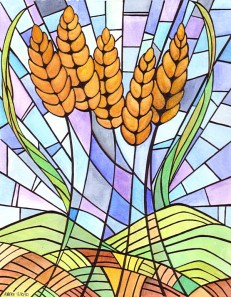
Autumn Wheat (c) Angela Porter 2010The word harvest comes from the Anglo-Saxon word ‘haerfest’ which meant autumn. According to the Venerable Bede, writing in the seventh to eight centuries, September was known to the pagan Anglo-Saxons as ‘Haleg-Monath’, which meant Holy Month, and it can be surmised that this was derived from the religious ceremonies that followed the harvest. However, no records of these ceremonies survived into Bede’s time.

In the Christian calendar, harvest traditionally started at Lammas tide (August 1), when the first corn of the new crop was made into bread and taken to church to be blessed. It finished at Michaelmas (September 29).

The harvest was the time of the agricultural year that the farmer needed the full cooperation of his workers.  Thirteenth Century Manorial records show that it was the custom that tenants were paid with refreshments to harvest the lord’s crops, and that in some areas there was a communal meal at the end of the harvest, and these are the earliest surviving records of this practice.

The workers knew that a successful harvest was needed for the economic well-being of the community, and a bad one would harm their chances of employment the following year.  During harvest, their wages doubled as the amount of work doubled.  Many customs and usages developed over the years which helped to keep the workers amused, gave further financial rewards, or celebrated their successful harvest.  The idea that these customs are direct survivors of pre-Christian times, of beliefs in corn goddesses and vegetation spirits, is not supported by the documentary record.

Prior to mechanisation, the mutual aid that existed between farmers and neighbours in the community was vital to the reaping of the crops. The fedel wenith, or reaping party, drew on the pattern of Cymhortha (from cymhorthu – to help), a characteristic of Welsh medieval society. Small-holders would help each other and also the large farms, in exchange for various things they had to give, like the loan of transport or a few rows of potatoes. In this way a system of goodwill and co-operation was built up within the community.

As soon as the last load of grain had been brought into the barn, the reapers and other workers were treated to a feast – the Harvest Supper – provided by the farmer for whom they had worked. In the eastern counties of England this feast was known as a Horkey Supper, while in Wales it was known as ffest y pen, cwrw cyfeddach or boddi’r cynhaeaf.

Whitlock says that in Wiltshire, the golden years of the Harvest Supper were during the second half of the 19th century and suggests that they had largely died out by the turn of that century. The suppers seem to have been quite lavish – or at least they seemed so to the farm workers who attended them. Food was plentiful. In Sussex caraway seed cake was traditional and was served to the workers throughout the harvesting because it was believed that the caraway seed provided the workers with strength and increased their loyalty to their employer, thus ensuring that they could not be enticed away by a neighbouring farmer offering higher wages. As well as seed cake, pumpkin pie and large apple turnovers called “Brown Georges” were served at Sussex harvest suppers.

In Carmarthenshire the supper included a dish called whipod which included rice, white bread, raisins, currants and treacle. In nearby Cardiganshire in 1760, a farmer reported that the feast following the reaping of his rye by about 50 neighbours consisted of ‘a brewing pan of beef and mutton, with arage and potatoes and pottage, and pudding of wheaten flour, about 20 gallons of light ale and over twenty gallons of beer’. After the meal, there was usually dancing to the music of the fiddle, with a plentiful supply of beer and tobacco.

Also in Wales, was the custom known as the caseg fedi, or harvest mare. When all the corn had been reaped except for the very last sheaf, the sheaf would be divided into three and plaited. The reapers would then take it in turns to throw their reaping hooks at it from a set distance and the one who succeeded in cutting it down would recite a verse:

Bore y codais hi,
Hwyr y dilyn hi,
Mi ces hi, mi ces hi!

[Early in the morning I got on her track,
late in the evening I followed her,
I have had her, I have had her!]

The other reapers would then respond with:

Beth gest ti?

[What did you have?]

and the reply was:

Gwrach! gwrach, gwrach!

[A hag, a hag, a hag!]

It was seen as an honour in Wales to be the one to bring down the caseg fedi, and the man who did so was often rewarded.

The plaited sheaf presided at the Harvest Supper, and was often hung in the house to show that all the corn had been gathered in. It could also, in one part of Wales, be put on the cross-beam of the barn or in the fork of a tree.

The ‘caseg fedi’ may have represented the fertility of the harvest condensed into the final sheaf. In one part of Wales, it was recorded that seed from it was mixed with the seed at planting time ‘in order to teach it to grow’. In other parts of Britain, this last sheaf was buried on Plough Monday, the first Monday after Epiphany (6 January) so that it could work its magic on the growing corn. It is possible that this association of the gwrach, a creature known to steal food, with the cutting down of the last sheaf, represents the triumph of the human forces of agriculture against the chaotic or malevolent forces of nature represented by the gwrach.

Once the grain harvest proper and the Harvest Supper was over, the women could begin gleaning, i.e. scouring the fields for the leftover ears of corn which they could claim and keep for themselves. In many places they elected a Harvest Queen to oversee the gleaning whose role was to ensure that everyone got fair shares. This she did by regulating the start and finish of work either by ringing a hand bell or by giving the word when the church bells rang. The Harvest Queen also had the right to initiate newcomers to the gleaning field by tapping the soles of their boots with a stone.

Today, most churches and many schools hold a service of thanksgiving for the harvest and hold their Harvest Festival on the first Sunday following the Full Moon closest to the Autumn Equinox. However, this custom only became popular in Victorian times.

In 1843 the Reverend R. S. Hawker had the idea of holding a special service on the first Sunday in October in his Cornwall parish. The idea caught on and soon it became the custom to decorate churches with fruit, vegetables and flowers and to sing the harvest hymns written for the occasion.

Harvest has now become a time when people come together to give food to the needy, or to raise money for worthy causes. Thus Harvest still commemorates not just the gathering of the fruits of the Earth, but also the community cooperation that exists and the desire of our own spirits to help worthy causes and to spread the abundance of gifts of all kinds to wherever there is a lack. It is also a time when we can reflect on the successes of our own endeavours, and reap the fruits of our own labours and count our blessings for all that we have in our lives.

  1. Steve Round – The English Year
  2. Sue Dale-Tunnicliffe – TES Magazine, 24 Sept 1999
  3. Raven – White Dragon Website
  4. Hillaire Wood – Harvest Customs in Wales
  5. Ronald Hutton – The Stations of the Sun

Catching up, customs, celebrations.

Catching up…

With the return to work last week, research and blogging has had to take a back seat, especially as my evenings and Saturday have been busy.  I noticed I’ve missed two days of  note in the calendar!

Two days of work and I’m shattered.  Mind you, that tends to happen being  a teacher.  The long summer break gives me the time to rest, relax and almost totally de-stress.  Unfortunately, it takes mere minutes for some of the good work to be undone.  Keeping up with my meditation regimen when I rise and before I sleep, and at lunch or during preparation time during the day usually helps me to keep the escalation of stress to a minimum, but it doesn’t eliminate it totally…not yet.  Recognising the automatic thoughts and reactions and then working to change them to more healthy versions is slow going, my mind has had a lifetime to reduce this self-talk to a susurrus that I have to be very cunning to clearly hear.

Isn’t susurrus a wonderful word?  It sounds like quiet, secretive whisperings.  A wonderful onomatopoeic word!  I like alliteration as well as onomatopoeia!

3rd September – Cromwell Day

On this day, The Cromwell Association commemorate his death with an open-air service in front of his statue outside the Houses of Parliament, London, where they lay a wreath there.  Only members of the Cromwell Association may attend, but the public can see and hear the ceremony from the public pavement.

70013 Oliver Cromwell is a Britannia Class (BR Standard Class 7) steam locomotive.

3rd September – Merchant Navy Day

Merchant seamen have long felt that their service’s significant contribution to the war effort has long been undervalued and it is one of the aims of the Merchant Navy Association to raise the profile of the Merchant Navy and celebrate its importance to Britain, both in the past and the present.  As part of this mission in 2000 they declared 3rd of September to be Merchant Navy Day.  This day was chosen as it also commemorates the sinking of the unarmed merchant vessel the SS Athenia on 3 September 1939, the first day of the Second World War.  All nineteen crew and ninety-three passengers were lost.

4th September – Abbots Bromley Horn Dance

On the Monday following the local Wakes Sunday (i.e. the first Sunday after 4 September, or Old St Bartholomew’s Day), the village and surroundings of Abbots Bromley in Staffordshire, England, UK, are visited by a unique set of dancers.  The team consists of six men, each carrying a splendid pair of reindeer antlers, plus a Fool, a Maid Marian (played by a man), a hobby horse, a bowman (who twangs a bow), a musician and a triangle player.

At 8 a.m., they set out from the village church and perambulates the parish, visiting key houses, farms and other places and at each stop they perform their dance.  It is thought to be unlucky if they do not visit your house or neighbourhood.  Around 8 p.m. they return to the village and perform their final dance in the street.

The horns are kept in the church when not in use.  They are genuine reindeer horns, mounted on wooden heads, with a handle protruding from below to allow the dancers to carry them as they dance.

There is a lot of speculation about the origin of the custom.  Many have connected it to a fertility ritual, an ancient ceremony to ensure successful hunting, or of some common right or privilege in regard to the chase, but none of these ideas is supported by evidence.  It may be that the hobby horse is older than the horn dance, and hobby horses were used in the C16th to collect taxes and dues owed to the lord of the manor; whether the horse made the collections or whether it was there to entertain and sweeten the process of money-gathering is not known.

4th September – Barnet Horse Fair

This horse fair was chartered in 1588 and for centuries was one of the busiest livestock marts in the region, although Barnet’s real fame lay in horse-racing which drew large and unruly crowds from London until it ended in 1870.  A mere shadow of its former self, Barnet Horse Fair is now held at Greengates Stables on 4, 5 and 6 September, unless one of those dates is a Sunday, in which case it continues on the following day.

Fruitful art?

Arty things

Well, I’ve just scanned in and added a pen and watercolour wash illustration of crab apples to yesterday’s post.  I got the bramble one done yesterday, though I’m not at all sure about using acrylic paints.  I do like the vibrancy of colour they give, but I also like the subtlety of watercolours too.  And working out how to use black ink with the colours so it looks ‘grown up’ and not childish/cartoony to me is a bit of a challenge, and I’m not at all sure that I’m succeeding.  But it is making for interesting art experiments I suppose.  Not sure what next though …

Awake too early

I woke up at stupid o’clock this morning, mind rushing, unable to settle to read, to meditate or anything.  I think that may be to do with today being the last day of my summer holidays and the return to work is really looming large.  I’ve had a rough few years at work, battling with stress/depression and other things, and though I am getting better, there’s still a way to go.  I don’t quite know how things will pan out – I’m doing my best to be positive about things, but the pressures involved in spending time with people, the noise, the fuss, the bustle, and that’s only the first day without the pupils back!  I do want to change careers but I have no idea what to … I’d like to work with my creativity, something that involves writing, art, imagination, working with people I can relate to, where there’s a level of respect and warmth would be good, where there are people I can bounce ideas off …exactly what that would be, I don’t know, but when I’m ready to make that move all will be apparent I’m sure.

I had an interesting time last night where I was showing some of my art to friends at my healing group.  They were pressuring me to frame my art, hang it, sell it, take it to galleries and hotels and libraries and craft centres and and and to display and sell it.  In the future I may be able to do that, but I find it so hard to show my art to people I know (unless it’s through the relative anonymity of t’interweb) and the thought of promoting it myself is … painful.  I found myself becoming quite angry and agitated as they kept repeating what I should do … and I tried to explain why I can’t do it…the financial cost of exhibiting is prohibitive for me at this time in my life.

Anyone know an agent who would represent me, or any other suggestions that don’t involve me pushing way too far outside my comfort zone?

A new month

Today is St Giles’ Day. St Giles died around the year 710.  During his lifetime he founded a monastery in Provence, near Arles, and that is about all that is known about his life.  The medieval myth makers, however, provided a colourful set of incidents for his life, including an explanation of how he was given the money to found the monastery.  When he was living as a hermit he had pet doe who provided milk for his nourishment.  Unfortunately, the King’s huntsmen loved to chase the doe and eventually they trapped her in the dense thicket in which Giles lived.  The doe was protected by harm by Giles’ prayers but he was wounded by a huntsman’s arrow.  The King recognised Giles’ holiness and bestowed many gifts upon him which he used to found the monastery.  Giles’ was also reputed to have remarkable healing powers as well as the ability to get a pardon for people’s sins, no matter how great or small, by praying.  These tales contributed to his fame, and Giles was widely popular in medieval England and many churches were dedicated to him.  His feast day was conveniently placed in the year for outdoor events, particularly local fairs, feasts and revels. [1]

  1. Steve Roud – The English Year

Echoes…

Why blog?…Why bother?

I just read a really good ‘blog entry’ – To Blog or Not to Blog’ by Skeltzer. Her words echo my thoughts …

And I write about all sorts of things. Some of my entries aren’t the best, but I’m not writing for anyone other than myself.

And I write about all sorts of things. Some of my entries aren’t the best, but I’m not writing for anyone other than myself. If people want to read and comment, that’s great.

So huge thanks to Skeltzer for her insights, and for helping the words surface for me about ‘Why blog?’.

I do love to write. I don’t often write to share with others. I have written some academic resources, and a children’s book about archaeology. But I really don’t write for other people to read, not unless I have a purpose. Perhaps by writing something that is public means that I get to practice the skills needed, and perhaps there may be some people out there who stumble across this little place and enjoy the words here, leave comments about my words, constructive comments especially, then that’s great.

It’s really interesting as I read through the comments left to the above blog-entry how many people seem to wonder ‘why’ or seek a kind of justification for their random, rambling blog. Modern life seems to insist that we have a ‘purpose’ to everything we do, and that just because we enjoy doing something isn’t justification enough. And isn’t that sad? In a life of hustle and bustle, it is becoming increasingly necessary to take time out to do something that gives us pleasure, just for us. And many of the replies to the blog echo that is the reason why they keep a blog – because they enjoy it. A totally valid reason in my opinion, especially if it gives motivation to express oneself, to be creative, something they may not do entirely for themselves in a personal journal.

I found the comment made by Ursula to be interesting.

People who write personal blogs should ask themselves why they have to “share” themselves with the rest of the web wide population. The purpose of blogging is to fulfill a basic human need: To be heard, to get feedback. Which is good. How else would I have had a chance to “meet” you?

Yes, it is nice to share, especially when there may not be other people around you who are willing to allow you to share, or who, for a myriad of other reasons, you are not comfortable to share with them. The world weird web allows for people to make connections, irrespective of physical distance, people who are willing to mutually share, and there is nothing wrong with that either.

Krysten commented the following concerning The Pioneer Woman:

She has a passion for life. She just wanted to share it with others and it has made her into something bigger than she expected.

And perhaps sharing that passion for life, to enthuse others, to inspire others to live life in a way that brings them great joy is another very good reason to blog.

I also like thorsaurus’ comment

Humans love telling stories. Every blog is a story…

And perhaps that is the comment that rings most true with me. In my ‘day job’ I find myself teaching in stories, communicating in stories. I do the same in the things I do outside of my ‘day job’ – I storytell during talks I give, I read stories at a preserved railway I’m a member of.

We all have a unique story to tell. Even though our lives may be incredibly similar, we experience it differently. And sharing that story to inspire others, to bond with strangers, to help others in similar circumstances, to make others laugh, to empathise, to sympathise.

This was contributed by Andrea:

I don’t have a lot of face-to-face conversation time in my life. I’m horrible at small talk, and just feel awkward (even with people I know sometimes!) Blogging is like a safer version of a face-to-face conversation for someone like me. But, it’s also way more available. Everyone’s too busy to hang out anymore, it seems. Through social media, I get that social connection with other human beings that I miss so much…

…Maybe we should stop analyzing this social media stuff and use it for whatever makes us happy (as long as it doesn’t hurt anyone).

That is also true … as is this from bagelonatree

Unless the blogger is selling something, it’s all about the connection and the joy of writing.

Lots of quotes from others there, and I hope that’s OK in blog-etiquette –

Thank You All

Thank you for writing the words that expressed my multiple feelings about starting a blog and for working my way through the conflicting feelings I have about it that can be summarised as ‘Why bother?’  The answers to this question are all given above.

Synchronicity

Synchronicity is the experience of two or more events that are apparently causally unrelated occuring together in a meaningful manner.

The musings about ‘Why blog?, above resulted from a synchronistic event.  I’ve been musing about ‘Why blog?  Why bother?’, and I randomly click on some title in a drop down menu to do with this WordPress interface and find a posting there exactly about that topic.

Synchronous occurrences are interesting, and many have happened recently, though they are all logged in my Luddite-journal!

WordPress

I love finding out how things work.  I do, really.  But finding my way around the WordPress Dashboard, settings, this visual or html place to type into … it’s all confusing at times…just so much to play with, to work out what it’s all about, and to use what needs to be used, and to keep consistency too.  I’m sure it will all work out.