The answer to falling school standards?

BBCNews – Reading tests for pupils part of Welsh school shake-up

Well, I think that’s another knee-jerk reaction to the apparent failing standards of education in Wales.  The Welsh pupils tested in the latest PISA tests slid down the table, so now it’s all panic stations by politicians wanting to prove that they improve education.

So, annual reading tests, more training on literacy and numeracy, more stringent performance management policies …

Has anyone thought about looking at how the curriculum and how it is delivered is different in Wales (or the UK for that matter) to the better performing countries?

Has anyone thought about the social importance placed on education? What about the expectations of the area in which the pupils live, the familial expectations, the peer group expectations for education?  What about the support given for education by the parents/carers of pupils? What about the changing attitudes and behaviour that are making it increasingly difficult to teach a whole lesson without disruption, except with a minority of very motivated, enthused pupils?

What about the status of teaching as a profession?

It is my experience that teachers are always blamed for falling standards, but few people will voice the fact that we are constrained by the curriculum which details what we are expected to teach and how we are expected to teach it!

I think looking at what is taught, when it is taught, and changing society’s view of eduction should be focused on.  Stop gap knee jerk reactions won’t bring about the increase in standards that are needed.

What do you think?

Diaries and Journals

In today’s Magazine section of the BBC News’ Website, was this gem of an article:

A Point of View: The Art of the Diary

I’ve kept a journal for the past 9 years or so now.  Originally I used A4 hardback notebooks, now I use A5 notebooks as they are far more portable and can accompany me on my travels as they slip easily into my handbags.  I can write and let my feelings flow into my journal whenever I wish and  I don’t need access to a computer of any kind or size.  Also,  the process of writing with a pen slows my thoughts down and helps with inner reflection.  I find this particularly useful at the end of the day, to reflect on the day, to get out any problems or issues.  I then always spend some time focusing on the positive points of the day before closing my journal and going to sleep, hopefully gaining a balance in favour of the positive over the negative views of my life.

I started my journal when I started exploring my spirituality, and since I started there have been relatively few days when an entry hasn’t been made.  Some days the entries are really short, other days they go on for pages and pages and pages.  I’ve moaned and groaned into them.  I’ve written about thoughts/feelings I don’t want to share with anyone else for fear of upsetting/hurting them. I’ve recorded the highs and lows of my life, the things I’d like to remember, and sometimes the things I’d rather forget.  I’ve wittered on about all kinds of things, worked my way through problems and issues, allowed my subconscious mind to let the words flow onto the page to help me with insights.  The process has helped me to realise I do have emotions, and to start the process of recognising them, expressing them, and doing what I can to become comfortable with them.  A lot of my journalling is very personal and I’d not want anyone to read them while I’m still here on this Earth.  But who knows, in the future I may meet someone or someones who I’d be comfortable in allowing to peruse my journals.

I’ve not looked back on my journals, not yet, not while I’m still undergoing counselling.  They record some of my darkest times in recent years as well as memories of the dark days of childhood, adolescence and earlier adulthood.  I don’t think I’m strong enough yet to face them and not be pulled back into a dark place.  When I’m ready, no doubt I will read them, and then I will realise just how far I have come along in terms of personal progress.  I’m hoping that when I read back through them, I’ll recognise the stages of unfolding my true self, the healing of the wounded soul, the successes rather than the perceived failures.

It was nice to read this article, some of the reasons for keeping a journal echo mine, some don’t.  It was also nice to see that other people keep journals too.

Of course blogging is the modern form of diary or journal, however they do tend to be about things we are willing to share with others.  Still, there are some things that just need to be kept between a writer and their journal and I hope that the art of journalling or diary writing will never disappear.

Mistletoe and Ivy

Well, as I’d done some notes about holly previously I thought it would be a good idea to complete the trio of plants most associated with Yuletide/Christmas/Winter festivities.

Mistletoe (Viscum album)

Early antiquaries thought all types of Christmas foliage came from that used by the Romans at Saturnalia, which was a festival that originated in Greece.  However, once mistletoe became especially popular, the more picturesque theory of Druidic origin gained ground.  Pliny the Elder (AD 23-79) recorded the following about mistletoe:

The Druids hold nothing more sacred than mistletoe and a tree on which it is growing, provided it is Valonia oak … Mistletoe is, however, rather seldom found on Valonia oak, and when it is discovered it is gathered with great ceremony, and particularly on the sixth day of the Moon (for which these [Gallic] trips constitutes the beginning of the months and years) … Hailing the Moon in a native word that means ‘healing all things’, they prepare a ritual sacrifice and banquet beneath a tree and bring up two white bulls, whose horns are bound for the first time on this occasion.  A priest arrayed in white vestments climbs the tree and with a golden sickle cuts down the mistletoe, which is caught in a white cloak.  Then finally they kill the victims, praying to God to render his gift propitious to those on whom he has bestowed it.  They believe that mistletoe given in drink will impart fertility to any animal that is barren, and that it is an antidote for all poisons.

Steve Roud in ‘Oxford Dictionary of Plant-lore’ comments that ‘largely as a result of this passage, more nonsense has been written about mistletoe than any other British plant’.  It is responsible for more disinformation in British folklore than almost any other.   Whatever its merits in itself, it has been repeated over and over and has been used for many flights of fancy about Druids and the ancient origins of our customs and beliefs.

Because of its Druid and pagan associations, mistletoe is traditionally banned from churches, according to the very influential John Brand in 1849.  However, recent research has shown he was wrong, at least for some regions such as Staffordshire where churchwardens’ accounts record repeated purchases of mistletoe.  In 1648 is first listed among the many evergreens decking churches and homes at Christmas by Herrick in Hesperides, no 893.   From the Middle Ages on, the use of holly and ivy in this way has been well recorded.

Mistletoe became important in the late 18th century as part, and soon to be the most valued part, of the elaborate kissing boughs/bushes that were hung up in farmhouses and kitchens, of which kissing under the mistletoe was first recorded in 1813.  There were rules as to when it must be taken down, which varied regionally.  Why mistletoe was included was never recorded, and why kissing beneath it became popular is never fully explained, though it is commonly attributed to it being a Druidic/pagan fertility plant.  This has been stated again and again that it has become ‘The Truth’ as opposed to ‘the truth’.

‘Pliny was writing about the Gauls, not the Brits.  We do now know where or from whom he got his information about the Druids.  Classical authors, however reliable they may be in other respects, are at their most unreliable when describing foreign people, their lands and their beliefs.  There is no hint anywhere else to support Pliny’s report.  There is no other mention of the sacred nature of mistletoe in Britain until antiquarians began reading and believing Pliny’s report some 1500 years later.  Even if Pliny’s report was accurate, there is no evidence that the practice was continued into historical times or had any influence on later lore.  Modern mistletoe beliefs are reported almost exclusively from England, and not the Celtic areas where was are told the Druidic traditions continue to have resonance.’ (4)

Nordic Mistletoe Myths

There may be a link to ancient Nordic myths too.  Mistletoe, apparently, was the plant of peace in Scandinavian countries and if enemies met beneath it, they would lay their arms down and keep a truce until the next day.  Perhaps it was this ancient Norse custom that led to the one of kissing beneath the mistletoe?

This tradition, however, went hand in hand with the story of  the death and resurrection of Baldur, one of the most intriguing of the Norse myths, and perhaps it is this that is the start of the tradition of mistletoe as a ‘kissing plant’.

Baldur’s mother was the Norse goddess, Frigga. When Baldur was born, Frigga made each and every plant, animal and inanimate object promise not to harm Baldur.  However, Frigga overlooked the mistletoe plant — and the mischievous god of the Norse myths, Loki, took advantage of this.  Always the prankster, Loki tricked one of the other gods into killing Baldur with a spear made from mistletoe.  This god was Hoder, who was Baldur’s blind brother.  Loki guided Hoder’s hand, and Baldur’s heart was pierced by the spear.  The death of Baldur, a vegetation deity in the Norse myths, brought winter to the world, although the gods did eventually restore Baldur to life, but not before Frigga’s tears had become the white berries of the mistletoe.   After this, Frigga pronounced the mistletoe sacred, ordering that from now on it should bring love rather than death into the world.  Happily complying with Frigga’s wishes, any two people passing under the plant from now on would celebrate Baldur’s resurrection by kissing under the mistletoe.Mistletoe etymology

While the romantic traditions woven around mistletoe give us a feeling that the plant is all dreamy and lovey-dovey, it’s interesting to ponder the etymology of ‘mistletoe’.  The second century Anglo-Saxon name for it was misteltan, with  mistel meaning dung and tan meaning twig.  It was believed at that time that the plant grew directly from the birds’ dung rather than the seed that passed through its digestive system.

Kissing and love

  • When a kiss is exchanged beneath the mistletoe, a berry should be removed.  Once all the berries have gone, no more kissing that year!
  • If an unmarried woman is not kissed beneath the mistletoe, she will not marry in the coming year.
  • If a couple in love kiss under the mistletoe, it is considered a promise to marry.

After Christmas is over …

  • Mistletoe should always be kept until the Christmas following.  It is believed around the Chudleigh district that it will stop the house from being struck by lightning.  At Ottery they say it will ensure that the house will never be without bread.
  • A piece of mistletoe must be kept to be burned under the Shrove Tuesday pancakes.
  • A piece of mistletoe must be kept from one year to the next because while mistletoe stays in the house love also stays.
  • A sprig kept hanging on the beam until next Christmas will keep the witches out/keep evil spirits way/goblins away.

My own mistletoe tradition

I must admit that I keep a bunch of mistletoe hanging in my front room at home.  I change it, usually, on the Winter Solstice, burning the old out doors.  I use a blowtorch to set fire to the old bunch and it burns fantastically well!  I make sure I stand upwind of the fumes too.

Why do I do this?  Well, it’s become a tradition for me at this time of year.  It symbolises the protection around my home that exists to keep bad away – maybe not ghosties and ghoulies and things that go bump in the night, but to keep people of ill intent out, to neutralise any ill intent sent my way, to create an environment of peace and harmony and love.  It seems to work … perhaps simply because it is a physical symbol of my intent to have such an environment around me, a safe environment to retire to when the world outside is just too much to cope with and I need quiet time to rest and recuperate.  Burning the old symbolises letting go of the past years’ troubles and worries and upsets and so on, and the fire purifies the darker elements that the mistletoe has symbolically soaked up, returning them to the light.

Whether you believe it or not, it works for me!

Ivy (Hedera helix)

Considered by some to be unlucky to have in the house at any time other than Christmas.

Ivy leaves formed the poets crown in ancient times, as well as the wreath of Bacchus, to whom the plant was dedicated most probably because leaves of ivy were bound around the forehead to prevent intoxication.

    Greek priests presented a wreath of ivy to newly-weds as a symbol of fidelity.

      English taverns used to display a sign of an ivy bush over their doors to advertise the excellence of the liquor served within – ‘Good wine needs no bush’.

        References

        1. Steve Roud, ‘Oxford Dictionary of Plant-lore’
        2. Jacqueline Simpson and Steve Roud, ‘ A Dictionary of English Folklore’
        3. Ronald Hutton ‘The Stations of the Sun’
        4. Steve Roud, ‘Penguin Guide to the Superstitions of Britain and Ireland’
        5. The Mistletoe Pages
        6. Norse Myths and Mistletoe at About.com
        7. The Truth vs. the truth – an old Wyrdsmithing blog engry
        8. BBC’s h2g2 website

        Holly

        English Holly (Ilex aquifolium)

        Holly © Angela Porter 19 Dec 2010

        Etymology

        The word holly comes from the Old English ‘holegn‘ which became the Middle English ‘holin‘, which Tolkien fans will recognise – Hollin was the name among men for the land of Elves that thrived to the west of the Mines of Moria, known as Eregion, and it was famous for its holly trees.

        In Welsh holly is called celyn.  In Terry Pratchett’s ‘Soul Music’, Imp Y Celyn is the lead singer of The Band With Rocks In

        Folk names for holly hulver bush, holm, hulm, holme chase, holy tree and Christ’s thorn.

        Holly decorations

        Holly is one of the most striking objects in the winter woodland with its glossy leaves and clusters of brilliant scarlet berries. It is very much connected with Christmas in many Western cultures. From very early days, it was gathered in great quantities for Yuletide decorations, both of the church and the home. The old Christmas Carols are full of references to holly.

        Christmas decorations are said to derive from a Roman custom that involved sending gifts to their friends during the festival of Saturnalia which occurred in mid-December. Strenae, twigs of holly or laurel with sweets fastened to them, were a popular gift. Boughs of holly and other evergreens were also used as decorations. Evergreens are symbolic, of course, of enduring and renewed life as well as a way to encourage the return of vegetation at the end of Winter.

        The Christians were quick to adopt holly for their own celebrations, with the holly representing the crown of thorns that Jesus wore, the berries symbolising drops of blood. A medieval legend asserts that the holly sprang up from the places where Christ walked, hence the name Christ’s Thorn.

        Old church calendars have Christmas Eve marked ‘templa exornantur‘ (churches are decked), and the custom is as deeply rooted in modern times, whether you celebrate Christmas, Yule, the Unconquered Sun, or the return of the light, as it was in either pagan or early Christian days.

        Childhood memories of ‘trimming up’.

        As a small child, I can remember going to bed on Christmas Eve to an ordinary home.  Generally, we were in bed early –  6pm on a school night, 7pm any other night.  On Christmas Eve, my parents used to keep us up until gone 7pm just to try to get us all to sleep through the night – I am one of six children, the second oldest.  I’d be blamed for everything, including the indecently early hour of waking on Christmas morning.  We’d make our way downstairs, bags of gifts in hand, and we’d be amazed!  The stairwell was lit by twinkling fairy lights.  The front room was sparkly with shimmering tinsel, metallic versions of fancy paper-chains, and the lights, baubles, lametta and tinsel on the tree.

        As a child this was magic!  It was, in many ways, the best part of the day.  We were always told that the the fairies that lived in the central heating did the work of decorating, but as we grew up, we took our places to help the ‘rents decorate, as well as taking part in the toast at 10pm to members of the family past and present.  Even when we were all young adults, the house was never decorated before Christmas Eve, and even when we all had moved away to our own homes we still returned on Christmas Eve to decorate for the ‘rents.  I still believe the rest of the family do so now.

        Holly superstitions

        It is said to be unlucky to cut a branch from a holly tree; it should be pulled off instead.

        Old stories advise people to take holly into their homes to act as a shelter for elves and fairies who could join mortals at this time without causing them harm. However, it must be entirely removed before Imbolc Eve (31st January) as just one leaf left within the house would result in bad luck.

        In Somerset, it was considered unlucky for holly to be brought into the house before Christmas Eve, and then only brought in by a man.

        In Herefordshire and Worcestershire, a small piece of holly which had adorned a church at Christmas time was regarded as very lucky to hang up in your home, even though the domestic decorations had to be burned as usual.

        Pliny tells us that if holly is planted near a house or a farm it would repel poison, deflect lighting and protect from witchcraft.

        Pythagoras noted that the flowers would cause water to freeze and if the wood, if thrown at any animal, would cause the animal to return and lie down by the wood, even if the wood did not touch the animal.

        A good crop of berries on holly is still said to be a sign that a hard winter is on the way.

        Holly uses

        Holly wood is heavy, hard and white-ish and it was used for the white chess pieces, ebony being used for the black.

        In the 1800s, weaving looms had holly wood spinning rods; holly was less likely to snag the threads being woven as it is a very dense wood and can be sanded very smooth.

        Peter Carl Faberge used holly cases for his famous Easter Eggs, as well as small objects such as hand seals.

        Holly is also used for veneering.

        1. www.wikipedia.com
        2. www.botanical.com
        3. homepage.ntlworld.com/blackbirdhollins/articles/Holly%20tree.htm
        4. “English Folklore” J Simpson and S Roud

        Rosebay Willowherb and Fern Plant-lore

        Rosebay Willowherb (Epilobium angustifolium)

        The genus name of Epilobium comes from two Greek words: epi meaning upon and lobos meaning a pod which alludes to the fact that the flowers seem to sit upon the top of long, thin pod-like seed vessels that look rather like thick flower stems.  The name willowherb refers to the leaves which look rather like the leaves of the willow tree.

        Rosebay willowherb was restricted in its habitat to clearings in woodland, until the advent of the railways.  The disturbance of the ground by the construction of the railways and the corridors of movement which they provided allowed the rosebay willowherb to spread far and wide

        Rosebay willowherb, known as fireweed in the USA and greater willowherb in Canada, rapidly colonises burnt ground.  During the bombing of London during WWII, this plant often colonised derelict sites giving a much needed splash of colour during this grim time.  In the later months of summer it produces lots of pollen and nectar which bees turn into a rich, spicy honey.  It is the main food source for the caterpillar of the Elephant Hawk-moth.  In Russia it is used as a substitute for tea, and is called kaipor tea.  The leaves of rosebay willowherb can be fermented just as the leaves of tea can.

        ‘The willowherb will stop bleeding, heal wounds and drive away snakes, gnats and flies’ [1]

        Picking the flower would mean your mother would die.[2]

        Thunderstorms ensue from picking the flowers.[2]

        Boys in the Thteford area used to smoke the fluffy down from the plant, but it was a very hot and strong smoke.[2]

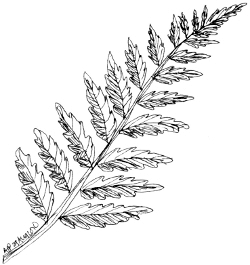
        Ferns

        In Elizabethan times, fern seed was believed to be invisible, expect for a few moments around midnight on Midsummer Eve when it could be seen falling to the ground.  Anyone who could catch some in a pewter plate would be invisible while they carried it (the seed not the plate!). [2]  Shakespeare, in Henry IV, wrote ‘we have the receipt of fern seed, we walk invisible’.

        In 19th century Lancashire, young people would go to Clough, near Moston, to silently gather the seeds of ‘St John’s Fern’ on the Eve of St John’s Day.  They would do this in order to gain the affections of those maidens who would not accept their attentions.  In Lincolnshire, St Mark’s Eve was called ‘the Devil’s Harvest’ because ferns were said to bud, blossom and release seed all between midnight and 1 a.m. and it would be the Devil that would harvest it.  If anyone managed to catch some of the seed between two pewter plates, then they would become as wise as the Devil. [2]

        In the 17th century it was believed that the burning of bracken – either in the preparation of potash (used in the manufacture of glass or soap) or for its control – would lead to rain.  [3]

        If you cut a fern stall horizontally you will see a significant letter, supposedly the initial of the person you will marry. A less common superstition, but one that was more serious, was the idea that the initial is always a ‘C’, signifying Christ, and for this reason witches are said to detest the plant. [2]

        Another version is that the shape is a representation of an oak tree, the clearer the shape the better your luck will be [1].

        The Druids classified ferns as sacred trees.  At Midsummer, uncurled fronds of Male Fern were gathered, dried and then carried as good-luck charms.  Fern leaves also have the reputation of preventing evil from entering one’s home.

        1. E Radford and M A Radford – Encyclopaedia of Superstitions 1949
        2. J Simpson and S Roud – A Dictionary of English Folklore
        3. R Vickery – Dictionary of Plant-Lore

        Pen vs Paper and States of Mind.

        Pen vs Paper

        I find it so much easier to think and/or let my thoughts flow when using a pen and paper! I like to think of myself as fairly computer-literate, I touch type a fair number of words a minute, yet words/ideas/thoughts never seem to flow quite as easily via the keyboard as via the pen.

        I wonder how many other people are the same? Is it an age-related thing? Is it something that you can get over?  Is it something that one should want to get over?

        I also find art programs don’t suit me either – nothing replaces the feel of pencil/pen/brush on paper for art or the materials being used. Digital art is not for me.

        Luddite? Me? I don’t think so.  I mean, I can use computers to create certain kinds of things without first writing them down or planning them out, but there are other things I like to do with words that just don’t seem to work smoothly or easily with a keyboard as compared to a pen.  The prime example of this being the ‘stream of consciousness’ writing that appears in my journal, that helps me sort though an issue, a problem, perhaps through connecting with the subconscious (unconscious?) level of the mind.  Somehow, this  just doesn’t flow quite the same way when I use a keyboard.

        My preference for pen and paper when I journal my thoughts is likely to make it an ‘interesting’ challenge for me to keep a blog!

        States of Mind

        Yesterday I spent a while meandering through the tangled paths of the weird world web looking for reputable information on the conscious, unconscious, subconscious and super-conscious states of mind.

        Naturally some of the paths led to fluffy-bunny inhabited places, but more led to places of what seemed like erudite learning, with good references to back up their information.

        It seems that the ‘subconscious’ does not exist, not psychologically speaking; it is a term mostly used by New Age aficionados.  The super-conscious seems to be another term bandied around by the same community.

        Of course, the term ‘subconscious’ has entered into everyday usage, especially when we grope for a memory or do/say something without thinking, or remember something we didn’t think we’d taken notice of.

        It’s all something I need to find out more about, read up on the psychology, try to find my way through all the New-Agey type stuff and see what seems to make sense, and, despite what hard science and total cynics say, and reach a conclusion that sits well with myself. Which isn’t easy as I’m a bit of an odd mix between scientist, artist, creative person and a spiritual person too!

        I know science doesn’t have the answers for everything, that it is only one way of viewing how the Universe works, that there are things about the Universe we can’t put into test-tubes or analytical machines and measure or prove scientifically, especially consciousness.

        I like to keep an open mind, question claims that are made and experiences I have had, and certainly read what is written with not just a pinch of salt but a huge sack-full of the stuff!  I like to see references to published work, and in those published works other references, especially when, say, someone claims that their book is about Anglo-Saxon beliefs yet they don’t even reference a single academic source!

        I certainly like the idea of, and believe there are, mysteries that science can’t fully explain.  It seems like each time science makes a step forward to understanding life, the universe and everything (see the BBC’s h2g2 site or BBC’s Hitchhiker’s Guide to the Galaxy or even Douglas Adams for my favourite answer to this eternal question), then it uncovers something else that can’t be understood yet. I wonder if it is like peeling back the layers of an infinite number of onions, each with an infinite number of layers!  And of course those are just the scientific onions, there’s the philosophical ones, the spiritual ones, and no doubt many others too.

        I wonder if science and spirituality will ever converge…