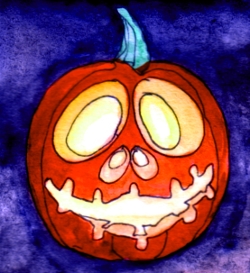
Punky Night – A Somerset Custom

Pumpkin3 © Angela Porter October 2010

It’s Punky Night tonight
Give us a candle, give us a light
It’s Punky Night tonight!

This is one of the verses of a song changed by children as they carry their ‘punkies’, or Jack O’ Lanterns around villages in Somerset, England, UK and, in times past, begging for candles.  In the village of Hinton St George, Punky, or Punkie, Night is the last Thursday in October.

Other variations on the verse include,

It’s Punky Night tonight
Adam and Eve would not believe
It’s Punky Night tonight!

It’s Punky Night tonight
Give me a candle, give me a light

If you don’t, you’ll get a fright!
It’s Punky Night tonight

It’s Punky Night tonight
Give me a candle, give me a light
If you haven’t a candle, a penny’s alright

It’s Punky Night Tonight!

If you want to sing-a-long with the words, visit “The Punky Night Song” webpage!

The threat of something not nice happening if a person didn’t give the children something compares to the more modern tradition of ‘trick or treat’.

Punkies are made from a mangold-wurzel, or a large turnip, in a similar manner to modern Hallowe’en pumpkins.  The top is cut off, the insides scooped out and designs are cut into the outer skin, leaving a thin membrane intact.  Scary faces are common, but there are many examples of more creative designs.  A lighted candle is then placed inside to shine through the cuts.

Despite the usual assumptions that this custom is an ancient one, there is little evidence of its existence before the C20th.  Various nights in late October served for this custom, but Hinton St George eventually settled on the last Thursday in October.  At one time, it seems to have been a simple house-visiting custom, but members of the local Women’s Institute reorganized it in the mid twentieth century.  It is now celebrated by a procession of children carrying their punkies, and a party where prizes for the best designs are given, a Punkie King and Punkie Queen are crowned and money is raised for charity.

A local legend purports to explain the custom’s origin.  One version of the legend is that the village menfolk went to Chiselborough Fair, and got too drunk to find their way home.  Their wives fashioned lanterns out of mangold-wurzels and went to fetch them.   There are variations on the tale, in some the menfolk make the lanterns, in others the drunken menfolk are scared by the lanterns scary faces believing them to be ghosts of dead children returning to the Earth until Hallowe’en.  The neighbouring village of Lopen claims the custom (and legend) as their own, and other villages have started their own punkie nights.

As a child, I remember helping to carve Jack O’ Lanterns from swedes.  Pumpkins were not a common item then.  It wasn’t easy work either, and my father usually took control of matters very quickly, at least by hollowing out the swede so that we could carve the designs into the shell more easily and with less likelihood of us cutting off our fingers, or worse!  The smell of cooking swede pervaded the house once the candle was lit; whenever I smell cooking swede I get get flashbacks to childhood Hallowe’en, before it became dominated by ‘trick or treat’ and the various forms of antisocial behaviour that occur on that night, and the surrounding nights.  We had our own Hallowe’en party in our home, with local friends visiting with us.  The living room was decorated with blood-red crepe paper streamers, home-made black bats and spiders and webs.  Candle light was the order of the evening.  We made ghoulish food that involved a lot of food dye!  Ducking apples, bobbing apples were always played. And the climax of the proceedings involved the  delivery and display of Captain Blood’s Cake, dripping with blood-coloured icing and ghastly green writing and a single candle placed in the middle of the cake.  This heralded the beginning of ghostly and ghoulish stories.  They would start with a tale about Captain Blood, and then would go onto other things as we children would exercise our imaginations to tell tales, add to the tale being told, and scaring ourselves with what we found most fearful.  It must be said there was a lot of laughing as well!  These were perhaps some of the best times of my childhood … even though I was most probably too shy to tell the tales, my imagination would run away with me and everyone would make fun of me, and I still bear those scars today, finding it hard to tell stories, write tales, be imaginative.  I’ll get over it though.  I will.

The drawing of a pumpkin punkie was done using a very fine technical drawing pen (0.1mm) and watercolour paints on cartridge paper.  The sketch was completed very quickly, the painting took a little longer as the white purry-furry one wanted to help/hinder by demanding cuddles and fusses!   I then fiddled with it in GIMP2 to make it more vibrant in colour, more blurry and better looking than the original!  I have a couple more done that I’ll use to decorate any entries I do about Hallowe’en.

  1. Steve Roud, “The English Year”
  2. Punkie Night at information-britain.co.uk
  3. Punkie Night at Monstrous.com
  4. It’s Punky Night! at wyrdwords.vispa.com
  5. Ronald Hutton, “The Stations of the Sun”
  6. Punkie Night at wikipedia
  7. Jack o’ Lanterns at wikipedia
  8. Jacqueline Simpson and Steve Roud, “A Dictionary of English Folklore”

Michaelmas

Hiring, firing and pack rag days

Today is the feast of St Michael the Archangel.  It is one of the four Quarter Days, important times in legal and economic matters from at least medieval times to the late C19th.  Today was a day for the payment of rents and the beginning or ending of hiring engagements.  As these contracts came to an end, many local families were busy packing their belongings and moving home on this day, and it became known as ‘Pack Rag Day’.  Also, local courts were often held on this day.

Michaelmas Roast Goose

It was also a day for feasting, traditionally on goose.  The goose had been fattened on the stubble fields.  Sometimes, these geese were presented by the tenant farmers to their landlords.  It was said that ‘if you eat goose on Michaelmas Day you will never lack money all year.

Blackberries

Blackberries were bad, or even poisonous, after this date.  The exact date varies from Michaelmas to the 10th or 11th October, depending on the area.  The latter dates equate to the 29th September before the change in calendar in 1752.

The reason for the blackberries’ sudden decline was that the Devil interfered with them in some way on this date – putting his foot on them, wiping his tail or club on them, spitting on them, urinating or defecating upon them.

Election of the Lord Mayor of London

The Lord Mayor of London is the head of the Corporation of London, the authority that governs the City of London.  This is not to be confused with the Mayor of London, a post created in 2000 for the head of the Greater London Authority.  The Lord Mayor of London is a position that dates from around the year 1192.

The Lord Mayor is elected on 29 September, presents himself to the Lord Chancellor at the House of Lords in October for royal approval, and finally takes office on the second Friday in November.

The Lord Mayor is still an extremely important person in the nation, and in many situations is second only in precedence to the monarch.  As well as all the ceremonial duties, the Lord Mayor chairs the Court of Aldermen and the Court of Common Council and serves as Admiral of the Port of London, Chief Magistrate of the City and Chancellor of the City University.

  1. Steve Roud – The English Year
  2. Jacqueline Simpson and Steve Roud – A Dictionary of English Folklore

A curious custom – sin eating.

The newly restored grave of the last sin eater in England, Richard Munslow,  is to be celebrated with a church service – BBCNews.

“The Last Sin Eater (2003)”is a film starring Heath Ledger, one I enjoyed watching the once, but has not been watched again even though the DVD resides in my collection.  It’s not the only film with this title, “The Last Sin Eater (2007)” featured this old custom too.

Harvest customs

Harvest Wheat (c) Angela Porter 2010

Pre-amblings

This is no way a definitive account!  I wrote/collated the main body of it last year when I was due to give a talk at a ‘harvest supper’ in a church, and I thought it would be appropriate to give a little of the history and customs of Harvest, particularly in Wales.  I’m not quite sure how the talk was received, as it certainly wasn’t the usual ‘Chicken Soup for the Soul’ or ‘Silver Birch’ that they are used to.  I am, if nothing else, more than a tad anarchic when it comes to my choice of ‘readings’ under such circumstances!

Harvest Customs

People have been giving thanks for the harvest since farming first began in the Neolithic, and the custom is still thriving today in many countries of the world.

In 1912, Alfred Williams, Wiltshire, wrote:

“The in-gathering of the corn-harvest is by far the most important feature of the farm year, especially where there is much arable land, or perhaps it may be all corn in some places, as on the Downs, for instance.  If the weather is wet in hay-time and the crop spoiled that may not matter very much; but in the harvest, that is truly tragic!  Who does not deeply grieve, apart from the monetary loss involved, to see all that is left of the beautiful corn blackening and rotting in the fields, under the dark rainy skies of October and November, as is sometimes the case, utterly useless for anything but litter and manure, and the ground too wet and sodden to admit of collecting it for that purpose even?  It seems as though you have lived the year for nothing then; that all the bloom and sunshine of the spring and summer were mockery; that Nature brought forth her beautiful children but to destroy them.”

In centuries past, the whole life of the Nation of Britain and its agricultural economy depended on the harvest.  Even when the harvest had lost some of its economic importance, it still had a deep psychological effect on rural communities.

Autumn Wheat (c) Angela Porter 2010The word harvest comes from the Anglo-Saxon word ‘haerfest’ which meant autumn. According to the Venerable Bede, writing in the seventh to eight centuries, September was known to the pagan Anglo-Saxons as ‘Haleg-Monath’, which meant Holy Month, and it can be surmised that this was derived from the religious ceremonies that followed the harvest. However, no records of these ceremonies survived into Bede’s time.

In the Christian calendar, harvest traditionally started at Lammas tide (August 1), when the first corn of the new crop was made into bread and taken to church to be blessed. It finished at Michaelmas (September 29).

The harvest was the time of the agricultural year that the farmer needed the full cooperation of his workers.  Thirteenth Century Manorial records show that it was the custom that tenants were paid with refreshments to harvest the lord’s crops, and that in some areas there was a communal meal at the end of the harvest, and these are the earliest surviving records of this practice.

The workers knew that a successful harvest was needed for the economic well-being of the community, and a bad one would harm their chances of employment the following year.  During harvest, their wages doubled as the amount of work doubled.  Many customs and usages developed over the years which helped to keep the workers amused, gave further financial rewards, or celebrated their successful harvest.  The idea that these customs are direct survivors of pre-Christian times, of beliefs in corn goddesses and vegetation spirits, is not supported by the documentary record.

Prior to mechanisation, the mutual aid that existed between farmers and neighbours in the community was vital to the reaping of the crops. The fedel wenith, or reaping party, drew on the pattern of Cymhortha (from cymhorthu – to help), a characteristic of Welsh medieval society. Small-holders would help each other and also the large farms, in exchange for various things they had to give, like the loan of transport or a few rows of potatoes. In this way a system of goodwill and co-operation was built up within the community.

As soon as the last load of grain had been brought into the barn, the reapers and other workers were treated to a feast – the Harvest Supper – provided by the farmer for whom they had worked. In the eastern counties of England this feast was known as a Horkey Supper, while in Wales it was known as ffest y pen, cwrw cyfeddach or boddi’r cynhaeaf.

Whitlock says that in Wiltshire, the golden years of the Harvest Supper were during the second half of the 19th century and suggests that they had largely died out by the turn of that century. The suppers seem to have been quite lavish – or at least they seemed so to the farm workers who attended them. Food was plentiful. In Sussex caraway seed cake was traditional and was served to the workers throughout the harvesting because it was believed that the caraway seed provided the workers with strength and increased their loyalty to their employer, thus ensuring that they could not be enticed away by a neighbouring farmer offering higher wages. As well as seed cake, pumpkin pie and large apple turnovers called “Brown Georges” were served at Sussex harvest suppers.

In Carmarthenshire the supper included a dish called whipod which included rice, white bread, raisins, currants and treacle. In nearby Cardiganshire in 1760, a farmer reported that the feast following the reaping of his rye by about 50 neighbours consisted of ‘a brewing pan of beef and mutton, with arage and potatoes and pottage, and pudding of wheaten flour, about 20 gallons of light ale and over twenty gallons of beer’. After the meal, there was usually dancing to the music of the fiddle, with a plentiful supply of beer and tobacco.

Also in Wales, was the custom known as the caseg fedi, or harvest mare. When all the corn had been reaped except for the very last sheaf, the sheaf would be divided into three and plaited. The reapers would then take it in turns to throw their reaping hooks at it from a set distance and the one who succeeded in cutting it down would recite a verse:

Bore y codais hi,
Hwyr y dilyn hi,
Mi ces hi, mi ces hi!

[Early in the morning I got on her track,
late in the evening I followed her,
I have had her, I have had her!]

The other reapers would then respond with:

Beth gest ti?

[What did you have?]

and the reply was:

Gwrach! gwrach, gwrach!

[A hag, a hag, a hag!]

It was seen as an honour in Wales to be the one to bring down the caseg fedi, and the man who did so was often rewarded.

The plaited sheaf presided at the Harvest Supper, and was often hung in the house to show that all the corn had been gathered in. It could also, in one part of Wales, be put on the cross-beam of the barn or in the fork of a tree.

The ‘caseg fedi’ may have represented the fertility of the harvest condensed into the final sheaf. In one part of Wales, it was recorded that seed from it was mixed with the seed at planting time ‘in order to teach it to grow’. In other parts of Britain, this last sheaf was buried on Plough Monday, the first Monday after Epiphany (6 January) so that it could work its magic on the growing corn. It is possible that this association of the gwrach, a creature known to steal food, with the cutting down of the last sheaf, represents the triumph of the human forces of agriculture against the chaotic or malevolent forces of nature represented by the gwrach.

Once the grain harvest proper and the Harvest Supper was over, the women could begin gleaning, i.e. scouring the fields for the leftover ears of corn which they could claim and keep for themselves. In many places they elected a Harvest Queen to oversee the gleaning whose role was to ensure that everyone got fair shares. This she did by regulating the start and finish of work either by ringing a hand bell or by giving the word when the church bells rang. The Harvest Queen also had the right to initiate newcomers to the gleaning field by tapping the soles of their boots with a stone.

Today, most churches and many schools hold a service of thanksgiving for the harvest and hold their Harvest Festival on the first Sunday following the Full Moon closest to the Autumn Equinox. However, this custom only became popular in Victorian times.

In 1843 the Reverend R. S. Hawker had the idea of holding a special service on the first Sunday in October in his Cornwall parish. The idea caught on and soon it became the custom to decorate churches with fruit, vegetables and flowers and to sing the harvest hymns written for the occasion.

Harvest has now become a time when people come together to give food to the needy, or to raise money for worthy causes. Thus Harvest still commemorates not just the gathering of the fruits of the Earth, but also the community cooperation that exists and the desire of our own spirits to help worthy causes and to spread the abundance of gifts of all kinds to wherever there is a lack. It is also a time when we can reflect on the successes of our own endeavours, and reap the fruits of our own labours and count our blessings for all that we have in our lives.

  1. Steve Round – The English Year
  2. Sue Dale-Tunnicliffe – TES Magazine, 24 Sept 1999
  3. Raven – White Dragon Website
  4. Hillaire Wood – Harvest Customs in Wales
  5. Ronald Hutton – The Stations of the Sun

Catching up, customs, celebrations.

Catching up…

With the return to work last week, research and blogging has had to take a back seat, especially as my evenings and Saturday have been busy.  I noticed I’ve missed two days of  note in the calendar!

Two days of work and I’m shattered.  Mind you, that tends to happen being  a teacher.  The long summer break gives me the time to rest, relax and almost totally de-stress.  Unfortunately, it takes mere minutes for some of the good work to be undone.  Keeping up with my meditation regimen when I rise and before I sleep, and at lunch or during preparation time during the day usually helps me to keep the escalation of stress to a minimum, but it doesn’t eliminate it totally…not yet.  Recognising the automatic thoughts and reactions and then working to change them to more healthy versions is slow going, my mind has had a lifetime to reduce this self-talk to a susurrus that I have to be very cunning to clearly hear.

Isn’t susurrus a wonderful word?  It sounds like quiet, secretive whisperings.  A wonderful onomatopoeic word!  I like alliteration as well as onomatopoeia!

3rd September – Cromwell Day

On this day, The Cromwell Association commemorate his death with an open-air service in front of his statue outside the Houses of Parliament, London, where they lay a wreath there.  Only members of the Cromwell Association may attend, but the public can see and hear the ceremony from the public pavement.

70013 Oliver Cromwell is a Britannia Class (BR Standard Class 7) steam locomotive.

3rd September – Merchant Navy Day

Merchant seamen have long felt that their service’s significant contribution to the war effort has long been undervalued and it is one of the aims of the Merchant Navy Association to raise the profile of the Merchant Navy and celebrate its importance to Britain, both in the past and the present.  As part of this mission in 2000 they declared 3rd of September to be Merchant Navy Day.  This day was chosen as it also commemorates the sinking of the unarmed merchant vessel the SS Athenia on 3 September 1939, the first day of the Second World War.  All nineteen crew and ninety-three passengers were lost.

4th September – Abbots Bromley Horn Dance

On the Monday following the local Wakes Sunday (i.e. the first Sunday after 4 September, or Old St Bartholomew’s Day), the village and surroundings of Abbots Bromley in Staffordshire, England, UK, are visited by a unique set of dancers.  The team consists of six men, each carrying a splendid pair of reindeer antlers, plus a Fool, a Maid Marian (played by a man), a hobby horse, a bowman (who twangs a bow), a musician and a triangle player.

At 8 a.m., they set out from the village church and perambulates the parish, visiting key houses, farms and other places and at each stop they perform their dance.  It is thought to be unlucky if they do not visit your house or neighbourhood.  Around 8 p.m. they return to the village and perform their final dance in the street.

The horns are kept in the church when not in use.  They are genuine reindeer horns, mounted on wooden heads, with a handle protruding from below to allow the dancers to carry them as they dance.

There is a lot of speculation about the origin of the custom.  Many have connected it to a fertility ritual, an ancient ceremony to ensure successful hunting, or of some common right or privilege in regard to the chase, but none of these ideas is supported by evidence.  It may be that the hobby horse is older than the horn dance, and hobby horses were used in the C16th to collect taxes and dues owed to the lord of the manor; whether the horse made the collections or whether it was there to entertain and sweeten the process of money-gathering is not known.

4th September – Barnet Horse Fair

This horse fair was chartered in 1588 and for centuries was one of the busiest livestock marts in the region, although Barnet’s real fame lay in horse-racing which drew large and unruly crowds from London until it ended in 1870.  A mere shadow of its former self, Barnet Horse Fair is now held at Greengates Stables on 4, 5 and 6 September, unless one of those dates is a Sunday, in which case it continues on the following day.