What is this blog about?
I’ve just been doing a bit of Luddite-style journalling – pen and paper that is! And I was musing about why on Earth I’d want to blog when I keep a journal, and this perhaps seems as a doubling up of work.
However, much of my Luddite-journal is very personal and I’d not share with anyone, no matter how close they are to me, and no-one will have access to them until I “have shuffled off this mortal coil”.
I suppose that this blog is a vehicle for me to share with anyone who wishes to read about my fairly random thoughts, research, insights, questions, perhaps even little stories, poems and some of my arty-crafty stuff. In other words things I’d like to share with others, but don’t really have the opportunities to do in my ‘real life’, and I think the relative anonymity the blog affords me may allow me to do so.
Like so many, there are parts of my life that are kept fairly separate, for instance my ‘day job’ and my spirituality and spiritual practices. My spirituality is with me always, but I can’t talk about it, my practices, or express it openly in my job, with those I work with, although I do get away with meditation during my working day when I begin to feel stressed or upset! The people I interact with spirituality are good souls (mostly), but generally have a fairly narrow spiritual view, and I tend to be a searcher looking for more, trying things from different traditions, working out what sits well with me, what works for me, what helps me find words for what I instinctively feel inside of me, finding ways to express to express this inner knowledge and understanding, changing and adapting things, melding and moulding them into something that is uniquely me. I do not, and would never, profess to be an expert, to have the one right answer, I’m just a seeker looking for what is right for me.
Along my way some of my musings, discoveries, thoughts, practices may help others also seeking their way, whether they agree or disagree with what I may write. Indeed, it is often through a disagreement that you can arrive at a better understanding of what is right for you. I sometimes think you can only find out who you truly are by finding out what it is that you are not (and that may be what others have told you to suit their own conscious or unconscious purposes/needs).
Spirituality is just one thing it’s difficult for me to share with others. I find the same is true of my art (to a much lesser degree), writing (about the same degree), and my interests in so many things, including folklore, folk-medicine (ethnopharmacology or ethnobotany), archaeology, history, etymology, self-help, counselling, forensic psychology, cookery, nature, astrology, astronomy…and that’s just a few things!
I’m very much a ‘random’ and sporadic researcher/reader/student of all the things I’m interested in. The cycles of interest wax and wane randomly, depending on whether something has sparked an interest in me. I tend to dive into that interest wholeheartedly for a while – a few weeks or months – and as my interest is beginning to feel quite sated, some other spark comes along and re-ignites another flame of passion and so off I go.
It must be frustrating for those who know me, who must think I’m quite shallow in my interests and passions as I seemingly flit from one thing to another. I know I’ve often questioned how serious I am and how deeply I get into things, but I know I dig as deeply as I need to into whatever is my current passion (or passions), and that interest/passion never entirely departs, it just becomes somnolent for a while…until I’m ready to continue digging deeper!
A dear friend of mine always said he was determined to turn me into a polymath (see Dictionary.reference.com or Wikipedia) Much more difficult to do in this day and age of so much information and knowledge. Polymaths were far more common in the past – Isaac Newton for instance. I think it’s quite clear, if my prior ramblings in this entry are clear, that I love to learn! If I didn’t have to work to pay the bills and keep a roof above my head (and keep my pusscat in Purina food!) and could afford it I’d be a perpetual student! As it is, I read, I browse the world weird web (with that sack of salt by my side!), listen to others, and soak it all up, processing it in my own internal way.
A cute tale about me being a sponge for knowledge is of a young person I worked with. They were discussing with another person what they’d like to do for a career and asked if they knew what qualifications they’d need. The person listening said that she didn’t know. The young person then suggested ‘Let’s go and ask …, she is the internet after all!’. Praise, maybe, though I would never, ever claim to be such a thing!
I can be a ‘mistress of the art of the Google’ when others fail to find what they wish while trolling around the weird wide web. So, perhaps another use of this blog will be to keep a record of my wanderings as I come across things of interest, or otherwise, in a way my Luddite-journal doesn’t! No doubt a series of wanderings that are unique to me.
It may turn out interesting to see how this blog evolves and develops.
Morning meanderings
I love alliteration – you have been warned!
Anyway, my morning meanderings through the world weird web included a search for moon-phase information to go into my Luddite-Journal, and that led me to an Astrological Diary that I will almost certainly be purchasing to use next year. My only whinge about diaries is that they rarely have a full year planner for the next year, and as one of my evening activities involves taking bookings at year in advance then I really need it! I guess I’ll just have to go looking for something I can stick in the back of the diary to accommodate my needs.
I did find a moon phase table for 2010 that suited my purpose (without me having to type it all out from my ephemeris!) and it’s a shame I couldn’t find one for 2011 at the same website. However, the search did lead me to the diary I found, and will be ordered very soon!
I do have an interest in astrology – but not your newspaper astrology, the ‘proper’ stuff. I’ve found my natal chart and the analysis of it to be most helpful in understanding myself and helping to heal myself from the wounds of the past, and much more than that. When done properly it can really help to understand what is going on in an individual’s life at any time. It is my experience that it can be incredibly specific, detailed and helpful, but only when done well. It’s not something I rely on and live my life by, but I do find it interesting to study. Perhaps it’s because science pooh-poohs it that I find it so fascinating – I can be terribly rebellious in such cases! I may be a scientist by education, but … it just fascinates me! And it is something I feel I ‘should’ spend more time on, but when I start I get so engrossed that nothing else gets done…
 Around the UK wishes can often be seen tied to beech trees. This custom has it’s origins in Celtic tree mythology where the beech is known as the tree of wishes. Fallen beech branches were seen as invitations to make a wish by writing it on a beech twig and then pushing the twig deep into the ground. The wish would then be taken by the wishing fairies to the Fairy Queen who would consider it. [1] Rods of beech are often favoured by water diviners. [2]
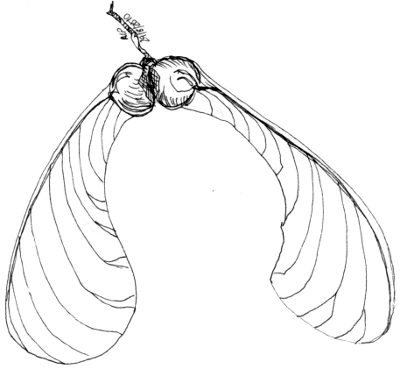 The Sycamore is also known as the Great Maple [5]. The winged seeds of the sycamore are called helicopters and were used in flying competitions by children. The sycamore was the favoured wood for making love spoons in Wales, which are made from a single piece of wood [6].




 Art is the Adventure