A bit more trolling round the world weird web, as well as my reference books, for information on some of the plants I saw on my travels on Friday. I get lost far too easily in the search for knowledge and information, but it’s always an enjoyable journey.
Beech (Fagus sylvatica)
 Around the UK wishes can often be seen tied to beech trees. This custom has it’s origins in Celtic tree mythology where the beech is known as the tree of wishes. Fallen beech branches were seen as invitations to make a wish by writing it on a beech twig and then pushing the twig deep into the ground. The wish would then be taken by the wishing fairies to the Fairy Queen who would consider it. [1] Rods of beech are often favoured by water diviners. [2]
The Greek deities Apollo and Athena were said to have sat, as vultures, in the branches of an oak or a beech tree to watch the war between the Trojans and the Greeks. [3, 4]
Beech nuts are known as mast [5].
Norse tradition says that tablets of beech were used to make the very first writing tablets for the runes. It is also a sacred wood of the Summer Solstice [10].
Sycamore (Acer pseudoplatanus)
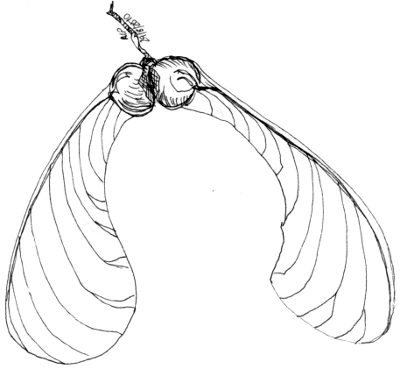 The Sycamore is also known as the Great Maple [5]. The winged seeds of the sycamore are called helicopters and were used in flying competitions by children. The sycamore was the favoured wood for making love spoons in Wales, which are made from a single piece of wood [6].
In Montgomeryshire there was a belief that sycamore trees kept the fairies away and stopped them from spoiling the milk [7].
In Scotland the feudal lairds used sycamore tress, known as dool or joug trees, as their gallows. Further south, in Wiltshire, sycamores had unlucky associations, perhaps because they were also sometimes known as ‘hanging trees’ [8].
The Sycamore is sometimes called the Martyrs’ tree after the Tolpuddle Martyrs who first met beneath a sycamore tree in 1843 and formed a secret society to fight starvation and poor wages. Unfortunately, they were caught and sentenced to seven years transportation to Australia. They were pardoned after two years and returned home [9].
- Tumbling Woods
- Oaken Woods
- Mystical World Wide Web
- messagenetcommresearch.com
- Botanical.com
- The Woodland Trust
- members.multimania.co.uk
- Roy Vickery – Plant Lore
- Forest of Leeds
- Spiritual Forums


 Art is the Adventure